Volume 1 · pp. 292–295
Chapter XI. Concerning the doubtful points which are about those things which have been said concerning good and evil. But among many there is a very ancient question: in what genus of opposition are good and evil opposed?
A marker with ≈ is an approximate page boundary, placed by measure of the text; the page photographs remain the authority. In the paired views, clicking a page marker brings that page into view.
CAPUT XI.
De dubitabilibus quæ sunt circa ea quæ dicta sunt de bono et malo.
Est autem apud multos antiquissima quæstio, quo genere oppositionis opponuntur bonum et malum. Et si considerentur verba Aristotelis in decimo tertio primæ philosophiæ, et verba Dionysii Areopagitæ in libro de Divinis nominibus, cap. 4, et verba Augustini in secundo libro de Libero arbitrio, et verba Petri Apostoli in capitulo de elementis contra Simonem magum, similiter autem verba Pythagoræ in stichia bonorum et malorum, planum est, quod omnes hi concorditer dicunt, ad quod etiam Aristoteles Socratem et Platonem inducit, quod malum privative et non contrarie opponitur bono, et quod malum est nihil secundum se, nec accidens, nec substantia, sed privatio. Privatio autem secundum se nihil est penitus. Cum enim sit in aliquo non est in eo sicut ens accidens, vel ens substantia, sed est in eo sicut habitus privatio: et hoc est idem sicut formitas et deformitas inesse dicitur in eo qui mutilatus sive denasatus est, quia Græce muti, Latine sonat nasus: constat autem quod denasatio non dicit inesse ens ut accidens, nec est ens ut substantia, quæ est forma vel materia vel compositum, sed solum ex defectu habitus debiti relinquit deformitatem et turpitudinem.
CHAPTER XI.
Concerning the doubtful points which are about those things which have been said concerning good and evil.
But among many there is a very ancient question: in what genus of opposition are good and evil opposed? And if the words of Aristotle in the thirteenth book of First Philosophy are considered, and the words of Dionysius the Areopagite in the book On Divine Names, chapter 4, and the words of Augustine in the second book On Free Choice, and the words of Peter the Apostle in the chapter concerning the elements against Simon Magus, and similarly the words of Pythagoras in the stichia of goods and evils, it is plain that all these concordantly say, to which also Aristotle leads Socrates and Plato, that evil is opposed to good privatively and not contrarily, and that evil is nothing according to itself, neither accident nor substance, but privation. But privation according to itself is altogether nothing. For since it is in something, it is not in it as an accidental being or a substantial being, but is in it as habit is privation; and this is the same as formness and deformity are said to be present in one who has been mutilated or de-nosed, because in Greek muti sounds in Latin as nose. But it is agreed that de-nosing does not say that a being is present as an accident, nor is it a being as substance, which is form or matter or composite, but from the defect alone of the due habit it leaves deformity and ugliness.
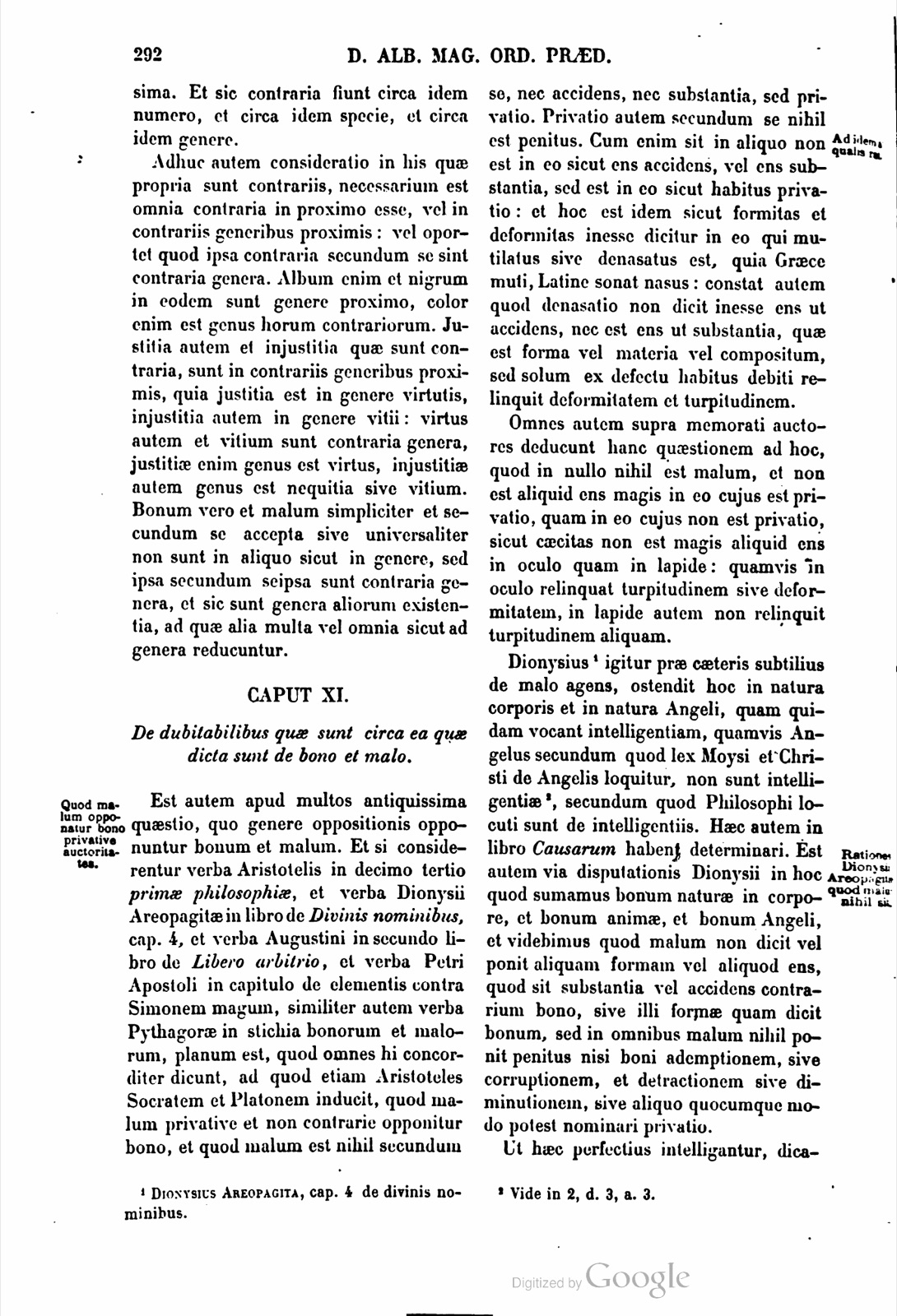
Omnes autem supra memorati auctores deducunt hanc quæstionem ad hoc, quod in nullo nihil est malum, et non est aliquid ens magis in eo cujus est privatio, quam in eo cujus non est privatio, sicut cæcitas non est magis aliquid ens in oculo quam in lapide: quamvis in oculo relinquat turpitudinem sive deformitatem, in lapide autem non relinquit turpitudinem aliquam.
Dionysius 1 igitur præ cæteris subtilius de malo agens, ostendit hoc in natura corporis et in natura Angeli, quam quidam vocant intelligentiam, quamvis Angelus secundum quod lex Moysi et Christi de Angelis loquitur, non sunt intelligentiæ 2, secundum quod Philosophi locuti sunt de intelligentiis. Hæc autem in libro Causarum habent determinari. Est autem via disputationis Dionysii in hoc quod sumamus bonum naturæ in corpore, et bonum animæ, et bonum Angeli, et videbimus quod malum non dicit vel ponit aliquam formam vel aliquod ens, quod sit substantia vel accidens contrarium bono, sive illi formæ quam dicit bonum, sed in omnibus malum nihil ponit penitus nisi boni ademptionem, sive corruptionem, et detractionem sive diminutionem, sive aliquo quocumque modo potest nominari privatio.
Ut hæc perfectius intelligantur, dicamus
But all the above-mentioned authors lead this question to this, that in nothing is nothing evil, and there is not some being more in that of which there is privation than in that of which there is not privation, just as blindness is not more some being in an eye than in a stone; although in an eye it leaves ugliness or deformity, but in a stone it does not leave any ugliness.
Therefore Dionysius 1, treating evil more subtly than the others, shows this in the nature of body and in the nature of an Angel, whom certain persons call an intelligence, although an Angel, according as the law of Moses and of Christ speaks about Angels, are not intelligences 2, according as the Philosophers spoke about intelligences. But these things have to be determined in the book of Causes. Now the way of Dionysius's disputation is in this, that we take the good of nature in body, and the good of the soul, and the good of an Angel, and we shall see that evil does not say or posit some form or some being which would be a substance or an accident contrary to good, or to that form which good says, but in all things evil posits altogether nothing except the taking away of good, or corruption, and detraction or diminution, or in whatever other way privation can be named.
That these things may be understood more perfectly, let us say
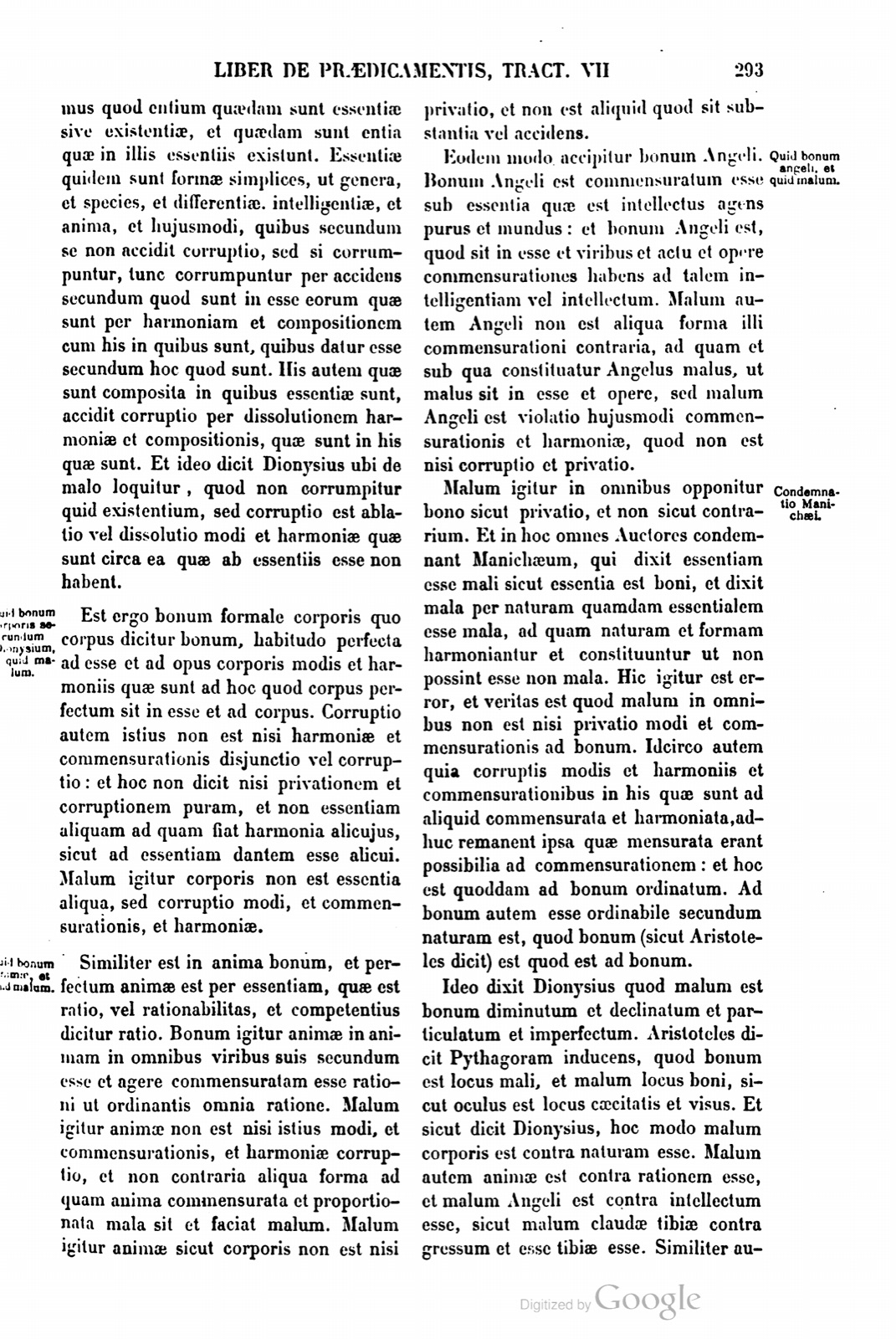
quod entium quædam sunt essentiæ sive existentiæ, et quædam sunt entia quæ in illis essentiis existunt. Essentiæ quidem sunt formæ simplices, ut genera, et species, et differentiæ, intelligentiæ, et anima, et hujusmodi, quibus secundum se non accidit corruptio, sed si corrumpuntur, tunc corrumpuntur per accidens secundum quod sunt in esse eorum quæ sunt per harmoniam et compositionem cum his in quibus sunt, quibus datur esse secundum hoc quod sunt. His autem quæ sunt composita in quibus essentiæ sunt, accidit corruptio per dissolutionem harmoniæ et compositionis, quæ sunt in his quæ sunt. Et ideo dicit Dionysius ubi de malo loquitur, quod non corrumpitur quid existentium, sed corruptio est ablatio vel dissolutio modi et harmoniæ quæ sunt circa ea quæ ab essentiis esse non habent.
Est ergo bonum formale corporis quo corpus dicitur bonum, habitudo perfecta ad esse et ad opus corporis modis et harmoniis quæ sunt ad hoc quod corpus perfectum sit in esse et ad corpus. Corruptio autem istius non est nisi harmoniæ et commensurationis disjunctio vel corruptio: et hoc non dicit nisi privationem et corruptionem puram, et non essentiam aliquam ad quam fiat harmonia alicujus, sicut ad essentiam dantem esse alicui. Malum igitur corporis non est essentia aliqua, sed corruptio modi, et commensurationis, et harmoniæ.
Similiter est in anima bonum, et perfectum animæ est per essentiam, quæ est ratio, vel rationabilitas, et competentius dicitur ratio. Bonum igitur animæ in animam in omnibus viribus suis secundum esse et agere commensuratam esse rationi ut ordinantis omnia ratione. Malum igitur animæ non est nisi istius modi, et commensurationis, et harmoniæ corruptio, et non contraria aliqua forma ad quam anima commensurata et proportionata mala sit et faciat malum. Malum igitur animæ sicut corporis non est nisi privatio, et non est aliquid quod sit substantia vel accidens.
Eodem modo, accipitur bonum Angeli. Bonum Angeli est commensuratum esse sub essentia quæ est intellectus agens purus et mundus: et bonum Angeli est, quod sit in esse et viribus et actu et opere commensurationes habens ad talem intelligentiam vel intellectum. Malum autem Angeli non est aliqua forma illi commensurationi contraria, ad quam et sub qua constituatur Angelus malus, ut malus sit in esse et opere, sed malum Angeli est violatio hujusmodi commensurationis et harmoniæ, quod non est nisi corruptio et privatio.
that among beings certain ones are essences or existences, and certain ones are beings which exist in those essences. Essences indeed are simple forms, as genera, and species, and differences, intelligences, and soul, and things of this sort, to which corruption does not happen according to themselves; but if they are corrupted, then they are corrupted accidentally according as they are in the being of those things which exist through harmony and composition with those things in which they are, to which being is given according to this, that they are. But to these things which are composite, in which essences are, corruption happens through dissolution of the harmony and composition which are in these things which are. And therefore Dionysius says where he speaks concerning evil, that nothing of existing things is corrupted, but corruption is the taking away or dissolution of the mode and harmony which are around those things which do not have being from essences.
Therefore the formal good of the body by which the body is called good is a perfect disposition toward the being and toward the work of the body by modes and harmonies which are for this, that the body may be perfect in being and toward the body. But the corruption of this is nothing except disjunction or corruption of harmony and commensuration; and this says nothing except privation and pure corruption, and not some essence to which the harmony of something is made, as to an essence giving being to something. Therefore evil of the body is not some essence, but corruption of mode, and of commensuration, and of harmony.
Similarly good is in the soul, and what is perfect of the soul is through an essence which is reason, or rationality, and more fittingly it is called reason. Therefore the good of the soul is the soul in all its powers according to being and acting being commensurated to reason as of one ordering all things by reason. Therefore evil of the soul is nothing except the corruption of this mode, and of commensuration, and of harmony, and not some contrary form to which the soul, commensurated and proportioned, may be evil and may do evil. Therefore evil of the soul, as of the body, is nothing except privation, and it is not something that is substance or accident.
In the same way, the good of an Angel is taken. The good of an Angel is to be commensurated under the essence which is pure and clean agent intellect; and the good of an Angel is that he be in being and powers and act and work, having commensurations to such an intelligence or intellect. But evil of an Angel is not some form contrary to that commensuration, to which and under which an evil Angel is constituted, so that he may be evil in being and work; but evil of an Angel is the violation of commensuration and harmony of this sort, which is nothing except corruption and privation.
Malum igitur in omnibus opponitur bono sicut privatio, et non sicut contrarium. Et in hoc omnes Auctores condemnant Manichæum, qui dixit essentiam esse mali sicut essentia est boni, et dixit mala per naturam quamdam essentialem esse mala, ad quam naturam et formam harmoniantur et constituuntur ut non possint esse non mala. Hic igitur est error, et veritas est quod malum in omnibus non est nisi privatio modi et commensurationis ad bonum. Idcirco autem quia corruptis modis et harmoniis et commensurationibus in his quæ sunt ad aliquid commensurata et harmoniata, adhuc remanent ipsa quæ mensurata erant possibilia ad commensurationem: et hoc est quoddam ad bonum ordinatum. Ad bonum autem esse ordinabile secundum naturam est, quod bonum (sicut Aristoteles dicit) est quod est ad bonum.
Ideo dixit Dionysius quod malum est bonum diminutum et declinatum et particulatum et imperfectum. Aristoteles dicit Pythagoram inducens, quod bonum est locus mali, et malum locus boni, sicut oculus est locus cæcitatis et visus. Et sicut dicit Dionysius, hoc modo malum corporis est contra naturam esse. Malum autem animæ est contra rationem esse, et malum Angeli est contra intellectum esse, sicut malum claudæ tibiæ contra gressum et esse tibiæ esse. Similiter autem est in febribus et aliis malis corporis quæ secundum quod mala sunt, nihil sunt nisi corruptio commensurationis complexionis in humoribus, vel compositionis in partibus et membris. Febris enim ex hoc quod est secundum naturam putridus humor vaporans per corpus, non est malum corporis, quia in bono et sano accidit humori quod vaporaliter per corpus diffundatur: sed ex hoc quod vaporatio corrumpit et impedit modos et harmoniam et commensurationem veræ secundum naturam sanitatis corporis, ex hoc habet mali rationem.
Therefore evil in all things is opposed to good as privation, and not as a contrary. And in this all the Authors condemn Manichaeus, who said that there is an essence of evil just as there is an essence of good, and said that evil things are evil through a certain essential nature, to which nature and form they are harmonized and constituted so that they cannot be not evil. Therefore this is error, and the truth is that evil in all things is nothing except privation of mode and of commensuration toward good. But for this reason, because when modes and harmonies and commensurations in these things which are commensurated and harmonized toward something have been corrupted, there still remain the very things which had been measured, possible toward commensuration; and this is a certain thing ordered toward good. But to be orderable toward good according to nature is that good, as Aristotle says, is what is toward good.
Therefore Dionysius said that evil is diminished and declined and particulated and imperfect good. Aristotle, introducing Pythagoras, says that good is the place of evil, and evil the place of good, just as the eye is the place of blindness and of sight. And as Dionysius says, in this way evil of the body is to be against nature. But evil of the soul is to be against reason, and evil of an Angel is to be against intellect, just as the evil of a lame shin is to be against walking and against the being of the shin. Similarly, moreover, it is in fevers and other evils of the body which, according as they are evils, are nothing except corruption of the commensuration of complexion in the humors, or of composition in the parts and members. For fever, from this that according to nature it is putrid humor vaporizing through the body, is not evil of the body, because in the good and healthy body it happens to humor that it is diffused vaporally through the body; but from this, that vaporization corrupts and impedes the modes and harmony and true commensuration according to the nature of the health of the body, from this it has the character of evil.
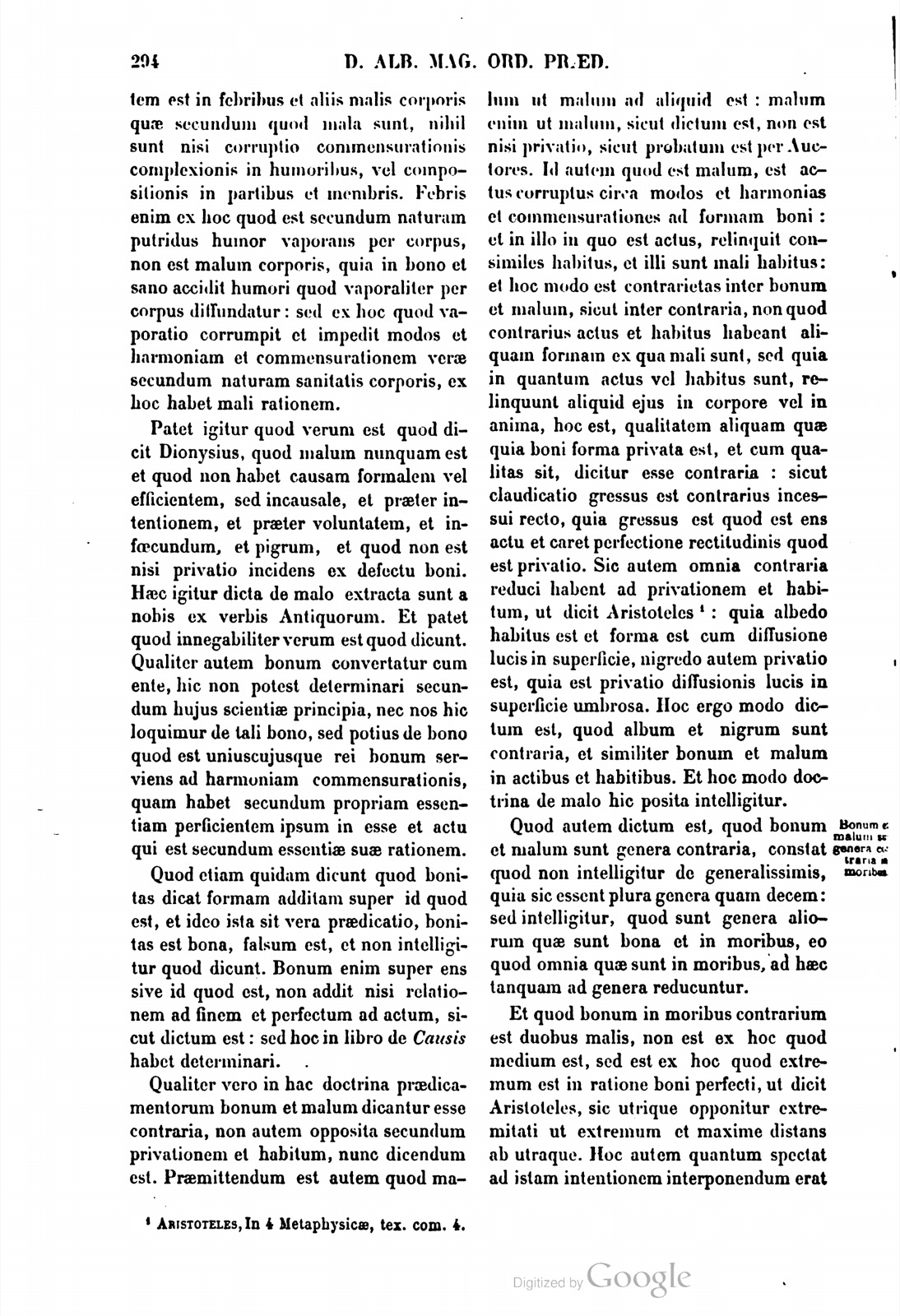
Patet igitur quod verum est quod dicit Dionysius, quod malum nunquam est et quod non habet causam formalem vel efficientem, sed incausale, et præter intentionem, et præter voluntatem, et infœcundum, et pigrum, et quod non est nisi privatio incidens ex defectu boni. Hæc igitur dicta de malo extracta sunt a nobis ex verbis Antiquorum. Et patet quod innegabiliter verum est quod dicunt.
Qualiter autem bonum convertatur cum ente, hic non potest determinari secundum hujus scientiæ principia, nec nos hic loquimur de tali bono, sed potius de bono quod est uniuscujusque rei bonum serviens ad harmoniam commensurationis, quam habet secundum propriam essentiam perficientem ipsum in esse et actu qui est secundum essentiæ suæ rationem.
Quod etiam quidam dicunt quod bonitas dicat formam additam super id quod est, et ideo ista sit vera prædicatio, bonitas est bona, falsum est, et non intelligitur quod dicunt. Bonum enim super ens sive id quod est, non addit nisi relationem ad finem et perfectum ad actum, sicut dictum est: sed hoc in libro de Causis habet determinari.
Qualiter vero in hac doctrina prædicamentorum bonum et malum dicantur esse contraria, non autem opposita secundum privationem et habitum, nunc dicendum est. Præmittendum est autem quod malum ut malum ad aliquid est: malum enim ut malum, sicut dictum est, non est nisi privatio, sicut probatum est per Auctores. Id autem quod est malum, est actus corruptus circa modos et harmonias et commensurationes ad formam boni: et in illo in quo est actus, relinquit consimiles habitus, et illi sunt mali habitus: et hoc modo est contrarietas inter bonum et malum, sicut inter contraria, non quod contrarius actus et habitus habeant aliquam formam ex qua mali sunt, sed quia in quantum actus vel habitus sunt, relinquunt aliquid ejus in corpore vel in anima, hoc est, qualitatem aliquam quæ quia boni forma privata est, et cum qualitas sit, dicitur esse contraria: sicut claudicatio gressus est contrarius incessui recto, quia gressus est quod est ens actu et caret perfectione rectitudinis quod est privatio. Sic autem omnia contraria reduci habent ad privationem et habitum, ut dicit Aristoteles 3: quia albedo habitus est et forma est cum diffusione lucis in superficie, nigredo autem privatio est, quia est privatio diffusionis lucis in superficie umbrosa. Hoc ergo modo dictum est, quod album et nigrum sunt contraria, et similiter bonum et malum in actibus et habitibus. Et hoc modo doctrina de malo hic posita intelligitur.
Therefore it is clear that what Dionysius says is true, that evil never is and that it does not have a formal or efficient cause, but is uncaused, and apart from intention, and apart from will, and unfecund, and sluggish, and that it is nothing except privation incident from a defect of good. Therefore these things said concerning evil have been extracted by us from the words of the Ancients. And it is clear that what they say is undeniably true.
But how good is converted with being cannot be determined here according to the principles of this science, nor do we speak here concerning such a good, but rather concerning the good which is the good of each thing, serving the harmony of commensuration which it has according to its proper essence perfecting it in being and in act which is according to the account of its essence.
But that which certain people also say, that goodness says a form added above that which is, and therefore that this predication may be true, goodness is good, is false, and what they say is not understood. For good above being, or that which is, adds nothing except a relation to an end and a perfect thing toward act, as has been said; but this has to be determined in the book On Causes.
But how, in this doctrine of the predicaments, good and evil are said to be contraries, and not opposites according to privation and habit, must now be said. But it must be set down beforehand that evil as evil is toward something; for evil as evil, as has been said, is nothing except privation, as has been proved through the Authors. But that which is evil is a corrupted act around modes and harmonies and commensurations toward the form of good; and in that in which it is an act, it leaves behind similar habits, and those are evil habits; and in this way there is contrariety between good and evil, as between contraries, not because a contrary act and habits have some form from which they are evil, but because insofar as they are act or habits, they leave behind something of it in the body or in the soul, that is, some quality which, because it is deprived of the form of good and since it is a quality, is said to be contrary: just as limping of a step is contrary to straight walking, because the step is that which is a being in act and lacks the perfection of straightness, which is privation. But thus all contraries have to be reduced to privation and habit, as Aristotle says 3: because whiteness is a habit and is a form with diffusion of light on a surface; but blackness is privation, because it is privation of the diffusion of light on a shadowy surface. Therefore in this way it has been said that white and black are contraries, and similarly good and evil in acts and habits. And in this way the doctrine concerning evil posited here is understood.
Quod autem dictum est, quod bonum et malum sunt genera contraria, constat quod non intelligitur de generalissimis, quia sic essent plura genera quam decem: sed intelligitur, quod sunt genera aliorum quæ sunt bona et in moribus, eo quod omnia quæ sunt in moribus, ad hæc tanquam ad genera reducuntur.
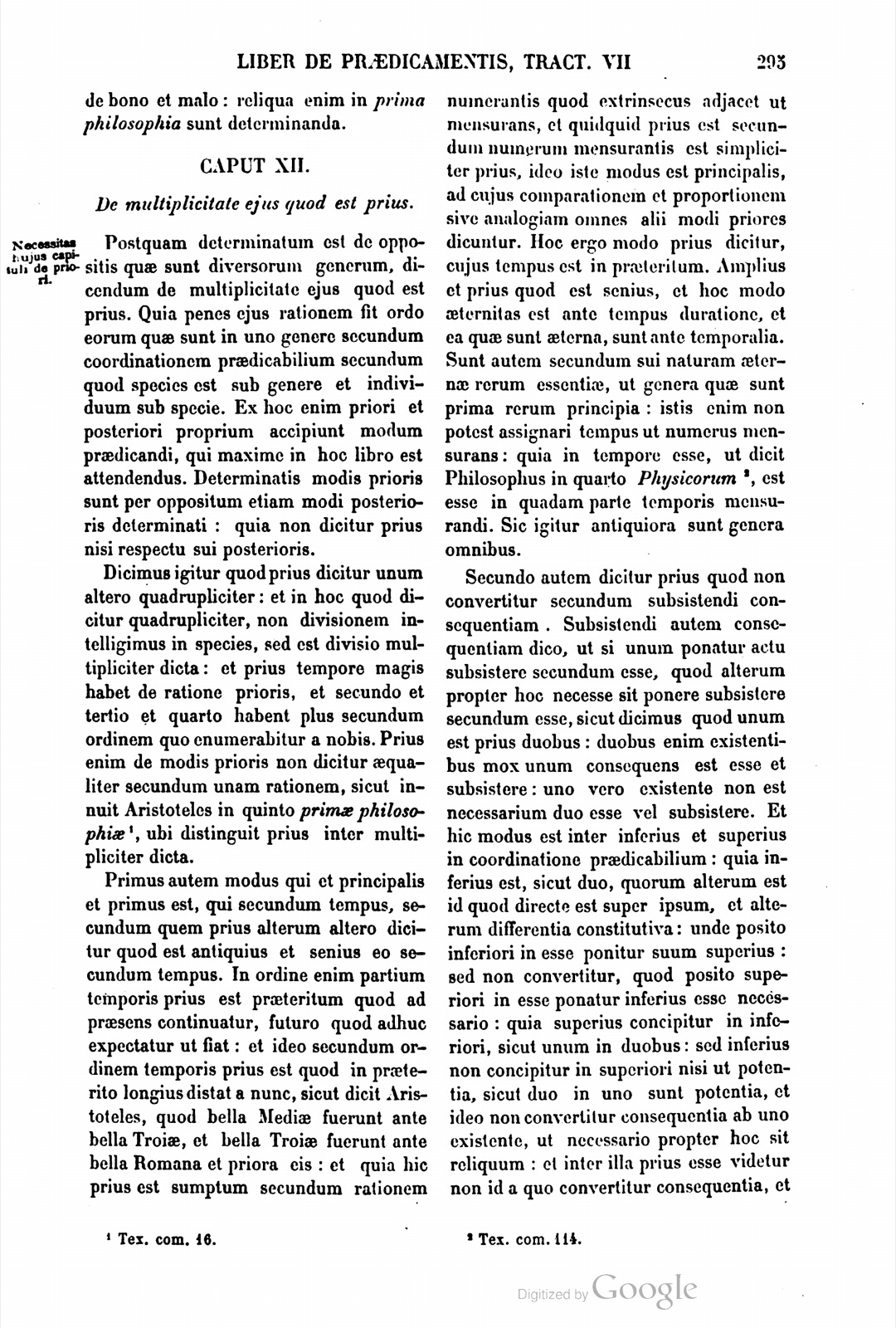
Et quod bonum in moribus contrarium est duobus malis, non est ex hoc quod medium est, sed est ex hoc quod extremum est in ratione boni perfecti, ut dicit Aristoteles, sic utrique opponitur extremitati ut extremum et maxime distans ab utraque. Hoc autem quantum spectat ad istam intentionem interponendum erat de bono et malo: reliqua enim in prima philosophia sunt determinanda.
But as for what has been said, that good and evil are contrary genera, it is established that this is not understood of the most general genera, because thus there would be more genera than ten; but it is understood that they are genera of other things which are good and in morals, for this reason, that all things which are in morals are reduced to these as to genera.
And that good in morals is contrary to two evils is not from this, that it is a mean, but is from this, that it is an extreme in the account of perfect good, as Aristotle says; thus it is opposed to each extremity as an extreme and as maximally distant from each. But this, insofar as it pertains to that intention, had to be interposed concerning good and evil; for the remaining things must be determined in First Philosophy.
If a page does not appear, its photograph has not been uploaded yet.