Volume 1 · pp. 290–292
Chapter X
A marker with ≈ is an approximate page boundary, placed by measure of the text; the page photographs remain the authority. In the paired views, clicking a page marker brings that page into view.
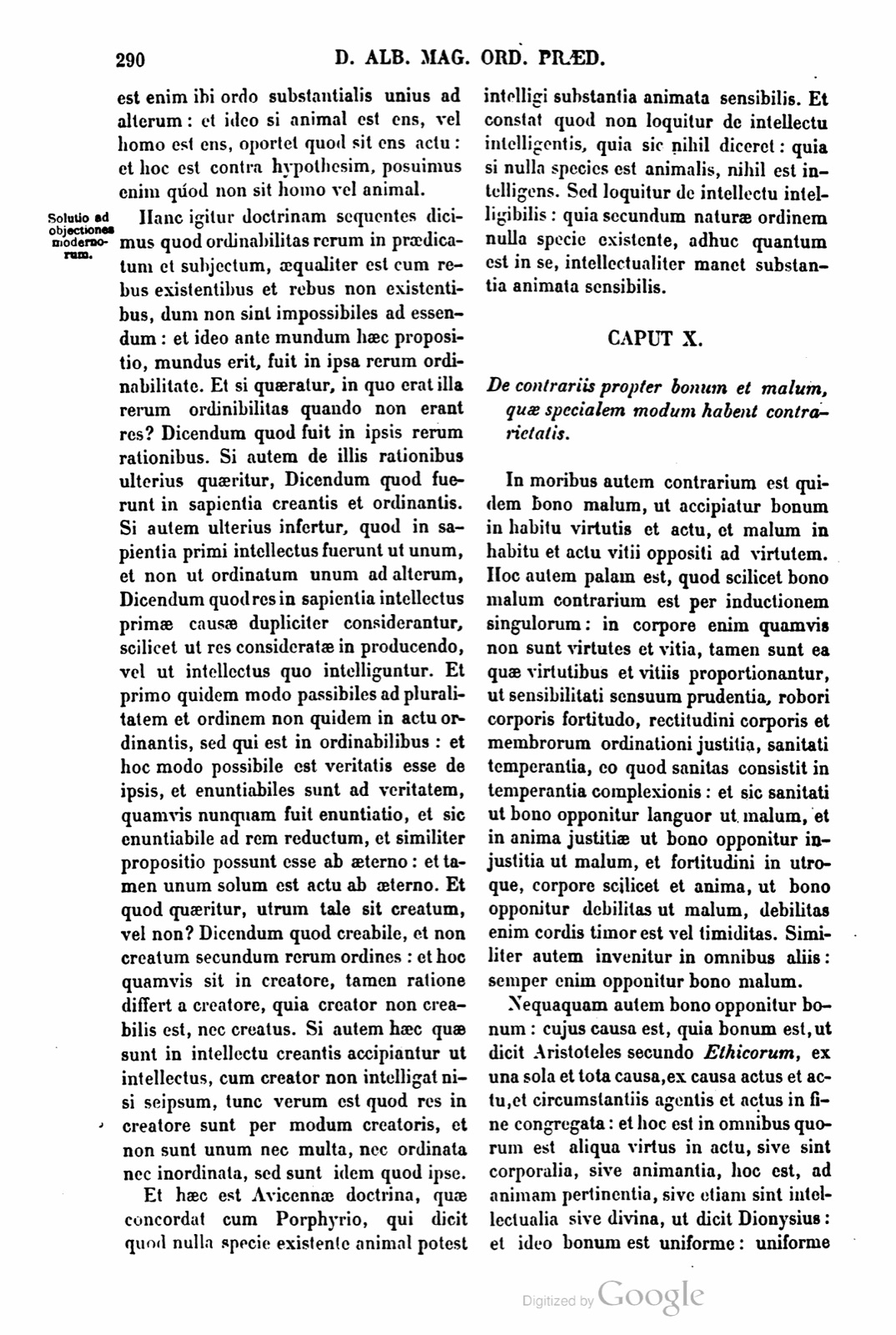
Hanc igitur doctrinam sequentes dicimus quod ordinabilitas rerum in prædicatum et subjectum, æqualiter est cum rebus existentibus et rebus non existentibus, dum non sint impossibiles ad essendum: et ideo ante mundum hæc propositio, mundus erit, fuit in ipsa rerum ordinabilitate. Et si quæratur, in quo erat illa rerum ordinibilitas quando non erant res? Dicendum quod fuit in ipsis rerum rationibus. Si autem de illis rationibus ulterius quæritur, Dicendum quod fuerunt in sapientia creantis et ordinantis. Si autem ulterius infertur, quod in sapientia primi intellectus fuerunt ut unum, et non ut ordinatum unum ad alterum, Dicendum quod res in sapientia intellectus primæ causæ dupliciter considerantur, scilicet ut res consideratæ in producendo, vel ut intellectus quo intelliguntur. Et primo quidem modo passibiles ad pluralitatem et ordinem non quidem in actu ordinantis, sed qui est in ordinabilibus: et hoc modo possibile est veritatis esse de ipsis, et enuntiabiles sunt ad veritatem, quamvis nunquam fuit enuntiatio, et sic enuntiabile ad rem reductum, et similiter propositio possunt esse ab æterno: et tamen unum solum est actu ab æterno. Et quod quæritur, utrum tale sit creatum, vel non? Dicendum quod creabile, et non creatum secundum rerum ordines: et hoc quamvis sit in creatore, tamen ratione differt a creatore, quia creator non creabilis est, nec creatus. Si autem hæc quæ sunt in intellectu creantis accipiantur ut intellectus, cum creator non intelligat nisi seipsum, tunc verum est quod res in creatore sunt per modum creatoris, et non sunt unum nec multa, nec ordinata nec inordinata, sed sunt idem quod ipse.
Et hæc est Avicennæ doctrina, quæ concordat cum Porphyrio, qui dicit quod nulla specie existente animal potest intelligi substantia animata sensibilis. Et constat quod non loquitur de intellectu intelligentis, quia sic nihil diceret: quia si nulla species est animalis, nihil est intelligens. Sed loquitur de intellectu intelligibilis: quia secundum naturæ ordinem nulla specie existente, adhuc quantum est in se, intellectualiter manet substantia animata sensibilis.
Following this doctrine, therefore, we say that the orderability of things into predicate and subject is equally with existing things and non-existing things, provided they are not impossible for being; and therefore before the world this proposition, the world will be, was in the very orderability of things. And if it is asked in what that orderability of things was when things were not, it must be said that it was in the very accounts of things. But if it is asked further concerning those accounts, it must be said that they were in the wisdom of the one creating and ordering. But if it is further inferred that in the wisdom of the first intellect they were as one, and not as one thing ordered to another, it must be said that things in the wisdom of the intellect of the first cause are considered in two ways, namely as things considered in producing, or as the intellect by which they are understood. And in the first mode indeed they are passible to plurality and order, not indeed in the act of the one ordering, but which is in orderable things; and in this mode it is possible for there to be truth concerning them, and they are enunciable toward truth, although there was never an enunciation; and thus the enunciable reduced to the thing, and similarly the proposition, can be from eternity, and yet only one thing is in act from eternity. And as to what is asked, whether such a thing is created or not, it must be said that it is creatable, and not created according to the orders of things. And although this is in the creator, nevertheless it differs by reason from the creator, because the creator is not creatable, nor created. But if these things which are in the intellect of the one creating are taken as intellect, since the creator understands nothing except himself, then it is true that things in the creator are through the mode of the creator, and they are not one nor many, nor ordered nor disordered, but are the same as he himself.
And this is Avicenna's doctrine, which agrees with Porphyry, who says that when no species exists, animal can be understood as animated sensible substance. And it is agreed that he does not speak of the intellect of the one understanding, because thus he would say nothing, because if there is no species of animal, there is nothing understanding. But he speaks of the intellect of the intelligible, because according to the order of nature, when no species exists, still as much as is in itself, animated sensible substance remains intellectually.
CAPUT X.
De contrariis propter bonum et malum, quæ specialem modum habent contrarietatis.
In moribus autem contrarium est quidem bono malum, ut accipiatur bonum in habitu virtutis et actu, et malum in habitu et actu vitii oppositi ad virtutem. Hoc autem palam est, quod scilicet bono malum contrarium est per inductionem singulorum: in corpore enim quamvis non sunt virtutes et vitia, tamen sunt ea quæ virtutibus et vitiis proportionantur, ut sensibilitati sensuum prudentia, robori corporis fortitudo, rectitudini corporis et membrorum ordinationi justitia, sanitati temperantia, eo quod sanitas consistit in temperantia complexionis: et sic sanitati ut bono opponitur languor ut malum, et in anima justitiæ ut bono opponitur injustitia ut malum, et fortitudini in utroque, corpore scilicet et anima, ut bono opponitur debilitas ut malum, debilitas enim cordis timor est vel timiditas. Similiter autem invenitur in omnibus aliis: semper enim opponitur bono malum.
Nequaquam autem bono opponitur bonum: cujus causa est, quia bonum est, ut dicit Aristoteles secundo Ethicorum, ex una sola et tota causa, ex causa actus et actu, et circumstantiis agentis et actus in fine congregata: et hoc est in omnibus quorum est aliqua virtus in actu, sive sint corporalia, sive animantia, hoc est, ad animam pertinentia, sive etiam sint intellectualia sive divina, ut dicit Dionysius: et ideo bonum est uniforme: uniforme autem uniformi non opponitur nec opponi potest, quia uniforme uniformi convenit et non potest esse oppositum: et ideo dicit Aristoteles quod omnia consonantia vera et bona sunt. Falsum autem statim dissonat vero, et malum statim dissonat bono. Intelliguntur autem hæc omnia de bono et malo dictis simpliciter, et non de bono et malo dictis per accidens ut hic et nunc: quia sic nihil prohibet esse idem malum et bonum, sicut secari et uri quæ mala sunt, sunt tamen bona et nunc et hic. De talibus autem disputari habet in ethicis: sed hoc sufficit scire tantum, quia malum bono opponitur, bono autem bonum nunquam opponitur.
CHAPTER X.
Concerning contraries on account of good and evil, which have a special mode of contrariety.
But in morals, evil indeed is contrary to good, so that good is taken in the habit and act of virtue, and evil in the habit and act of vice opposed to virtue. But this is plain, namely that evil is contrary to good, through induction of singulars; for in the body, although there are not virtues and vices, nevertheless there are those things which are proportioned to virtues and vices, as prudence to the sensibility of the senses, fortitude to the strength of the body, justice to the rectitude of the body and the ordering of the members, temperance to health, because health consists in temperance of complexion; and thus sickness as evil is opposed to health as good, and in the soul injustice as evil is opposed to justice as good, and to fortitude in each, namely body and soul, weakness as evil is opposed to good, for weakness of heart is fear or timidity. But it is found similarly in all other things; for evil is always opposed to good.
But good is by no means opposed to good. The cause of this is that good, as Aristotle says in the second book of the Ethics, is from one sole and total cause, gathered together from the cause of the act and the act, and from the circumstances of the agent and of the act in the end; and this is in all things of which there is some virtue in act, whether they are corporeal things, or animate things, that is, things pertaining to the soul, or even whether they are intellectual or divine, as Dionysius says; and therefore good is uniform. But the uniform is not opposed to the uniform, nor can it be opposed, because the uniform agrees with the uniform and cannot be opposed; and therefore Aristotle says that all consonant things are true and good. But the false at once is dissonant with the true, and evil at once is dissonant with good. But all these things are understood concerning good and evil said simply, and not concerning good and evil said by accident, as here and now, because thus nothing prevents the same thing from being evil and good, as being cut and being burned, which are evils, are nevertheless good both now and here. But concerning such things disputation has to be had in ethics; but it suffices to know only this, that evil is opposed to good, but good is never opposed to good.
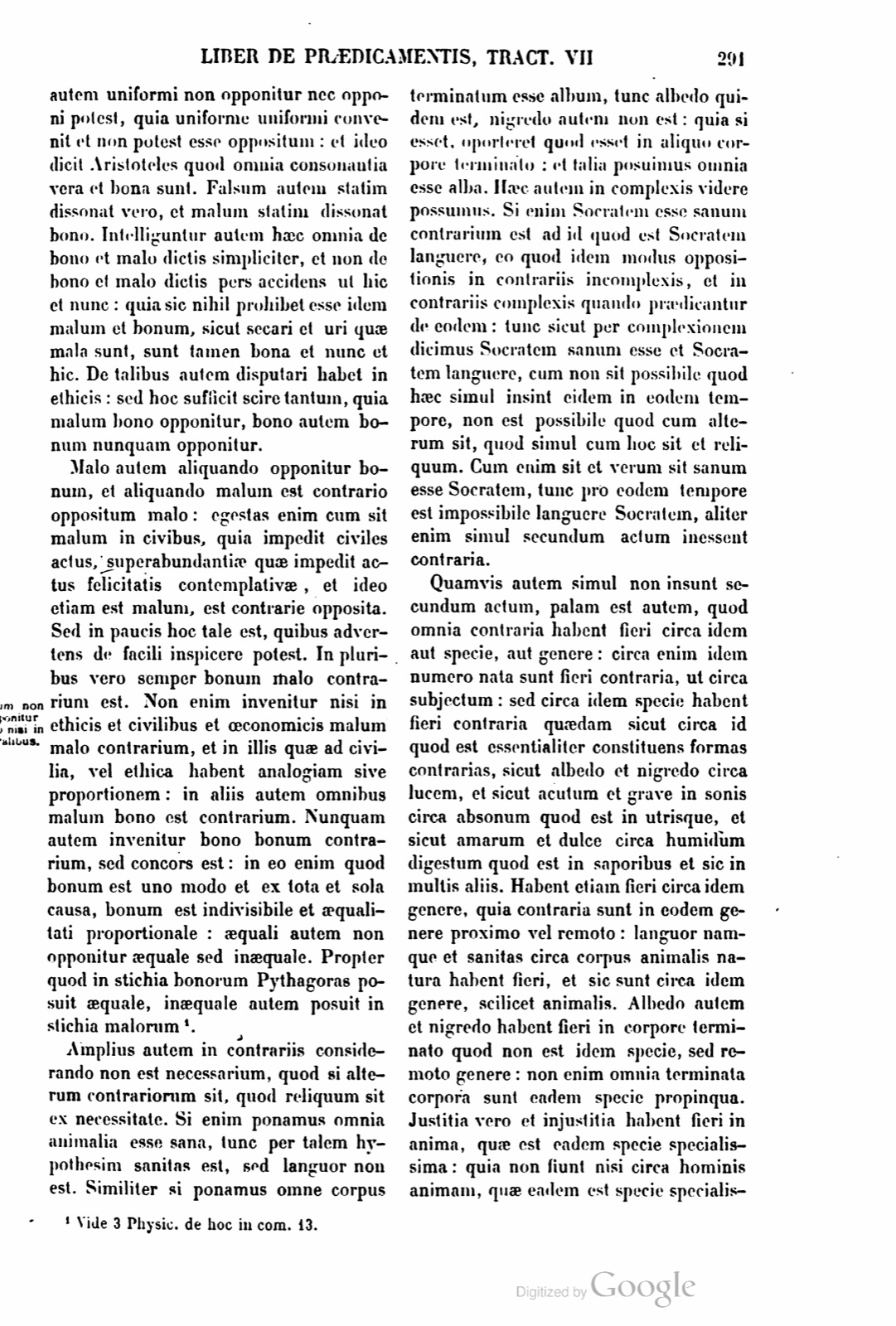
Malo autem aliquando opponitur bonum, et aliquando malum est contrario oppositum malo: egestas enim cum sit malum in civibus, quia impedit civiles actus, superabundantiæ quæ impedit actus felicitatis contemplativæ, et ideo etiam est malum, est contrarie opposita. Sed in paucis hoc tale est, quibus advertens de facili inspicere potest. In pluribus vero semper bonum malo contrarium est. Non enim invenitur nisi in ethicis et civilibus et œconomicis malum malo contrarium, et in illis quæ ad civilia, vel ethica habent analogiam sive proportionem: in aliis autem omnibus malum bono est contrarium. Nunquam autem invenitur bono bonum contrarium, sed concors est: in eo enim quod bonum est uno modo et ex tota et sola causa, bonum est indivisibile et æqualitati proportionale: æquali autem non opponitur æquale sed inæquale. Propter quod in stichia bonorum Pythagoras posuit æquale, inæquale autem posuit in stichia malorum 1.
Amplius autem in contrariis considerando non est necessarium, quod si alterum contrariorum sit, quod reliquum sit ex necessitate. Si enim ponamus omnia animalia esse sana, tunc per talem hypothesim sanitas est, sed languor non est. Similiter si ponamus omne corpus terminatum esse album, tunc albedo quidem est, nigredo autem non est: quia si esset, oporteret quod esset in aliquo corpore terminato: et talia posuimus omnia esse alba. Hæc autem in complexis videre possumus. Si enim Socratem esse sanum contrarium est ad id quod est Socratem languere, eo quod idem modus oppositionis in contrariis incomplexis, et in contrariis complexis quando prædicantur de eodem: tunc sicut per complexionem dicimus Socratem sanum esse et Socratem languere, cum non sit possibile quod hæc simul insint eidem in eodem tempore, non est possibile quod cum alterum sit, quod simul cum hoc sit et reliquum. Cum enim sit et verum sit sanum esse Socratem, tunc pro eodem tempore est impossibile languere Socratem, aliter enim simul secundum actum inessent contraria.
But sometimes good is opposed to evil, and sometimes evil is contrary-opposed to evil. For poverty, since it is an evil in citizens because it impedes civil acts, is contrary-opposed to superabundance, which impedes the acts of contemplative happiness and therefore also is an evil. But this is such in few things, which one attending can easily inspect. But in more things good is always contrary to evil. For evil contrary to evil is found only in ethics and civil and economic matters, and in those things which have an analogy or proportion to civil or ethical matters; but in all other things evil is contrary to good. But good is never found contrary to good, but is concordant: for in that good is in one mode and from a total and sole cause, good is indivisible and proportional to equality. But equal is not opposed to equal, but unequal. On account of this Pythagoras posited equal in the stichia of goods, but unequal he posited in the stichia of evils 1.
Further, in considering contraries, it is not necessary that if one of the contraries exists, the remaining one exists from necessity. For if we posit all animals to be healthy, then through such a hypothesis health exists, but sickness does not exist. Similarly, if we posit every terminated body to be white, then whiteness indeed exists, but blackness does not exist, because if it existed, it would have to be in some terminated body; and we have posited all such things to be white. But we can see these things in complexes. For if Socrates to be healthy is contrary to that which is Socrates to be sick, because the same mode of opposition is in incomplex contraries and in complex contraries when they are predicated of the same thing, then, just as through complex speech we say Socrates to be healthy and Socrates to be sick, since it is not possible that these be present at once in the same thing at the same time, it is not possible that when one exists, the remaining one also exist at once with it. For when it exists and it is true that Socrates is healthy, then for the same time it is impossible for Socrates to be sick; for otherwise contraries would be present at once according to act.
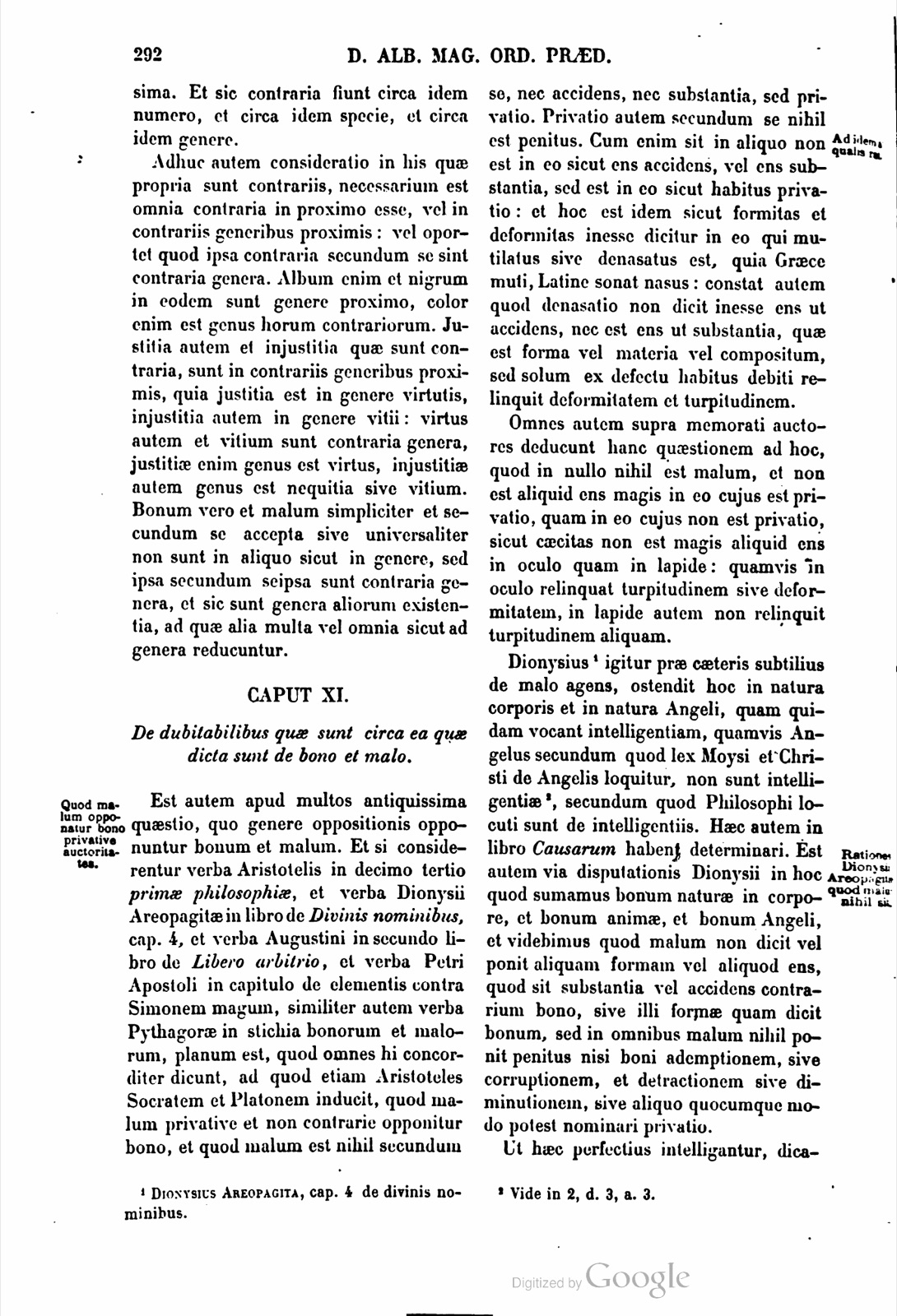
Quamvis autem simul non insunt secundum actum, palam est autem, quod omnia contraria habent fieri circa idem aut specie, aut genere: circa enim idem numero nata sunt fieri contraria, ut circa subjectum: sed circa idem specie habent fieri contraria quædam sicut circa id quod est essentialiter constituens formas contrarias, sicut albedo et nigredo circa lucem, et sicut acutum et grave in sonis circa absonum quod est in utrisque, et sicut amarum et dulce circa humidum digestum quod est in saporibus et sic in multis aliis. Habent etiam fieri circa idem genere, quia contraria sunt in eodem genere proximo vel remoto: languor namque et sanitas circa corpus animalis natura habent fieri, et sic sunt circa idem genere, scilicet animalis. Albedo autem et nigredo habent fieri in corpore terminato quod non est idem specie, sed remoto genere: non enim omnia terminata corpora sunt eadem specie propinqua. Justitia vero et injustitia habent fieri in anima, quæ est eadem specie specialissima: quia non fiunt nisi circa hominis animam, quæ eadem est specie specialissima. Et sic contraria fiunt circa idem numero, et circa idem specie, et circa idem genere.
But although they are not present at once according to act, nevertheless it is plain that all contraries have to come to be about the same thing either in species or in genus. For contraries are naturally apt to come to be about the same thing in number, as about a subject; but certain contraries have to come to be about the same thing in species, as about that which essentially constitutes the contrary forms, as whiteness and blackness about light, and as high-pitched and low-pitched in sounds about discordant sound, which is in both, and as bitter and sweet about digested moisture, which is in tastes, and so in many other things. They also have to come to be about the same thing in genus, because contraries are in the same genus, proximate or remote. For sickness and health naturally have to come to be about the body of an animal, and thus they are about the same thing in genus, namely of animal. But whiteness and blackness have to come to be in a terminated body which is not the same in species, but in remote genus; for not all terminated bodies are the same in proximate species. But justice and injustice have to come to be in the soul, which is the same in most special species, because they come to be only about the soul of man, which is the same in most special species. And thus contraries come to be about the same thing in number, and about the same thing in species, and about the same thing in genus.
Notes
- See book 3 of the Physics concerning this in commentary 13. (Vide 3 Physic. de hoc in com. 13.) ↩
If a page does not appear, its photograph has not been uploaded yet.