Volume 1 · pp. 288–290
Chapter IX
A marker with ≈ is an approximate page boundary, placed by measure of the text; the page photographs remain the authority. In the paired views, clicking a page marker brings that page into view.
sicut cæcitas ad visum se habet: et talis privatio sequitur habitum tempore et natura: hæc enim privatio non relinquit subjectum sine habilitate ad habitum. Est autem alia privatio quæ non privat habitum, sed essentiam secundum esse actu habitum: et hæc est in qua est inchoatio habitus secundum potentiam, et ex qua educitur habitus, et ab hac in omni motu et mutatione fit processus in habitum secundum actum per modum quo movetur subjectum susceptibile actus de potentia ad actum: et hæc privatio semper præcedit habitum tempore et motu, et etiam natura materiæ et potentiæ: et de hac privatione nos hic non loquimur, quia in toto non privat habitum. Nec etiam inter talem privationem et suum habitum est plena oppositio privative oppositorum. Nos autem hic loquimur de differentia modorum oppositionis, et ideo non loquimur de privatione et habitu, nisi secundum quod plenam habent ad invicem hujusmodi oppositionem. Alia vero quæ dicta sunt, per se sunt manifesta.
Quod autem de nive dictum est, quod per naturam inest ei candidam esse: hoc namque est, quia nix materialiter generatur de perspicuo indurato et concusso per minima: perspicuum autem concussum et induratum per indurationem efficitur ubique in superficie clara luminis receptivum: et hæc est natura et naturalis causa albedinis: per hanc ergo naturam inest nivi candidam esse.
CAPUT IX.
De differentia contradictionis ad alias oppositiones, et utrum veritas sit ab æterno.
His habitis, ostendenda est differentia contradictionis ad omnes alias oppositiones. Dicamus ergo quod in affirmatione et negatione semper, sive sit subjectum de quo sit affirmatio et negatio, sive non sit, una quidem pars contradictionis est vera et altera falsa: de quolibet enim sive existente sive non existente dicitur affirmatio vel negatio vera: et de nullo simul ambo vera vel falsa sunt contradictoria, ut in quarto primæ philosophiæ probatum est 1: sive enim sit Socrates sive non sit, de Socrate unum contradictoriorum est verum, aliud autem falsum: palam enim est cum dicitur Socratem (dum ipse est Socrates) languere et Socratem non languere, quod alterum istorum falsum est et alterum verum. Similiter si Socrates ponitur non esse, et dicatur quod Socrates languet vel non languet, alterum est verum, et alterum est falsum, languere enim Socratem quando non est Socrates, falsum est, et non languere Socratem verum est. Propter hoc in his solum quæ sunt opposita contradictorie, proprium est, semper alterum eorum verum et alterum falsum esse, et nunquam esse simul vera vel simul falsa.
as blindness has itself to sight; and such privation follows habit in time and nature, for this privation does not leave the subject without aptitude for habit. But there is another privation which does not deprive habit, but essence according to being had in act; and this is the one in which there is an inception of habit according to potency, and from which habit is educed, and from this in every motion and mutation there comes to be a process into habit according to act, through the mode by which the subject susceptible of act is moved from potency to act. And this privation always precedes habit in time and motion, and also by the nature of matter and potency; and concerning this privation we do not speak here, because it does not deprive habit wholly. Nor also between such privation and its habit is there a full opposition of privatively opposed things. But we here speak of the difference of the modes of opposition, and therefore we do not speak of privation and habit except according as they have this sort of opposition fully toward one another. But the other things which have been said are manifest through themselves.
But what was said concerning snow, that to be white is present in it by nature: this indeed is because snow materially is generated from the transparent hardened and shaken together through minimal parts; but the transparent shaken together and hardened by hardening is made everywhere on the surface receptive of clear light; and this is the nature and natural cause of whiteness; therefore through this nature to be white is present in snow.
CHAPTER IX.
Concerning the difference of contradiction from the other oppositions, and whether truth is from eternity.
With these things had, the difference of contradiction from all the other oppositions must be shown. Therefore let us say that in affirmation and negation always, whether the subject about which there is affirmation and negation exists or does not exist, one part of the contradiction is true and the other false. For of anything whatever, whether existing or not existing, affirmation or negation is said to be true, and concerning nothing are both contradictories at once true or false, as has been proved in the fourth book of First Philosophy 1. For whether Socrates exists or does not exist, concerning Socrates one of the contradictories is true, but the other false; for it is plain when Socrates is said to be sick (while he himself is Socrates) and Socrates not to be sick, that one of these is false and the other true. Similarly, if Socrates is posited not to exist, and it is said that Socrates is sick or is not sick, one is true and the other is false; for Socrates to be sick when Socrates does not exist is false, and Socrates not to be sick is true. On account of this, in these things alone which are opposed contradictorily, it is proper that always one of them be true and the other false, and never be at once true or at once false.
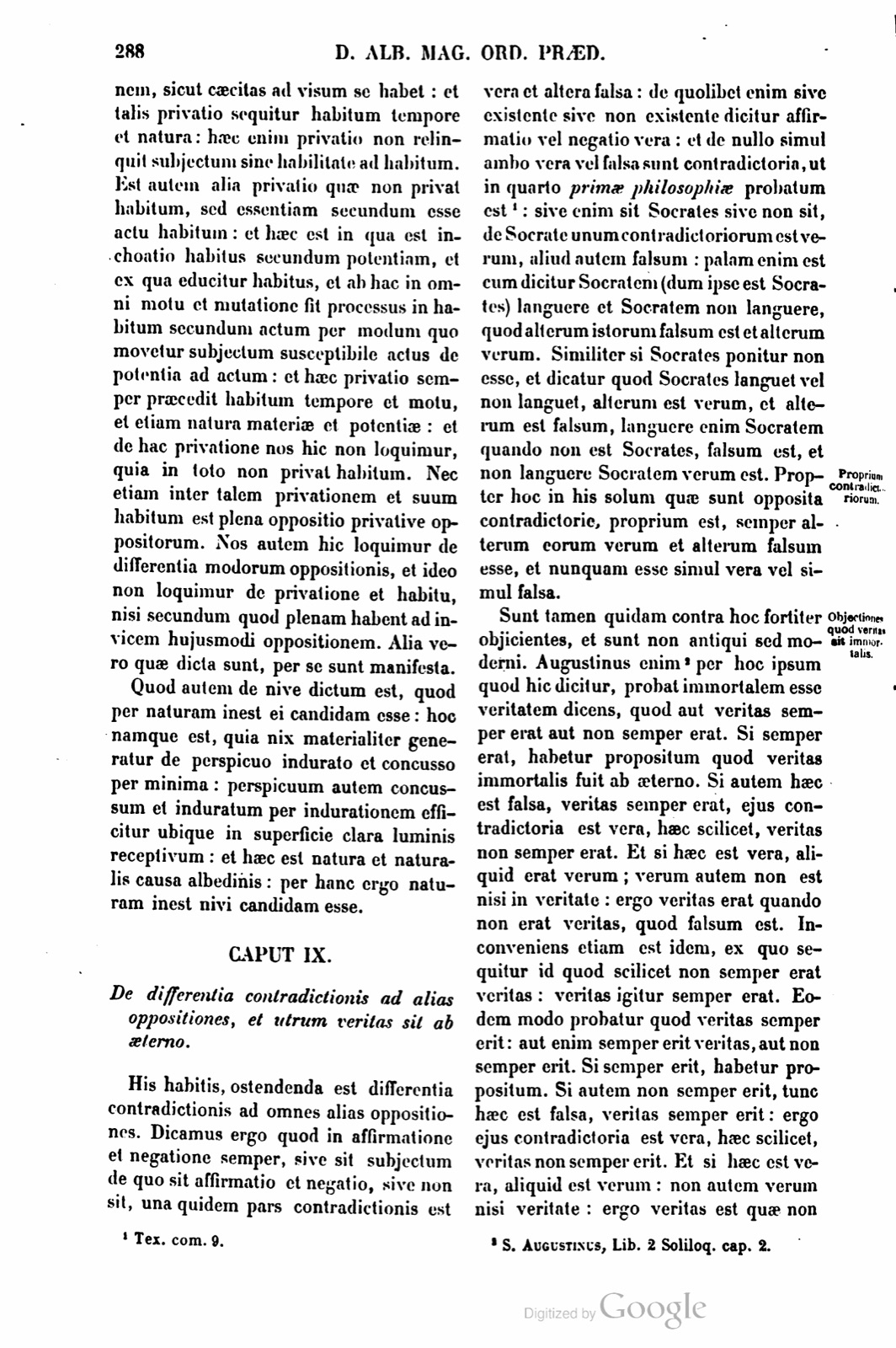
Sunt tamen quidam contra hoc fortiter objicientes, et sunt non antiqui sed moderni. Augustinus enim 2 per hoc ipsum quod hic dicitur, probat immortalem esse veritatem dicens, quod aut veritas semper erat aut non semper erat. Si semper erat, habetur propositum quod veritas immortalis fuit ab æterno. Si autem hæc est falsa, veritas semper erat, ejus contradictoria est vera, hæc scilicet, veritas non semper erat. Et si hæc est vera, aliquid erat verum; verum autem non est nisi in veritate: ergo veritas erat quando non erat veritas, quod falsum est. Inconveniens etiam est idem, ex quo sequitur id quod scilicet non semper erat veritas: veritas igitur semper erat. Eodem modo probatur quod veritas semper erit: aut enim semper erit veritas, aut non semper erit. Si semper erit, habetur propositum. Si autem non semper erit, tunc hæc est falsa, veritas semper erit: ergo ejus contradictoria est vera, hæc scilicet, veritas non semper erit. Et si hæc est vera, aliquid est verum: non autem verum nisi veritate: ergo veritas est quæ non erit veritas,
Nevertheless there are certain men objecting strongly against this, and they are not ancient but modern. For Augustine 2, through this very thing which is said here, proves truth to be immortal, saying that either truth always was or was not always. If it always was, the proposed thing is had, that truth was immortal from eternity. But if this is false, truth always was, its contradictory is true, namely this, truth was not always. And if this is true, something was true; but the true exists only in truth; therefore truth was when truth was not, which is false. The same also is unfitting, from which there follows that, namely that truth was not always; therefore truth always was. In the same mode it is proved that truth always will be: for either truth always will be, or will not always be. If it always will be, the proposed thing is had. But if it will not always be, then this is false, truth always will be; therefore its contradictory is true, namely this, truth will not always be. And if this is true, something is true; but it is not true except by truth; therefore there is a truth which will not be truth,
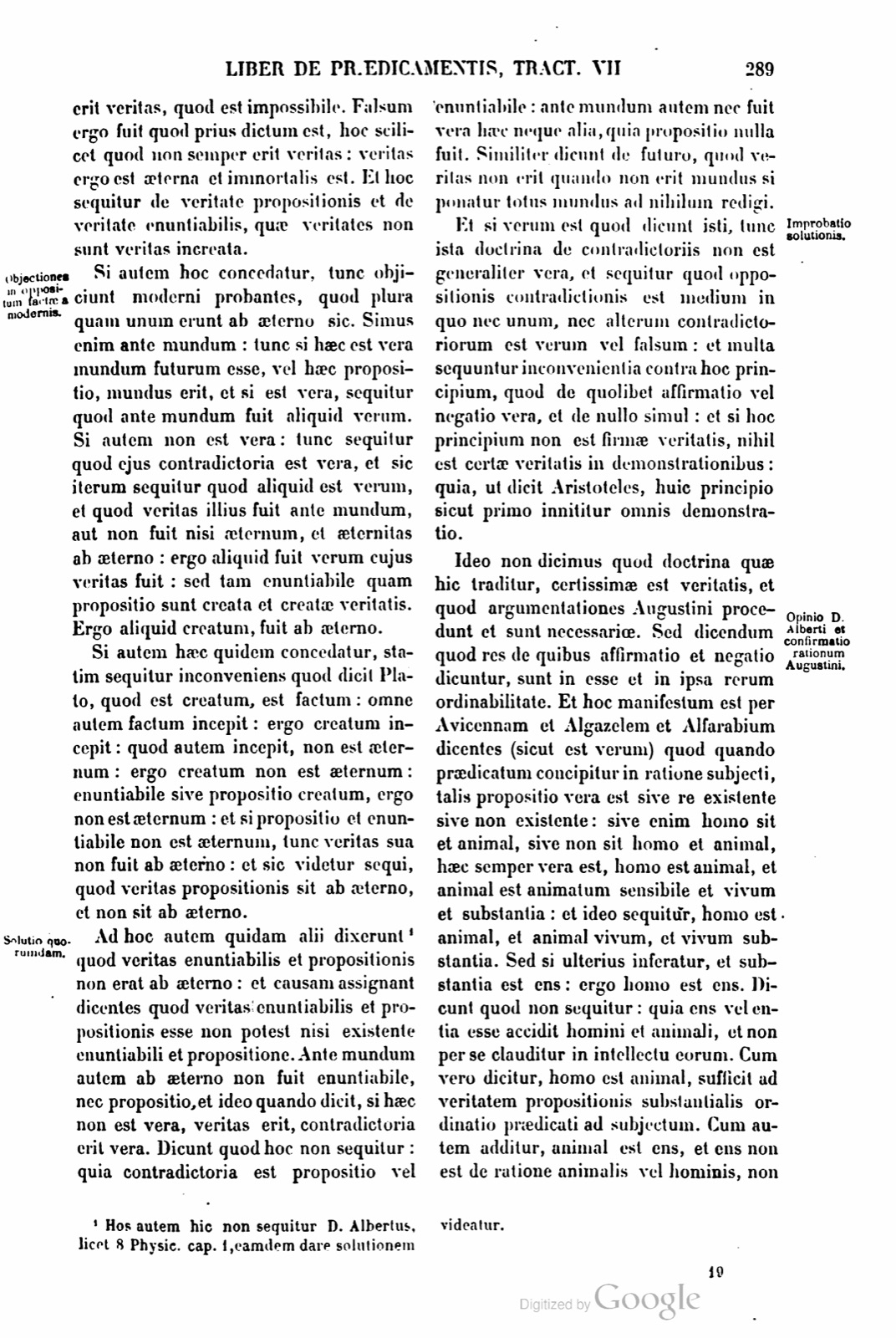
quod est impossibile. Falsum ergo fuit quod prius dictum est, hoc scilicet quod non semper erit veritas: veritas ergo est æterna et immortalis est. Et hoc sequitur de veritate propositionis et de veritate enuntiabilis, quæ veritates non sunt veritas increata.
Si autem hoc concedatur, tunc objiciunt moderni probantes, quod plura quam unum erunt ab æterno sic. Simus enim ante mundum: tunc si hæc est vera mundum futurum esse, vel hæc propositio, mundus erit, et si est vera, sequitur quod ante mundum fuit aliquid verum. Si autem non est vera: tunc sequitur quod ejus contradictoria est vera, et sic iterum sequitur quod aliquid est verum, et quod veritas illius fuit ante mundum, aut non fuit nisi æternum, et æternitas ab æterno: ergo aliquid fuit verum cujus veritas fuit: sed tam enuntiabile quam propositio sunt creata et creatæ veritatis. Ergo aliquid creatum, fuit ab æterno.
Si autem hæc quidem concedatur, statim sequitur inconveniens quod dicit Plato, quod est creatum, est factum: omne autem factum incepit: ergo creatum incepit: quod autem incepit, non est æternum: ergo creatum non est æternum: enuntiabile sive propositio creatum, ergo non est æternum: et si propositio et enuntiabile non est æternum, tunc veritas sua non fuit ab æterno: et sic videtur sequi, quod veritas propositionis sit ab æterno, et non sit ab æterno.
Ad hoc autem quidam alii dixerunt 3 quod veritas enuntiabilis et propositionis non erat ab æterno: et causam assignant dicentes quod veritas enuntiabilis et propositionis esse non potest nisi existente enuntiabili et propositione. Ante mundum autem ab æterno non fuit enuntiabile, nec propositio, et ideo quando dicit, si hæc non est vera, veritas erit, contradictoria erit vera. Dicunt quod hoc non sequitur: quia contradictoria est propositio vel enuntiabile: ante mundum autem nec fuit vera hæc neque alia, quia propositio nulla fuit. Similiter dicunt de futuro, quod veritas non erit quando non erit mundus si ponatur totus mundus ad nihilum redigi.
which is impossible. Therefore what was said before was false, namely this, that truth will not always be; therefore truth is eternal and is immortal. And this follows concerning the truth of the proposition and concerning the truth of the enunciable, which truths are not uncreated truth.
But if this is conceded, then the moderns object, proving that more things than one will be from eternity thus. For let us be before the world: then if this is true, that the world is going to be, or this proposition, the world will be, and if it is true, it follows that before the world there was something true. But if it is not true, then it follows that its contradictory is true, and thus again it follows that something is true, and that the truth of that was before the world, or it was nothing except eternal, and eternity from eternity. Therefore something was true whose truth was; but both the enunciable and the proposition are created and of created truth. Therefore something created was from eternity.
But if this indeed is conceded, immediately there follows the unfitting consequence which Plato says, that what is created is made; but everything made has begun; therefore the created has begun; but what has begun is not eternal; therefore the created is not eternal. An enunciable or proposition is created; therefore it is not eternal. And if the proposition and enunciable is not eternal, then its truth was not from eternity. And thus it seems to follow that the truth of the proposition is from eternity and is not from eternity.
To this, however, certain others have said 3 that the truth of an enunciable and of a proposition was not from eternity; and they assign the cause, saying that the truth of an enunciable and of a proposition cannot be except with the enunciable and proposition existing. But before the world from eternity there was no enunciable, nor proposition, and therefore when he says, if this is not true, truth will be, the contradictory will be true. They say that this does not follow, because the contradictory is a proposition or enunciable; but before the world neither this nor another was true, because there was no proposition. Similarly they speak of the future, that truth will not be when the world will not be, if the whole world is posited to be reduced to nothing.
Et si verum est quod dicunt isti, tunc ista doctrina de contradictoriis non est generaliter vera, et sequitur quod oppositionis contradictionis est medium in quo nec unum, nec alterum contradictoriorum est verum vel falsum: et multa sequuntur inconvenientia contra hoc principium, quod de quolibet affirmatio vel negatio vera, et de nullo simul: et si hoc principium non est firmæ veritatis, nihil est certæ veritatis in demonstrationibus: quia, ut dicit Aristoteles, huic principio sicut primo innititur omnis demonstratio.
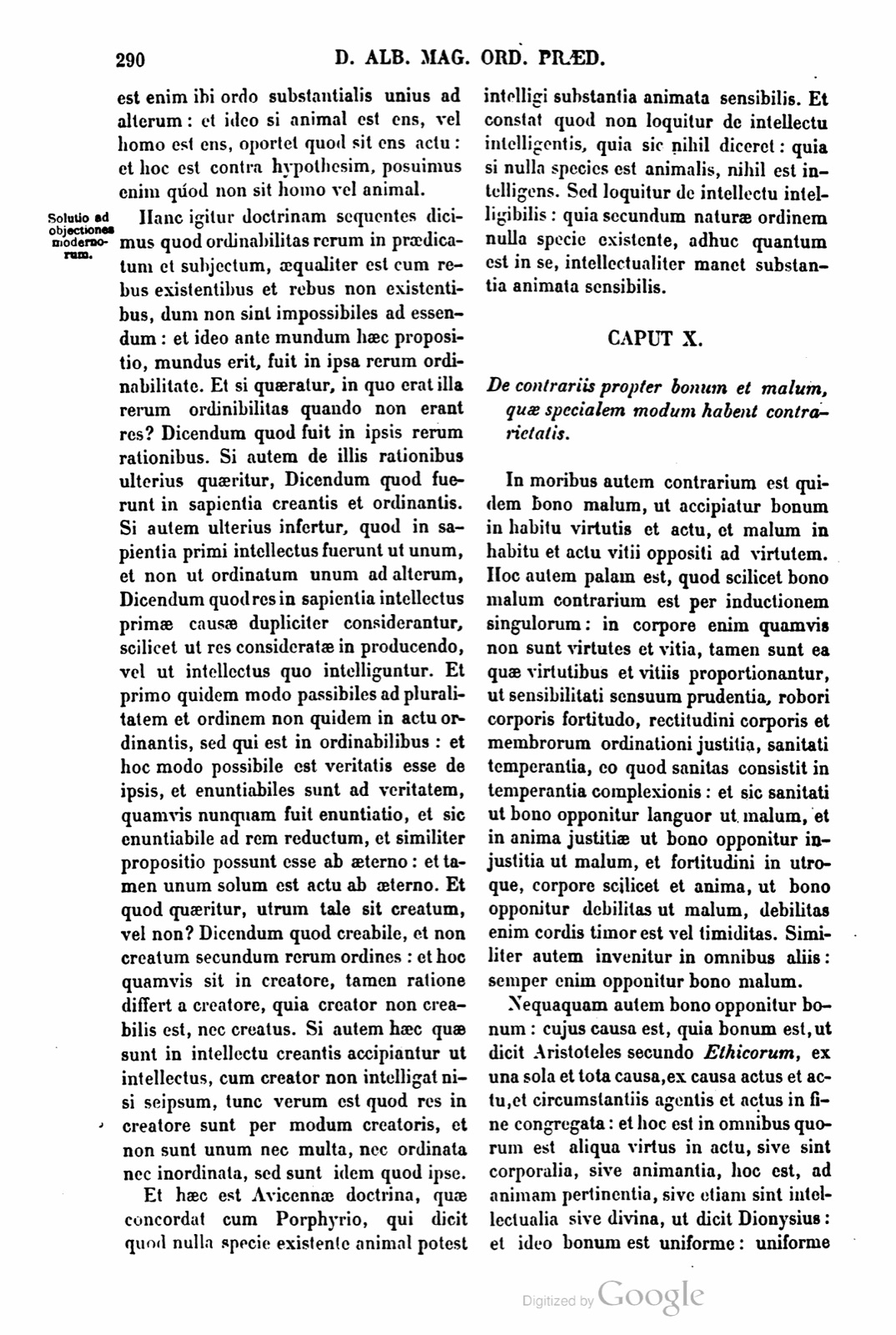
Ideo non dicimus quod doctrina quæ hic traditur, certissimæ est veritatis, et quod argumentationes Augustini procedunt et sunt necessariæ. Sed dicendum quod res de quibus affirmatio et negatio dicuntur, sunt in esse et in ipsa rerum ordinabilitate. Et hoc manifestum est per Avicennam et Algazelem et Alfarabium dicentes (sicut est verum) quod quando prædicatum concipitur in ratione subjecti, talis propositio vera est sive re existente sive non existente: sive enim homo sit et animal, sive non sit homo et animal, hæc semper vera est, homo est animal, et animal est animatum sensibile et vivum et substantia: et ideo sequitur, homo est animal, et animal vivum, et vivum substantia. Sed si ulterius inferatur, et substantia est ens: ergo homo est ens. Dicunt quod non sequitur: quia ens vel entia esse accidit homini et animali, et non per se clauditur in intellectu eorum. Cum vero dicitur, homo est animal, sufficit ad veritatem propositionis substantialis ordinatio prædicati ad subjectum. Cum autem additur, animal est ens, et ens non est de ratione animalis vel hominis, non est enim ibi ordo substantialis unius ad alterum: et ideo si animal est ens, vel homo est ens, oportet quod sit ens actu: et hoc est contra hypothesim, posuimus enim quod non sit homo vel animal.
And if what these men say is true, then that doctrine concerning contradictories is not generally true, and it follows that there is a middle of the opposition of contradiction in which neither one nor the other of the contradictories is true or false; and many unfitting consequences follow against this principle, that of anything affirmation or negation is true, and of nothing at once. And if this principle is not of firm truth, nothing is of certain truth in demonstrations, because, as Aristotle says, every demonstration rests on this principle as on a first principle.
Therefore we do not say that the doctrine which is handed down here is of most certain truth, and that the argumentations of Augustine proceed and are necessary. But it must be said that the things concerning which affirmation and negation are said are in being and in the very orderability of things. And this is manifest through Avicenna and Algazel and Alfarabi, saying (as is true) that when the predicate is conceived in the account of the subject, such a proposition is true whether the thing exists or does not exist. For whether man and animal exist, or man and animal do not exist, this is always true, man is animal, and animal is animated, sensible, living, and substance; and therefore it follows, man is animal, and animal is living, and the living is substance. But if it is inferred further, and substance is being, therefore man is being. They say that it does not follow, because being or to be beings befalls man and animal, and is not enclosed per se in their understanding. But when it is said, man is animal, the substantial ordering of the predicate to the subject suffices for the truth of the proposition. But when it is added, animal is being, and being is not of the account of animal or of man, for there is not there a substantial order of one to the other; and therefore if animal is being, or man is being, it must be being in act, and this is against the hypothesis, for we have posited that man or animal does not exist.
Notes
- Text commentary 9. (Tex. com. 9.) ↩
- Saint Augustine, book 2 of the Soliloquies, chapter 2. (S. Augustinus, Lib. 2 Soliloq. cap. 2.) ↩
- But D. Albert does not follow these men here, although in Physics 8, chapter 1, he seems to give the same solution. (Hos autem hic non sequitur D. Albertus, licet 8 Physic. cap. 1, eamdem dare solutionem videatur.) ↩
If a page does not appear, its photograph has not been uploaded yet.