Volume 1 · pp. 286–288
Chapter VIII
A marker with ≈ is an approximate page boundary, placed by measure of the text; the page photographs remain the authority. In the paired views, clicking a page marker brings that page into view.
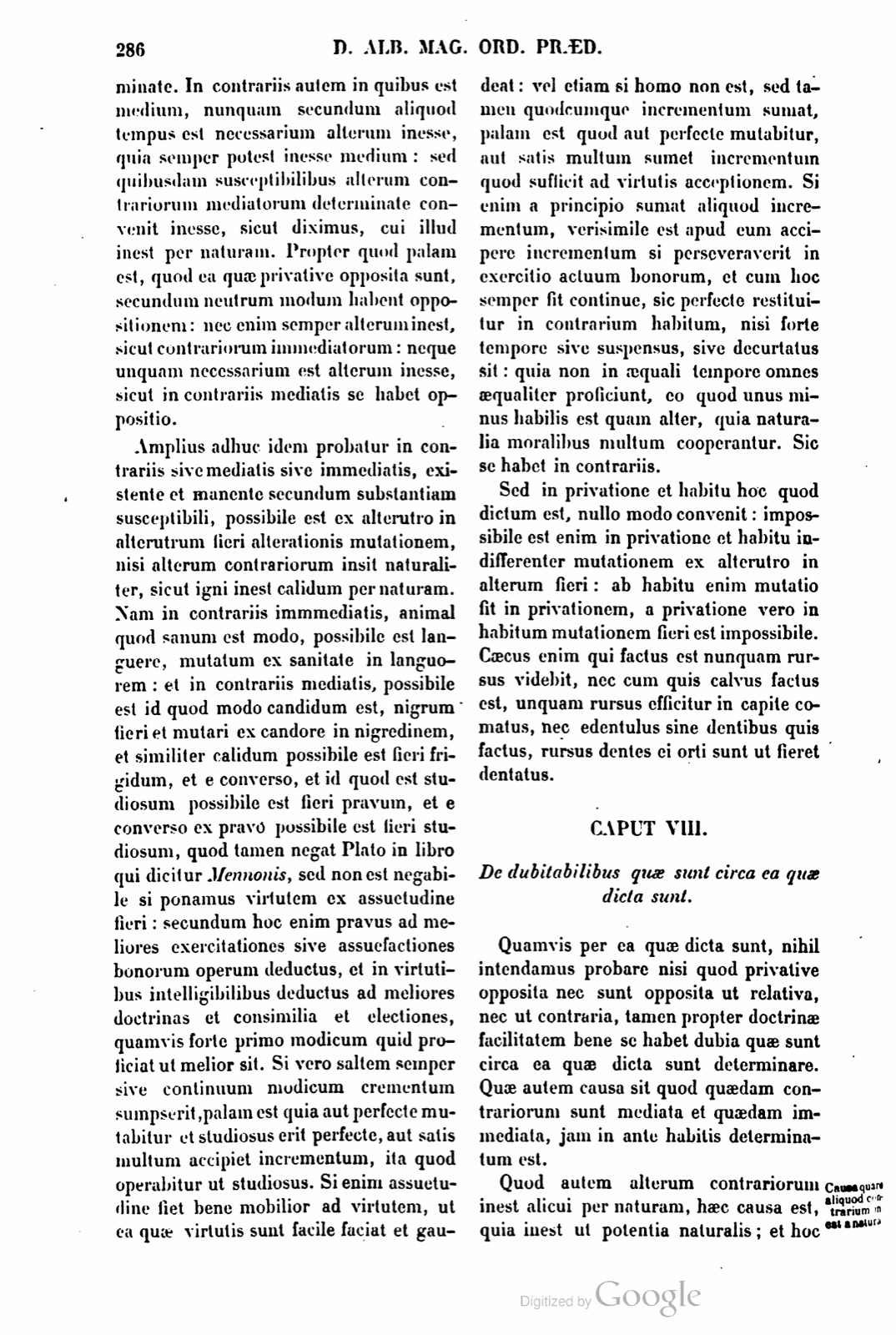
In contrariis autem in quibus est medium, nunquam secundum aliquod tempus est necessarium alterum inesse, quia semper potest inesse medium: sed quibusdam susceptibilibus alterum contrariorum mediatorum determinate convenit inesse, sicut diximus, cui illud inest per naturam. Propter quod planum est, quod ea quæ privative opposita sunt, secundum neutrum modum habent oppositionem: nec enim semper alterum inest, sicut contrariorum immediatorum: neque unquam necessarium est alterum inesse, sicut in contrariis mediatis se habet oppositio.
Amplius adhuc idem probatur in contrariis sive mediatis sive immediatis, existente et manente secundum substantiam susceptibili, possibile est ex alterutro in alterutrum fieri alterationis mutationem, nisi alterum contrariorum insit naturaliter, sicut igni inest calidum per naturam. Nam in contrariis immediatis, animal quod sanum est modo, possibile est languere, mutatum ex sanitate in languorem: et in contrariis mediatis, possibile est id quod modo candidum est, nigrum fieri et mutari ex candore in nigredinem, et similiter calidum possibile est fieri frigidum, et e converso, et id quod est studiosum possibile est fieri pravum, et e converso ex pravo possibile est fieri studiosum, quod tamen negat Plato in libro qui dicitur Mennonis, sed non est negabile si ponamus virtutem ex assuetudine fieri: secundum hoc enim pravus ad meliores exercitationes sive assuefactiones bonorum operum deductus, et in virtutibus intelligibilibus deductus ad meliores doctrinas et consimilia et electiones, quamvis forte primo modicum quid proficiat ut melior sit. Si vero saltem semper sive continuum modicum crementum sumpserit, palam est quia aut perfecte mutabitur et studiosus erit perfecte, aut satis multum accipiet incrementum, ita quod operabitur ut studiosus. Si enim assuetudine fiet bene mobilior ad virtutem, ut ea quæ virtutis sunt facile faciat et gaudeat: vel etiam si homo non est, sed tamen quodcumque incrementum sumat, palam est quod aut perfecte mutabitur, aut satis multum sumet incrementum quod sufficit ad virtutis acceptionem. Si enim a principio sumat aliquod incrementum, verisimile est apud eum accipere incrementum si perseveraverit in exercitio actuum bonorum, et cum hoc semper fit continue, sic perfecte restituitur in contrarium habitum, nisi forte tempore sive suspensus, sive decurtatus sit: quia non in æquali tempore omnes æqualiter proficiunt, eo quod unus minus habilis est quam alter, quia naturalia moralibus multum cooperantur. Sic se habet in contrariis.
Sed in privatione et habitu hoc quod dictum est, nullo modo convenit: impossibile est enim in privatione et habitu indifferenter mutationem ex alterutro in alterum fieri: ab habitu enim mutatio fit in privationem, a privatione vero in habitum mutationem fieri est impossibile. Cæcus enim qui factus est nunquam rursus videbit, nec cum quis calvus factus est, unquam rursus efficitur in capite comatus, nec edentulus sine dentibus quis factus, rursus dentes ei orti sunt ut fieret dentatus.
CAPUT VIII.
De dubitabilibus quæ sunt circa ea quæ dicta sunt.
Quamvis per ea quæ dicta sunt, nihil intendamus probare nisi quod privative opposita nec sunt opposita ut relativa, nec ut contraria, tamen propter doctrinæ facilitatem bene se habet dubia quæ sunt circa ea quæ dicta sunt determinare. Quæ autem causa sit quod quædam contrariorum sunt mediata et quædam immediata, jam in ante habitis determinatum est.
Quod autem alterum contrariorum inest alicui per naturam, hæc causa est, quia inest ut potentia naturalis; et hoc
But in contraries in which there is a mean, never according to any time is it necessary that one be present, because a mean can always be present. But in certain susceptibles one of the mediated contraries is fitting to be present determinately, as we have said, in the thing to which that is present by nature. On account of this it is plain that those things which are privatively opposed have opposition according to neither mode: for one is not always present, as in immediate contraries; nor is it ever necessary that one be present, as opposition has itself in mediate contraries.
Further, still the same is proved in contraries, whether mediate or immediate: with the susceptible existing and remaining according to substance, it is possible for a mutation of alteration to come to be from either into the other, unless one of the contraries is naturally present, as hot is present in fire by nature. For in immediate contraries, an animal which is now healthy can be sick, having been changed from health into sickness; and in mediate contraries, it is possible that what is now bright become black and be changed from brightness into blackness, and similarly that what is hot become cold, and conversely, and that what is virtuous can become depraved, and conversely from depraved can become virtuous, which nevertheless Plato denies in the book which is called Mennonis, but it is not deniable if we posit that virtue comes to be from habituation. For according to this a depraved man, having been led down to better exercises or habituations of good works, and in intelligible virtues having been led down to better teachings and similar things and choices, although perhaps at first he may advance a little so as to be better. But if at least always, or continuously, he has taken a small increase, it is clear that either he will be changed perfectly and will be virtuous perfectly, or he will receive an increase sufficiently great that he will operate as virtuous. For if by habituation he will become well more movable toward virtue, so that he may easily do those things which belong to virtue and rejoice in them; or even if he is not a man, but nevertheless takes whatever increase, it is clear that either he will be changed perfectly, or he will take an increase sufficiently great which suffices for the reception of virtue. For if from the beginning he takes some increase, it is plausible in him to receive increase if he perseveres in the exercise of good acts, and when this happens continuously always, thus he is perfectly restored into the contrary habit, unless perhaps in time he has either been suspended or cut short, because not all advance equally in an equal time, since one is less apt than another, because natural things cooperate much with moral things. Thus it has itself in contraries.
But in privation and habit that which has been said agrees in no way: for in privation and habit it is impossible that change come to be indifferently from either into the other. For from habit change comes to be into privation, but for change to come to be from privation into habit is impossible. For one who has been made blind will never see again, nor, when someone has been made bald, is he ever again made hairy in the head, nor, when someone has been made toothless without teeth, have teeth again arisen for him so that he would become toothed.
CHAPTER VIII.
Concerning the doubtful points which are about those things which have been said.
Although through the things which have been said we intend to prove nothing except that privatively opposed things are neither opposed as relatives nor as contraries, nevertheless on account of facility of teaching it is fitting to determine the doubts which are about those things which have been said. But what the cause is that some contraries are mediate and some immediate has now been determined among the things had before.
But that one of the contraries is present in something by nature, this is the cause, because it is present as natural potency; and this
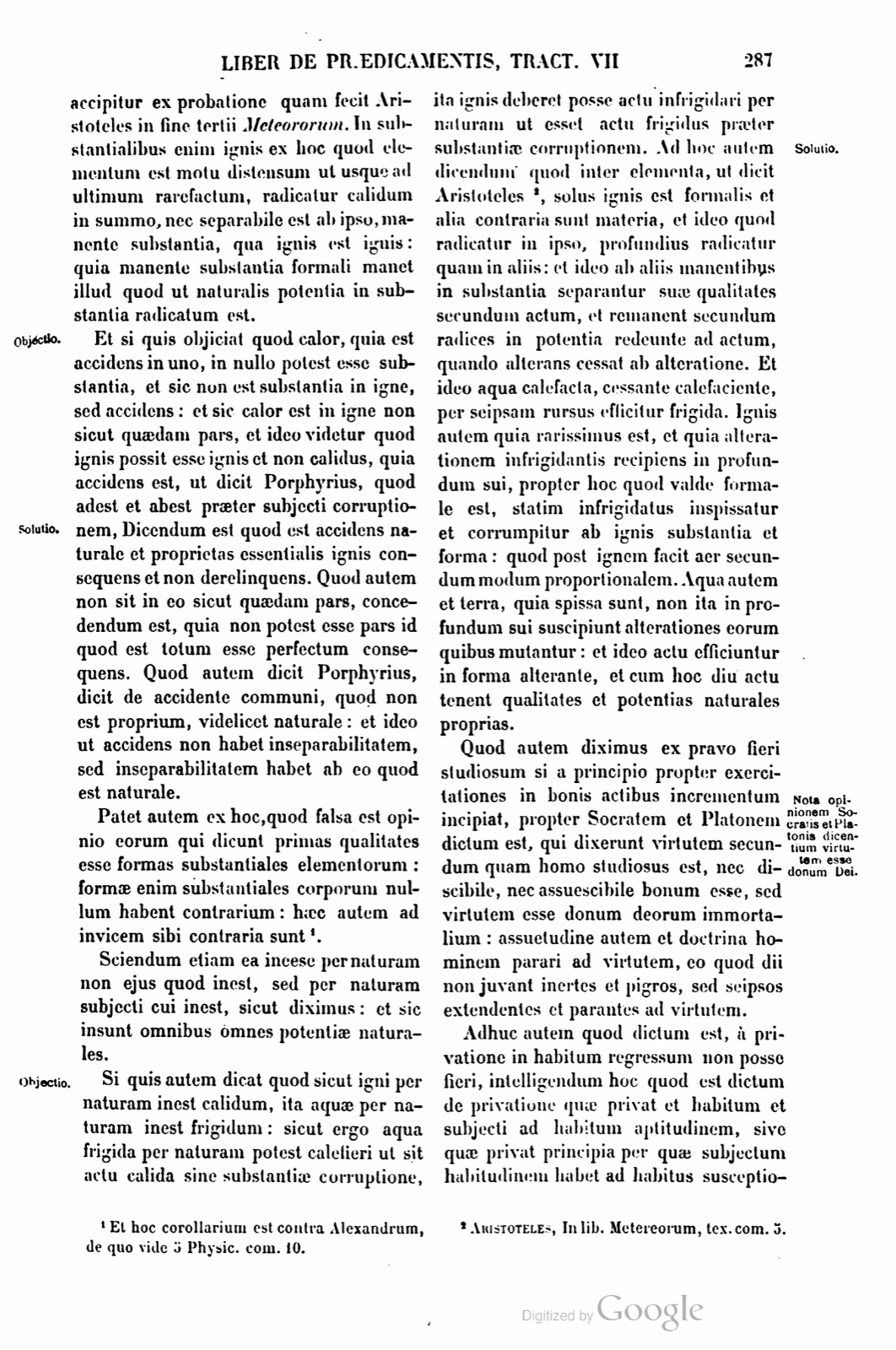
accipitur ex probatione quam fecit Aristoteles in fine tertii Meteororum. In substantialibus enim ignis ex hoc quod elementum est motu distensum ut usque ad ultimum rarefactum, radicatur calidum in summo, nec separabile est ab ipso, manente substantia, qua ignis est ignis: quia manente substantia formali manet illud quod ut naturalis potentia in substantia radicatum est.
Et si quis objiciat quod calor, quia est accidens in uno, in nullo potest esse substantia, et sic non est substantia in igne, sed accidens: et sic calor est in igne non sicut quædam pars, et ideo videtur quod ignis possit esse ignis et non calidus, quia accidens est, ut dicit Porphyrius, quod adest et abest præter subjecti corruptionem, Dicendum est quod est accidens naturale et proprietas essentialis ignis consequens et non derelinquens. Quod autem non sit in eo sicut quædam pars, concedendum est, quia non potest esse pars id quod est totum esse perfectum consequens. Quod autem dicit Porphyrius, dicit de accidente communi, quod non est proprium, videlicet naturale: et ideo ut accidens non habet inseparabilitatem, sed inseparabilitatem habet ab eo quod est naturale.
Patet autem ex hoc, quod falsa est opinio eorum qui dicunt primas qualitates esse formas substantiales elementorum: formæ enim substantiales corporum nullum habent contrarium: hæc autem ad invicem sibi contraria sunt 1.
Sciendum etiam ea inesse per naturam non ejus quod inest, sed per naturam subjecti cui inest, sicut diximus: et sic insunt omnibus omnes potentiæ naturales.
Si quis autem dicat quod sicut igni per naturam inest calidum, ita aquæ per naturam inest frigidum: sicut ergo aqua frigida per naturam potest calefieri ut sit actu calida sine substantiæ corruptione, ita ignis deberet posse actu infrigidari per naturam ut esset actu frigidus præter substantiæ corruptionem. Ad hoc autem dicendum quod inter elementa, ut dicit Aristoteles 2, solus ignis est formalis et alia contraria sunt materia, et ideo quod radicatur in ipso, profundius radicatur quam in aliis: et ideo ab aliis manentibus in substantia separantur suæ qualitates secundum actum, et remanent secundum radices in potentia redeunte ad actum, quando alterans cessat ab alteratione. Et ideo aqua calefacta, cessante calefaciente, per seipsam rursus efficitur frigida. Ignis autem quia rarissimus est, et quia alterationem infrigidantis recipiens in profundum sui, propter hoc quod valde formale est, statim infrigidatus inspissatur et corrumpitur ab ignis substantia et forma: quod post ignem facit aer secundum modum proportionalem. Aqua autem et terra, quia spissa sunt, non ita in profundum sui suscipiunt alterationes eorum quibus mutantur: et ideo actu efficiuntur in forma alterante, et cum hoc diu actu tenent qualitates et potentias naturales proprias.
is taken from the proof which Aristotle made at the end of the third book of the Meteororum. For in substantial things, from this, that fire is an element extended by motion so as to be rarefied to the utmost, the hot is rooted in the highest degree, nor is it separable from it while the substance remains, by which fire is fire, because while the formal substance remains, that which has been rooted in the substance as a natural potency remains.
And if someone objects that heat, because it is an accident in one thing, can be substance in nothing, and thus it is not substance in fire, but an accident; and thus heat is in fire not as a certain part, and therefore it seems that fire could be fire and not hot, because an accident is, as Porphyry says, what is present and absent apart from the corruption of the subject. It must be said that it is a natural accident and an essential property of fire, consequent and not abandoning. But that it is not in it as a certain part must be conceded, because that cannot be a part which is the whole perfect consequent being. But what Porphyry says, he says concerning a common accident, which is not proper, namely natural; and therefore as an accident it does not have inseparability, but it has inseparability from that which is natural.
But it is clear from this that the opinion of those who say that the first qualities are the substantial forms of the elements is false; for the substantial forms of bodies have no contrary, but these are contrary to one another 1.
It must also be known that these things are present by nature not by the nature of that which is present, but by the nature of the subject to which it is present, as we have said; and thus all natural powers are present in all things.
But if someone says that just as hot is present in fire by nature, so cold is present in water by nature, therefore just as cold water can be heated by nature so that it is hot in act without corruption of the substance, so fire ought to be able to be made cold in act by nature so that it would be cold in act apart from corruption of the substance. To this, however, it must be said that among the elements, as Aristotle says 2, fire alone is formal and the other contrary things are matter, and therefore what is rooted in it is rooted more profoundly than in the others; and therefore from the others, while they remain in substance, their qualities are separated according to act, and they remain according to their roots in potency returning to act when the altering thing ceases from alteration. And therefore heated water, when the heating thing ceases, again is made cold through itself. But fire, because it is most rare, and because, receiving the alteration of the thing making cold in the depth of itself, on account of this, because it is very formal, once made cold it is immediately thickened and corrupted away from the substance and form of fire; air does this after fire according to a proportional mode. But water and earth, because they are dense, do not thus receive into the depth of themselves the alterations of those things by which they are changed; and therefore they are made in act in the altering form, and with this for a long time they hold in act their own natural qualities and potencies.
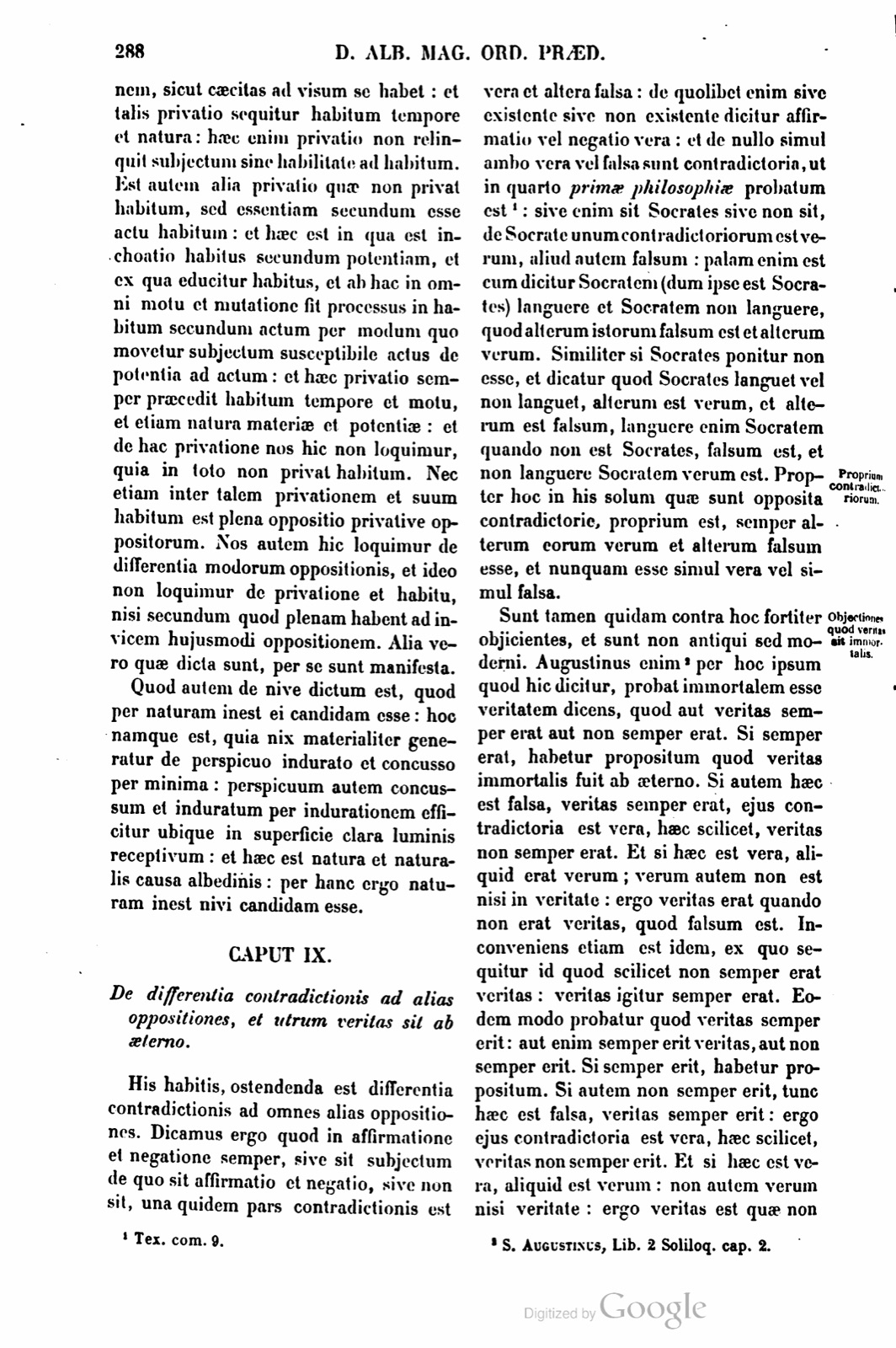
Quod autem diximus ex pravo fieri studiosum si a principio propter exercitationes in bonis actibus incrementum incipiat, propter Socratem et Platonem dictum est, qui dixerunt virtutem secundum quam homo studiosus est, nec discibile, nec assuescibile bonum esse, sed virtutem esse donum deorum immortalium: assuetudine autem et doctrina hominem parari ad virtutem, eo quod dii non juvant inertes et pigros, sed seipsos extendentes et parantes ad virtutem.
Adhuc autem quod dictum est, a privatione in habitum regressum non posse fieri, intelligendum hoc quod est dictum de privatione quæ privat et habitum et subjecti ad habitum aptitudinem, sive quæ privat principia per quæ subjectum habitudinem habet ad habitus susceptionem,
But what we have said, that from a depraved man a virtuous man comes to be if from the beginning, on account of exercises in good acts, increase begins, was said on account of Socrates and Plato, who said that virtue, according to which a man is virtuous, is neither a learnable nor habituable good, but that virtue is a gift of the immortal gods; but that by habituation and teaching a man is prepared for virtue, because the gods do not help the inactive and slothful, but those extending themselves and preparing themselves for virtue.
Further, that which has been said, that return from privation into habit cannot come to be, must be understood, this which has been said, concerning the privation which deprives both the habit and the aptitude of the subject for the habit, or which deprives the principles through which the subject has aptitude for the reception of habit,
If a page does not appear, its photograph has not been uploaded yet.