Volume 1 · pp. 284–286
Chapter VII
A marker with ≈ is an approximate page boundary, placed by measure of the text; the page photographs remain the authority. In the paired views, clicking a page marker brings that page into view.
referantur eamdem affirmatio et negatio, et ad eumdem intellectum componentem et dividentem, et quod observetur in sermone identitas significandi in affirmatione et negatione: quia res est causa, intellectus autem componens et dividens, et sermo signum compositionis et divisionis.
Attendendum autem quod diffinientes affirmationem et negationem, utuntur genere remoto dicentes, quod affirmatio est oratio affirmativa, et non dicentes quod est enuntiatio: quia volentes ostendere quod affirmatio et negatio opposita sunt, melius ostenditur ex genere quod est oratio, quia hoc commune est utrique, affirmationi scilicet et negationi: enuntiatio autem species est orationis, et proprie loquendo nihil enuntiatur in enuntiatione negativa, sed potius negatur in enuntiatione aliquid de aliquo: et quod enuntiatum est in affirmatione, negatur in negatione.
Adhuc notandum quod cum dicitur, affirmatio est oratio affirmativa, ponitur affirmatio pro specie enuntiationis sive propositionis cujus genus est oratio. Cum autem subjungitur affirmativa, ponitur affirmatio pro qualitate propositionis quæ ad quale informat et denominat orationem.
Et si dicat aliquis, quod aliæ orationum sunt affirmativæ, Dicendum quod non sunt: quia non affirmant verum vel falsum. Unde cum dicitur, utinam non moriar, non est negatum aliquid, sed optatum est de non moriendo. Similiter etiam cum dicitur, non fac hoc, vel non facias aliquid aliud, nihil negatur, sed imperium vel præceptum est de non faciendo. Et idem est in affirmativis, cum dicitur, fac hoc, vel utinam facias: hoc enim nihil est dictum, sed præceptum vel optatum de aliquo fiendo vel faciendo: et in talibus non proprie est affirmatio vel negatio, sicut dictum est, quia si insit per modum affirmationis vel negationis, totum significat affectum mentis, qui per modum verbi importatur quod ponitur in oratione.
that the same affirmation and negation be referred to the thing, and to the same intellect composing and dividing, and that identity of signifying be observed in speech in affirmation and negation, because the thing is the cause, but the intellect is composing and dividing, and speech is the sign of composition and division.
But one must attend that those defining affirmation and negation use a remote genus, saying that affirmation is affirmative speech, and not saying that it is enunciation; because, wishing to show that affirmation and negation are opposites, it is shown better from the genus which is speech, because this is common to each, namely to affirmation and negation. But enunciation is a species of speech, and properly speaking nothing is enunciated in a negative enunciation, but rather something is denied of something in an enunciation; and what is enunciated in affirmation is denied in negation.
Further it must be noted that when it is said, affirmation is affirmative speech, affirmation is posited for a species of enunciation or proposition, whose genus is speech. But when affirmative is added, affirmation is posited for the quality of the proposition which informs and denominates the speech as to quale.
And if someone says that other kinds of speeches are affirmative, it must be said that they are not, because they do not affirm the true or the false. Hence when it is said, would that I not die, something is not denied, but it is wished concerning not dying. Similarly also when it is said, do not do this, or may you not do something else, nothing is denied, but there is a command or precept concerning not doing. And it is the same in affirmatives, when it is said, do this, or would that you do it; for this is not something said, but a precept or something wished concerning something coming to be or being done. And in such things there is not properly affirmation or negation, as has been said, because if it is present through the mode of affirmation or negation, the whole signifies the affection of the mind, which is carried through the mode of the verb which is posited in the speech.
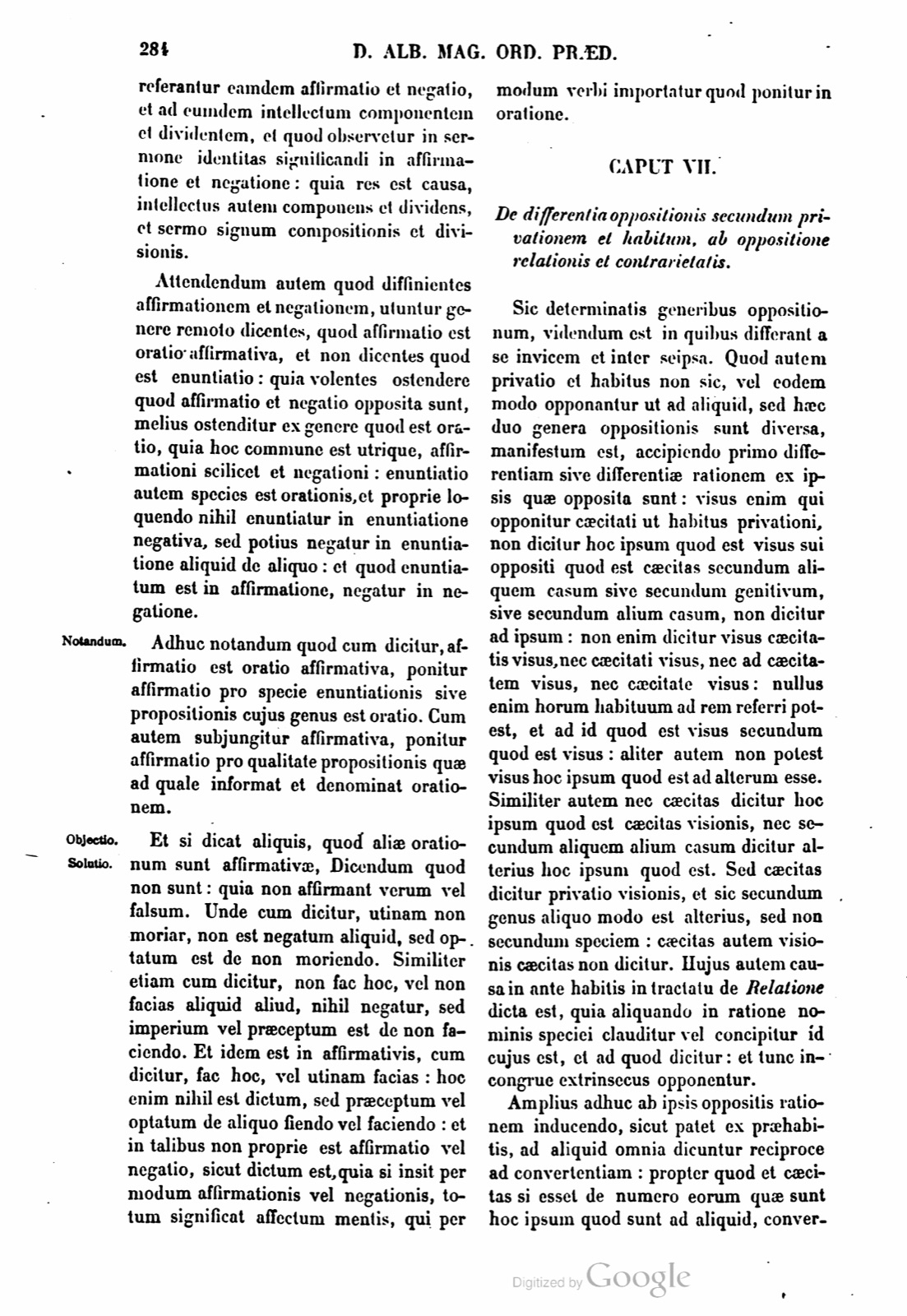
CAPUT VII.
De differentia oppositionis secundum privationem et habitum, ab oppositione relationis et contrarietatis.
Sic determinatis generibus oppositionum, videndum est in quibus differant a se invicem et inter seipsa. Quod autem privatio et habitus non sic, vel eodem modo opponantur ut ad aliquid, sed hæc duo genera oppositionis sunt diversa, manifestum est, accipiendo primo differentiam sive differentiæ rationem ex ipsis quæ opposita sunt: visus enim qui opponitur cæcitati ut habitus privationi, non dicitur hoc ipsum quod est visus sui oppositi quod est cæcitas secundum aliquem casum sive secundum genitivum, sive secundum alium casum, non dicitur ad ipsum: non enim dicitur visus cæcitatis visus, nec cæcitati visus, nec ad cæcitatem visus, nec cæcitate visus: nullus enim horum habituum ad rem referri potest, et ad id quod est visus secundum quod est visus: aliter autem non potest visus hoc ipsum quod est ad alterum esse. Similiter autem nec cæcitas dicitur hoc ipsum quod est cæcitas visionis, nec secundum aliquem alium casum dicitur alterius hoc ipsum quod est. Sed cæcitas dicitur privatio visionis, et sic secundum genus aliquo modo est alterius, sed non secundum speciem: cæcitas autem visionis cæcitas non dicitur. Hujus autem causa in ante habitis in tractatu de Relatione dicta est, quia aliquando in ratione nominis speciei clauditur vel concipitur id cujus est, et ad quod dicitur: et tunc incongrue extrinsecus opponentur.
Amplius adhuc ab ipsis oppositis rationem inducendo, sicut patet ex præhabitis, ad aliquid omnia dicuntur reciproce ad convertentiam: propter quod et cæcitas si esset de numero eorum quæ sunt hoc ipsum quod sunt ad aliquid, converteretur
CHAPTER VII.
Concerning the difference of opposition according to privation and habit from the opposition of relation and of contrariety.
With the genera of oppositions thus determined, it must be seen in which things they differ from one another and among themselves. But that privation and habit are not thus, or in the same mode, opposed as toward something, but that these two genera of opposition are diverse, is manifest by first taking the difference or the account of the difference from the things themselves which are opposed. For sight, which is opposed to blindness as habit to privation, is not called this very thing which it is, sight of its opposite which is blindness, according to some case or according to the genitive, or according to another case; it is not said toward it. For it is not said sight of blindness, nor sight to blindness, nor sight toward blindness, nor sight by blindness; for none of these habits can be referred to the thing and to that which sight is according as it is sight. But otherwise sight cannot be this very thing which it is, to be toward another. Similarly, blindness also is not said to be this very thing which it is, blindness of vision, nor according to some other case is it said to be this very thing which it is of another. But blindness is called privation of vision, and thus according to genus in some way it is of another, but not according to species; for blindness is not called blindness of vision. But the cause of this was stated among the things had before in the treatise on Relation, because sometimes in the account of the name of a species that of which it is and toward which it is said is enclosed or conceived, and then they will be opposed externally in an incongruous way.
Further, still by inducing an account from the opposed things themselves, as is clear from the things had before, all things toward something are said reciprocally toward convertence; on account of which also blindness, if it were of the number of those things which are toward something as this very thing which they are, would be converted
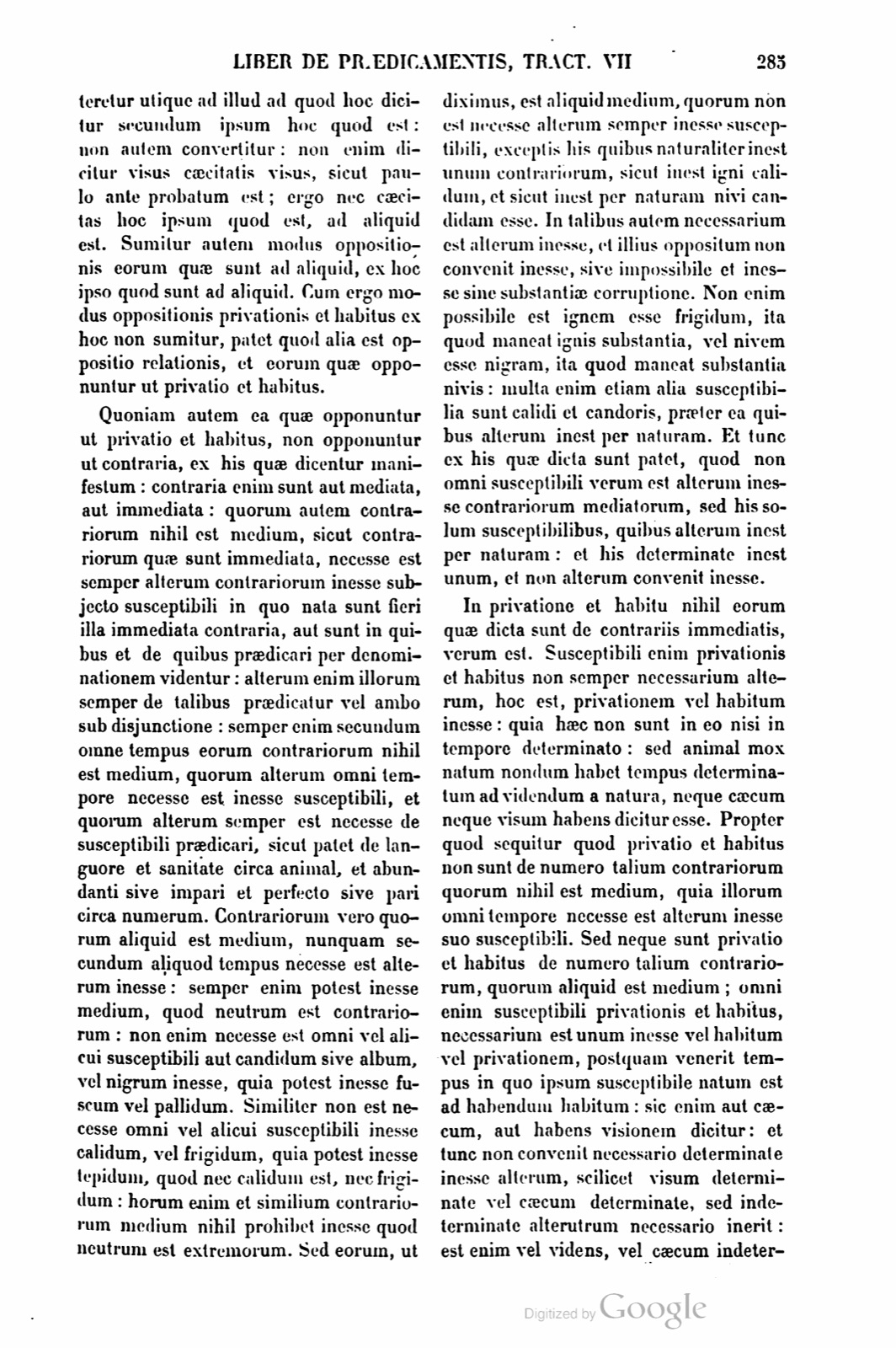
utique ad illud ad quod hoc dicitur secundum ipsum hoc quod est: non autem convertitur: non enim dicitur visus cæcitatis visus, sicut paulo ante probatum est; ergo nec cæcitas hoc ipsum quod est, ad aliquid est. Sumitur autem modus oppositionis eorum quæ sunt ad aliquid, ex hoc ipso quod sunt ad aliquid. Cum ergo modus oppositionis privationis et habitus ex hoc non sumitur, patet quod alia est oppositio relationis, et eorum quæ opponuntur ut privatio et habitus.
Quoniam autem ea quæ opponuntur ut privatio et habitus, non opponuntur ut contraria, ex his quæ dicentur manifestum: contraria enim sunt aut mediata, aut immediata: quorum autem contrariorum nihil est medium, sicut contrariorum quæ sunt immediata, necesse est semper alterum contrariorum inesse subjecto susceptibili in quo nata sunt fieri illa immediata contraria, aut sunt in quibus et de quibus prædicari per denominationem videntur: alterum enim illorum semper de talibus prædicatur vel ambo sub disjunctione: semper enim secundum omne tempus eorum contrariorum nihil est medium, quorum alterum omni tempore necesse est inesse susceptibili, et quorum alterum semper est necesse de susceptibili prædicari, sicut patet de languore et sanitate circa animal, et abundanti sive impari et perfecto sive pari circa numerum. Contrariorum vero quorum aliquid est medium, nunquam secundum aliquod tempus necesse est alterum inesse: semper enim potest inesse medium, quod neutrum est contrariorum: non enim necesse est omni vel alicui susceptibili aut candidum sive album, vel nigrum inesse, quia potest inesse fuscum vel pallidum. Similiter non est necesse omni vel alicui susceptibili inesse calidum, vel frigidum, quia potest inesse tepidum, quod nec calidum est, nec frigidum: horum enim et similium contrariorum medium nihil prohibet inesse quod neutrum est extremorum. Sed eorum, ut diximus, est aliquid medium, quorum non est necesse alterum semper inesse susceptibili, exceptis his quibus naturaliter inest unum contrariorum, sicut inest igni calidum, et sicut inest per naturam nivi candidam esse. In talibus autem necessarium est alterum inesse, et illius oppositum non convenit inesse, sive impossibile et inesse sine substantiæ corruptione. Non enim possibile est ignem esse frigidum, ita quod maneat ignis substantia, vel nivem esse nigram, ita quod maneat substantia nivis: multa enim etiam alia susceptibilia sunt calidi et candoris, præter ea quibus alterum inest per naturam. Et tunc ex his quæ dicta sunt patet, quod non omni susceptibili verum est alterum inesse contrariorum mediatorum, sed his solum susceptibilibus, quibus alterum inest per naturam: et his determinate inest unum, et non alterum convenit inesse.
indeed to that to which this is said according to this very thing which it is; but it is not converted, for sight of blindness is not said to be sight, as was proved a little before. Therefore neither is blindness, this very thing which it is, toward something. But the mode of opposition of those things which are toward something is taken from this very thing, that they are toward something. Therefore since the mode of opposition of privation and habit is not taken from this, it is clear that the opposition of relation is other than the opposition of those things which are opposed as privation and habit.
But because those things which are opposed as privation and habit are not opposed as contraries, it is manifest from the things which will be said. For contraries are either mediate or immediate; but of contraries of which there is no mean, as of contraries which are immediate, one of the contraries must always be in the susceptible subject in which those immediate contraries are naturally apt to come to be, or they are in things in which and of which they seem to be predicated by denomination. For one of them is always predicated of such things, or both under disjunction. For always according to every time there is no mean of those contraries of which one at every time must be in the susceptible, and of which one must always be predicated of the susceptible, as is clear concerning sickness and health about animal, and concerning abundant or odd and perfect or even about number. But of contraries of which there is some mean, it is never necessary according to some time that one be in it; for a mean can always be in it which is neither of the contraries. For it is not necessary that either bright or white, or black, be in every or some susceptible, because dusky or pale can be in it. Similarly it is not necessary that hot or cold be in every or some susceptible, because tepid can be in it, which is neither hot nor cold. For nothing prevents the mean of these and similar contraries from being in it, which is neither of the extremes. But of those, as we have said, there is some mean of which it is not necessary that one always be in the susceptible, except in these things in which one of the contraries is naturally present, as hot is present in fire and as to be white is present in snow by nature. But in such things it is necessary that one be present, and the opposite of that one is not fitting to be present, or is impossible both to be present without the corruption of the substance. For it is not possible for fire to be cold in such a way that the substance of fire remains, or for snow to be black in such a way that the substance of snow remains; for there are many other susceptibles also of hot and whiteness, besides those in which one is present by nature. And then from the things which have been said it is clear that it is not true of every susceptible that one of mediated contraries is present, but only of those susceptibles in which one is present by nature; and in these one is present determinately, and the other is not fitting to be present.
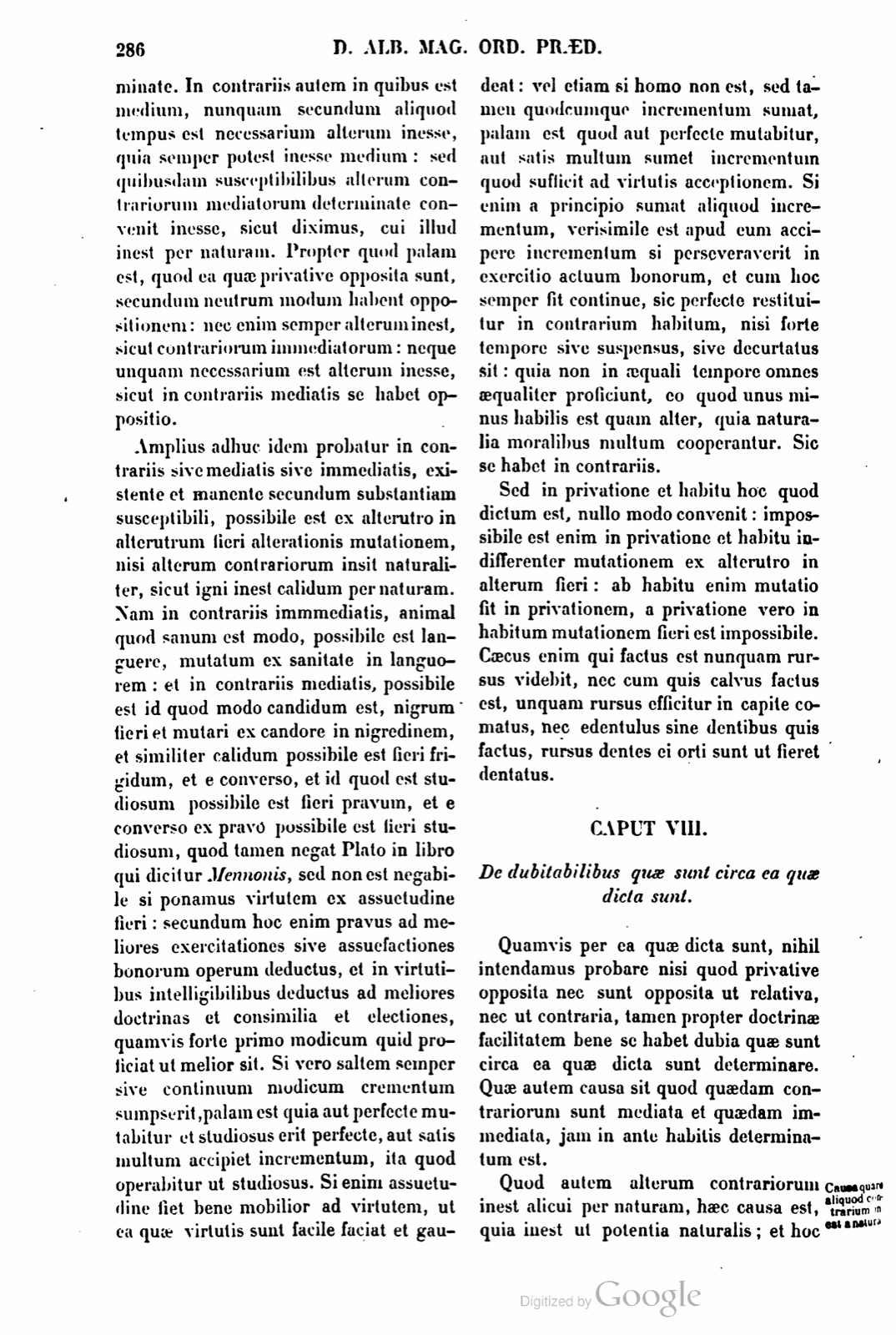
In privatione et habitu nihil eorum quæ dicta sunt de contrariis immediatis, verum est. Susceptibili enim privationis et habitus non semper necessarium alterum, hoc est, privationem vel habitum inesse: quia hæc non sunt in eo nisi in tempore determinato: sed animal mox natum nondum habet tempus determinatum ad videndum a natura, neque cæcum neque visum habens dicitur esse. Propter quod sequitur quod privatio et habitus non sunt de numero talium contrariorum quorum nihil est medium, quia illorum omni tempore necesse est alterum inesse suo susceptibili. Sed neque sunt privatio et habitus de numero talium contrariorum, quorum aliquid est medium; omni enim susceptibili privationis et habitus, necessarium est unum inesse vel habitum vel privationem, postquam venerit tempus in quo ipsum susceptibile natum est ad habendum habitum: sic enim aut cæcum, aut habens visionem dicitur: et tunc non convenit necessario determinate inesse alterum, scilicet visum determinate vel cæcum determinate, sed indeterminate alterutrum necessario inerit: est enim vel videns, vel cæcum indeterminate.
In privation and habit none of the things which have been said about immediate contraries is true. For it is not always necessary for one, that is, privation or habit, to be in the susceptible of privation and habit, because these are not in it except at a determined time; but an animal soon after birth does not yet have the time determined by nature for seeing, nor is it said to be blind or having sight. On account of this it follows that privation and habit are not of the number of such contraries of which there is no mean, because in those, at every time, one must be in its susceptible. But neither are privation and habit of the number of such contraries of which there is some mean; for in every susceptible of privation and habit it is necessary for one to be present, either habit or privation, after the time has come in which the susceptible itself is naturally apt for having the habit. For thus it is said either to be blind or having vision; and then it is not fitting that one necessarily be present determinately, namely sight determinately or blind determinately, but indeterminately one or the other will necessarily be present: for it is either seeing or blind indeterminately.
If a page does not appear, its photograph has not been uploaded yet.