Volume 1 · pp. 282–283
Chapter VI
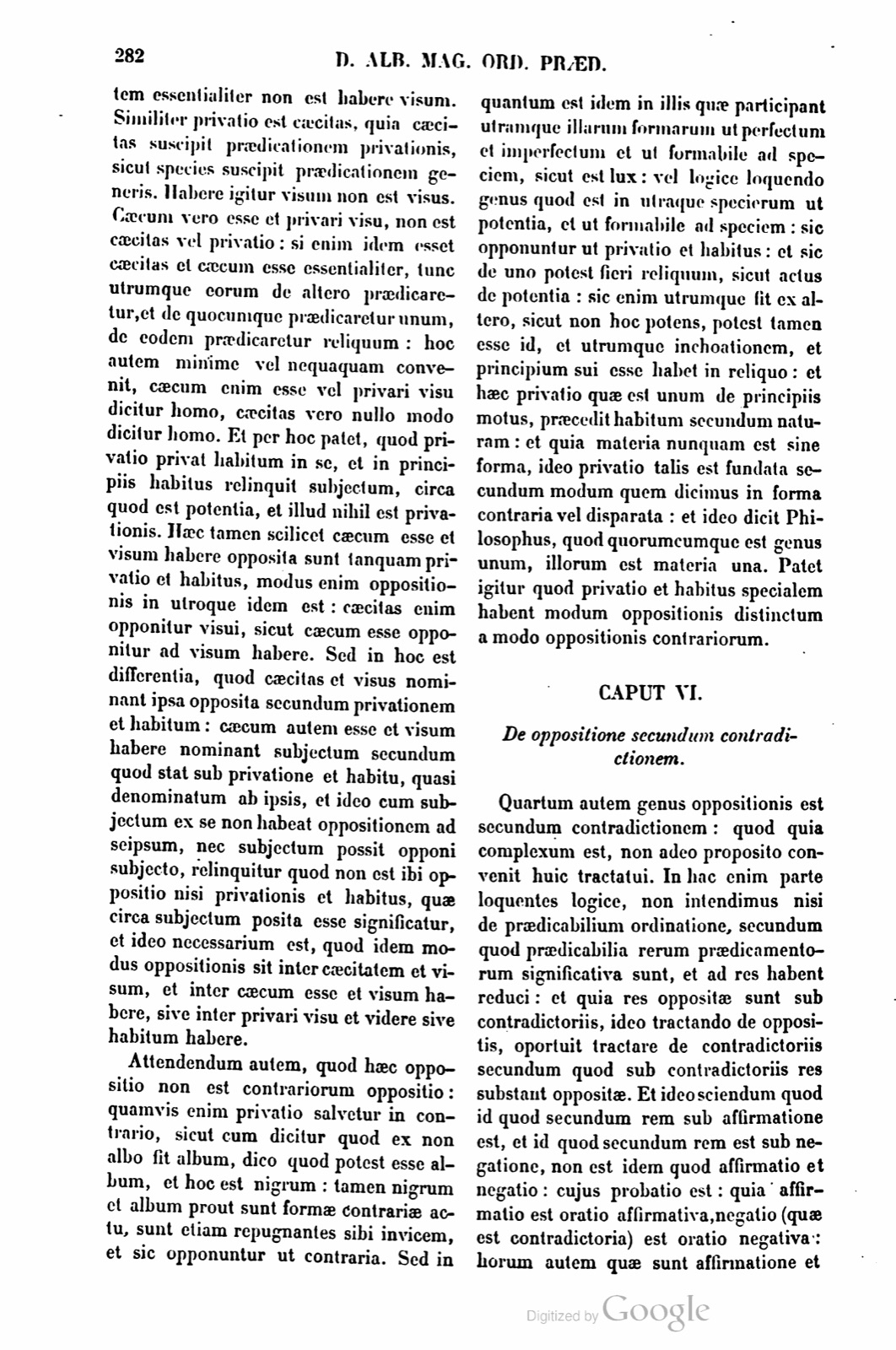
essentialiter non est habere visum. Similiter privatio est cæcitas, quia cæcitas suscipit prædicationem privationis, sicut species suscipit prædicationem generis. Habere igitur visum non est visus. Cæcum vero esse et privari visu, non est cæcitas vel privatio: si enim idem esset cæcitas et cæcum esse essentialiter, tunc utrumque eorum de altero prædicaretur, et de quocumque prædicaretur unum, de eodem prædicaretur reliquum: hoc autem minime vel nequaquam convenit, cæcum enim esse vel privari visu dicitur homo, cæcitas vero nullo modo dicitur homo. Et per hoc patet, quod privatio privat habitum in se, et in principiis habitus relinquit subjectum, circa quod est potentia, et illud nihil est privationis. Hæc tamen scilicet cæcum esse et visum habere opposita sunt tanquam privatio et habitus, modus enim oppositionis in utroque idem est: cæcitas enim opponitur visui, sicut cæcum esse opponitur ad visum habere. Sed in hoc est differentia, quod cæcitas et visus nominant ipsa opposita secundum privationem et habitum: cæcum autem esse et visum habere nominant subjectum secundum quod stat sub privatione et habitu, quasi denominatum ab ipsis, et ideo cum subjectum ex se non habeat oppositionem ad seipsum, nec subjectum possit opponi subjecto, relinquitur quod non est ibi oppositio nisi privationis et habitus, quæ circa subjectum posita esse significatur, et ideo necessarium est, quod idem modus oppositionis sit inter cæcitatem et visum, et inter cæcum esse et visum habere, sive inter privari visu et videre sive habitum habere.
Attendendum autem, quod hæc oppositio non est contrariorum oppositio: quamvis enim privatio salvetur in contrario, sicut cum dicitur quod ex non albo fit album, dico quod potest esse album, et hoc est nigrum: tamen nigrum et album prout sunt formæ contrariæ actu, sunt etiam repugnantes sibi invicem, et sic opponuntur ut contraria. Sed in quantum est idem in illis quæ participant utrumque illarum formarum ut perfectum et imperfectum et ut formabile ad speciem, sicut est lux: vel logice loquendo genus quod est in utraque specierum ut potentia, et ut formabile ad speciem: sic opponuntur ut privatio et habitus: et sic de uno potest fieri reliquum, sicut actus de potentia: sic enim utrumque fit ex altero, sicut non hoc potens, potest tamen esse id, et utrumque inchoationem, et principium sui esse habet in reliquo: et hæc privatio quæ est unum de principiis motus, præcedit habitum secundum naturam: et quia materia numquam est sine forma, ideo privatio talis est fundata secundum modum quem dicimus in forma contraria vel disparata: et ideo dicit Philosophus, quod quorumcumque est genus unum, illorum est materia una. Patet igitur quod privatio et habitus specialem habent modum oppositionis distinctum a modo oppositionis contrariorum.
CAPUT VI.
De oppositione secundum contradictionem.
Quartum autem genus oppositionis est secundum contradictionem: quod quia complexum est, non adeo proposito convenit huic tractatui. In hac enim parte loquentes logice, non intendimus nisi de prædicabilium ordinatione, secundum quod prædicabilia rerum prædicamentorum significativa sunt, et ad res habent reduci: et quia res oppositæ sunt sub contradictoriis, ideo tractando de oppositis, oportuit tractare de contradictoriis secundum quod sub contradictoriis res substant oppositæ. Et ideo sciendum quod id quod secundum rem sub affirmatione est, et id quod secundum rem est sub negatione, non est idem quod affirmatio et negatio: cujus probatio est: quia affirmatio est oratio affirmativa, negatio (quæ est contradictoria) est oratio negativa: horum autem quæ sunt affirmatione et
essentially is not to have sight. Similarly privation is blindness, because blindness receives the predication of privation, just as a species receives the predication of genus. Therefore to have sight is not sight. But to be blind and to be deprived of sight is not blindness or privation; for if blindness and to be blind were essentially the same, then each of them would be predicated of the other, and of whatever one would be predicated, of the same the remaining one would be predicated. But this in the least or in no way agrees; for to be blind or to be deprived of sight is said of man, but blindness in no way is said of man. And through this it is clear that privation deprives the habit in itself, and in the principles of the habit it leaves the subject, concerning which there is potency, and that is nothing of privation. Nevertheless these, namely to be blind and to have sight, are opposed as privation and habit, for the mode of opposition in each is the same: for blindness is opposed to sight just as to be blind is opposed to having sight. But the difference is in this, that blindness and sight name the opposites themselves according to privation and habit; but to be blind and to have sight name the subject according as it stands under privation and habit, as denominated by them. And therefore, since the subject from itself does not have opposition to itself, nor can subject be opposed to subject, it remains that there is no opposition there except of privation and habit, which is signified to be posited concerning the subject; and therefore it is necessary that the same mode of opposition be between blindness and sight, and between to be blind and to have sight, or between to be deprived of sight and to see or to have the habit.
But it must be attended to that this opposition is not the opposition of contraries. For although privation is saved in a contrary, as when it is said that from non-white white comes to be, I say that it can be white, and this is black; nevertheless black and white according as they are contrary forms in act are also repugnant to one another, and thus they are opposed as contraries. But insofar as there is the same in those things which participate each of those forms as perfect and imperfect and as formable to species, as light is; or, speaking logically, genus which is in each of the species as potency and as formable to species; thus they are opposed as privation and habit, and thus from one the remaining one can come to be, as act from potency. For thus each comes to be from the other, just as what is not able to be this nevertheless can be that, and each has the beginning and principle of its being in the remaining one; and this privation, which is one of the principles of motion, precedes habit according to nature. And because matter is never without form, therefore such privation is founded according to the mode which we speak of in a contrary or disparate form; and therefore the Philosopher says that of whatever things there is one genus, of those there is one matter. Therefore it is clear that privation and habit have a special mode of opposition distinct from the mode of opposition of contraries.
CHAPTER VI.
Concerning opposition according to contradiction.
But the fourth genus of opposition is according to contradiction; because this is complex, it does not so much fit the proposal of this treatise. For in this part, speaking logically, we intend only concerning the ordering of predicables, according as predicables are significative of things of the predicaments and have to be reduced to things; and because opposed things are under contradictories, therefore in treating of opposites it was necessary to treat of contradictories according as opposed things stand under contradictories. And therefore one must know that that which according to the thing is under affirmation, and that which according to the thing is under negation, is not the same as affirmation and negation. The proof of this is because affirmation is an affirmative speech, negation, which is contradictory, is negative speech; but of those things which are by affirmation and
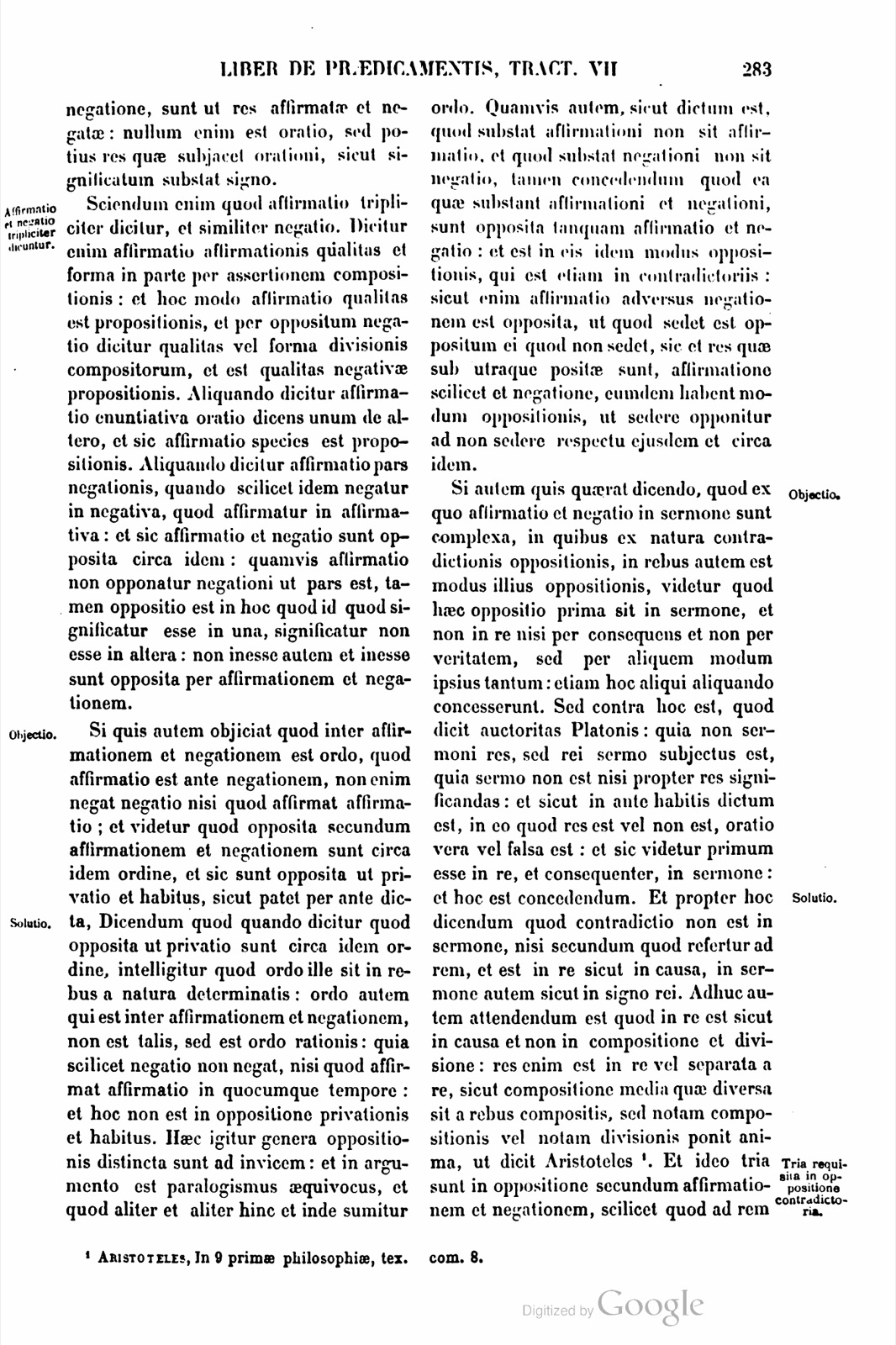
negatione, sunt ut res affirmatæ et negatæ: nullum enim est oratio, sed potius res quæ subjacet orationi, sicut significatum substat signo.
Sciendum enim quod affirmatio tripliciter dicitur, et similiter negatio. Dicitur enim affirmatio affirmationis qualitas et forma in parte per assertionem compositionis: et hoc modo affirmatio qualitas est propositionis, et per oppositum negatio dicitur qualitas vel forma divisionis compositorum, et est qualitas negativæ propositionis. Aliquando dicitur affirmatio enuntiativa oratio dicens unum de altero, et sic affirmatio species est propositionis. Aliquando dicitur affirmatio pars negationis, quando scilicet idem negatur in negativa, quod affirmatur in affirmativa: et sic affirmatio et negatio sunt opposita circa idem: quamvis affirmatio non opponatur negationi ut pars est, tamen oppositio est in hoc quod id quod significatur esse in una, significatur non esse in altera: non inesse autem et inesse sunt opposita per affirmationem et negationem.
Si quis autem objiciat quod inter affirmationem et negationem est ordo, quod affirmatio est ante negationem, non enim negat negatio nisi quod affirmat affirmatio; et videtur quod opposita secundum affirmationem et negationem sunt circa idem ordine, et sic sunt opposita ut privatio et habitus, sicut patet per ante dicta, Dicendum quod quando dicitur quod opposita ut privatio sunt circa idem ordine, intelligitur quod ordo ille sit in rebus a natura determinatis: ordo autem qui est inter affirmationem et negationem, non est talis, sed est ordo rationis: quia scilicet negatio non negat, nisi quod affirmat affirmatio in quocumque tempore: et hoc non est in oppositione privationis et habitus. Hæc igitur genera oppositionis distincta sunt ad invicem: et in argumento est paralogismus æquivocus, et quod aliter et aliter hinc et inde sumitur ordo. Quamvis autem, sicut dictum est, quod substat affirmationi non sit affirmatio, et quod substat negationi non sit negatio, tamen concedendum quod ea quæ substant affirmationi et negationi, sunt opposita tanquam affirmatio et negatio: et est in eis idem modus oppositionis, qui est etiam in contradictoriis: sicut enim affirmatio adversus negationem est opposita, ut quod sedet est oppositum ei quod non sedet, sic et res quæ sub utraque positæ sunt, affirmatione scilicet et negatione, eumdem habent modum oppositionis, ut sedere opponitur ad non sedere respectu ejusdem et circa idem.
Si autem quis quærat dicendo, quod ex quo affirmatio et negatio in sermone sunt complexa, in quibus ex natura contradictionis oppositionis, in rebus autem est modus illius oppositionis, videtur quod hæc oppositio prima sit in sermone, et non in re nisi per consequens et non per veritatem, sed per aliquem modum ipsius tantum: etiam hoc aliqui aliquando concesserunt. Sed contra hoc est, quod dicit auctoritas Platonis: quia non sermoni res, sed rei sermo subjectus est, quia sermo non est nisi propter res significandas: et sicut in ante habitis dictum est, in eo quod res est vel non est, oratio vera vel falsa est: et sic videtur primum esse in re, et consequenter, in sermone: et hoc est concedendum. Et propter hoc dicendum quod contradictio non est in sermone, nisi secundum quod refertur ad rem, et est in re sicut in causa, in sermone autem sicut in signo rei. Adhuc autem attendendum est quod in re est sicut in causa et non in compositione et divisione: res enim est in re vel separata a re, sicut compositione media quæ diversa sit a rebus compositis, sed notam compositionis vel notam divisionis ponit anima, ut dicit Aristoteles 1. Et ideo tria sunt in oppositione secundum affirmationem et negationem, scilicet quod ad rem
negation are as affirmed and denied things; for none of these is speech, but rather the thing which underlies speech, as what is signified stands under the sign.
For one must know that affirmation is said in three ways, and similarly negation. For affirmation is called the quality and form of affirmation in a part through assertion of composition; and in this mode affirmation is the quality of a proposition, and by the opposite negation is called the quality or form of the division of composed things, and is the quality of a negative proposition. Sometimes affirmation is called an enunciative speech saying one thing of another, and thus affirmation is a species of proposition. Sometimes affirmation is called a part of negation, namely when the same thing is denied in the negative which is affirmed in the affirmative; and thus affirmation and negation are opposites concerning the same thing. Although affirmation is not opposed to negation insofar as it is a part, nevertheless opposition is in this, that what is signified to be in one is signified not to be in the other; but not to be in and to be in are opposed through affirmation and negation.
But if someone objects that between affirmation and negation there is order, because affirmation is before negation, for negation does not deny except what affirmation affirms; and it seems that opposites according to affirmation and negation are concerning the same thing in order, and thus are opposites as privation and habit, as is clear through the things said before. It must be said that when it is said that opposites as privation are concerning the same thing in order, it is understood that that order is in things determined by nature; but the order which is between affirmation and negation is not such, but is an order of reason, namely because negation does not deny except what affirmation affirms at whatever time; and this is not in the opposition of privation and habit. Therefore these genera of opposition are distinct from one another; and in the argument there is an equivocal paralogism, and order is taken differently and differently from here and from there. But although, as has been said, what stands under affirmation is not affirmation, and what stands under negation is not negation, nevertheless it must be conceded that the things which stand under affirmation and negation are opposites as affirmation and negation; and in them there is the same mode of opposition which is also in contradictories. For just as affirmation is opposed against negation, as that which sits is opposed to that which does not sit, so also the things which are posited under each, namely affirmation and negation, have the same mode of opposition, as to sit is opposed to not to sit with respect to the same thing and concerning the same thing.
But if someone asks by saying that, since affirmation and negation in speech are complex, in which things there is opposition from the nature of contradiction, but in things there is the mode of that opposition, it seems that this opposition is first in speech, and not in the thing except consequently and not through truth, but only through some mode of it. Some also sometimes have conceded this. But against this is what the authority of Plato says: that the thing is not subjected to speech, but speech to the thing, because speech exists only on account of things to be signified; and, as was said among the things had before, in that the thing is or is not, speech is true or false; and thus it seems that the first is in the thing, and consequently in speech; and this must be conceded. And on account of this one must say that contradiction is not in speech except according as it is referred to the thing, and it is in the thing as in a cause, but in speech as in a sign of the thing. Further, one must attend that in the thing it is as in a cause and not in composition and division; for the thing is in the thing or separated from the thing, as by a mediating composition which may be diverse from the composed things, but the soul posits the mark of composition or the mark of division, as Aristotle says 1. And therefore there are three things in opposition according to affirmation and negation, namely that they be referred to the thing
Notes
- Aristotle, in book IX of First Philosophy, text commentary 8. (Aristoteles, In 9 primæ philosophiæ, tex. com. 8.) ↩
If a page does not appear, its photograph has not been uploaded yet.