Volume 1 · pp. 280–282
Chapter V
A marker with ≈ is an approximate page boundary, placed by measure of the text; the page photographs remain the authority. In the paired views, clicking a page marker brings that page into view.
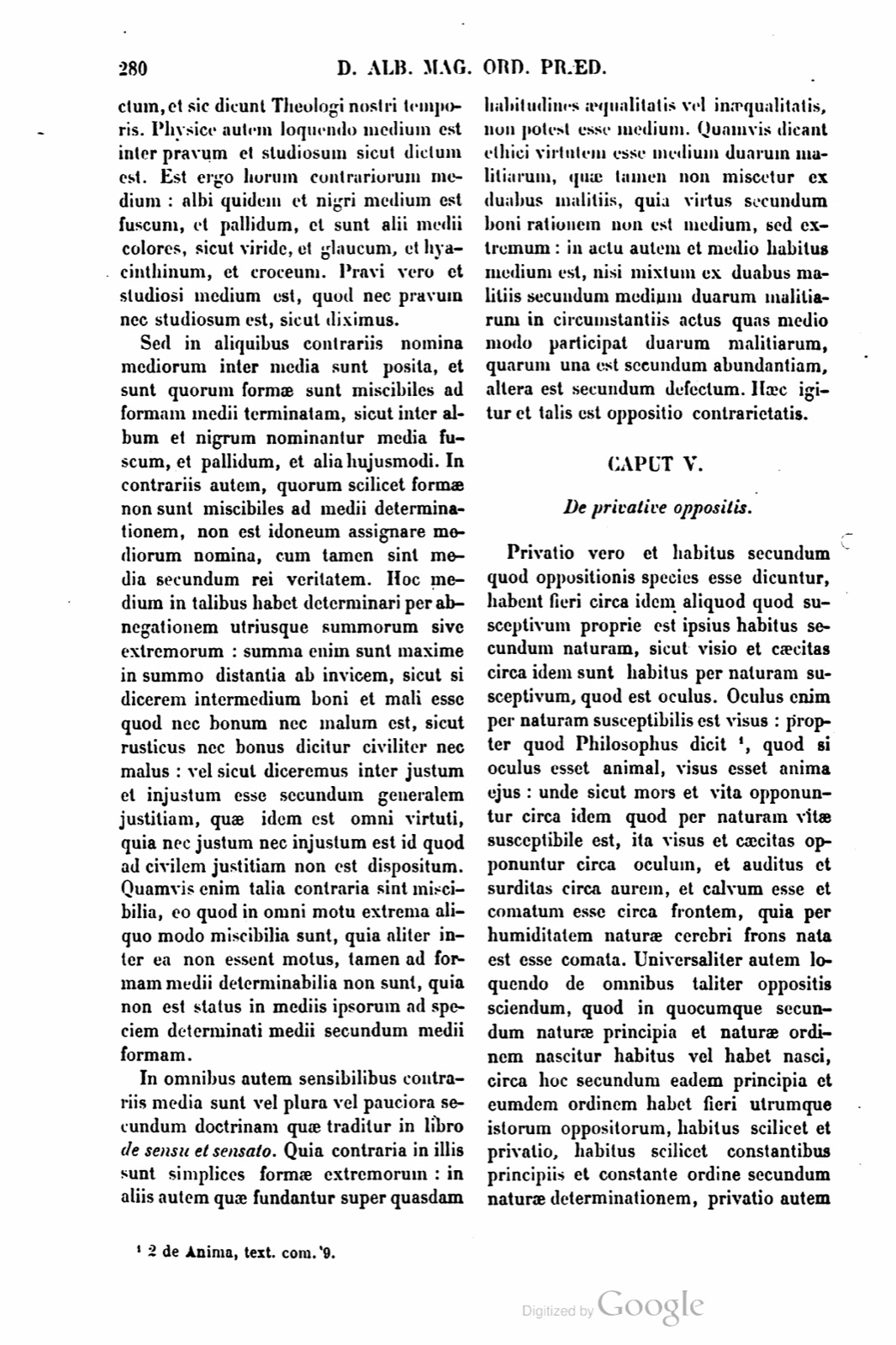
et sic dicunt Theologi nostri temporis. Physice autem loquendo medium est inter pravum et studiosum sicut dictum est. Est ergo horum contrariorum medium: albi quidem et nigri medium est fuscum, et pallidum, et sunt alii medii colores, sicut viride, et glaucum, et hyacinthinum, et croceum. Pravi vero et studiosi medium est, quod nec pravum nec studiosum est, sicut diximus.
Sed in aliquibus contrariis nomina mediorum inter media sunt posita, et sunt quorum formæ sunt miscibiles ad formam medii terminatam, sicut inter album et nigrum nominantur media fuscum, et pallidum, et alia hujusmodi. In contrariis autem, quorum scilicet formæ non sunt miscibiles ad medii determinationem, non est idoneum assignare mediorum nomina, cum tamen sint media secundum rei veritatem. Hoc medium in talibus habet determinari per abnegationem utriusque summorum sive extremorum: summa enim sunt maxime in summo distantia ab invicem, sicut si dicerem intermedium boni et mali esse quod nec bonum nec malum est, sicut rusticus nec bonus dicitur civiliter nec malus: vel sicut diceremus inter justum et injustum esse secundum generalem justitiam, quæ idem est omni virtuti, quia nec justum nec injustum est id quod ad civilem justitiam non est dispositum. Quamvis enim talia contraria sint miscibilia, eo quod in omni motu extrema aliquo modo miscibilia sunt, quia aliter inter ea non essent motus, tamen ad formam medii determinabilia non sunt, quia non est status in mediis ipsorum ad speciem determinati medii secundum medii formam.
In omnibus autem sensibilibus contrariis media sunt vel plura vel pauciora secundum doctrinam quæ traditur in libro de sensu et sensato. Quia contraria in illis sunt simplices formæ extremorum: in aliis autem quæ fundantur super quasdam habitudines æqualitatis vel inæqualitatis, non potest esse medium. Quamvis dicant ethici virtutem esse medium duarum malitiarum, quæ tamen non miscetur ex duabus malitiis, quia virtus secundum boni rationem non est medium, sed extremum: in actu autem et medio habitus medium est, nisi mixtum ex duabus malitiis secundum medium duarum malitiarum in circumstantiis actus quas medio modo participat duarum malitiarum, quarum una est secundum abundantiam, altera est secundum defectum. Hæc igitur et talis est oppositio contrarietatis.
CAPUT V.
De privative oppositis.
Privatio vero et habitus secundum quod oppositionis species esse dicuntur, habent fieri circa idem aliquid quod susceptivum proprie est ipsius habitus secundum naturam, sicut visio et cæcitas circa idem sunt habitus per naturam susceptivum, quod est oculus. Oculus enim per naturam susceptibilis est visus: propter quod Philosophus dicit 1, quod si oculus esset animal, visus esset anima ejus: unde sicut mors et vita opponuntur circa idem quod per naturam vitæ susceptibile est, ita visus et cæcitas opponuntur circa oculum, et auditus et surditas circa aurem, et calvum esse et comatum esse circa frontem, quia per humiditatem naturæ cerebri frons nata est esse comata. Universaliter autem loquendo de omnibus taliter oppositis sciendum, quod in quocumque secundum naturæ principia et naturæ ordinem nascitur habitus vel habet nasci, circa hoc secundum eadem principia et eumdem ordinem habet fieri utrumque istorum oppositorum, habitus scilicet et privatio, habitus scilicet constantibus principiis et constante ordine secundum naturæ determinationem, privatio autem
and thus the theologians of our time speak. But speaking physically, there is a mean between depraved and virtuous, as has been said. Therefore there is a mean of these contraries: indeed the mean of white and black is dusky and pale, and there are other intermediate colors, as green, bluish-gray, hyacinthine, and saffron-yellow. But the mean of depraved and virtuous is what is neither depraved nor virtuous, as we have said.
But in some contraries the names of means are posited among the means, and they are those whose forms are mixable toward the bounded form of a mean, as between white and black the means dusky and pale and other things of this kind are named. But in contraries whose forms, namely, are not mixable toward the determination of a mean, it is not suitable to assign names of means, although nevertheless there are means according to the truth of the thing. This mean in such things has to be determined through denial of each of the highest things or extremes; for the highest things are those most greatly distant in the highest degree from one another, as if I were to say that the intermediate of good and evil is what is neither good nor evil, as the rustic is said to be neither good civilly nor evil; or as if we were to say that there is between just and unjust according to general justice, which is the same as every virtue, because what is not disposed to civil justice is neither just nor unjust. For although such contraries are mixable, because in every motion the extremes are in some way mixable, because otherwise there would not be motions between them, nevertheless they are not determinable to the form of a mean, because there is no standing in their means toward the species of a determinate mean according to the form of the mean.
But in all sensible contraries there are either more or fewer means according to the teaching which is handed down in the book On Sense and the Sensible. Because contraries in those are simple forms of the extremes; but in other things which are founded upon certain relations of equality or inequality, there cannot be a mean. Although ethicists say that virtue is a mean of two vices, which nevertheless is not mixed from two vices, because virtue according to the account of good is not a mean, but an extreme; but in act and in the middle of habit it is a mean, unless mixed from two vices according to the mean of two vices in the circumstances of the act, which it participates in an intermediate mode from two vices, of which one is according to abundance, the other according to defect. Therefore this, and such, is the opposition of contrariety.
CHAPTER V.
Concerning privatively opposed things.
But privation and habit, according as they are said to be a species of opposition, have to come to be concerning the same something which properly is susceptible by nature of the habit itself, as sight and blindness are concerning the same thing susceptible by nature of habit, which is the eye. For the eye by nature is susceptible of sight; on account of which the Philosopher says 1 that if the eye were an animal, sight would be its soul. Whence just as death and life are opposed concerning the same thing which by nature is susceptible of life, so sight and blindness are opposed concerning the eye, and hearing and deafness concerning the ear, and to be bald and to be hairy concerning the forehead, because through the humidity of the nature of the brain the forehead is naturally apt to be hairy. But universally speaking concerning all things opposed in such a way, one must know that in whatever thing, according to the principles of nature and the order of nature, a habit is born or has to be born, concerning this according to the same principles and the same order each of these opposites has to come to be, namely habit and privation: habit, namely, with the principles standing and with the order standing according to the determination of nature, but privation
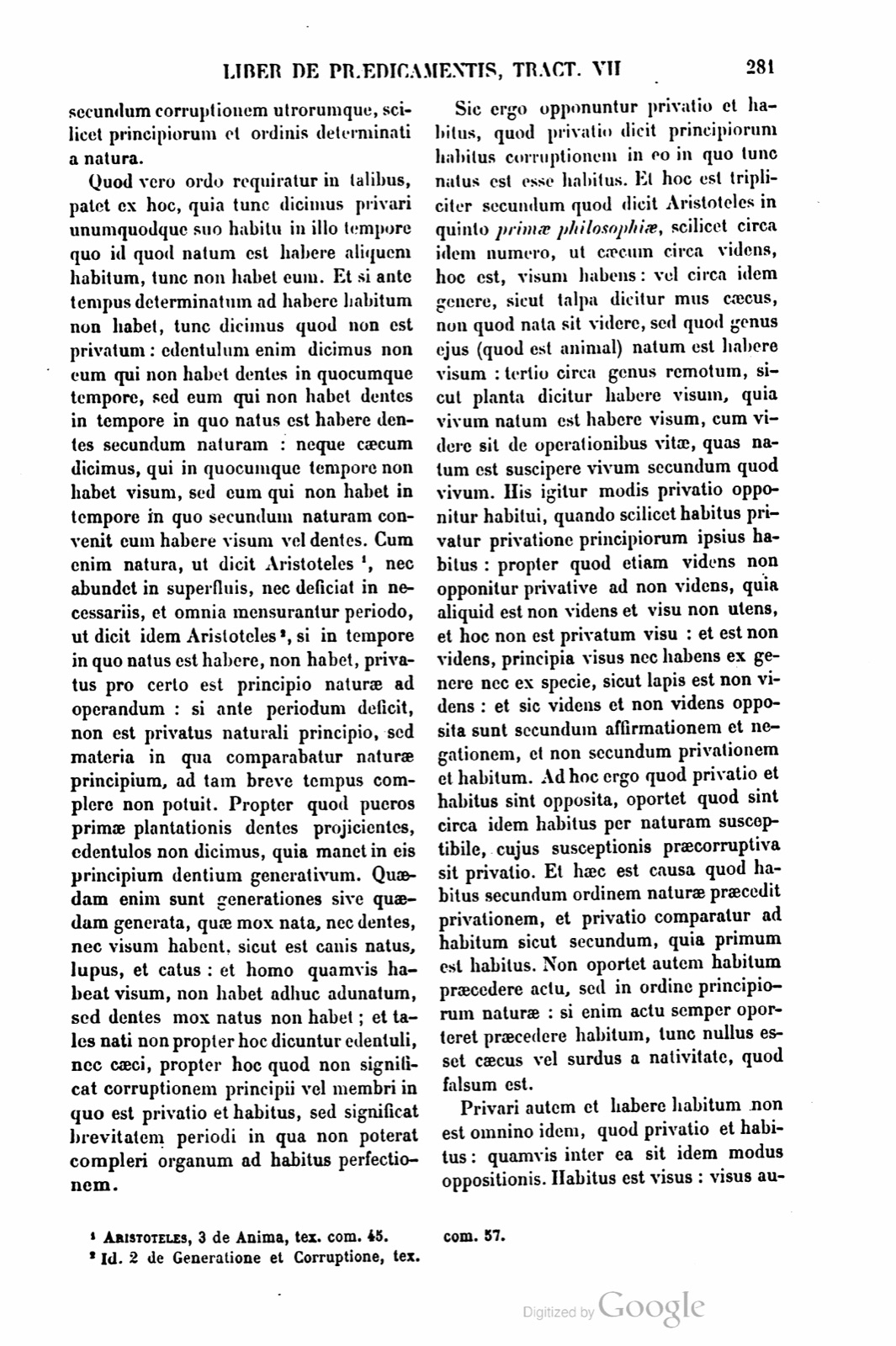
secundum corruptionem utrorumque, scilicet principiorum et ordinis determinati a natura.
Quod vero ordo requiratur in talibus, patet ex hoc, quia tunc dicimus privari unumquodque suo habitu in illo tempore quo id quod natum est habere aliquem habitum, tunc non habet eum. Et si ante tempus determinatum ad habere habitum non habet, tunc dicimus quod non est privatum: edentulum enim dicimus non eum qui non habet dentes in quocumque tempore, sed eum qui non habet dentes in tempore in quo natus est habere dentes secundum naturam: neque cæcum dicimus, qui in quocumque tempore non habet visum, sed eum qui non habet in tempore in quo secundum naturam convenit eum habere visum vel dentes. Cum enim natura, ut dicit Aristoteles 2, nec abundet in superfluis, nec deficiat in necessariis, et omnia mensurantur periodo, ut dicit idem Aristoteles 3, si in tempore in quo natus est habere, non habet, privatus pro certo est principio naturæ ad operandum: si ante periodum deficit, non est privatus naturali principio, sed materia in qua comparabatur naturæ principium, ad tam breve tempus complere non potuit. Propter quod pueros primæ plantationis dentes projicientes, edentulos non dicimus, quia manet in eis principium dentium generativum. Quædam enim sunt generationes sive quædam generata, quæ mox nata, nec dentes, nec visum habent, sicut est canis natus, lupus, et catus: et homo quamvis habeat visum, non habet adhuc adunatum, sed dentes mox natus non habet; et tales nati non propter hoc dicuntur edentuli, nec cæci, propter hoc quod non significat corruptionem principii vel membri in quo est privatio et habitus, sed significat brevitatem periodi in qua non poterat compleri organum ad habitus perfectionem.
Sic ergo opponuntur privatio et habitus, quod privatio dicit principiorum habitus corruptionem in eo in quo tunc natus est esse habitus. Et hoc est tripliciter secundum quod dicit Aristoteles in quinto primæ philosophiæ, scilicet circa idem numero, ut cæcum circa videns, hoc est, visum habens: vel circa idem genere, sicut talpa dicitur mus cæcus, non quod nata sit videre, sed quod genus ejus (quod est animal) natum est habere visum: tertio circa genus remotum, sicut planta dicitur habere visum, quia vivum natum est habere visum, cum videre sit de operationibus vitæ, quas natum est suscipere vivum secundum quod vivum. His igitur modis privatio opponitur habitui, quando scilicet habitus privatur privatione principiorum ipsius habitus: propter quod etiam videns non opponitur privative ad non videns, quia aliquid est non videns et visu non utens, et hoc non est privatum visu: et est non videns, principia visus nec habens ex genere nec ex specie, sicut lapis est non videns: et sic videns et non videns opposita sunt secundum affirmationem et negationem, et non secundum privationem et habitum. Ad hoc ergo quod privatio et habitus sint opposita, oportet quod sint circa idem habitus per naturam susceptibile, cujus susceptionis præcorruptiva sit privatio. Et hæc est causa quod habitus secundum ordinem naturæ præcedit privationem, et privatio comparatur ad habitum sicut secundum, quia primum est habitus. Non oportet autem habitum præcedere actu, sed in ordine principiorum naturæ: si enim actu semper oporteret præcedere habitum, tunc nullus esset cæcus vel surdus a nativitate, quod falsum est.
according to the corruption of each, namely of the principles and of the order determined by nature.
But that order is required in such things is clear from this, because then we say that each thing is deprived of its habit in that time in which that which is naturally apt to have some habit then does not have it. And if before the determined time for having the habit it does not have it, then we say that it is not deprived. For we do not call toothless one who does not have teeth at whatever time, but one who does not have teeth in the time in which he is naturally apt to have teeth according to nature; nor do we call blind one who at whatever time does not have sight, but one who does not have it in the time in which according to nature it is fitting for him to have sight or teeth. For since nature, as Aristotle says 2, neither abounds in superfluous things nor is deficient in necessary things, and all things are measured by a period, as the same Aristotle says 3, if in the time in which it is naturally apt to have, it does not have, it is certainly deprived of the principle of nature for operating; if it is deficient before the period, it is not deprived of a natural principle, but the matter in which the principle of nature was being compared could not complete itself in so brief a time. On account of this we do not call toothless children of first planting who are casting forth teeth, because the generative principle of teeth remains in them. For there are certain generations or certain generated things which, soon after birth, have neither teeth nor sight, as a dog born, a wolf, and a cat; and man, although he has sight, does not yet have it united, but soon after birth he does not have teeth; and such born things are not on account of this called toothless, nor blind, on account of this, that it does not signify corruption of the principle or member in which there is privation and habit, but signifies the shortness of the period in which the organ could not be completed for the perfection of the habit.
Thus therefore privation and habit are opposed, because privation says the corruption of the principles of the habit in that in which the habit then is naturally apt to be. And this is in three ways according as Aristotle says in the fifth book of First Philosophy, namely concerning the same in number, as blind concerning seeing, that is, having sight; or concerning the same in genus, as the mole is called a blind mouse, not because it is naturally apt to see, but because its genus, which is animal, is naturally apt to have sight; third concerning a remote genus, as a plant is said to have sight, because the living thing is naturally apt to have sight, since to see is among the operations of life, which the living thing according as living is naturally apt to receive. Therefore in these modes privation is opposed to habit, namely when the habit is deprived by privation of the principles of that habit; on account of which also seeing is not opposed privatively to non-seeing, because something is non-seeing and not using sight, and this is not deprived of sight; and something is non-seeing, having the principles of sight neither from genus nor from species, as a stone is non-seeing; and thus seeing and non-seeing are opposed according to affirmation and negation, and not according to privation and habit. Therefore in order that privation and habit may be opposites, they must be concerning the same thing susceptible by nature of the habit, of whose susceptibility privation is precorruptive. And this is the cause that habit according to the order of nature precedes privation, and privation is compared to habit as second, because habit is first. But habit need not precede in act, but in the order of the principles of nature; for if habit always had to precede in act, then no one would be blind or deaf from birth, which is false.
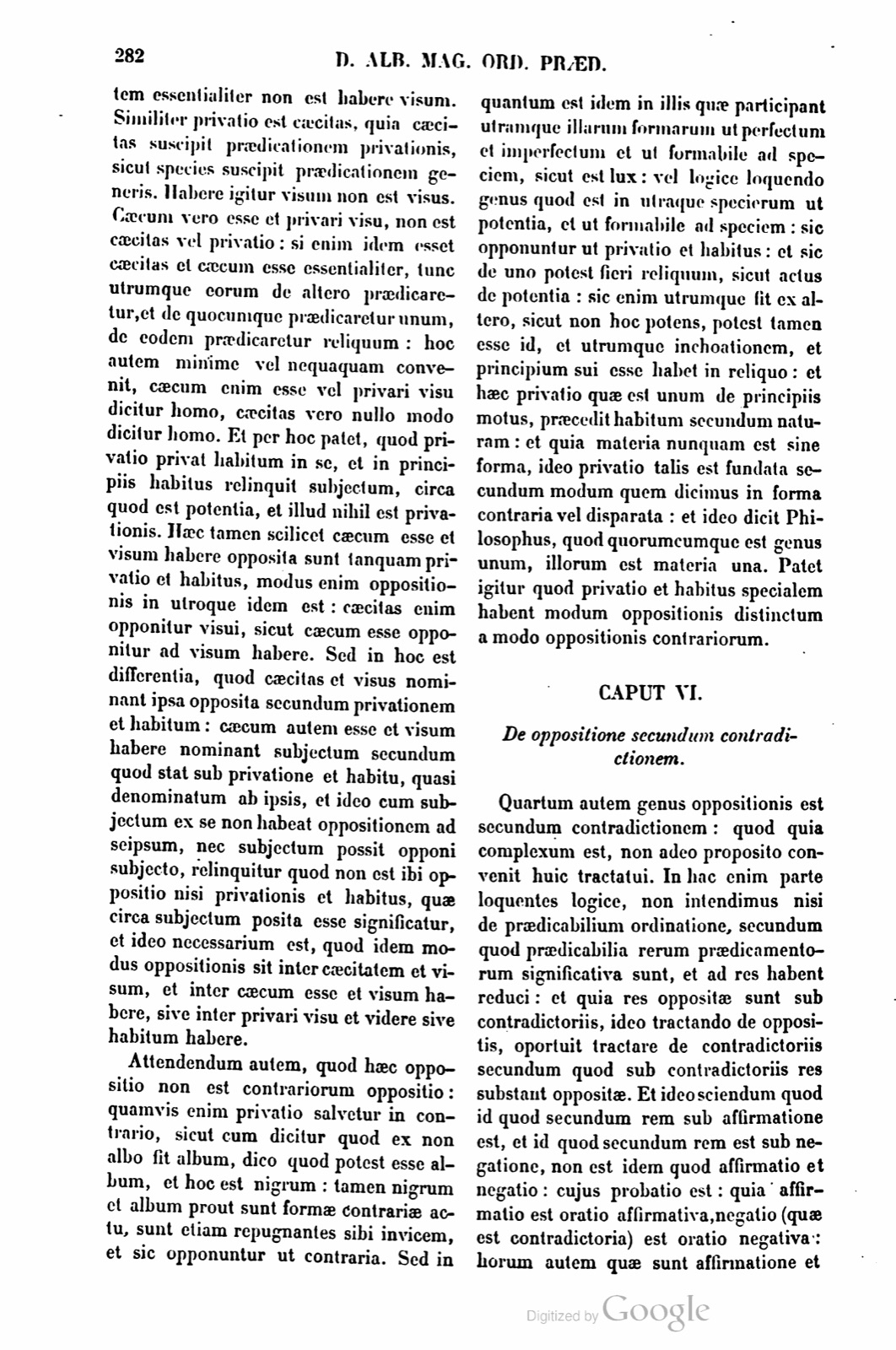
Privari autem et habere habitum non est omnino idem, quod privatio et habitus: quamvis inter ea sit idem modus oppositionis. Habitus est visus: visus autem
But to be deprived and to have a habit is not altogether the same as privation and habit, although between them there is the same mode of opposition. Habit is sight; but sight
If a page does not appear, its photograph has not been uploaded yet.