Volume 1 · pp. 278–280
Chapter IV. Concerning contraries, or concerning the opposition of contrariety.
A marker with ≈ is an approximate page boundary, placed by measure of the text; the page photographs remain the authority. In the paired views, clicking a page marker brings that page into view.
CAPUT IV.
De contrariis, sive de oppositione contrarietatis.
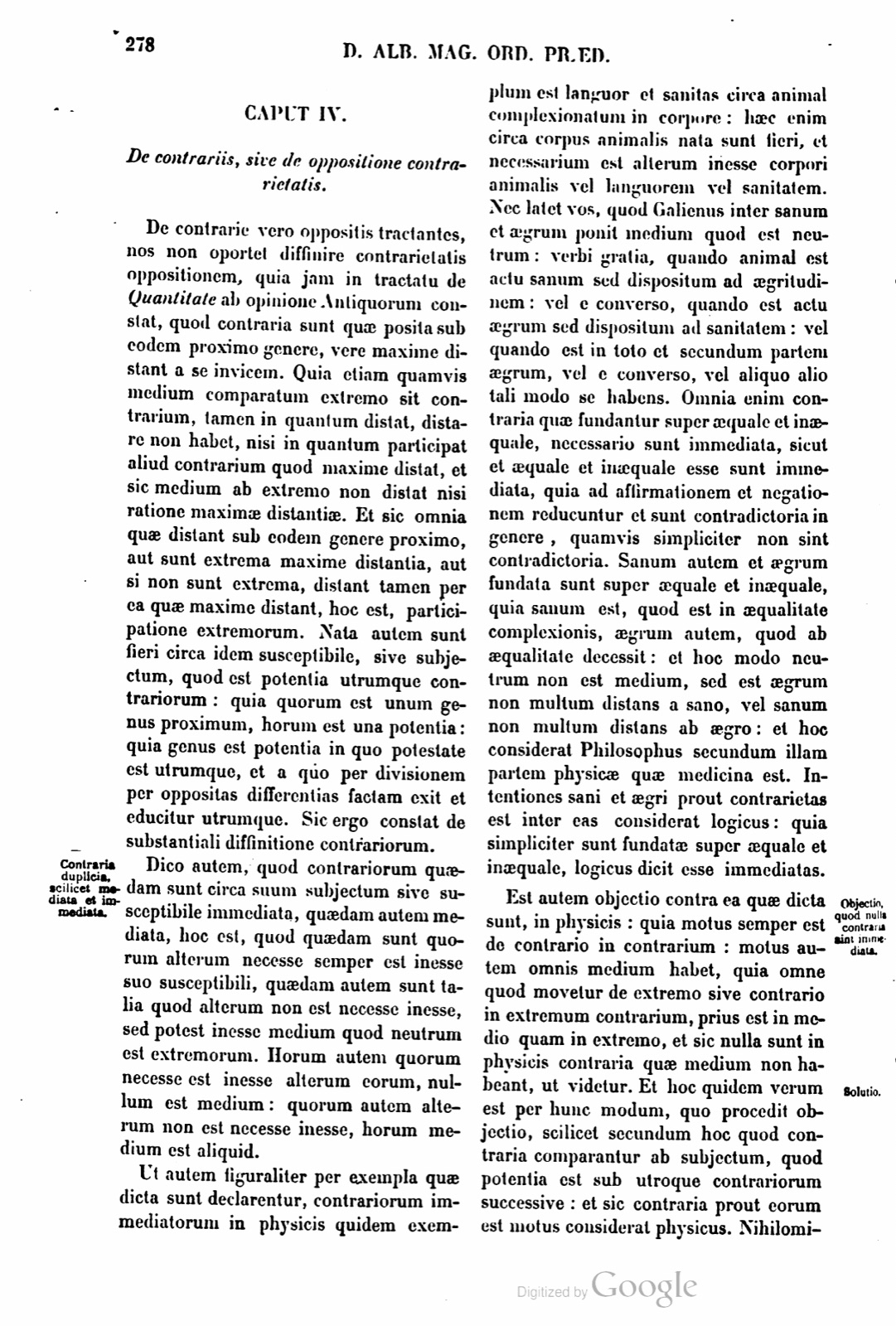
De contrarie vero oppositis tractantes, nos non oportet diffinire contrarietatis oppositionem, quia jam in tractatu de Quantitate ab opinione Antiquorum constat, quod contraria sunt quæ posita sub eodem proximo genere, vere maxime distant a se invicem. Quia etiam quamvis medium comparatum extremo sit contrarium, tamen in quantum distat, distare non habet, nisi in quantum participat aliud contrarium quod maxime distat, et sic medium ab extremo non distat nisi ratione maximæ distantiæ. Et sic omnia quæ distant sub eodem genere proximo, aut sunt extrema maxime distantia, aut si non sunt extrema, distant tamen per ea quæ maxime distant, hoc est, participatione extremorum. Nata autem sunt fieri circa idem susceptibile, sive subjectum, quod est potentia utrumque contrariorum: quia quorum est unum genus proximum, horum est una potentia: quia genus est potentia in quo potestate est utrumque, et a quo per divisionem per oppositas differentias factam exit et educitur utrumque. Sic ergo constat de substantiali diffinitione contrariorum.
Dico autem, quod contrariorum quædam sunt circa suum subjectum sive susceptibile immediata, quædam autem mediata, hoc est, quod quædam sunt quorum alterum necesse semper est inesse suo susceptibili, quædam autem sunt talia quod alterum non est necesse inesse, sed potest inesse medium quod neutrum est extremorum. Horum autem quorum necesse est inesse alterum eorum, nullum est medium: quorum autem alterum non est necesse inesse, horum medium est aliquid.
Ut autem figuraliter per exempla quæ dicta sunt declarentur, contrariorum immediatorum in physicis quidem exemplum est languor et sanitas circa animal complexionatum in corpore: hæc enim circa corpus animalis nata sunt fieri, et necessarium est alterum inesse corpori animalis vel languorem vel sanitatem. Nec latet vos, quod Galienus inter sanum et ægrum ponit medium quod est neutrum: verbi gratia, quando animal est actu sanum sed dispositum ad ægritudinem: vel e converso, quando est actu ægrum sed dispositum ad sanitatem: vel quando est in toto et secundum partem ægrum, vel e converso, vel aliquo alio tali modo se habens. Omnia enim contraria quæ fundantur super æquale et inæquale, necessario sunt immediata, sicut et æquale et inæquale esse sunt immediata, quia ad affirmationem et negationem reducuntur et sunt contradictoria in genere, quamvis simpliciter non sint contradictoria. Sanum autem et ægrum fundata sunt super æquale et inæquale, quia sanum est, quod est in æqualitate complexionis, ægrum autem, quod ab æqualitate decessit: et hoc modo neutrum non est medium, sed est ægrum non multum distans a sano, vel sanum non multum distans ab ægro: et hoc considerat Philosophus secundum illam partem physicæ quæ medicina est. Intentiones sani et ægri prout contrarietas est inter eas considerat logicus: quia simpliciter sunt fundatæ super æquale et inæquale, logicus dicit esse immediatas.
CHAPTER IV.
Concerning contraries, or concerning the opposition of contrariety.
But treating of contrarily opposed things, it is not necessary for us to define the opposition of contrariety, because already in the treatise on Quantity, from the opinion of the Ancients, it is established that contraries are those things which, posited under the same proximate genus, truly are most greatly distant from one another. For also although a mean compared to an extreme is contrary, nevertheless insofar as it is distant, it does not have to be distant except insofar as it participates another contrary which is most greatly distant; and thus a mean is not distant from an extreme except by reason of the greatest distance. And thus all things which are distant under the same proximate genus either are extremes most greatly distant, or if they are not extremes, nevertheless they are distant through those things which are most greatly distant, that is, by participation of the extremes. But they are naturally apt to come to be concerning the same susceptible or subject, which is potentially each of the contraries, because of those things of which there is one proximate genus, there is one potency, because genus is potency in which each is in power, and from which through division made through opposed differences each goes forth and is drawn out. Thus therefore it is established concerning the substantial definition of contraries.
But I say that some contraries are immediate concerning their subject or susceptible, but some are mediate; that is, some are those of which one must always be in its susceptible, but some are such that one does not have to be in it, but a mean can be in it which is neither of the extremes. Of those, however, of which it is necessary that one of them be in it, there is no mean; but of those of which one does not have to be in it, there is some mean.
But so that the things which have been said may be declared figuratively through examples, of immediate contraries in physics indeed an example is sickness and health concerning an animal with a complexion in body. For these are naturally apt to come to be concerning the body of an animal, and it is necessary that one be in the body of an animal, either sickness or health. Nor is it hidden from you that Galen posits between the healthy and the sick a mean which is neither; for example, when an animal is healthy in act but disposed to sickness, or conversely, when it is sick in act but disposed to health, or when it is sick in whole and according to part, or conversely, or having itself in some other such mode. For all contraries which are founded upon equal and unequal are necessarily immediate, just as equal and unequal being are immediate, because they are reduced to affirmation and negation and are contradictories in genus, although simply they are not contradictories. But healthy and sick are founded upon equal and unequal, because healthy is what is in equality of complexion, but sick is what has departed from equality; and in this way neither is not a mean, but is sick not much distant from healthy, or healthy not much distant from sick. And the Philosopher considers this according to that part of physics which is medicine. The logician considers the intentions of healthy and sick according as contrariety is between them, because they are simply founded upon equal and unequal; the logician says that they are immediate.
Est autem objectio contra ea quæ dicta sunt, in physicis: quia motus semper est de contrario in contrarium: motus autem omnis medium habet, quia omne quod movetur de extremo sive contrario in extremum contrarium, prius est in medio quam in extremo, et sic nulla sunt in physicis contraria quæ medium non habeant, ut videtur. Et hoc quidem verum est per hunc modum, quo procedit objectio, scilicet secundum hoc quod contraria comparantur ad subjectum, quod potentia est sub utroque contrariorum successive: et sic contraria prout eorum est motus considerat physicus. Nihilominus
But there is an objection against the things which have been said, in physics: because motion is always from contrary into contrary; but every motion has a mean, because everything which is moved from an extreme or contrary into a contrary extreme is first in the middle than in the extreme, and thus in physics there are no contraries which do not have a mean, as it seems. And this indeed is true according to this mode in which the objection proceeds, namely according to this, that contraries are compared to a subject which is in potency successively under each of the contraries; and thus the physicist considers contraries according as motion belongs to them. Nevertheless
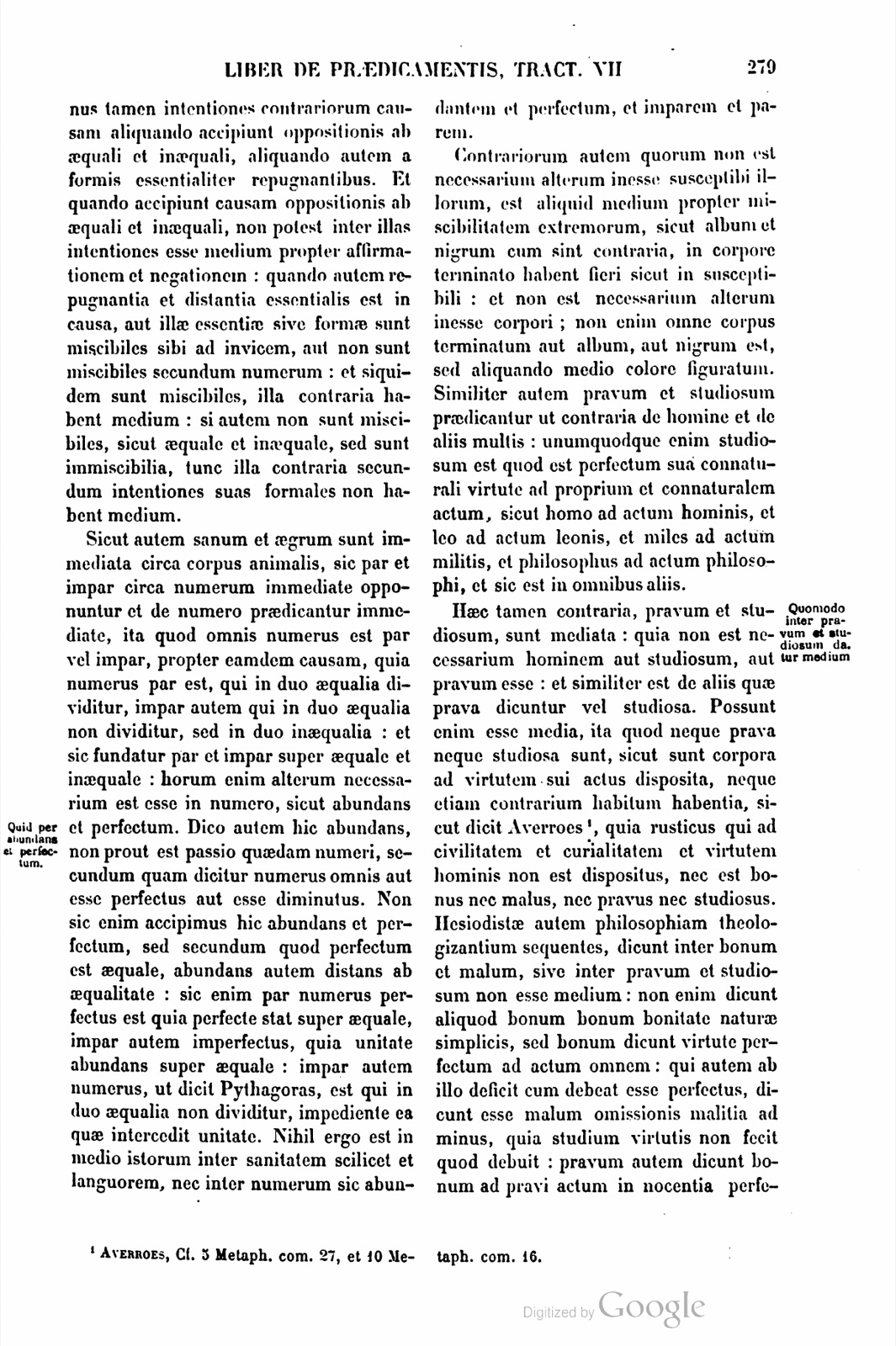
tamen intentiones contrariorum causam aliquando accipiunt oppositionis ab æquali et inæquali, aliquando autem a formis essentialiter repugnantibus. Et quando accipiunt causam oppositionis ab æquali et inæquali, non potest inter illas intentiones esse medium propter affirmationem et negationem: quando autem repugnantia et distantia essentialis est in causa, aut illæ essentiæ sive formæ sunt miscibiles sibi ad invicem, aut non sunt miscibiles secundum numerum: et siquidem sunt miscibiles, illa contraria habent medium: si autem non sunt miscibiles, sicut æquale et inæquale, sed sunt immiscibilia, tunc illa contraria secundum intentiones suas formales non habent medium.
Sicut autem sanum et ægrum sunt immediata circa corpus animalis, sic par et impar circa numerum immediate opponuntur et de numero prædicantur immediate, ita quod omnis numerus est par vel impar, propter eamdem causam, quia numerus par est, qui in duo æqualia dividitur, impar autem qui in duo æqualia non dividitur, sed in duo inæqualia: et sic fundatur par et impar super æquale et inæquale: horum enim alterum necessarium est esse in numero, sicut abundans et perfectum. Dico autem hic abundans, non prout est passio quædam numeri, secundum quam dicitur numerus omnis aut esse perfectus aut esse diminutus. Non sic enim accipimus hic abundans et perfectum, sed secundum quod perfectum est æquale, abundans autem distans ab æqualitate: sic enim par numerus perfectus est quia perfecte stat super æquale, impar autem imperfectus, quia unitate abundans super æquale: impar autem numerus, ut dicit Pythagoras, est qui in duo æqualia non dividitur, impediente ea quæ intercedit unitate. Nihil ergo est in medio istorum inter sanitatem scilicet et languorem, nec inter numerum sic abundantem et perfectum, et imparem et parem.
nevertheless the intentions of contraries sometimes take the cause of opposition from equal and unequal, but sometimes from forms essentially repugnant. And when they take the cause of opposition from equal and unequal, there cannot be a mean between those intentions on account of affirmation and negation; but when repugnance and essential distance is in the cause, either those essences or forms are mixable with one another, or they are not mixable according to number; and if indeed they are mixable, those contraries have a mean; but if they are not mixable, as equal and unequal, but are unmixable, then those contraries according to their formal intentions do not have a mean.
But just as healthy and sick are immediate concerning the body of an animal, so even and odd concerning number are immediately opposed and are predicated immediately of number, so that every number is even or odd, on account of the same cause, because an even number is one which is divided into two equal things, but an odd one is one which is not divided into two equal things, but into two unequal things; and thus even and odd are founded upon equal and unequal; for one of these must necessarily be in number, as abundant and perfect. But I say abundant here not as it is a certain passion of number, according to which every number is said either to be perfect or to be diminished. For we do not take abundant and perfect here in this way, but according as perfect is equal, but abundant is distant from equality: for thus an even number is perfect because it stands perfectly upon the equal, but an odd number is imperfect because it is abundant by unity over the equal. But an odd number, as Pythagoras says, is one which is not divided into two equal things, the unity which intervenes preventing it. Therefore there is nothing in the middle of these, namely between health and sickness, nor between number thus abundant and perfect, and odd and even.
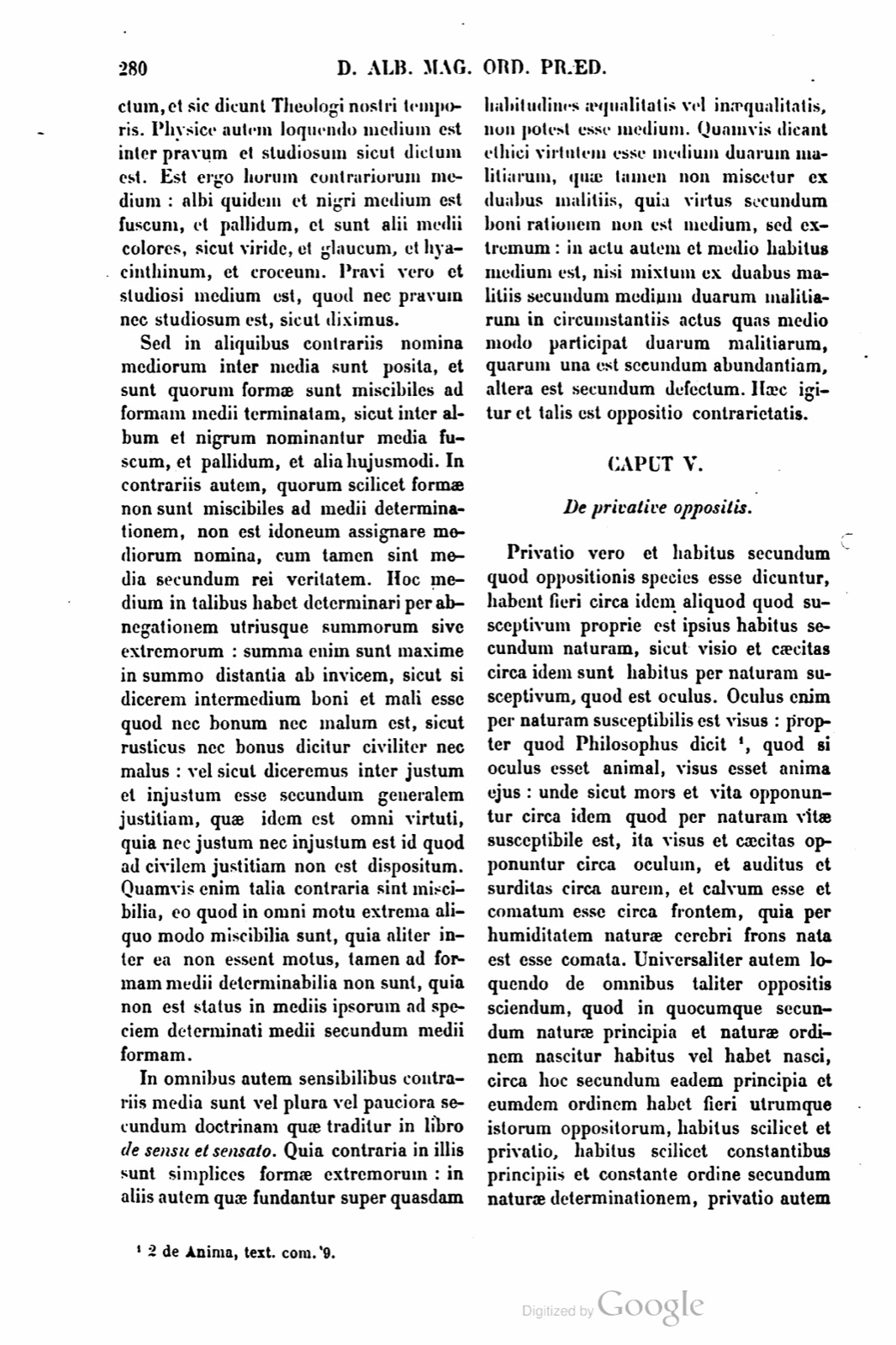
Contrariorum autem quorum non est necessarium alterum inesse susceptibili illorum, est aliquid medium propter miscibilitatem extremorum, sicut album et nigrum cum sint contraria, in corpore terminato habent fieri sicut in susceptibili: et non est necessarium alterum inesse corpori; non enim omne corpus terminatum aut album, aut nigrum est, sed aliquando medio colore figuratum. Similiter autem pravum et studiosum prædicantur ut contraria de homine et de aliis multis: unumquodque enim studiosum est quod est perfectum suâ connaturali virtute ad proprium et connaturalem actum, sicut homo ad actum hominis, et leo ad actum leonis, et miles ad actum militis, et philosophus ad actum philosophi, et sic est in omnibus aliis.
Hæc tamen contraria, pravum et studiosum, sunt mediata: quia non est necessarium hominem aut studiosum, aut pravum esse: et similiter est de aliis quæ prava dicuntur vel studiosa. Possunt enim esse media, ita quod neque prava neque studiosa sunt, sicut sunt corpora ad virtutem sui actus disposita, neque etiam contrarium habitum habentia, sicut dicit Averroes 1, quia rusticus qui ad civilitatem et curialitatem et virtutem hominis non est dispositus, nec est bonus nec malus, nec pravus nec studiosus. Hesiodistæ autem philosophiam theologizantium sequentes, dicunt inter bonum et malum, sive inter pravum et studiosum non esse medium: non enim dicunt aliquod bonum bonum bonitate naturæ simplicis, sed bonum dicunt virtute perfectum ad actum omnem: qui autem ab illo deficit cum debeat esse perfectus, dicunt esse malum omissionis malitia ad minus, quia studium virtutis non fecit quod debuit: pravum autem dicunt bonum ad pravi actum in nocentia perfectum,
But of contraries of which it is not necessary that one be in their susceptible, there is some mean because of the mixability of the extremes, as white and black, since they are contraries, have to come to be in a bounded body as in a susceptible; and it is not necessary that one be in the body, for not every bounded body is either white or black, but sometimes formed with an intermediate color. Similarly, depraved and virtuous are predicated as contraries of man and of many other things; for each virtuous thing is what is perfect by its connatural virtue for its proper and connatural act, as man for the act of man, and lion for the act of lion, and soldier for the act of soldier, and philosopher for the act of philosopher, and so it is in all other things.
Nevertheless these contraries, depraved and virtuous, are mediate, because it is not necessary for a man to be either virtuous or depraved; and it is similar concerning other things which are called depraved or virtuous. For there can be means, such that they are neither depraved nor virtuous, as bodies are disposed to the virtue of their act, nor also having a contrary habit, as Averroes says 1, because the rustic who is not disposed to civility and courtliness and the virtue of man is neither good nor evil, neither depraved nor virtuous. But the Hesiodists, following the philosophy of those theologizing, say that between good and evil, or between depraved and virtuous, there is no mean: for they do not call something good good by the goodness of simple nature, but they call good what is perfected by virtue for every act. But one who falls short from that, when he ought to be perfect, they say to be evil at least by the malice of omission, because he has not done what he ought by pursuit of virtue; but they call depraved a good perfected for the act of the depraved in harmfulness,
Notes
- Averroes, compare Metaphysics V, commentary 27, and Metaphysics X, commentary 16. (Averroes, Cf. 5 Metaph. com. 27, et 10 Metaph. com. 16.) ↩
If a page does not appear, its photograph has not been uploaded yet.