Volume 1 · pp. 274–276
Chapter II
A marker with ≈ is an approximate page boundary, placed by measure of the text; the page photographs remain the authority. In the paired views, clicking a page marker brings that page into view.
quod est prius et posterius: quia genus se habet in coordinatione sicut prius, et species sicut posterius, et prius et posterius est ratio coordinationis eorum in genere uno. Si autem sumitur penes ea in quibus stat coordinatio tota, et per quæ fit divisio coordinatorum, tunc erit tractatus de simul: quia etiam et individua in quibus stat coordinatio sunt simul natura, et differentiæ per quas fit divisio coordinatorum, ex quo sunt oppositæ simul exeuntes ex eodem genere, sunt simul natura. Hic ergo de necessitate tractandum est eo quod est simul. Quia autem in omni natura cujuslibet generis est potentia et actus, et inter hæc aliquo modo motus (et ideo etiam motus est in omnibus generibus) ideo necesse fuit etiam de illa ratione coordinationis prædicabilium determinare: et ideo oportuit tractare de motu secundum motus communitatem quam in motibus ponit ratio coordinans prædicabilia ad unum commune quod in generibus pluribus invenitur. Si autem est secundum ordinationem illorum generum ad primum quæ est etiam coordinatio quam ratio ponit, sic logico necesse fuit tractare de habere, et in his sufficientia est coordinationis prædicabilium.
Et per ipsam divisionem patet ordo capitulorum istorum: quia prius est id quod sumitur secundum ipsorum generum diversitatem, quam quod sumitur penes ea quæ sunt in genere: et sic oppositio est ante omnia alia. Adhuc prius est quod est in genere secundum substantiam suæ coordinationis, quam id quod est in genere secundum reductionem ad ens generis: et sic prius et simul sunt ante reliqua. Adhuc quod est in genere secundum reductionem ad commune quod est hoc genus, vel id, est ante reductionem ad unum quod est habens ut subjectum: et sic capitulum de motu est ante capitulum de habere. Patet igitur sufficientia post-prædicamentorum et ordo eorum ad invicem: quia etiam prius est ante simul: quia in coordinatione prius sunt ipsa coordinata secundum rationem, quam ea in quibus stat coordinatio: et de his hac de causa quæ dicta tractandum est.
CAPUT II.
De oppositione in communi et generibus oppositorum.
Inter illa ergo primo tractandum est de oppositione, quæ forma est et intentio rationis posita supra ea quæ opposita sunt: ideo in quantum stat super ea quæ sunt entia aliquo modo forma est entis: in quantum autem actualis oppositio est comparatio rationis, qua unum oppositorum comparatur alteri, tunc est forma et intentio quæ attingit et non ens, in quantum ens opponitur non enti tam in contradictoriis, quam in privative oppositis, et etiam in contrariis secundum quod contraria ad privationem et habitum reducuntur. Hoc enim non est inconveniens, quod intentio vel forma quæ potentialiter est in rebus et actualiter in ratione, sit et entis et non entis: quia ratio comparans unum alteri, comparationem facere non potest nisi respiciat et stet aliquo modo super utrumque: et sic quidem oppositio simpliciter est forma entis, secundum quid autem etiam est non entis.
Ex his etiam patet quod oppositio aliquo modo forma est unius, et aliquo modo multorum: est enim unius secundum quod unum consideratur oppositum alteri, sed non est forma quæ absolute sit in uno, hoc est, in uno respectu alterius. Est etiam oppositio multorum, quia dicimus quod illa vel illa sunt opposita, et hoc est, quod per rationem utriusque oppositorum comparata est ad alterum et stat sic in oppositis: hoc enim modo forma quæ non est absoluta potest esse multorum.
Ex his etiam patet quod oppositio in quantum oppositio secundum genus est ad aliquid: quamvis species oppositionis non sint ad aliquid, nisi mediante genere, hoc est, reduplicatione ad genus, sic ut dicatur, quod contrarietas in quantum est oppositio, est ad aliquid, secundum quod
which is prior and posterior, because genus has itself in coordination as prior, and species as posterior, and prior and posterior is the account of their coordination in one genus. But if it is taken according to those things in which the whole coordination stands, and through which the division of coordinated things is made, then there will be a treatise concerning the simultaneous; because also the individuals in which coordination stands are simultaneous by nature, and the differences through which the division of coordinated things is made, from the fact that they are opposites going out simultaneously from the same genus, are simultaneous by nature. Here therefore it is necessary to treat of that which is simultaneous. But because in every nature of any genus there is potency and act, and between these in some way motion, and therefore motion also is in all genera, it was therefore necessary also to determine concerning that account of coordination of predicables; and therefore it was necessary to treat of motion according to the commonality of motion which reason coordinating predicables to one common thing posits in motions, which is found in several genera. But if it is according to the ordering of those genera to the first, which is also a coordination which reason posits, thus it was necessary for the logician to treat of to have, and in these is the sufficiency of the coordination of predicables.
And through the division itself the order of these chapters is clear: because what is taken according to the diversity of the genera themselves is prior to what is taken according to those things which are in a genus; and thus opposition is before all other things. Further, what is in a genus according to the substance of its coordination is prior to that which is in a genus according to reduction to the being of the genus; and thus prior and simultaneous are before the remaining things. Further, what is in a genus according to reduction to the common which is this genus or that is before reduction to one which is having as subject; and thus the chapter on motion is before the chapter on to have. Therefore the sufficiency of the post-predicaments and their order with respect to one another is clear, because prior is also before simultaneous, because in coordination the coordinated things themselves are prior according to reason to those things in which coordination stands; and concerning these, for this cause which has been stated, one must treat.
CHAPTER II.
Concerning opposition in common and the genera of opposites.
Therefore among those things, first one must treat of opposition, which is a form and intention of reason posited over those things which are opposed; therefore insofar as it stands over those things which are beings, in some way it is a form of being; but insofar as actual opposition is a comparison of reason, by which one of the opposites is compared to the other, then it is a form and intention which reaches also non-being, insofar as being is opposed to non-being both in contradictories and in privatively opposed things, and also in contraries according as contraries are reduced to privation and habit. For this is not unfitting, that an intention or form which is potentially in things and actually in reason should be both of being and of non-being, because reason comparing one thing to another cannot make comparison unless it looks to and stands in some way over each; and thus indeed opposition simply is a form of being, but in a qualified respect it is also of non-being.
From these things it is also clear that opposition in some way is the form of one, and in some way of many: for it is of one according as one thing is considered opposed to another, but it is not a form which is absolutely in one, that is, in one without respect to another. Opposition is also of many, because we say that these or those are opposed, and this is that through the account of each of the opposites it is compared to the other and stands thus in the opposites; for in this way a form which is not absolute can be of many.
From these things it is also clear that opposition, insofar as it is opposition according to genus, is toward something; although the species of opposition are not toward something except through the mediation of the genus, that is, by reduplication to the genus, as that contrariety, insofar as it is opposition, is said to be toward something, according as
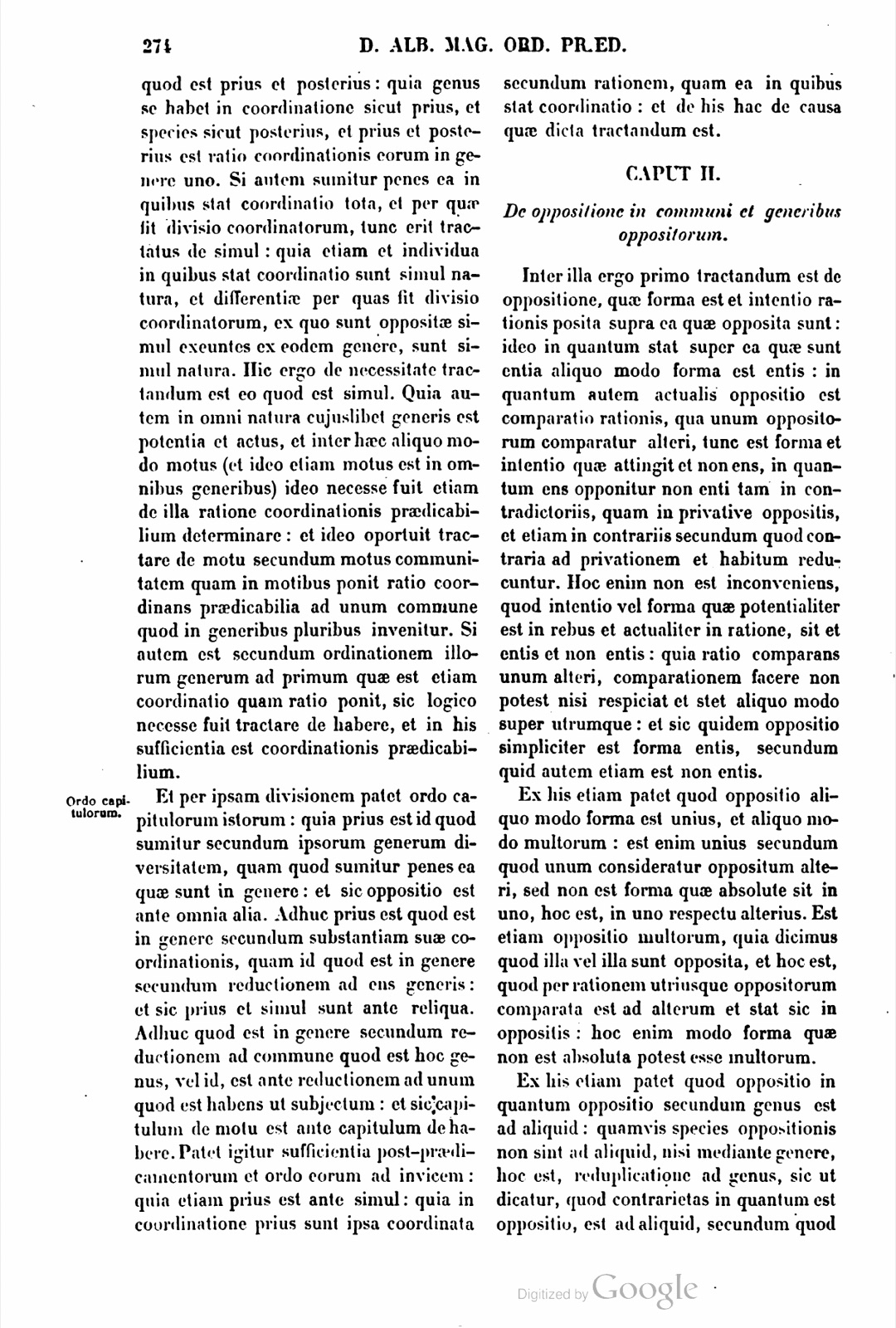
in antehabitis dictum est, quod grammatica secundum quod est disciplina est ad aliquid, et non secundum quod est grammatica vel hæc scientia.
Et si quis objiciat, quod relatio est forma eorum quorum utrumque est ens actu: oppositio autem potest esse eorum quorum alterum est non ens: et quod ideo oppositio non sit relatio. Adhuc autem quia relatio est secundum genus unum tantum; oppositio autem est in pluribus generibus, et quod ideo oppositio non est relatio.
Dicendum quod hæ argumentationes non valent, quia oppositio, sicut ante dictum est, est intentio quam ponit ratio super res: et ideo relatio quæ ponitur ibi a ratione, intentio est, et talis relatio est relatio entis, quod (ut oppositum est et non ut res) est in ratione: et tale ens sufficit relationi quæ est posita super intentiones. Ad aliud autem dicendum quod quamvis relatio sit unum genus, non tamen propter hoc sequitur quod relativa sint in genere uno omni modo: oppositio autem est distantia relatorum ad invicem, et hoc modo est in diversis prædicamentis. Sic ergo patet quid sit oppositio: est enim, ut dicit Boetius, hoc habens quod opposita non possunt esse simul in uno et eodem: unde oppositio est repugnantia vel essentialis distantia aliquorum se non permittentium esse in eodem simul.
Nunc ergo quærendum est secundum oppositionis divisionem, quoties sive quot modis solet unum opponi alteri. Dicitur autem alterum alteri sive unum alteri opponi quadrupliciter, hoc est, uno quatuor modorum: aut enim opponitur ut ad aliquid, aut ut contraria, aut ut habitus et privatio, aut ut affirmatio et negatio. Oppositio enim (quæ est forma rationis secundum intentiones quæ in ratione sunt, quæ respicit tam ens quam non ens) aut est inter ea quæ actu sunt, aut inter ea quorum unum est et alterum non est. Si enim est inter ea quæ actu sunt, et suis formis repugnantiam habent oppositionis, tunc aut se sunt expellentia ab eodem susceptibili secundum potentiam et actum, aut expellentia se secundum actum, non secundum potentiam. Si primo modo: tunc est oppositio secundum ad aliquid, sicut patet in patre et filio. Idem enim respectu ejusdem pater nec est nec potest esse et filius. Si autem se expellant ab eodem secundum actum, et non secundum potentiam: tunc est oppositio contrarietatis. Et istæ duæ, quia sunt super ens, aliis duabus oppositionibus præordinandæ sunt: et quia oppositio relationis expellit oppositum secundum actum et potentiam, contrarietas autem secundum actum tantum, ideo oppositio relationis ponitur ante oppositionem contrarietatis. Si autem est inter ens simpliciter, et non ens: tunc aut est inter ens simpliciter et non ens secundum quid, aut inter ens simpliciter et non ens simpliciter. Et primo quidem modo est oppositio inter habitum et privationem, quæ licet privet habitum, relinquit tamen subjectum. Et si est secundo modo: tunc est oppositio inter affirmationem et negationem, in quibus affirmatio dicit ens, negatio autem simpliciter non ens, et habent ordinem secundum quod plus vel minus habent de ente, et hoc modo privatio et habitus sunt ante affirmationem et negationem.
in the things had before it was said that grammar, according as it is a discipline, is toward something, and not according as it is grammar or this science.
And if someone objects that relation is the form of those of which each is a being in act, but opposition can be of those of which one is non-being, and that therefore opposition is not relation. Furthermore, because relation is according to one genus only, but opposition is in several genera, and that therefore opposition is not relation.
It must be said that these arguments have no force, because opposition, as was said before, is an intention which reason posits over things; and therefore the relation which is posited there by reason is an intention, and such a relation is a relation of being, which, as opposed and not as a thing, is in reason; and such being suffices for the relation which is posited over intentions. But to the other it must be said that although relation is one genus, nevertheless on account of this it does not follow that relatives are in one genus in every way; but opposition is the distance of related things from one another, and in this way it is in diverse predicaments. Thus therefore it is clear what opposition is: for it is, as Boethius says, having this, that opposites cannot be at once in one and the same thing; whence opposition is repugnance or the essential distance of certain things not permitting themselves to be at once in the same thing.
Now therefore it must be asked, according to the division of opposition, how often or in how many ways one thing is accustomed to be opposed to another. But one thing is said to be opposed to another, or one to another, fourfold, that is, in one of four modes: for it is opposed either as toward something, or as contraries, or as habit and privation, or as affirmation and negation. For opposition, which is a form of reason according to intentions which are in reason, which looks both to being and to non-being, either is between those things which are in act, or between those things of which one is and the other is not. For if it is between those things which are in act, and in their own forms they have the repugnance of opposition, then either they are things expelling themselves from the same susceptible according to potency and act, or things expelling themselves according to act, not according to potency. If in the first mode, then it is opposition according to toward something, as is clear in father and son. For the same thing with respect to the same thing neither is nor can be both father and son. But if they expel themselves from the same thing according to act, and not according to potency, then it is the opposition of contrariety. And these two, because they are over being, must be ordered before the other two oppositions; and because the opposition of relation expels the opposite according to act and potency, but contrariety according to act only, therefore the opposition of relation is placed before the opposition of contrariety. But if it is between being simply and non-being, then either it is between being simply and non-being in a qualified respect, or between being simply and non-being simply. And in the first mode indeed there is opposition between habit and privation, which, although it deprives the habit, nevertheless leaves the subject. And if it is in the second mode, then there is opposition between affirmation and negation, in which affirmation says being, but negation says simply non-being, and they have order according as they have more or less of being; and in this way privation and habit are before affirmation and negation.
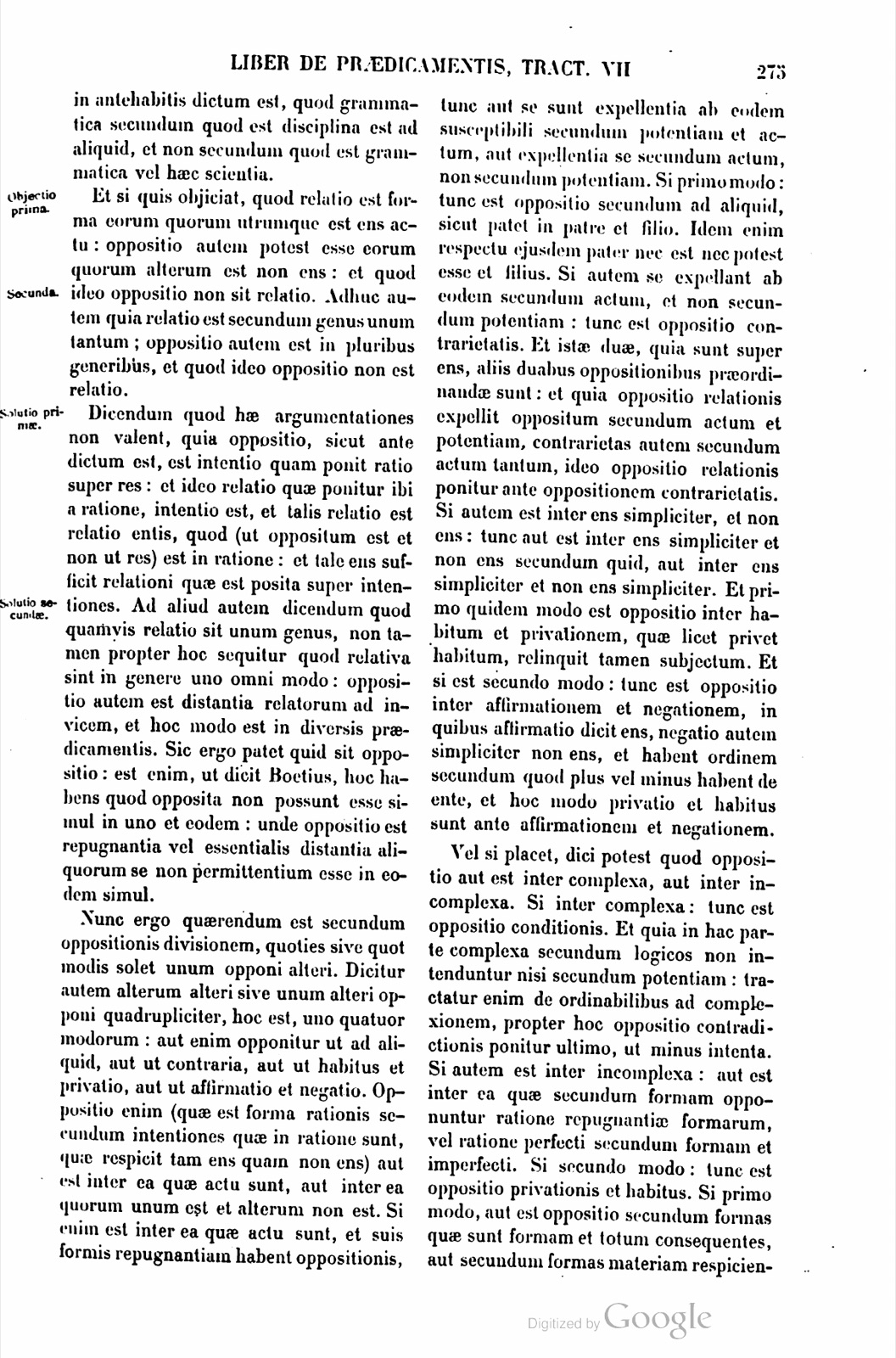
Vel si placet, dici potest quod oppositio aut est inter complexa, aut inter incomplexa. Si inter complexa: tunc est oppositio contradictionis. Et quia in hac parte complexa secundum logicos non intenduntur nisi secundum potentiam: tractatur enim de ordinabilibus ad complexionem, propter hoc oppositio contradictionis ponitur ultimo, ut minus intenta. Si autem est inter incomplexa: aut est inter ea quæ secundum formam opponuntur ratione repugnantiæ formarum, vel ratione perfecti secundum formam et imperfecti. Si secundo modo: tunc est oppositio privationis et habitus. Si primo modo, aut est oppositio secundum formas quæ sunt formam et totum consequentes, aut secundum formas materiam respicientes
Or, if it pleases, it can be said that opposition is either between complex things or between incomplex things. If between complex things, then it is the opposition of contradiction. And because in this part complex things according to logicians are intended only according to potency, for the treatise is about things orderable to combination, on account of this the opposition of contradiction is placed last, as less intended. But if it is between incomplex things, it is either between those things which are opposed according to form by reason of the repugnance of forms, or by reason of the perfect according to form and the imperfect. If in the second mode, then there is opposition of privation and habit. If in the first mode, either it is opposition according to forms which follow form and the whole, or according to forms looking to matter
If a page does not appear, its photograph has not been uploaded yet.