Volume 1 · p. 273
Chapter I
TRACTATUS VII.
DE POST-PRÆDICAMENTIS.
CAPUT I.
Quæ sint et quot tractanda in hoc tractatu.
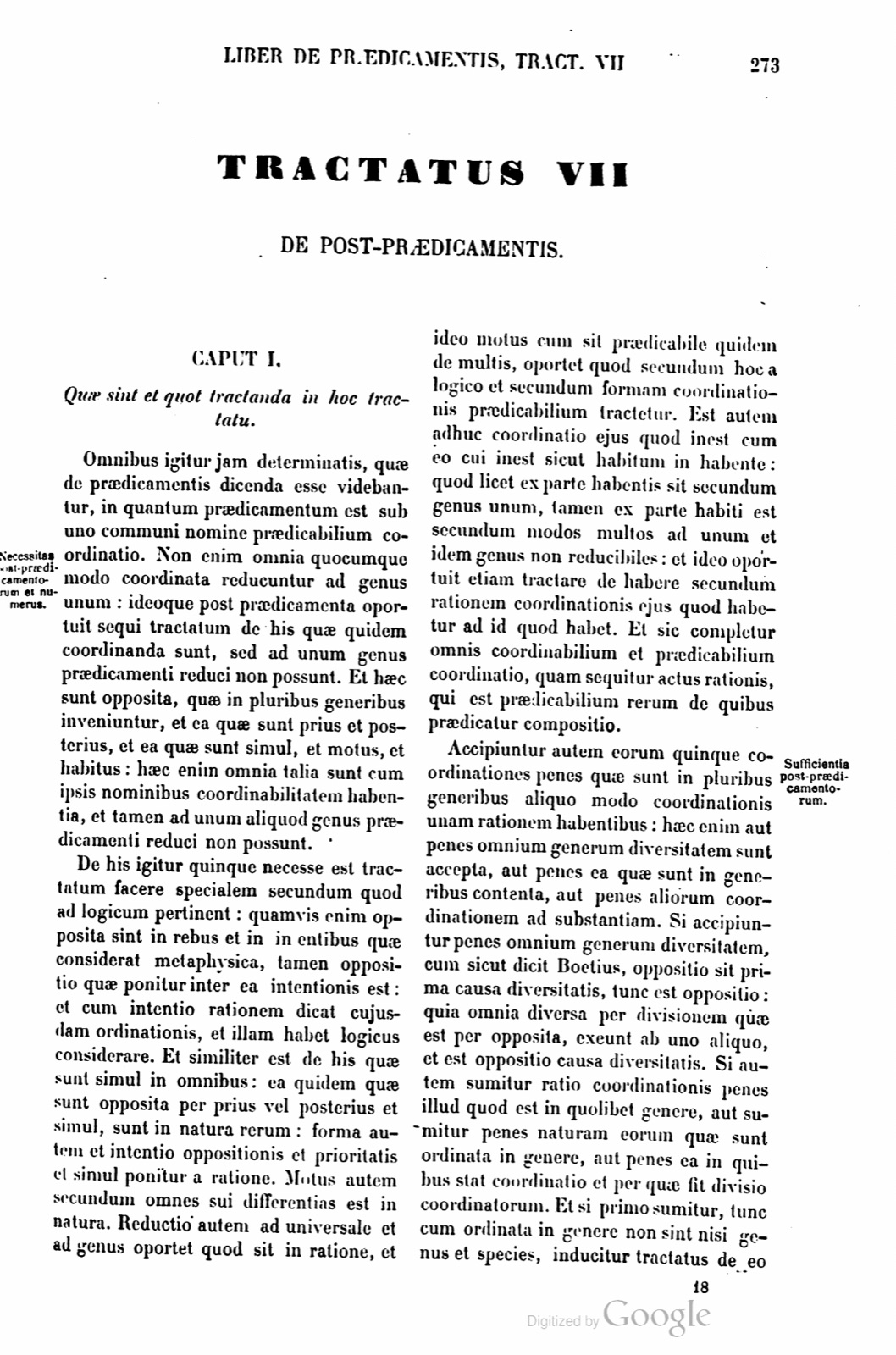
Omnibus igitur jam determinatis, quæ de prædicamentis dicenda esse videbantur, in quantum prædicamentum est sub uno communi nomine prædicabilium coordinatio. Non enim omnia quocumque modo coordinata reducuntur ad genus unum: ideoque post prædicamenta oportuit sequi tractatum de his quæ quidem coordinanda sunt, sed ad unum genus prædicamenti reduci non possunt. Et hæc sunt opposita, quæ in pluribus generibus inveniuntur, et ea quæ sunt prius et posterius, et ea quæ sunt simul, et motus, et habitus: hæc enim omnia talia sunt cum ipsis nominibus coordinabilitatem habentia, et tamen ad unum aliquod genus prædicamenti reduci non possunt.
De his igitur quinque necesse est tractatum facere specialem secundum quod ad logicum pertinent: quamvis enim opposita sint in rebus et in in entibus quæ considerat metaphysica, tamen oppositio quæ ponitur inter ea intentionis est: et cum intentio rationem dicat cujusdam ordinationis, et illam habet logicus considerare. Et similiter est de his quæ sunt simul in omnibus: ea quidem quæ sunt opposita per prius vel posterius et simul, sunt in natura rerum: forma autem et intentio oppositionis et prioritatis et simul ponitur a ratione. Motus autem secundum omnes sui differentias est in natura. Reductio autem ad universale et ad genus oportet quod sit in ratione, et ideo motus cum sit prædicabile quidem de multis, oportet quod secundum hoc a logico et secundum formam coordinationis prædicabilium tractetur. Est autem adhuc coordinatio ejus quod inest cum eo cui inest sicut habitum in habente: quod licet ex parte habentis sit secundum genus unum, tamen ex parte habiti est secundum modos multos ad unum et idem genus non reducibiles: et ideo oportuit etiam tractare de habere secundum rationem coordinationis ejus quod habetur ad id quod habet. Et sic completur omnis coordinabilium et prædicabilium coordinatio, quam sequitur actus rationis, qui est prædicabilium rerum de quibus prædicatur compositio.
Accipiuntur autem eorum quinque coordinationes penes quæ sunt in pluribus generibus aliquo modo coordinationis unam rationem habentibus: hæc enim aut penes omnium generum diversitatem sunt accepta, aut penes ea quæ sunt in generibus contenta, aut penes aliorum coordinationem ad substantiam. Si accipiuntur penes omnium generum diversitatem, cum sicut dicit Boetius, oppositio sit prima causa diversitatis, tunc est oppositio: quia omnia diversa per divisionem quæ est per opposita, exeunt ab uno aliquo, et est oppositio causa diversitatis. Si autem sumitur ratio coordinationis penes illud quod est in quolibet genere, aut sumitur penes naturam eorum quæ sunt ordinata in genere, aut penes ea in quibus stat coordinatio et per quæ fit divisio coordinatorum. Et si primo sumitur, tunc cum ordinata in genere non sint nisi genus et species, inducitur tractatus de eo
TRACTATE VII.
CONCERNING THE POST-PREDICAMENTS.
CHAPTER I.
What and how many things are to be treated in this treatise.
Therefore, with all things now determined which seemed to have to be said concerning the predicaments, insofar as a predicament is a coordination of predicables under one common name. For not all things coordinated in whatever way are reduced to one genus; and therefore after the predicaments it was necessary that there follow a treatise concerning those things which indeed must be coordinated, but cannot be reduced to one genus of predicament. And these are opposites, which are found in several genera, and those things which are prior and posterior, and those things which are simultaneous, and motion, and habit; for all these are such things, having coordinability with the names themselves, and nevertheless they cannot be reduced to some one genus of predicament.
Therefore concerning these five it is necessary to make a special treatise according as they pertain to the logician. For although opposites are in things and in in beings which metaphysics considers, nevertheless the opposition which is posited between them belongs to intention; and since intention says the account of a certain ordering, the logician has to consider that. And similarly it is concerning those things which are simultaneous in all things: indeed those things which are opposed by prior or posterior and simultaneous are in the nature of things; but the form and intention of opposition and of priority and of simultaneous is posited by reason. But motion according to all its differences is in nature. Yet reduction to the universal and to genus must be in reason, and therefore since motion is indeed predicable of many, according to this it must be treated by the logician and according to the form of coordination of predicables. But there is still the coordination of that which inheres with that in which it inheres, as the thing had in the haver; although from the side of the haver this is according to one genus, nevertheless from the side of the thing had it is according to many modes not reducible to one and the same genus; and therefore it was also necessary to treat of to have according to the account of coordination of that which is had to that which has it. And thus every coordination of coordinables and predicables is completed, which the act of reason follows, which is composition of predicable things concerning which it is predicated.
But their five coordinations are taken according to those things which are in several genera having in some mode of coordination one account: for these are taken either according to the diversity of all genera, or according to those things which are contained in genera, or according to the coordination of the others to substance. If they are taken according to the diversity of all genera, since, as Boethius says, opposition is the first cause of diversity, then there is opposition; because all diverse things through the division which is through opposites go out from some one thing, and opposition is the cause of diversity. But if the account of coordination is taken according to that which is in any genus, it is taken either according to the nature of those things which are ordered in the genus, or according to those things in which coordination stands and through which the division of coordinated things is made. And if it is taken in the first way, then since things ordered in a genus are only genus and species, there is introduced the treatise concerning that
If a page does not appear, its photograph has not been uploaded yet.