Volume 1 · p. 272
Chapter II
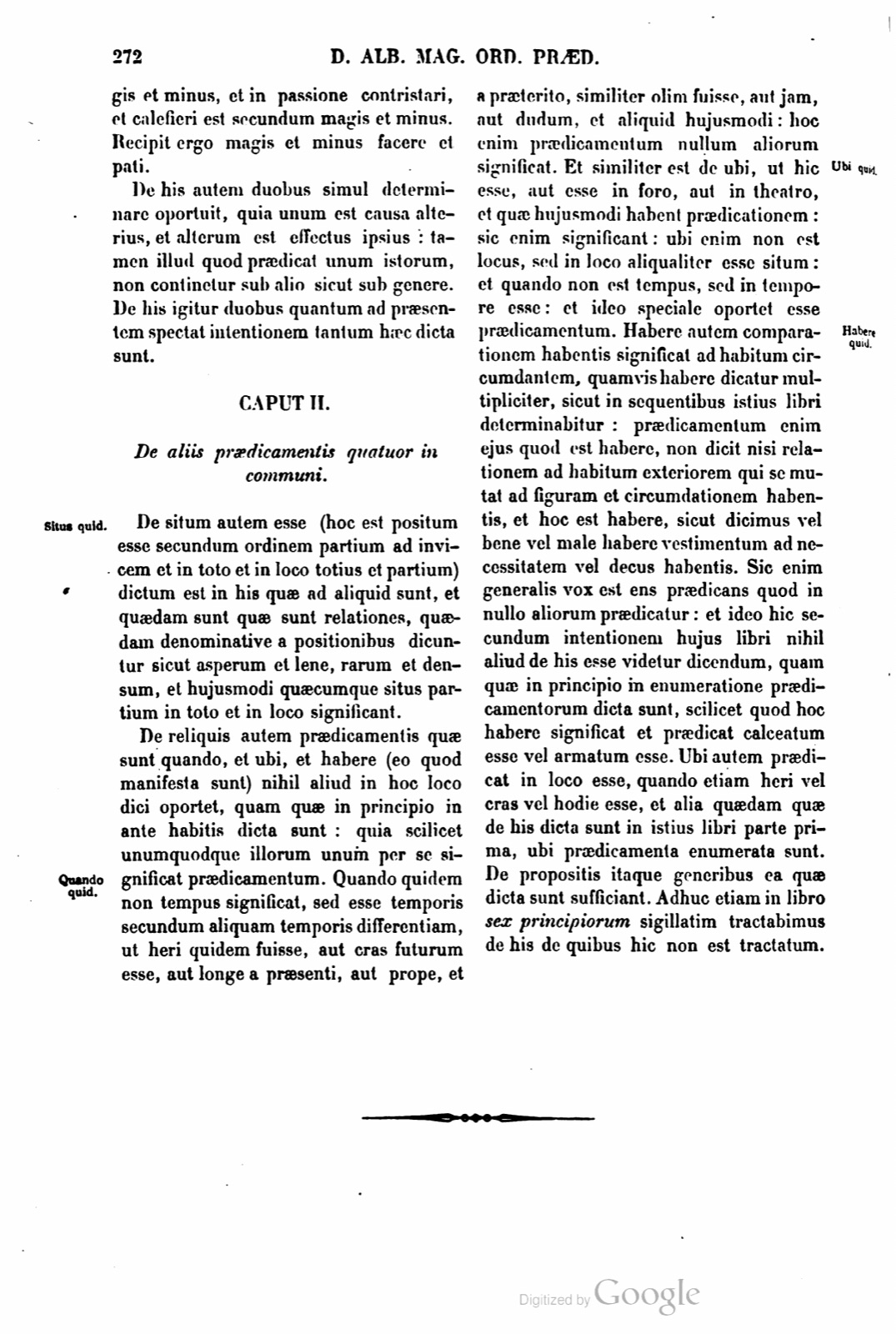
et minus, et in passione contristari, et calefieri est secundum magis et minus. Recipit ergo magis et minus facere et pati.
De his autem duobus simul determinare oportuit, quia unum est causa alterius, et alterum est effectus ipsius: tamen illud quod prædicat unum istorum, non continetur sub alio sicut sub genere. De his igitur duobus quantum ad præsentem spectat intentionem tantum hæc dicta sunt.
CAPUT II.
De aliis prædicamentis quatuor in communi.
De situm autem esse (hoc est positum esse secundum ordinem partium ad invicem et in toto et in loco totius et partium) dictum est in his quæ ad aliquid sunt, et quædam sunt quæ sunt relationes, quædam denominative a positionibus dicuntur sicut asperum et lene, rarum et densum, et hujusmodi quæcumque situs partium in toto et in loco significant.
De reliquis autem prædicamentis quæ sunt quando, et ubi, et habere (eo quod manifesta sunt) nihil aliud in hoc loco dici oportet, quam quæ in principio in ante habitis dicta sunt: quia scilicet unumquodque illorum unum per se significat prædicamentum. Quando quidem non tempus significat, sed esse temporis secundum aliquam temporis differentiam, ut heri quidem fuisse, aut cras futurum esse, aut longe a præsenti, aut prope, et a præterito, similiter olim fuisse, aut jam, aut dudum, et aliquid hujusmodi: hoc enim prædicamentum nullum aliorum significat. Et similiter est de ubi, ut hic esse, aut esse in foro, aut in theatro, et quæ hujusmodi habent prædicationem: sic enim significant: ubi enim non est locus, sed in loco aliqualiter esse situm: et quando non est tempus, sed in tempore esse: et ideo speciale oportet esse prædicamentum. Habere autem comparationem habentis significat ad habitum circumdantem, quamvis habere dicatur multipliciter, sicut in sequentibus istius libri determinabitur: prædicamentum enim ejus quod est habere, non dicit nisi relationem ad habitum exteriorem qui se mutat ad figuram et circumdationem habentis, et hoc est habere, sicut dicimus vel bene vel male habere vestimentum ad necessitatem vel decus habentis. Sic enim generalis vox est ens prædicans quod in nullo aliorum prædicatur: et ideo hic secundum intentionem hujus libri nihil aliud de his esse videtur dicendum, quam quæ in principio in enumeratione prædicamentorum dicta sunt, scilicet quod hoc habere significat et prædicat calceatum esse vel armatum esse. Ubi autem prædicat in loco esse, quando etiam heri vel cras vel hodie esse, et alia quædam quæ de his dicta sunt in istius libri parte prima, ubi prædicamenta enumerata sunt. De propositis itaque generibus ea quæ dicta sunt sufficiant. Adhuc etiam in libro sex principiorum sigillatim tractabimus de his de quibus hic non est tractatum.
and less, and in passion to be saddened and to be heated is according to more and less. Therefore to make and to suffer receives more and less.
But it was necessary to determine concerning these two together, because one is the cause of the other, and the other is its effect; nevertheless that which predicates one of these is not contained under the other as under a genus. Therefore concerning these two, so far as regards the present intention, only these things have been said.
CHAPTER II.
Concerning the other four predicaments in common.
But concerning to be situated, that is, to be positioned according to the order of parts with respect to one another and in the whole and in the place of the whole and of the parts, it was said in those things which are toward something, and certain things are relations, certain things are said denominatively from positions, as rough and smooth, rare and dense, and whatever things of this kind signify the situation of parts in the whole and in place.
But concerning the remaining predicaments, which are when, and where, and to have, because they are manifest, nothing else needs to be said in this place than the things which were said in the beginning among the things had before: namely because each of them signifies one predicament through itself. When indeed does not signify time, but the being of time according to some difference of time, as indeed to have been yesterday, or to be going to be tomorrow, or far from the present, or near, and from the past, similarly to have been formerly, or now, or just now, and something of this kind; for this predicament signifies none of the others. And it is similar concerning where, as to be here, or to be in the marketplace, or in the theater, and things of this kind have predication; for they signify thus. For where is not place, but to be situated in a place in some way; and when is not time, but to be in time; and therefore it must be a special predicament. But to have signifies a comparison of the haver to the habit surrounding, although to have is said in many ways, as will be determined in the following parts of this book; for the predicament of that which is to have says only relation to an exterior habit which changes itself to the figure and surrounding of the haver, and this is to have, as we say to have a garment well or badly for the necessity or adornment of the haver. For thus it is a general word predicating being which is predicated in none of the others; and therefore here according to the intention of this book nothing else seems to have to be said concerning these than the things which were said in the beginning in the enumeration of the predicaments, namely that this to have signifies and predicates to be shod or to be armed. But where predicates to be in place, and when also predicates to be yesterday or tomorrow or today, and certain other things which were said concerning these in the first part of this book, where the predicaments were enumerated. Therefore concerning the proposed genera let the things which have been said suffice. Still also in the book of the Six Principles we will treat separately of these things concerning which there has not been treatment here.
If a page does not appear, its photograph has not been uploaded yet.