Volume 1 · pp. 270–272
Chapter I
A marker with ≈ is an approximate page boundary, placed by measure of the text; the page photographs remain the authority. In the paired views, clicking a page marker brings that page into view.
TRACTATUS VI.
DE ALIIS SEX PRÆDICAMENTIS IN COMMUNI.
CAPUT I.
De agere et pati.
Habitis quatuor vocibus quatuor genera rerum significantibus, in quibus substantia prædicat id quod simpliciter est ens et per seipsum, Quantitas prædicat ens in alio per quod ipsa subjicitur et substat multis aliis accidentibus, et etiam motui, quia illi non subjicitur substantia simpliciter sed substantia quanta: et omnibus illis quæ dicunt formas quæ in majori quantitate majores, et in minori minores sunt, sicut sunt omnes qualitates activæ et passivæ, per hanc subjicitur motui et mutationi, quia illis subjicitur materia quantitate determinata: propter quod etiam quantum separatam rationem habet a physico, et est secundum rationem ante ipsum, sicut metaphysicum ante physicum. Ad aliquid autem prædicat id quod est comparatum ad aliquid, qui modus immixtus est omnibus sex prædicamentis, et ideo ut principium ad alia præmitti debuit. Habita etiam qualitate et qualibus, quæ etiam generalem modum prædicandi in quale habent, qui quodammodo inest omnibus aliis. Propterea etiam præmitti debuit, ut hic substantia præcederet ut omni subjectum, quantitas ut subjectum ad physicum, ad aliquid autem ut modus aliorum comparatus, quale autem et qualitas ut modum prædicandi dans residuis omnibus.
Restat enim dicere de his quæ non habent res absolutas prædicare nec modum prædicandi habent ab illis absolutum: habent enim modum relationis et qualitatis, et addunt aliquid super utrumque, per quod efficiuntur specialia prædicamenta. Propter quod ipsa sex genera causantur ab aliis quatuor, quæ præhabita sunt, et non causantur ab ipsis sicut inferiora causantur a superioribus, quia si hoc ita esset, continerentur in eis, sicut in suis generibus, sed causantur ex comparationibus supradictorum generum ad aliud: cum tamen secundum causam eamdem vel diversam non dicantur ad convertentiam. Sicut actio a forma vel qualitate substantiali, vel accidentali comparata ad id quod actioni subjicitur. Passio a materia vel subjecto quod agenti subjicitur, et in qualitate accidentali actio a potentia naturali, passio a naturali impotentia. Quando vero non a tempore, sed a temporis adjacentia. Ubi autem non a loco, sed a loci circumscriptione. Positio autem a partibus secundum ordinem comparatis inter se et toto et in loco. Habitus autem comparatione extrinsecorum ad totum subjectum. De quibus omnibus non magnum hic oportet facere tractatum, eo quod hic specialiter intendimus de quatuor quæ aliorum sex sunt causa, postea autem in alio libro de aliis sex est tractandum. Inter hæc primum est prædicamentum actionis, quod est de facere: et quia actio est in patiens per effectum procedens virtus agentis, ideo cum hoc genere oportet etiam de pati determinare.
TRACTATE VI.
CONCERNING THE OTHER SIX PREDICAMENTS IN COMMON.
CHAPTER I.
Concerning to act and to suffer.
Once the four words signifying the four genera of things have been had, in which substance predicates that which is simply a being and through itself; quantity predicates being in another, through which it is subjected and underlies many other accidents and also motion, because substance simply is not subjected to it, but quantified substance; and by this it is subjected to motion and alteration for all those things which say forms which are greater in a greater quantity and lesser in a lesser one, as all active and passive qualities are, because matter determined by quantity is subjected to them. On account of this, the quantum also has an account separated from the physical, and according to reason is before it, as the metaphysical before the physical. But toward something predicates that which is compared to something, which mode is mixed into all six predicaments, and therefore as a principle to the others it ought to have been set before. Quality and qualia also having been had, which also have the general mode of predicating in quale, which in a certain way is present in all the others. For this reason also it ought to have been set before, so that here substance would precede as subject to every one, quantity as subject to the physical, toward something as the mode of the others compared, but quale and quality as giving the mode of predicating to all the remaining ones.
For it remains to speak about those things which do not have to predicate absolute things, nor have a mode of predicating absolute from those things; for they have the mode of relation and of quality, and add something above each, through which they are made special predicaments. On account of this those six genera are caused by the other four, which have been had before, and are not caused by them as inferiors are caused by superiors, because if this were so, they would be contained in them as in their genera; rather they are caused from the comparisons of the aforesaid genera to another, although nevertheless they are not said according to the same or diverse cause toward convertence. Thus action is from substantial or accidental form or quality compared to that which is subjected to action. Passion is from matter or the subject which is subjected to the agent, and in accidental quality action is from natural potency, passion from natural impotence. When, indeed, is not from time, but from the adjacency of time. Where, however, is not from place, but from the circumscription of place. Position, moreover, is from parts compared according to order among themselves and to the whole and in place. Habit, moreover, is by comparison of extrinsic things to the whole subject. Concerning all these things it is not necessary here to make a great treatise, because here we specially intend the four which are the cause of the other six; but afterward in another book one must treat of the other six. Among these the first is the predicament of action, which concerns doing; and because action is in the patient, the virtue of the agent proceeding through effect, therefore with this genus one must also determine concerning suffering.
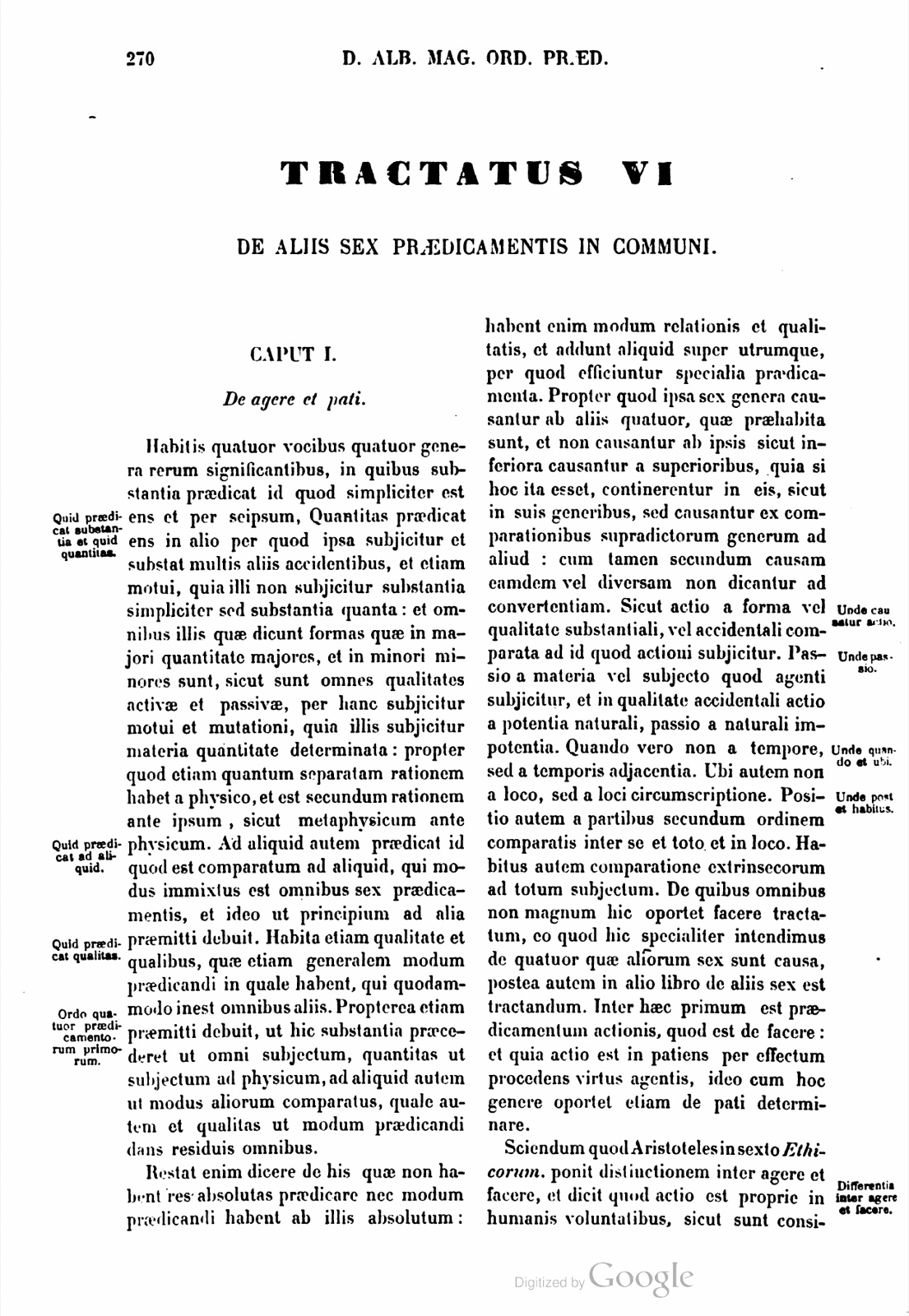
Sciendum quod Aristoteles in sexto Ethicorum ponit distinctionem inter agere et facere, et dicit quod actio est proprie in humanis voluntatibus, sicut sunt consiliari
It must be known that Aristotle, in the sixth book of the Ethics, posits a distinction between to act and to make, and says that action is properly in human voluntary acts, such as to deliberate
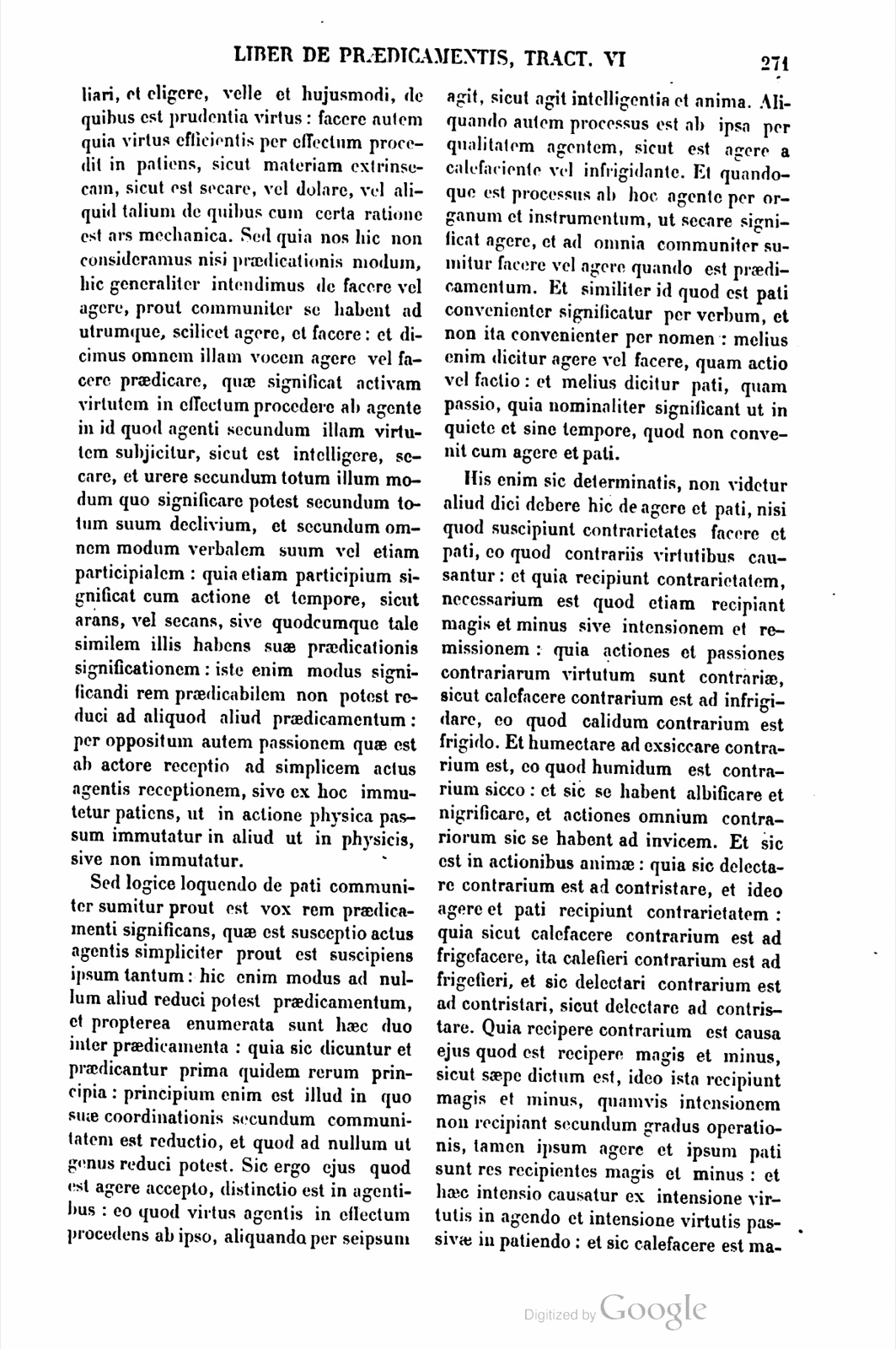
et eligere, velle et hujusmodi, de quibus est prudentia virtus: facere autem quia virtus efficientis per effectum procedit in patiens, sicut materiam extrinsecam, sicut est secare, vel dolare, vel aliquid talium de quibus cum certa ratione est ars mechanica. Sed quia nos hic non consideramus nisi prædicationis modum, hic generaliter intendimus de facere vel agere, prout communiter se habent ad utrumque, scilicet agere, et facere: et dicimus omnem illam vocem agere vel facere prædicare, quæ significat activam virtutem in effectum procedere ab agente in id quod agenti secundum illam virtutem subjicitur, sicut est intelligere, secare, et urere secundum totum illum modum quo significare potest secundum totum suum declivium, et secundum omnem modum verbalem suum vel etiam participialem: quia etiam participium significat cum actione et tempore, sicut arans, vel secans, sive quodcumque tale similem illis habens suæ prædicationis significationem: iste enim modus significandi rem prædicabilem non potest reduci ad aliquod aliud prædicamentum: per oppositum autem passionem quæ est ab actore receptio ad simplicem actus agentis receptionem, sive ex hoc immutetur patiens, ut in actione physica passum immutatur in aliud ut in physicis, sive non immutatur.
Sed logice loquendo de pati communiter sumitur prout est vox rem prædicamenti significans, quæ est susceptio actus agentis simpliciter prout est suscipiens ipsum tantum: hic enim modus ad nullum aliud reduci potest prædicamentum, et propterea enumerata sunt hæc duo inter prædicamenta: quia sic dicuntur et prædicantur prima quidem rerum principia: principium enim est illud in quo suæ coordinationis secundum communitatem est reductio, et quod ad nullum ut genus reduci potest. Sic ergo ejus quod est agere accepto, distinctio est in agentibus: eo quod virtus agentis in effectum procedens ab ipso, aliquando per seipsum agit, sicut agit intelligentia et anima. Aliquando autem processus est ab ipsa per qualitatem agentem, sicut est agere a calefaciente vel infrigidante. Et quandoque est processus ab hoc agente per organum et instrumentum, ut secare significat agere, et ad omnia communiter sumitur facere vel agere quando est prædicamentum. Et similiter id quod est pati convenienter significatur per verbum, et non ita convenienter per nomen: melius enim dicitur agere vel facere, quam actio vel factio: et melius dicitur pati, quam passio, quia nominaliter significant ut in quiete et sine tempore, quod non convenit cum agere et pati.
and to choose, to will and things of this kind, concerning which prudence is the virtue; but to make, because the virtue of the efficient proceeds through an effect into the patient, as into extrinsic matter, as to cut, or to hew, or something of such things concerning which, when with a certain account, there is mechanical art. But because here we consider only the mode of predication, here we generally intend concerning to make or to act, according as they have themselves commonly to each, namely to act and to make; and we say that every word predicates to act or to make which signifies an active virtue proceeding into effect from the agent into that which is subjected to the agent according to that virtue, as to understand, to cut, and to burn, according to that whole mode in which it can signify according to its whole declension, and according to every verbal mode of its own or even participial mode; because a participle also signifies with action and time, as plowing, or cutting, or whatever such thing has a signification of its predication similar to those. For this mode of signifying a predicable thing cannot be reduced to any other predicament; but through the opposite, passion, which is a reception from the actor toward the simple reception of the act of the agent, whether from this the patient is altered, as in physical action the thing suffered is altered into another as in physics, or is not altered.
But speaking logically, concerning to suffer, it is commonly taken according as it is a word signifying a thing of a predicament, which is the susceptibility of the act of the agent simply according as it is receiving it only; for this mode cannot be reduced to any other predicament, and for this reason these two have been enumerated among the predicaments, because in this way the first principles of things indeed are said and predicated. For a principle is that in which there is the reduction of its coordination according to community, and which cannot be reduced to anything as genus. Thus therefore, when that which is to act has been taken, distinction is in the agents, because the virtue of the agent proceeding from it into effect sometimes acts through itself, as intelligence and soul act. But sometimes the procession is from it through an acting quality, as to act from something heating or cooling. And sometimes the procession is from this agent through an organ and instrument, as to cut signifies to act; and to make or to act is taken commonly for all things when it is a predicament. And similarly that which is to suffer is fittingly signified through a verb, and not so fittingly through a noun; for to act or to make is better said than action or making, and to suffer is better said than passion, because nominally they signify as in quiet and without time, which does not agree with to act and to suffer.
His enim sic determinatis, non videtur aliud dici debere hic de agere et pati, nisi quod suscipiunt contrarietates facere et pati, eo quod contrariis virtutibus causantur: et quia recipiunt contrarietatem, necessarium est quod etiam recipiant magis et minus sive intensionem et remissionem: quia actiones et passiones contrariarum virtutum sunt contrariæ, sicut calefacere contrarium est ad infrigidare, eo quod calidum contrarium est frigido. Et humectare ad exsiccare contrarium est, eo quod humidum est contrarium sicco: et sic se habent albificare et nigrificare, et actiones omnium contrariorum sic se habent ad invicem. Et sic est in actionibus animæ: quia sic delectare contrarium est ad contristare, et ideo agere et pati recipiunt contrarietatem: quia sicut calefacere contrarium est ad frigefacere, ita calefieri contrarium est ad frigefieri, et sic delectari contrarium est ad contristari, sicut delectare ad contristare. Quia recipere contrarium est causa ejus quod est recipere magis et minus, sicut sæpe dictum est, ideo ista recipiunt magis et minus, quamvis intensionem non recipiant secundum gradus operationis, tamen ipsum agere et ipsum pati sunt res recipientes magis et minus: et hæc intensio causatur ex intensione virtutis in agendo et intensione virtutis passivæ in patiendo: et sic calefacere est magis
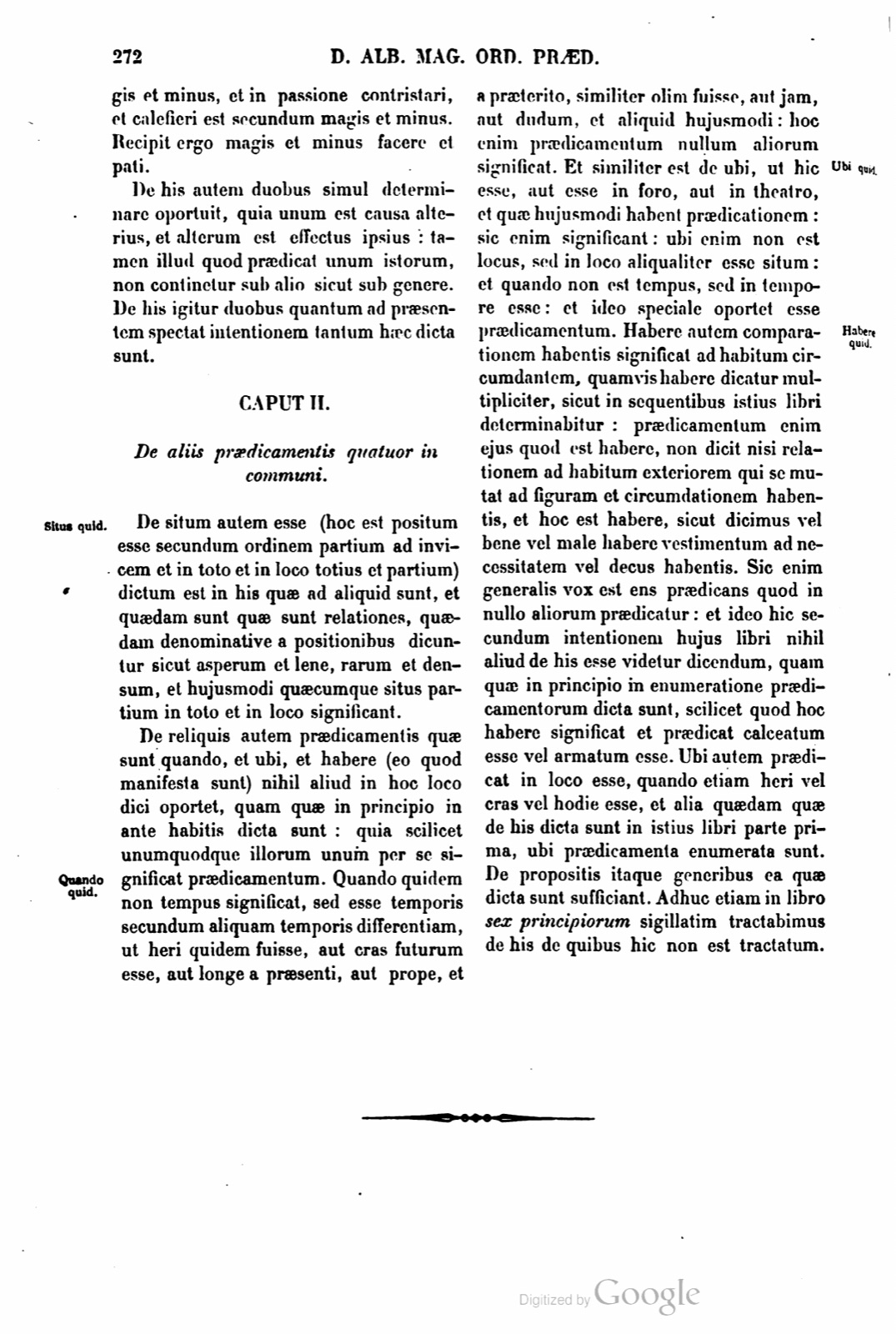
For with these thus determined, it does not seem that anything else ought to be said here concerning to act and to suffer, except that to make and to suffer receive contrarieties, because they are caused by contrary virtues; and because they receive contrariety, it is necessary that they also receive more and less or intension and remission, because actions and passions of contrary virtues are contrary, as to heat is contrary to to cool, because hot is contrary to cold. And to moisten is contrary to to dry, because moist is contrary to dry; and thus to whiten and to blacken have themselves, and the actions of all contraries have themselves to one another in this way. And so it is in the actions of the soul, because in this way to delight is contrary to to sadden, and therefore to act and to suffer receive contrariety, because just as to heat is contrary to to make cold, so to be heated is contrary to to be made cold, and thus to be delighted is contrary to to be saddened, as to delight is to to sadden. Because to receive a contrary is the cause of receiving more and less, as has often been said, therefore these receive more and less; although they do not receive intension according to grades of operation, nevertheless to act itself and to suffer itself are things receiving more and less, and this intension is caused from the intension of virtue in acting and the intension of passive virtue in suffering; and thus to heat is more
If a page does not appear, its photograph has not been uploaded yet.