Volume 1 · pp. 264–266
Chapter XI
A marker with ≈ is an approximate page boundary, placed by measure of the text; the page photographs remain the authority. In the paired views, clicking a page marker brings that page into view.
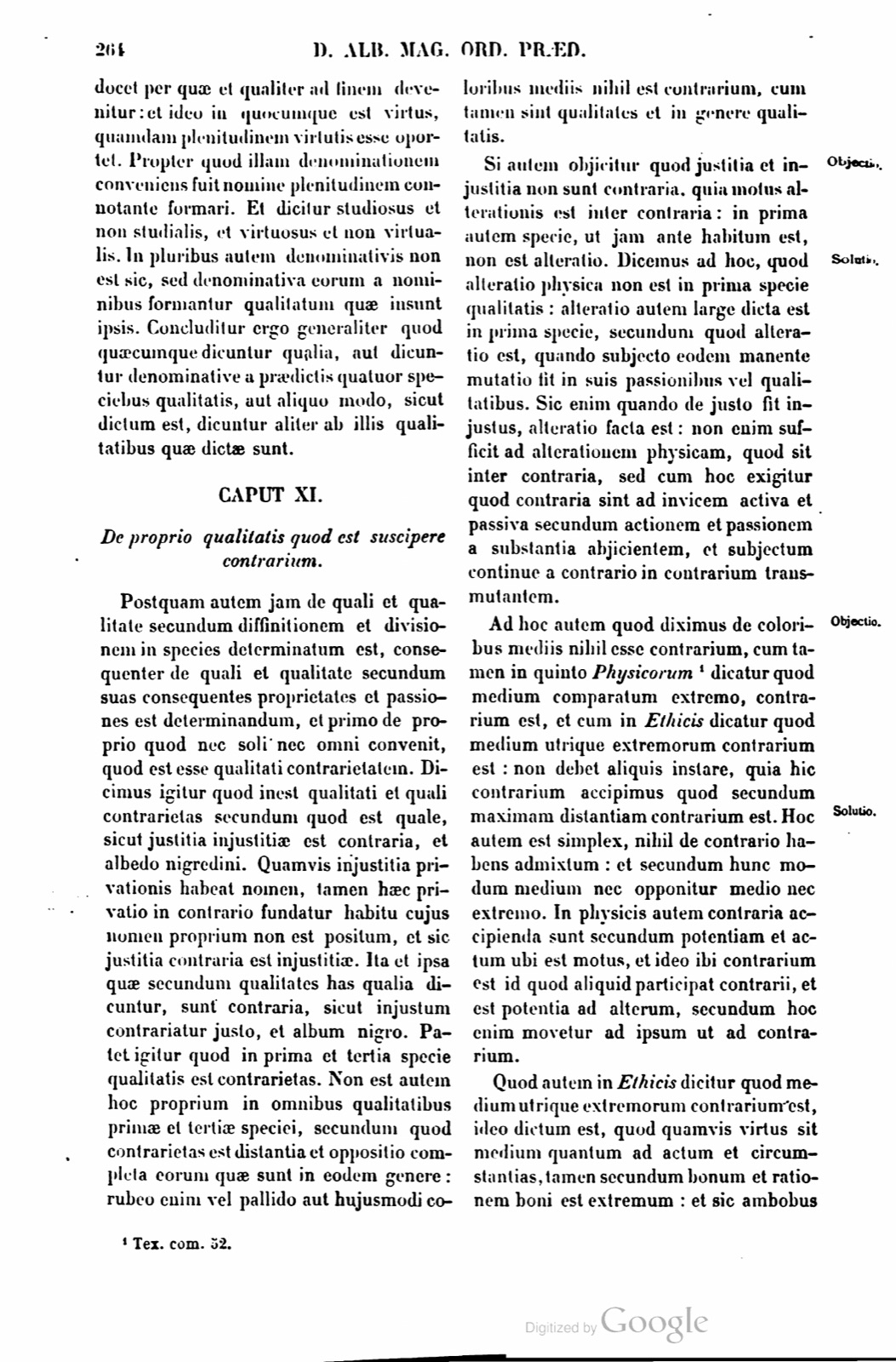
ducet per quæ et qualiter ad finem devenitur: et ideo in quocumque est virtus, quamdam plenitudinem virtutis esse oportet. Propter quod illam denominationem conveniens fuit nomine plenitudinem connotante formari. Et dicitur studiosus et non studialis, et virtuosus et non virtualis. In pluribus autem denominativis non est sic, sed denominativa eorum a nominibus formantur qualitatum quæ insunt ipsis. Concluditur ergo generaliter quod quæcumque dicuntur qualia, aut dicuntur denominative a prædictis quatuor speciebus qualitatis, aut aliquo modo, sicut dictum est, dicuntur aliter ab illis qualitatibus quæ dictæ sunt.
CAPUT XI.
De proprio qualitatis quod est suscipere contrarium.
Postquam autem jam de quali et qualitate secundum diffinitionem et divisionem in species determinatum est, consequenter de quali et qualitate secundum suas consequentes proprietates et passiones est determinandum, et primo de proprio quod nec soli nec omni convenit, quod est esse qualitati contrarietatem. Dicimus igitur quod inest qualitati et quali contrarietas secundum quod est quale, sicut justitia injustitiæ est contraria, et albedo nigredini. Quamvis injustitia privationis habeat nomen, tamen hæc privatio in contrario fundatur habitu cujus nomen proprium non est positum, et sic justitia contraria est injustitiæ. Ita et ipsa quæ secundum qualitates has qualia dicuntur, sunt contraria, sicut injustum contrariatur justo, et album nigro. Patet igitur quod in prima et tertia specie qualitatis est contrarietas. Non est autem hoc proprium in omnibus qualitatibus primæ et tertiæ speciei, secundum quod contrarietas est distantia et oppositio completa eorum quæ sunt in eodem genere: rubeo enim vel pallido aut hujusmodi coloribus mediis nihil est contrarium, cum tamen sint qualitates et in genere qualitatis.
Si autem objicitur quod justitia et injustitia non sunt contraria, quia motus alterationis est inter contraria: in prima autem specie, ut jam ante habitum est, non est alteratio. Dicemus ad hoc, quod alteratio physica non est in prima specie qualitatis: alteratio autem large dicta est in prima specie, secundum quod alteratio est, quando subjecto eodem manente mutatio fit in suis passionibus vel qualitatibus. Sic enim quando de justo fit injustus, alteratio facta est: non enim sufficit ad alterationem physicam, quod sit inter contraria, sed cum hoc exigitur quod contraria sint ad invicem activa et passiva secundum actionem et passionem a substantia abjicientem, et subjectum continue a contrario in contrarium transmutantem.
Ad hoc autem quod diximus de coloribus mediis nihil esse contrarium, cum tamen in quinto Physicorum1 dicatur quod medium comparatum extremo, contrarium est, et cum in Ethicis dicatur quod medium utrique extremorum contrarium est: non debet aliquis instare, quia hic contrarium accipimus quod secundum maximam distantiam contrarium est. Hoc autem est simplex, nihil de contrario habens admixtum: et secundum hunc modum medium nec opponitur medio nec extremo. In physicis autem contraria accipienda sunt secundum potentiam et actum ubi est motus, et ideo ibi contrarium est id quod aliquid participat contrarii, et est potentia ad alterum, secundum hoc enim movetur ad ipsum ut ad contrarium.
Quod autem in Ethicis dicitur quod medium utrique extremorum contrarium est, ideo dictum est, quod quamvis virtus sit medium quantum ad actum et circumstantias, tamen secundum bonum et rationem boni est extremum: et sic ambobus
and leads through what things and in what way the end is arrived at; and therefore in whatever there is virtue, there must be a certain fullness of virtue. On account of this it was fitting that that denomination be formed by a name connoting fullness. And he is called studious and not studial, and virtuous and not virtual. But in many denominatives it is not so, but their denominatives are formed from the names of the qualities which are present in them. Therefore it is generally concluded that whatever things are called qualia either are said denominatively from the aforesaid four species of quality, or in some way, as has been said, are said otherwise from those qualities which have been said.
CHAPTER XI.
Concerning the property of quality which is to receive a contrary.
But after it has now been determined concerning quale and quality according to definition and division into species, consequently one must determine concerning quale and quality according to their consequent properties and passions, and first concerning the property which belongs neither to it alone nor to every one, which is that contrariety belongs to quality. Therefore we say that contrariety is present in quality and in quale according as it is quale, as justice is contrary to injustice, and whiteness to blackness. Although injustice has the name of privation, nevertheless this privation is founded in a contrary habit of which the proper name has not been posited, and thus justice is contrary to injustice. So also those very things which are called qualia according to these qualities are contraries, as unjust is contrary to just, and white to black. Therefore it is clear that in the first and third species of quality there is contrariety. But this is not a property in all qualities of the first and third species, according as contrariety is the complete distance and opposition of those things which are in the same genus; for nothing is contrary to red or pale or middle colors of this kind, although nevertheless they are qualities and in the genus of quality.
But if it is objected that justice and injustice are not contraries, because the motion of alteration is between contraries, but in the first species, as has already been had before, there is no alteration, we will say to this that physical alteration is not in the first species of quality. But alteration broadly said is in the first species, according as there is alteration when, the same subject remaining, change comes to be in its passions or qualities. For in this way, when from just there comes to be unjust, alteration has been made. For it is not sufficient for physical alteration that it be between contraries, but with this it is required that the contraries be active and passive with respect to one another according to action and passion casting off from substance and continuously transmuting the subject from contrary into contrary.
But as to this, that we said that nothing is contrary to middle colors, although nevertheless in the fifth book of the Physics1 it is said that the mean compared to an extreme is contrary, and although in the Ethics it is said that the mean is contrary to each of the extremes: no one ought to press an objection, because here we take contrary as that which is contrary according to the greatest distance. But this is simple, having nothing of the contrary admixed; and according to this mode the mean is opposed neither to a mean nor to an extreme. But in physics contraries must be taken according to potency and act where there is motion, and therefore there a contrary is that which participates something of the contrary, and is in potency to the other; for according to this it is moved to it as to a contrary.
But what is said in the Ethics, that the mean is contrary to each of the extremes, was said for this reason, that although virtue is a mean as to act and circumstances, nevertheless according to good and the account of good it is an extreme; and thus to both
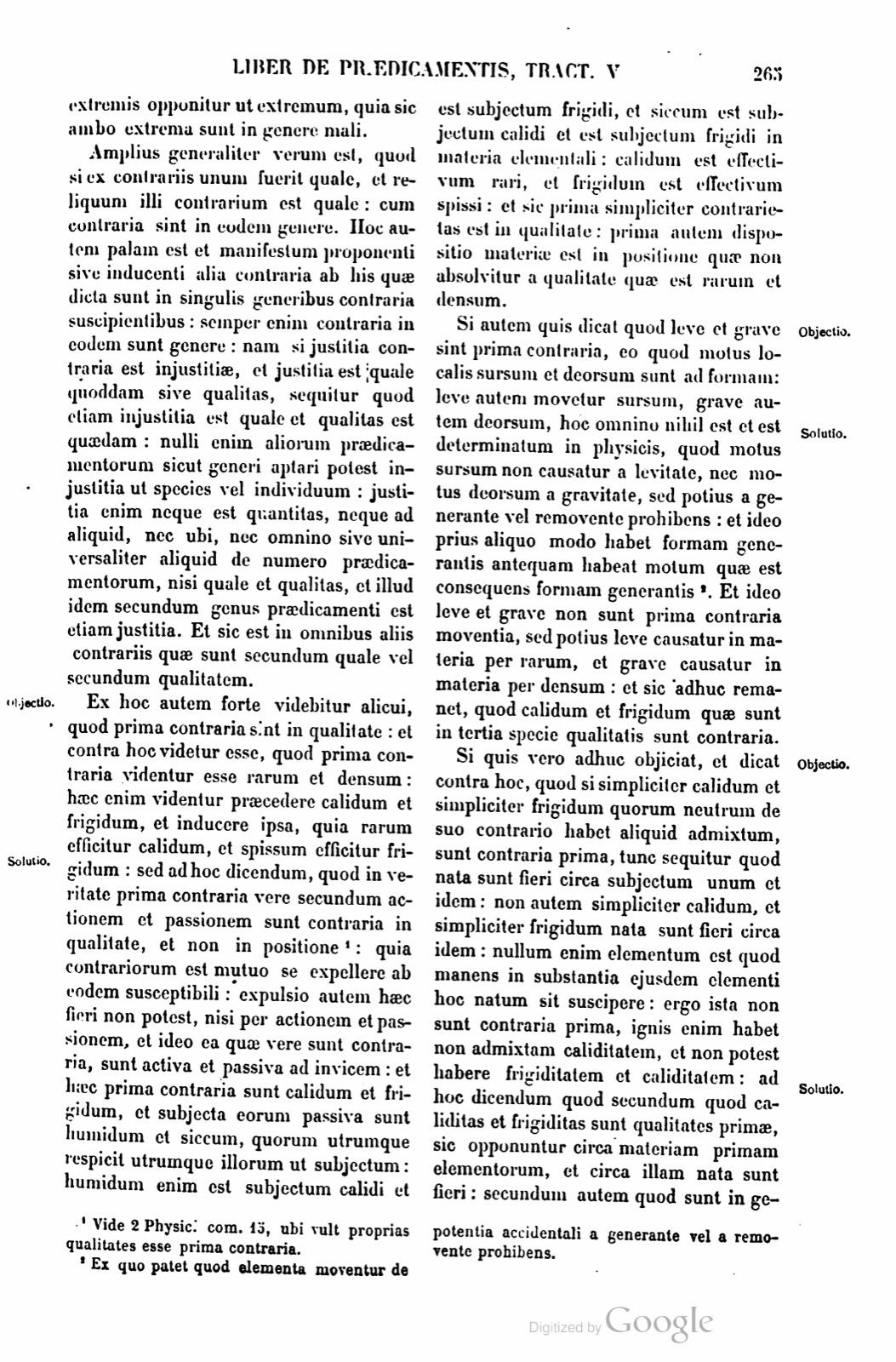
extremis opponitur ut extremum, quia sic ambo extrema sunt in genere mali.
Amplius generaliter verum est, quod si ex contrariis unum fuerit quale, et reliquum illi contrarium est quale: cum contraria sint in eodem genere. Hoc autem palam est et manifestum proponenti sive inducenti alia contraria ab his quæ dicta sunt in singulis generibus contraria suscipientibus: semper enim contraria in eodem sunt genere: nam si justitia contraria est injustitiæ, et justitia est quale quoddam sive qualitas, sequitur quod etiam injustitia est quale et qualitas est quædam: nulli enim aliorum prædicamentorum sicut generi aptari potest injustitia ut species vel individuum: justitia enim neque est quantitas, neque ad aliquid, nec ubi, nec omnino sive universaliter aliquid de numero prædicamentorum, nisi quale et qualitas, et illud idem secundum genus prædicamenti est etiam justitia. Et sic est in omnibus aliis contrariis quæ sunt secundum quale vel secundum qualitatem.
Ex hoc autem forte videbitur alicui, quod prima contraria sint in qualitate: et contra hoc videtur esse, quod prima contraria videntur esse rarum et densum: hæc enim videntur præcedere calidum et frigidum, et inducere ipsa, quia rarum efficitur calidum, et spissum efficitur frigidum: sed ad hoc dicendum, quod in veritate prima contraria vere secundum actionem et passionem sunt contraria in qualitate, et non in positione2: quia contrariorum est mutuo se expellere ab eodem susceptibili: expulsio autem hæc fieri non potest, nisi per actionem et passionem, et ideo ea quæ vere sunt contraria, sunt activa et passiva ad invicem: et hæc prima contraria sunt calidum et frigidum, et subjecta eorum passiva sunt humidum et siccum, quorum utrumque respicit utrumque illorum ut subjectum: humidum enim est subjectum calidi et est subjectum frigidi, et siccum est subjectum calidi et est subjectum frigidi in materia elementali: calidum est effectivum rari, et frigidum est effectivum spissi: et sic prima simpliciter contrarietas est in qualitate: prima autem dispositio materiæ est in positione quæ non absolvitur a qualitate quæ est rarum et densum.
it is opposed to the extremes as an extreme, because in this way both extremes are in the genus of evil.
Further, it is generally true that if one of contraries has been a quale, the remaining thing contrary to it is a quale, since contraries are in the same genus. But this is plain and manifest to one proposing or inducing other contraries from those things which have been said in the several genera receiving contraries; for contraries are always in the same genus. For if justice is contrary to injustice, and justice is a certain quale or quality, it follows that injustice also is a quale and is a certain quality. For injustice can be fitted to none of the other predicaments as to a genus, as species or individual; for justice is neither quantity, nor toward something, nor where, nor wholly or universally anything from the number of predicaments, except quale and quality, and justice also is that same thing according to the genus of predicament. And so it is in all other contraries which are according to quale or according to quality.
But from this perhaps it will seem to someone that the first contraries are in quality; and against this there seems to be this, that the first contraries seem to be rare and dense. For these seem to precede hot and cold, and to induce them, because the rare is made hot, and the dense is made cold. But to this it must be said that in truth the first contraries truly according to action and passion are contraries in quality, and not in position2, because it belongs to contraries mutually to expel one another from the same susceptible thing. But this expulsion cannot happen except through action and passion, and therefore those things which are truly contraries are active and passive with respect to one another; and these first contraries are hot and cold, and their passive subjects are moist and dry, each of which regards each of them as subject. For moist is the subject of hot and is the subject of cold, and dry is the subject of hot and is the subject of cold in elemental matter. Hot is productive of rare, and cold is productive of dense; and thus the first contrariety simply is in quality. But the first disposition of matter is in position which is not separated from the quality which is rare and dense.
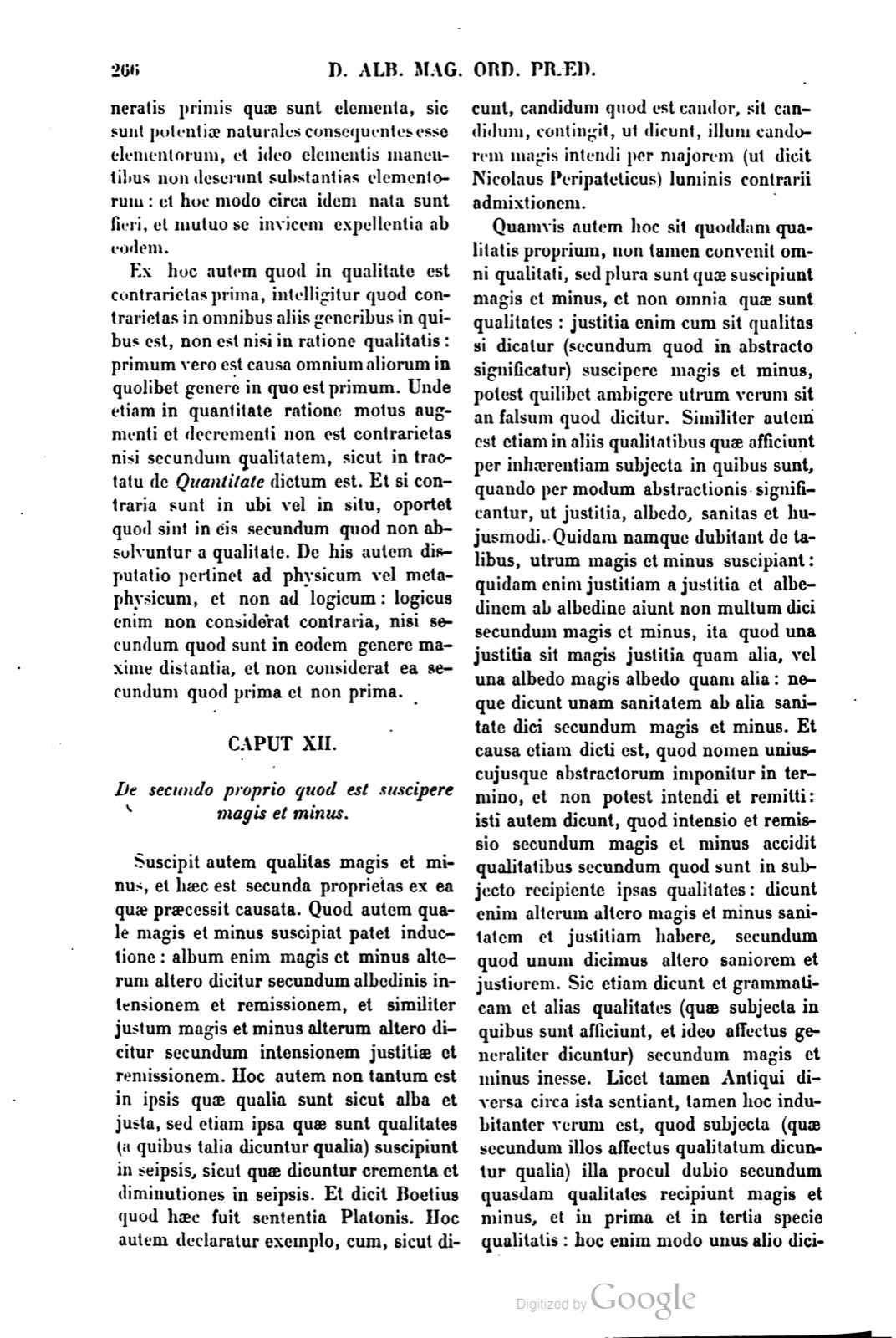
Si autem quis dicat quod leve et grave sint prima contraria, eo quod motus localis sursum et deorsum sunt ad formam: leve autem movetur sursum, grave autem deorsum, hoc omnino nihil est et est determinatum in physicis, quod motus sursum non causatur a levitate, nec motus deorsum a gravitate, sed potius a generante vel removente prohibens: et ideo prius aliquo modo habet formam generantis antequam habeat motum quæ est consequens formam generantis3. Et ideo leve et grave non sunt prima contraria moventia, sed potius leve causatur in materia per rarum, et grave causatur in materia per densum: et sic adhuc remanet, quod calidum et frigidum quæ sunt in tertia specie qualitatis sunt contraria.
Si quis vero adhuc objiciat, et dicat contra hoc, quod si simpliciter calidum et simpliciter frigidum quorum neutrum de suo contrario habet aliquid admixtum, sunt contraria prima, tunc sequitur quod nata sunt fieri circa subjectum unum et idem: non autem simpliciter calidum, et simpliciter frigidum nata sunt fieri circa idem: nullum enim elementum est quod manens in substantia ejusdem elementi hoc natum sit suscipere: ergo ista non sunt contraria prima, ignis enim habet non admixtam caliditatem, et non potest habere frigiditatem et caliditatem: ad hoc dicendum quod secundum quod caliditas et frigiditas sunt qualitates primæ, sic opponuntur circa materiam primam elementorum, et circa illam nata sunt fieri: secundum autem quod sunt in generatis
But if someone says that light and heavy are the first contraries, because local motions upward and downward are toward form, but the light is moved upward and the heavy downward, this is altogether nothing, and it is determined in the Physics that motion upward is not caused by lightness, nor motion downward by heaviness, but rather by the generator or by the one removing what prevents; and therefore in some way it first has the form of the generator before it has the motion which is consequent on the form of the generator3. And therefore light and heavy are not the first moving contraries, but rather light is caused in matter through rare, and heavy is caused in matter through dense; and thus it still remains that hot and cold, which are in the third species of quality, are contraries.
But if someone still objects, and says against this, that if simply hot and simply cold, neither of which has anything admixed from its contrary, are first contraries, then it follows that they are apt to come to be around one and the same subject; but simply hot and simply cold are not apt to come to be around the same thing, for there is no element which, while remaining in the substance of the same element, is apt to receive this; therefore these are not first contraries, for fire has unadmixed heat and cannot have coldness and heat. To this it must be said that according as heat and coldness are first qualities, in this way they are opposed around the first matter of the elements and are apt to come to be around it; but according as they are in generated things
Notes
- Text/comment 52. (Tex. com. 52.) ↩
- See Physics 2, comment 15, where he intends the proper qualities to be the first contraries. (Vide 2 Physic. com. 15, ubi vult proprias qualitates esse prima contraria.) ↩
- From this it is clear that the elements are moved from accidental potency by the generator or by one removing what prevents. (Ex quo patet quod elementa moventur de potentia accidentali a generante vel a removente prohibens.) ↩
If a page does not appear, its photograph has not been uploaded yet.