Volume 1 · pp. 262–263
Chapter X
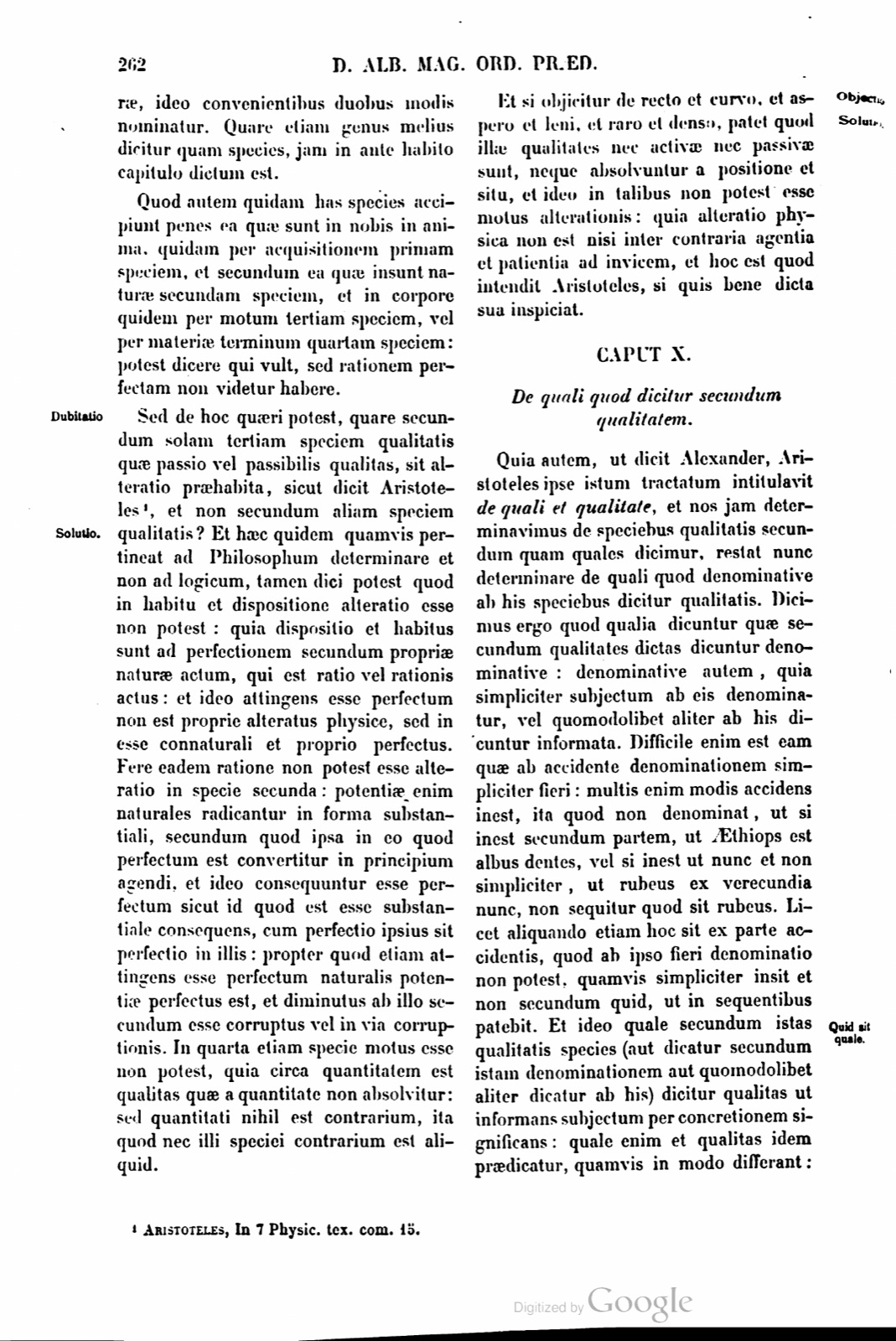
ideo convenientibus duobus modis nominatur. Quare etiam genus melius dicitur quam species, jam in ante habito capitulo dictum est.
Quod autem quidam has species accipiunt penes ea quæ sunt in nobis in anima, quidam per acquisitionem primam speciem, et secundum ea quæ insunt naturæ secundam speciem, et in corpore quidem per motum tertiam speciem, vel per materiæ terminum quartam speciem: potest dicere qui vult, sed rationem perfectam non videtur habere.
Sed de hoc quæri potest, quare secundum solam tertiam speciem qualitatis quæ passio vel passibilis qualitas, sit alteratio præhabita, sicut dicit Aristoteles,1 et non secundum aliam speciem qualitatis? Et hæc quidem quamvis pertineat ad Philosophum determinare et non ad logicum, tamen dici potest quod in habitu et dispositione alteratio esse non potest: quia dispositio et habitus sunt ad perfectionem secundum propriæ naturæ actum, qui est ratio vel rationis actus: et ideo attingens esse perfectum non est proprie alteratus physice, sed in esse connaturali et proprio perfectus. Fere eadem ratione non potest esse alteratio in specie secunda: potentiæ enim naturales radicantur in forma substantiali, secundum quod ipsa in eo quod perfectum est convertitur in principium agendi, et ideo consequuntur esse perfectum sicut id quod est esse substantiale consequens, cum perfectio ipsius sit perfectio in illis: propter quod etiam attingens esse perfectum naturalis potentiæ perfectus est, et diminutus ab illo secundum esse corruptus vel in via corruptionis. In quarta etiam specie motus esse non potest, quia circa quantitatem est qualitas quæ a quantitate non absolvitur: sed quantitati nihil est contrarium, ita quod nec illi speciei contrarium est aliquid.
Et si objicitur de recto et curvo, et aspero et leni, et raro et denso, patet quod illæ qualitates nec activæ nec passivæ sunt, neque absolvuntur a positione et situ, et ideo in talibus non potest esse motus alterationis: quia alteratio physica non est nisi inter contraria agentia et patientia ad invicem, et hoc est quod intendit Aristoteles, si quis bene dicta sua inspiciat.
CAPUT X.
De quali quod dicitur secundum qualitatem.
Quia autem, ut dicit Alexander, Aristoteles ipse istum tractatum intitulavit de quali et qualitate, et nos jam determinavimus de speciebus qualitatis secundum quam quales dicimur, restat nunc determinare de quali quod denominative ab his speciebus dicitur qualitatis. Dicimus ergo quod qualia dicuntur quæ secundum qualitates dictas dicuntur denominative: denominative autem, quia simpliciter subjectum ab eis denominatur, vel quomodolibet aliter ab his dicuntur informata. Difficile enim est eam quæ ab accidente denominationem simpliciter fieri: multis enim modis accidens inest, ita quod non denominat, ut si inest secundum partem, ut Æthiops est albus dentes, vel si inest ut nunc et non simpliciter, ut rubeus ex verecundia nunc, non sequitur quod sit rubeus. Licet aliquando etiam hoc sit ex parte accidentis, quod ab ipso fieri denominatio non potest, quamvis simpliciter insit et non secundum quid, ut in sequentibus patebit. Et ideo quale secundum istas qualitatis species (aut dicatur secundum istam denominationem aut quomodolibet aliter dicatur ab his) dicitur qualitas ut informans subjectum per concretionem significans: quale enim et qualitas idem prædicatur, quamvis in modo differant:
therefore it is named by two fitting modes. Why also it is better called a genus than a species has already been said in the chapter had before.
But that some take these species according to those things which are in us in the soul, some taking the first species through acquisition, and the second species according to those things which are present in nature, and in the body indeed the third species through motion, or the fourth species through the boundary of matter: whoever wishes can say this, but it does not seem to have a perfect account.
But concerning this it can be asked why, according to the third species of quality alone, which is passion or passible quality, there is the alteration treated before, as Aristotle says,1 and not according to another species of quality. And although this indeed pertains to the Philosopher and not to the logician to determine, nevertheless it can be said that there cannot be alteration in habit and disposition, because disposition and habit are toward perfection according to the act of their proper nature, which is an account or an act of reason; and therefore what attains perfect being is not properly altered physically, but perfected in connatural and proper being. By almost the same account there cannot be alteration in the second species; for natural potencies are rooted in substantial form, according as it, in that which has been perfected, is converted into a principle of acting, and therefore they follow upon perfect being as that which is consequent upon substantial being, since its perfection is perfection in them; on account of this also what attains the perfect being of natural potency is perfected, and what is diminished from that is corrupted according to being or is on the way of corruption. In the fourth species also there cannot be motion, because around quantity there is quality which is not separated from quantity; but nothing is contrary to quantity, so that neither is anything contrary to that species.
And if an objection is made concerning straight and curved, and rough and smooth, and rare and dense, it is clear that those qualities are neither active nor passive, nor are they separated from position and situation, and therefore in such things there cannot be motion of alteration, because physical alteration is only between contrary things acting and suffering with respect to one another, and this is what Aristotle intends, if someone inspects his sayings well.
CHAPTER X.
Concerning the quale which is said according to quality.
But because, as Alexander says, Aristotle himself entitled this treatise On Quale and Quality, and we have now determined concerning the species of quality according to which we are called quales, it remains now to determine concerning the quale which is said denominatively from these species of quality. Therefore we say that those things are called qualia which according to the qualities said are said denominatively; denominatively, moreover, because the subject is denominated from them simply, or in whatever other way things informed by these are said from these. For it is difficult for the denomination which is from an accident to be made simply; for an accident is present in many ways, such that it does not denominate, as if it is present according to a part, as an Ethiopian is white with respect to the teeth, or if it is present as now and not simply, as red now from shame, it does not follow that he is red. Although sometimes this also is from the side of the accident, that denomination cannot be made from it, although it is present simply and not in a qualified respect, as will be clear in the following things. And therefore quale according to these species of quality, whether it is said according to that denomination or in whatever other way it is said from these, is called quality as signifying what informs the subject through concretion; for quale and quality are predicated the same, although they differ in mode:
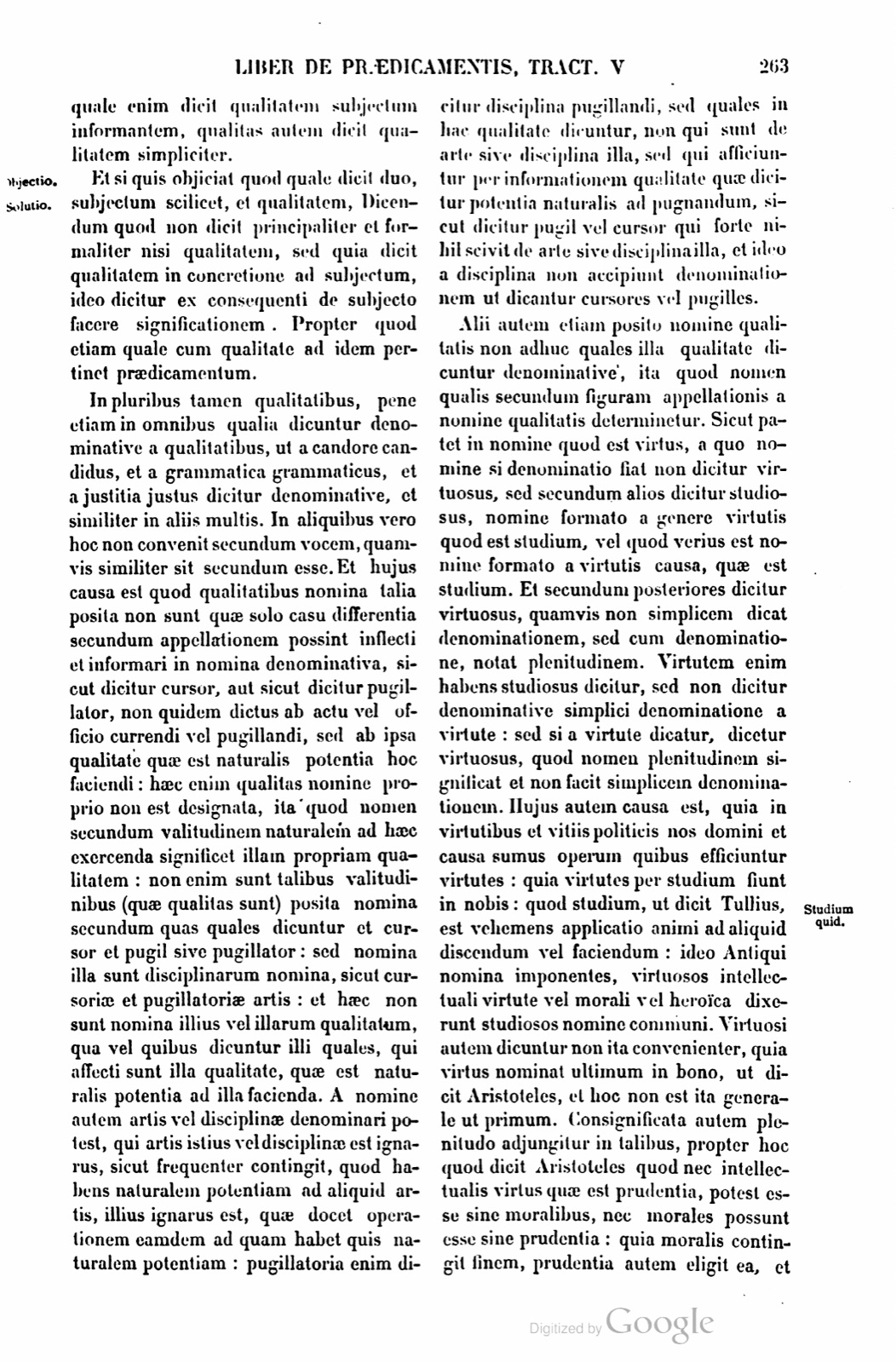
quale enim dicit qualitatem subjectum informantem, qualitas autem dicit qualitatem simpliciter.
Et si quis objiciat quod quale dicit duo, subjectum scilicet, et qualitatem, Dicendum quod non dicit principaliter et formaliter nisi qualitatem, sed quia dicit qualitatem in concretione ad subjectum, ideo dicitur ex consequenti de subjecto facere significationem. Propter quod etiam quale cum qualitate ad idem pertinet prædicamentum.
In pluribus tamen qualitatibus, pene etiam in omnibus qualia dicuntur denominative a qualitatibus, ut a candore candidus, et a grammatica grammaticus, et a justitia justus dicitur denominative, et similiter in aliis multis. In aliquibus vero hoc non convenit secundum vocem, quamvis similiter sit secundum esse. Et hujus causa est quod qualitatibus nomina talia posita non sunt quæ solo casu differentia secundum appellationem possint inflecti et informari in nomina denominativa, sicut dicitur cursor, aut sicut dicitur pugillator, non quidem dictus ab actu vel officio currendi vel pugillandi, sed ab ipsa qualitate quæ est naturalis potentia hoc faciendi: hæc enim qualitas nomine proprio non est designata, ita quod nomen secundum valitudinem naturalem ad hæc exercenda significet illam propriam qualitatem: non enim sunt talibus valitudinibus (quæ qualitas sunt) posita nomina secundum quas quales dicuntur et cursor et pugil sive pugillator: sed nomina illa sunt disciplinarum nomina, sicut cursoriæ et pugillatoriæ artis: et hæc non sunt nomina illius vel illarum qualitatum, qua vel quibus dicuntur illi quales, qui affecti sunt illa qualitate, quæ est naturalis potentia ad illa facienda. A nomine autem artis vel disciplinæ denominari potest, qui artis istius vel disciplinæ est ignarus, sicut frequenter contingit, quod habens naturalem potentiam ad aliquid artis, illius ignarus est, quæ docet operationem eamdem ad quam habet quis naturalem potentiam: pugillatoria enim dicitur disciplina pugillandi, sed quales in hac qualitate dicuntur, non qui sunt de arte sive disciplina illa, sed qui afficiuntur per informationem qualitate quæ dicitur potentia naturalis ad pugnandum, sicut dicitur pugil vel cursor qui forte nihil scivit de arte sive disciplina illa, et ideo a disciplina non accipiunt denominationem ut dicantur cursores vel pugilles.
Alii autem etiam posito nomine qualitatis non adhuc quales illa qualitate dicuntur denominative, ita quod nomen qualis secundum figuram appellationis a nomine qualitatis determinetur. Sicut patet in nomine quod est virtus, a quo nomine si denominatio fiat non dicitur virtuosus, sed secundum alios dicitur studiosus, nomine formato a genere virtutis quod est studium, vel quod verius est nomine formato a virtutis causa, quæ est studium. Et secundum posteriores dicitur virtuosus, quamvis non simplicem dicat denominationem, sed cum denominatione, notat plenitudinem. Virtutem enim habens studiosus dicitur, sed non dicitur denominative simplici denominatione a virtute: sed si a virtute dicatur, dicetur virtuosus, quod nomen plenitudinem significat et non facit simplicem denominationem. Hujus autem causa est, quia in virtutibus et vitiis politicis nos domini et causa sumus operum quibus efficiuntur virtutes: quia virtutes per studium fiunt in nobis: quod studium, ut dicit Tullius, est vehemens applicatio animi ad aliquid discendum vel faciendum: ideo Antiqui nomina imponentes, virtuosos intellectuali virtute vel morali vel heroica dixerunt studiosos nomine communi. Virtuosi autem dicuntur non ita convenienter, quia virtus nominat ultimum in bono, ut dicit Aristoteles, et hoc non est ita generale ut primum. Consignificata autem plenitudo adjungitur in talibus, propter hoc quod dicit Aristoteles quod nec intellectualis virtus quæ est prudentia, potest esse sine moralibus, nec morales possunt esse sine prudentia: quia moralis contingit finem, prudentia autem eligit ea, et
for quale says quality informing a subject, but quality says quality simply.
And if someone objects that quale says two things, namely subject and quality, it must be said that principally and formally it says only quality; but because it says quality in concretion to a subject, therefore consequently it is said to make signification concerning the subject. On account of this, quale also belongs with quality to the same predicament.
Yet in several qualities, almost even in all, qualia are said denominatively from qualities, as from whiteness white, and from grammar grammatical, and from justice just is said denominatively, and similarly in many others. But in some this does not agree according to the word, although similarly it is so according to being. And the cause of this is that such names have not been posited for qualities which, differing by case alone according to appellation, could be inflected and informed into denominative names, as runner is said, or as boxer is said, not indeed said from the act or office of running or boxing, but from the quality itself which is natural potency for doing this. For this quality is not designated by its own name, such that a name according to natural aptitude for exercising these things would signify that proper quality; for names are not posited for such aptitudes, which are quality, according to which both runner and fighter or boxer are called quales; but those names are names of disciplines, as of the running and boxing art; and these are not names of that quality or of those qualities, by which or according to which those are called quales who are affected by that quality, which is natural potency for doing those things. But from the name of an art or discipline one can be denominated who is ignorant of that art or discipline, as frequently happens, that one having a natural potency toward something of an art is ignorant of that art which teaches the same operation for which someone has a natural potency; for boxing is called the discipline of boxing, but those are called quales in this quality, not who are of that art or discipline, but who are affected through information by the quality which is called natural potency for fighting, as he is called fighter or runner who perhaps knew nothing of that art or discipline, and therefore they do not receive denomination from the discipline so as to be called runners or fighters.
But some, even when the name of the quality has been posited, are not yet called quales denominatively by that quality, so that the name of the quale is determined according to the figure of appellation from the name of the quality. This is clear in the name which is virtue; if denomination is made from this name, one is not called virtuous, but according to others is called studious, by a name formed from the genus of virtue, which is study, or, what is truer, by a name formed from the cause of virtue, which is study. And according to later writers he is called virtuous, although it does not say a simple denomination, but, with denomination, marks plenitude. For one having virtue is called studious, but he is not called denominatively from virtue by a simple denomination; but if he is said from virtue, he will be called virtuous, which name signifies plenitude and does not make simple denomination. But the cause of this is that in the political virtues and vices we are lords and cause of the works by which virtues are produced, because virtues come to be in us through study; and this study, as Tullius says, is a vehement application of the soul to learning or doing something. Therefore the Ancients, imposing names, called those virtuous by intellectual virtue or moral or heroic virtue by the common name studious. But they are called virtuous not so conveniently, because virtue names the ultimate in good, as Aristotle says, and this is not as general as the first. But co-signified plenitude is added in such cases, on account of this which Aristotle says, that neither intellectual virtue, which is prudence, can exist without the moral virtues, nor can the moral virtues exist without prudence, because the moral virtue reaches the end, but prudence chooses those things, and
Notes
- Aristotle, On Physics 7, text/comment 45. (Aristoteles, In 7 Physic. tex. com. 45.) ↩
If a page does not appear, its photograph has not been uploaded yet.