Volume 1 · pp. 257–259
Chapter VII
A marker with ≈ is an approximate page boundary, placed by measure of the text; the page photographs remain the authority. In the paired views, clicking a page marker brings that page into view.
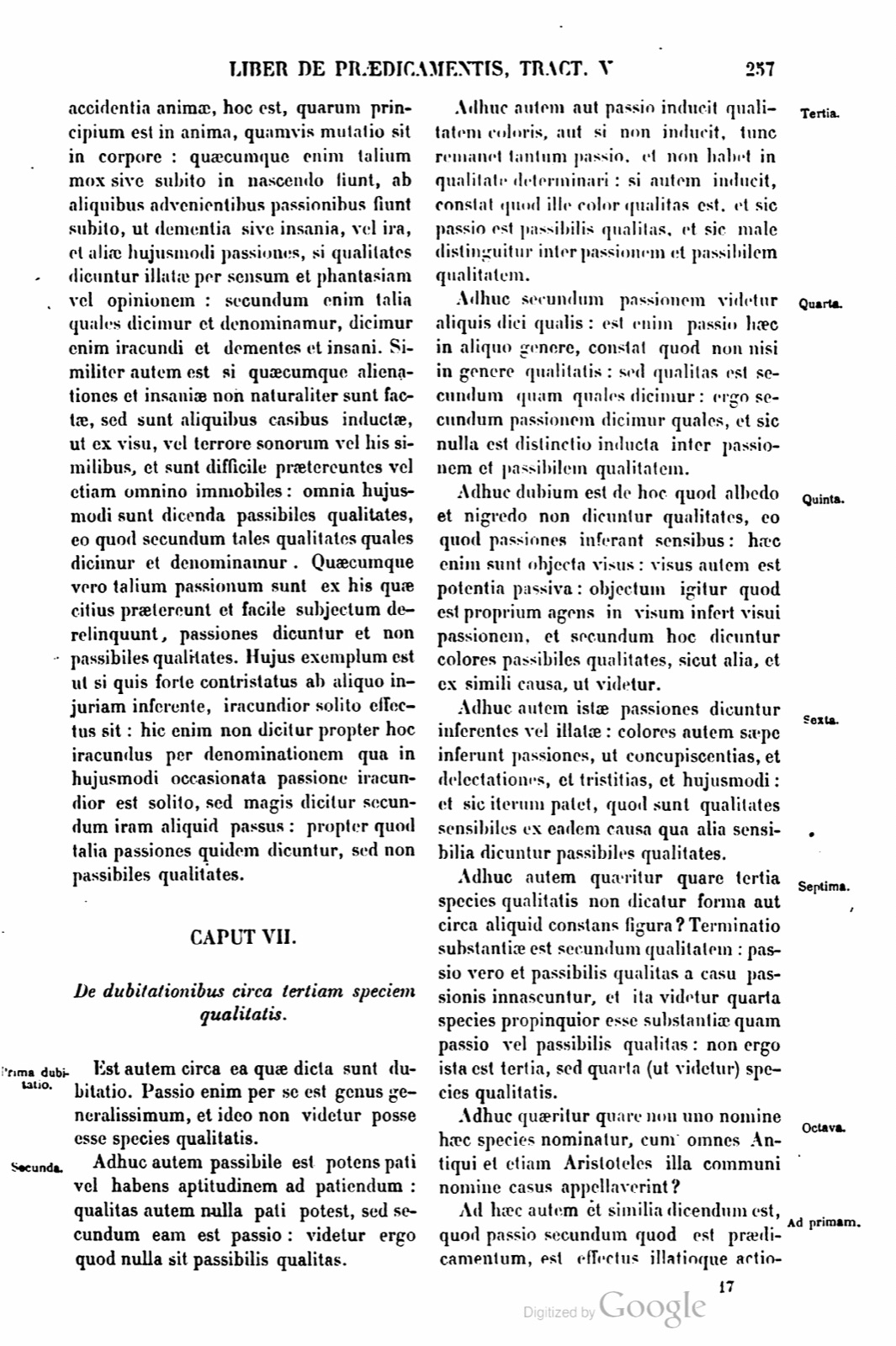
accidentia animæ, hoc est, quarum principium est in anima, quamvis mutatio sit in corpore: quæcumque enim talium mox sive subito in nascendo fiunt, ab aliquibus advenientibus passionibus fiunt subito, ut dementia sive insania, vel ira, et aliæ hujusmodi passiones, si qualitates dicuntur illatæ per sensum et phantasiam vel opinionem: secundum enim talia quales dicimur et denominamur, dicimur enim iracundi et dementes et insani. Similiter autem est si quæcumque alienationes et insaniæ non naturaliter sunt factæ, sed sunt aliquibus casibus inductæ, ut ex visu, vel terrore sonorum vel his similibus, et sunt difficile prætereuntes vel etiam omnino immobiles: omnia hujusmodi sunt dicenda passibiles qualitates, eo quod secundum tales qualitates quales dicimur et denominamur. Quæcumque vero talium passionum sunt ex his quæ citius prætereunt et facile subjectum derelinquunt, passiones dicuntur et non passibiles qualitates. Hujus exemplum est ut si quis forte contristatus ab aliquo injuriam inferente, iracundior solito effectus sit: hic enim non dicitur propter hoc iracundus per denominationem qua in hujusmodi occasionata passione iracundior est solito, sed magis dicitur secundum iram aliquid passus: propter quod talia passiones quidem dicuntur, sed non passibiles qualitates.
CAPUT VII.
De dubitationibus circa tertiam speciem qualitatis.
Est autem circa ea quæ dicta sunt dubitatio. Passio enim per se est genus generalissimum, et ideo non videtur posse esse species qualitatis.
Adhuc autem passibile est potens pati vel habens aptitudinem ad patiendum: qualitas autem nulla pati potest, sed secundum eam est passio: videtur ergo quod nulla sit passibilis qualitas.
Adhuc autem aut passio inducit qualitatem coloris, aut si non inducit, tunc remanet tantum passio, et non habet in qualitate determinari: si autem inducit, constat quod ille color qualitas est, et sic passio est passibilis qualitas, et sic male distinguitur inter passionem et passibilem qualitatem.
Adhuc secundum passionem videtur aliquis dici qualis: est enim passio hæc in aliquo genere, constat quod non nisi in genere qualitatis: sed qualitas est secundum quam quales dicimur: ergo secundum passionem dicimur quales, et sic nulla est distinctio inducta inter passionem et passibilem qualitatem.
Adhuc dubium est de hoc quod albedo et nigredo non dicuntur qualitates, eo quod passiones inferant sensibus: hæc enim sunt objecta visus: visus autem est potentia passiva: objectum igitur quod est proprium agens in visum infert visui passionem, et secundum hoc dicuntur colores passibiles qualitates, sicut alia, et ex simili causa, ut videtur.
Adhuc autem istæ passiones dicuntur inferentes vel illatæ: colores autem sæpe inferunt passiones, ut concupiscentias, et delectationes, et tristitias, et hujusmodi: et sic iterum patet, quod sunt qualitates sensibiles ex eadem causa qua alia sensibilia dicuntur passibiles qualitates.
Adhuc autem quæritur quare tertia species qualitatis non dicatur forma aut circa aliquid constans figura? Terminatio substantiæ est secundum qualitatem: passio vero et passibilis qualitas a casu passionis innascuntur, et ita videtur quarta species propinquior esse substantiæ quam passio vel passibilis qualitas: non ergo ista est tertia, sed quarta (ut videtur) species qualitatis.
Adhuc quæritur quare non uno nomine hæc species nominatur, cum omnes Antiqui et etiam Aristoteles illa communi nomine casus appellaverint?
Ad hæc autem et similia dicendum est, quod passio secundum quod est prædicamentum, est effectus illationisque actionis
accidents of the soul, that is, those whose principle is in the soul, although the alteration is in the body; for whatever such things come to be immediately or suddenly in being born, they come to be suddenly from some arriving passions, as dementia or insanity, or anger, and other passions of this kind, if they are called qualities brought in through sense and phantasy or opinion. For according to such things we are called quales and are denominated; for we are called wrathful and demented and insane. But it is similar if any alienations and insanities have been made not naturally, but have been induced by some cases, as from sight, or by terror of sounds or by things similar to these, and are difficult to pass away or even altogether immobile: all things of this kind must be called passible qualities, because according to such qualities we are called quales and are denominated. But whatever of such passions are from those things which pass away more quickly and easily leave the subject behind are called passions and not passible qualities. The example of this is that if perhaps someone, having been saddened by someone inflicting injury, has become more wrathful than usual, he is not for this reason called wrathful by a denomination by which in such an occasioned passion he is more wrathful than usual, but rather he is said to have suffered something according to anger; on account of this such things are indeed called passions, but not passible qualities.
CHAPTER VII.
Concerning the doubts about the third species of quality.
Now there is a doubt about the things which have been said. For passion through itself is a most general genus, and therefore does not seem able to be a species of quality.
Further, the passible is able to suffer or has an aptitude for suffering; but no quality can suffer, but according to it there is passion; therefore it seems that there is no passible quality.
Further, either passion induces the quality of color, or if it does not induce it, then it remains only passion and does not have to be determined in quality. But if it induces it, it is agreed that that color is a quality, and thus passion is passible quality, and thus a bad distinction is made between passion and passible quality.
Further, according to passion someone seems to be called quale; for this passion is in some genus, and it is agreed that it is only in the genus of quality; but quality is that according to which we are called quales; therefore according to passion we are called quales, and thus no distinction has been introduced between passion and passible quality.
Further, there is doubt concerning this, that whiteness and blackness are not called qualities because they introduce passions to the senses; for these are objects of sight, and sight is a passive potency; therefore the object which is the proper agent upon sight introduces passion to sight, and according to this colors are called passible qualities, as the other things are, and from a similar cause, as it seems.
Further, those passions are called inferent or brought-in; but colors often introduce passions, as desires and delights and sadnesses and things of this kind; and thus again it is clear that they are sensible qualities from the same cause by which other sensible things are called passible qualities.
Further, it is asked why the third species of quality is not called form or figure standing around something. The termination of substance is according to quality; but passion and passible quality arise from the case of passion, and thus the fourth species seems to be nearer to substance than passion or passible quality; therefore that is not the third species, but the fourth, as it seems, of quality.
Further, it is asked why this species is not named by one name, since all the Ancients and even Aristotle called it by the common name case.
But to these and similar things it must be said that passion, according as it is a predicament, is the effect of bringing-in and of action
in id quod patitur: et sic non sumitur passio quæ est species qualitatis, sed pro forma qualitatis quæ afficit subjectum ex hoc quod aliquid passum est, quod est causa affectionis illius, vel ex eo quod affectui subjectum ex ipsa affectione inducit passionem quæ continet subjectum secundum complexionantia vel componentia subjectum, sicut ira inducta ab aliquo circumstante accendit sanguinem circa cor et immiscet vaporem fellis ad vindictæ appetitum. Et ideo æquivocatio est in passione, quæ secundum quod est effectus agentis genus est: secundum autem quod affectio commotione facta vel commotionem inducens est species qualitatis.
Ad aliud dicendum quod non dicitur passibilis qualitas eo quod ipsa qualitas aliquid patiatur, sed (sicut dictum est) quod vel passione inducitur vel passionem inducit, et quia sic passioni conjuncta est, ut causa vel effectus, ideo dicitur passibilis qualitas.
Ad aliud dicendum quod passio inducit id quod est qualitas secundum essentiam: sed non est qualitas secundum quod ab ipso quale dicitur denominative, quia denominationes non sunt nisi ab his quæ insunt simpliciter: simpliciter autem non inest quod non est in subjecto radicatum et firmatum, quia sic non sequitur, iste est affectus rubore ex verecundia, ergo est rubeus.
Et per hoc patet solutio ad sequens: est enim id quod inducitur ex passione in genere qualitatis, sed non secundum quod quale simpliciter, sed secundum hoc denominative prædicatur.
Ad id autem quod ulterius dubitatur de albedine et nigredine, satis in ante habito capitulo responsum est. Et quod dicitur quod passiones inferunt visui, Dicendum quod illæ sunt passiones secundum quid et non simpliciter: quia sunt talia in visu secundum esse spirituale, et ideo motum et passionem simpliciter non inducunt.
Ad hoc autem quod objicitur, quod inducunt delectationes et concupiscentias, Dicendum quod hoc est per accidens, non enim hoc faciunt in quantum visibilia tantum, sed in quantum sunt signa delectabilium secundum gustum et secundum tactum: secundum quid enim et non simpliciter est delectatio in visu secundum quod visus movetur a visibili tantum.
into that which suffers; and thus passion which is a species of quality is not taken, but rather it is taken for the form of quality which affects the subject from the fact that something has been suffered, which is the cause of that affection, or from the fact that the subject affected by the affection itself induces a passion which contains the subject according to the things complexioning or composing the subject, as anger induced by some surrounding thing kindles the blood around the heart and mixes the vapor of gall toward the appetite for vengeance. And therefore there is equivocation in passion, which, according as it is the effect of the agent, is a genus; but according as it is an affection made by commotion or inducing commotion, it is a species of quality.
To the other, it must be said that it is not called a passible quality because the quality itself suffers something, but, as has been said, because either it is induced by passion or it induces passion; and because in this way it is conjoined to passion, as cause or effect, therefore it is called a passible quality.
To the other, it must be said that passion induces that which is quality according to essence; but it is not quality according as from it the quale itself is said denominatively, because denominations are only from those things which are present simply. But what is not rooted and made firm in a subject is not present simply, because in this way it does not follow: this man is affected by redness from shame, therefore he is red.
And through this the solution to the following is clear; for that which is induced from passion is in the genus of quality, but not according as quale is predicated simply, but it is predicated denominatively according to this.
To that, moreover, which is further doubted about whiteness and blackness, enough response has been made in the chapter had before. And as to what is said, that they introduce passions to sight, it must be said that those are passions in a qualified respect and not simply, because such things are in sight according to spiritual being, and therefore they do not induce motion and passion simply.
To this, moreover, which is objected, that they induce delights and desires, it must be said that this is accidentally; for they do not do this insofar as they are visible only, but insofar as they are signs of things delightful according to taste and according to touch. For delight is in sight in a qualified respect and not simply, according as sight is moved by the visible only.
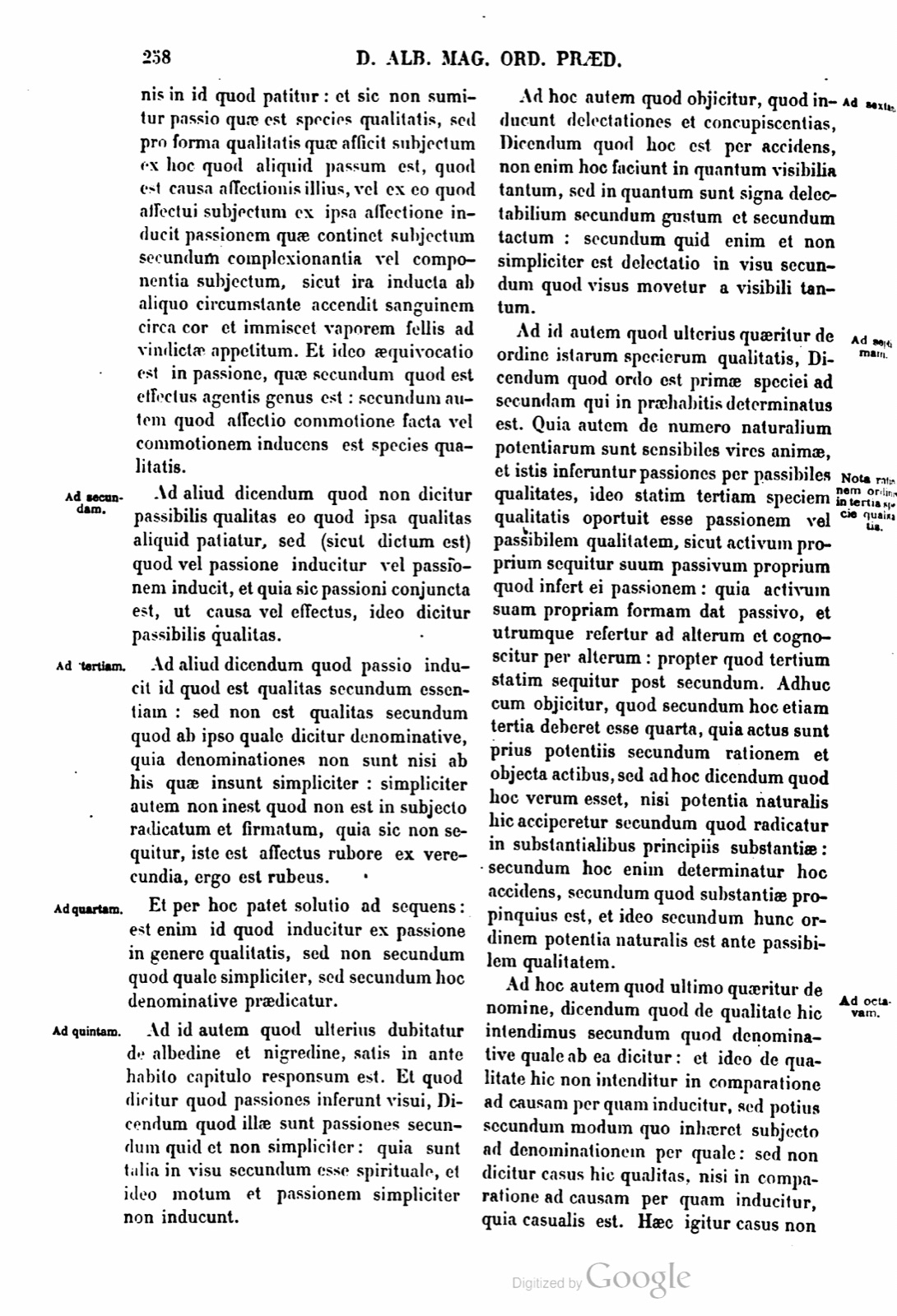
Ad id autem quod ulterius quæritur de ordine istarum specierum qualitatis, Dicendum quod ordo est primæ speciei ad secundam qui in præhabitis determinatus est. Quia autem de numero naturalium potentiarum sunt sensibiles vires animæ, et istis inferuntur passiones per passibiles qualitates, ideo statim tertiam speciem qualitatis oportuit esse passionem vel passibilem qualitatem, sicut activum proprium sequitur suum passivum proprium quod infert ei passionem: quia activum suam propriam formam dat passivo, et utrumque refertur ad alterum et cognoscitur per alterum: propter quod tertium statim sequitur post secundum. Adhuc cum objicitur, quod secundum hoc etiam tertia deberet esse quarta, quia actus sunt prius potentiis secundum rationem et objecta actibus, sed ad hoc dicendum quod hoc verum esset, nisi potentia naturalis hic acciperetur secundum quod radicatur in substantialibus principiis substantiæ: secundum hoc enim determinatur hoc accidens, secundum quod substantiæ propinquius est, et ideo secundum hunc ordinem potentia naturalis est ante passibilem qualitatem.
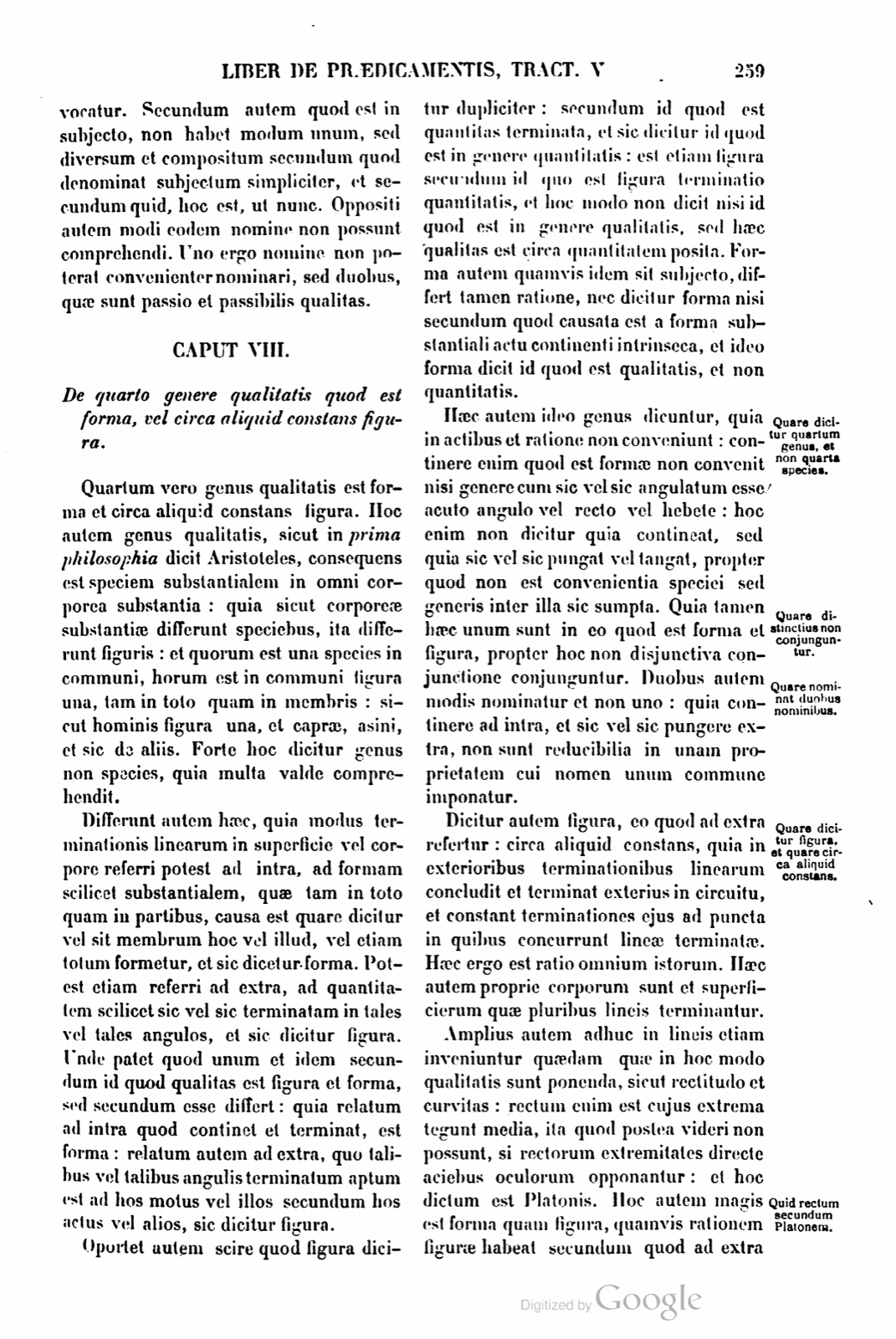
Ad hoc autem quod ultimo quæritur de nomine, dicendum quod de qualitate hic intendimus secundum quod denominative quale ab ea dicitur: et ideo de qualitate hic non intenditur in comparatione ad causam per quam inducitur, sed potius secundum modum quo inhæret subjecto ad denominationem per quale: sed non dicitur casus hic qualitas, nisi in comparatione ad causam per quam inducitur, quia casualis est. Hæc igitur casus non vocatur.
To that, moreover, which is further asked about the order of these species of quality, it must be said that the order is of the first species to the second, which was determined in the things treated before. But because the sensible powers of the soul are of the number of natural potencies, and passions are introduced to these through passible qualities, therefore immediately it was necessary that the third species of quality be passion or passible quality, just as the proper active follows its proper passive, which introduces passion to it; because the active gives its own proper form to the passive, and each is referred to the other and is known through the other. On account of this the third immediately follows after the second. Further, when it is objected that according to this the third ought also to be fourth, because acts are prior to potencies according to reason and objects prior to acts, to this it must be said that this would be true unless natural potency here were taken according as it is rooted in the substantial principles of substance. For according to this this accident is determined, according as it is nearer to substance, and therefore according to this order natural potency is before passible quality.
To this, moreover, which is asked last about the name, it must be said that here we intend quality according as the denominative quale is said from it; and therefore quality is not intended here in comparison to the cause through which it is induced, but rather according to the mode by which it inheres in the subject for denomination through quale. But case is not here called quality except in comparison to the cause through which it is induced, because it is casual. Therefore this is not called case.
If a page does not appear, its photograph has not been uploaded yet.