Volume 1 · pp. 252–254
Chapter V
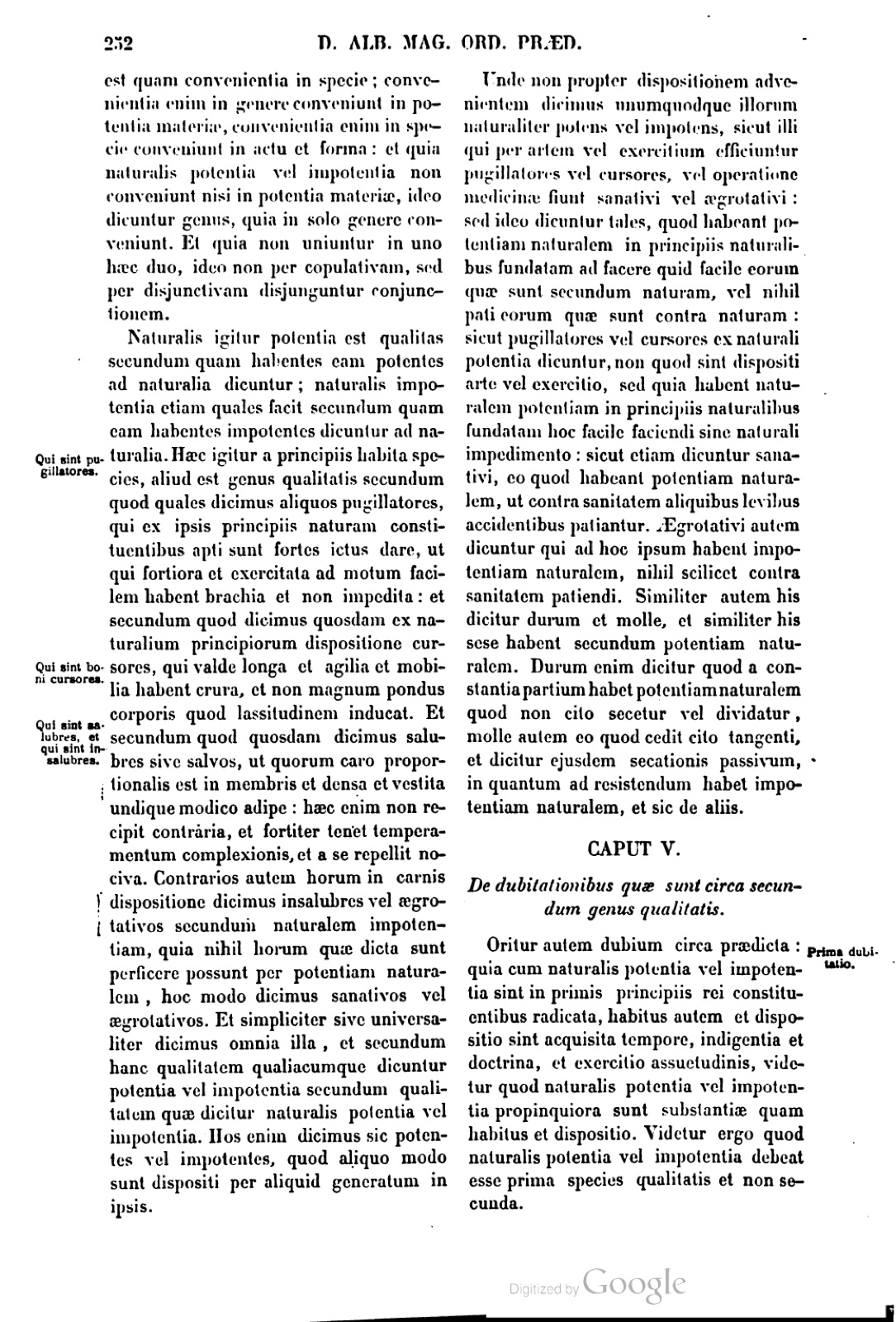
est quam convenientia in specie; convenientia enim in genere conveniunt in potentia materiæ, convenientia enim in specie conveniunt in actu et forma: et quia naturalis potentia vel impotentia non conveniunt nisi in potentia materiæ, ideo dicuntur genus, quia in solo genere conveniunt. Et quia non uniuntur in uno hæc duo, ideo non per copulativam, sed per disjunctivam disjunguntur conjunctionem.
Naturalis igitur potentia est qualitas secundum quam habentes eam potentes ad naturalia dicuntur; naturalis impotentia etiam quales facit secundum quam eam habentes impotentes dicuntur ad naturalia. Hæc igitur a principiis habita species, aliud est genus qualitatis secundum quod quales dicimus aliquos pugillatores, qui ex ipsis principiis naturam constituentibus apti sunt fortes ictus dare, ut qui fortiora et exercitata ad motum facilem habent brachia et non impedita: et secundum quod dicimus quosdam ex naturalium principiorum dispositione cursores, qui valde longa et agilia et mobilia habent crura, et non magnum pondus corporis quod lassitudinem inducat. Et secundum quod quosdam dicimus salubres sive salvos, ut quorum caro proportionalis est in membris et densa et vestita undique modico adipe: hæc enim non recipit contraria, et fortiter tenet temperamentum complexionis, et a se repellit nociva. Contrarios autem horum in carnis dispositione dicimus insalubres vel ægrotativos secundum naturalem impotentiam, quia nihil horum quæ dicta sunt perficere possunt per potentiam naturalem, hoc modo dicimus sanativos vel ægrotativos. Et simpliciter sive universaliter dicimus omnia illa, et secundum hanc qualitatem qualiacumque dicuntur potentia vel impotentia secundum qualitatem quæ dicitur naturalis potentia vel impotentia. Hos enim dicimus sic potentes vel impotentes, quod aliquo modo sunt dispositi per aliquid generatum in ipsis.
Unde non propter dispositionem advenientem dicimus unumquodque illorum naturaliter potens vel impotens, sicut illi qui per artem vel exercitium efficiuntur pugillatores vel cursores, vel operatione medicinæ fiunt sanativi vel ægrotativi: sed ideo dicuntur tales, quod habeant potentiam naturalem in principiis naturalibus fundatam ad facere quid facile eorum quæ sunt secundum naturam, vel nihil pati eorum quæ sunt contra naturam: sicut pugillatores vel cursores ex naturali potentia dicuntur, non quod sint dispositi arte vel exercitio, sed quia habent naturalem potentiam in principiis naturalibus fundatam hoc facile faciendi sine naturali impedimento: sicut etiam dicuntur sanativi, eo quod habeant potentiam naturalem, ut contra sanitatem aliquibus levibus accidentibus patiantur. Ægrotativi autem dicuntur qui ad hoc ipsum habent impotentiam naturalem, nihil scilicet contra sanitatem patiendi. Similiter autem his dicitur durum et molle, et similiter his sese habent secundum potentiam naturalem. Durum enim dicitur quod a constantia partium habet potentiam naturalem quod non cito secetur vel dividatur, molle autem eo quod cedit cito tangenti, et dicitur ejusdem secationis passivum, in quantum ad resistendum habet impotentiam naturalem, et sic de aliis.
CAPUT V.
De dubitationibus quæ sunt circa secundum genus qualitatis.
Oritur autem dubium circa prædicta: quia cum naturalis potentia vel impotentia sint in primis principiis rei constituentibus radicata, habitus autem et dispositio sint acquisita tempore, indigentia et doctrina, et exercitio assuetudinis, videtur quod naturalis potentia vel impotentia propinquiora sunt substantiæ quam habitus et dispositio. Videtur ergo quod naturalis potentia vel impotentia debeat esse prima species qualitatis et non secunda.
than agreement in species; for agreements in genus agree in the potency of matter, but agreements in species agree in act and form. And because natural potency or impotence agree only in the potency of matter, therefore they are called a genus, because they agree only in genus. And because these two are not united in one, therefore they are separated not through a copulative conjunction, but through a disjunctive one.
Therefore natural potency is a quality according to which those having it are called powerful with respect to natural things; natural impotence also makes qualia according to which those having it are called powerless with respect to natural things. Therefore this species, had from principles, is another genus of quality, according to which we call certain men qualia, namely boxers, who from the very principles constituting nature are apt to give strong blows, as those who have stronger arms, exercised for easy motion and not impeded; and according to which we call certain men runners from the disposition of natural principles, who have very long, agile, and mobile legs, and not a great weight of body which would induce weariness. And according to which we call certain persons healthy or safe, as those whose flesh is proportionate in the members and dense and clothed everywhere with a small amount of fat; for this does not receive contraries, and strongly holds the temperament of complexion, and repels harmful things from itself. But the contraries of these in the disposition of flesh we call unhealthy or prone-to-sickness according to natural impotence, because they can perfect none of the things that have been said through natural potency; in this mode we call them able-to-heal or prone-to-sickness. And simply or universally we say all those things, and according to this quality whatsoever things are called qualia are said by potency or impotence according to the quality which is called natural potency or impotence. For we call these powerful or powerless in such a way that in some mode they are disposed through something generated in them.
Hence we do not call each of those things naturally powerful or powerless on account of an added disposition, as those who through art or exercise are made boxers or runners, or by the operation of medicine are made able-to-heal or prone-to-sickness; but they are called such because they have a natural potency founded in natural principles for easily doing something of those things which are according to nature, or suffering nothing of those things which are contrary to nature. Thus boxers or runners are so called from natural potency, not because they are disposed by art or exercise, but because they have a natural potency founded in natural principles for easily doing this without natural impediment; just as they are also called able-to-heal because they have a natural potency so that they may suffer with respect to health by some light accidents. But those are called prone-to-sickness who have natural impotence with respect to this very thing, namely for suffering nothing contrary to health. Similarly to these, hard and soft are said, and similarly to these they have themselves according to natural potency. For hard is said because from the constancy of parts it has a natural potency so that it is not quickly cut or divided, but soft is said because it yields quickly to what touches it, and is said to be passive of the same cutting insofar as it has natural impotence for resisting, and so with others.
CHAPTER V.
Concerning the doubts which are about the second genus of quality.
But a doubt arises about the things said before: because since natural potency or impotence are rooted in the first principles constituting the thing, but habit and disposition are acquired by time, need and teaching, and exercise of habituation, it seems that natural potency or impotence are nearer to substance than habit and disposition. Therefore it seems that natural potency or impotence ought to be the first species of quality and not the second.
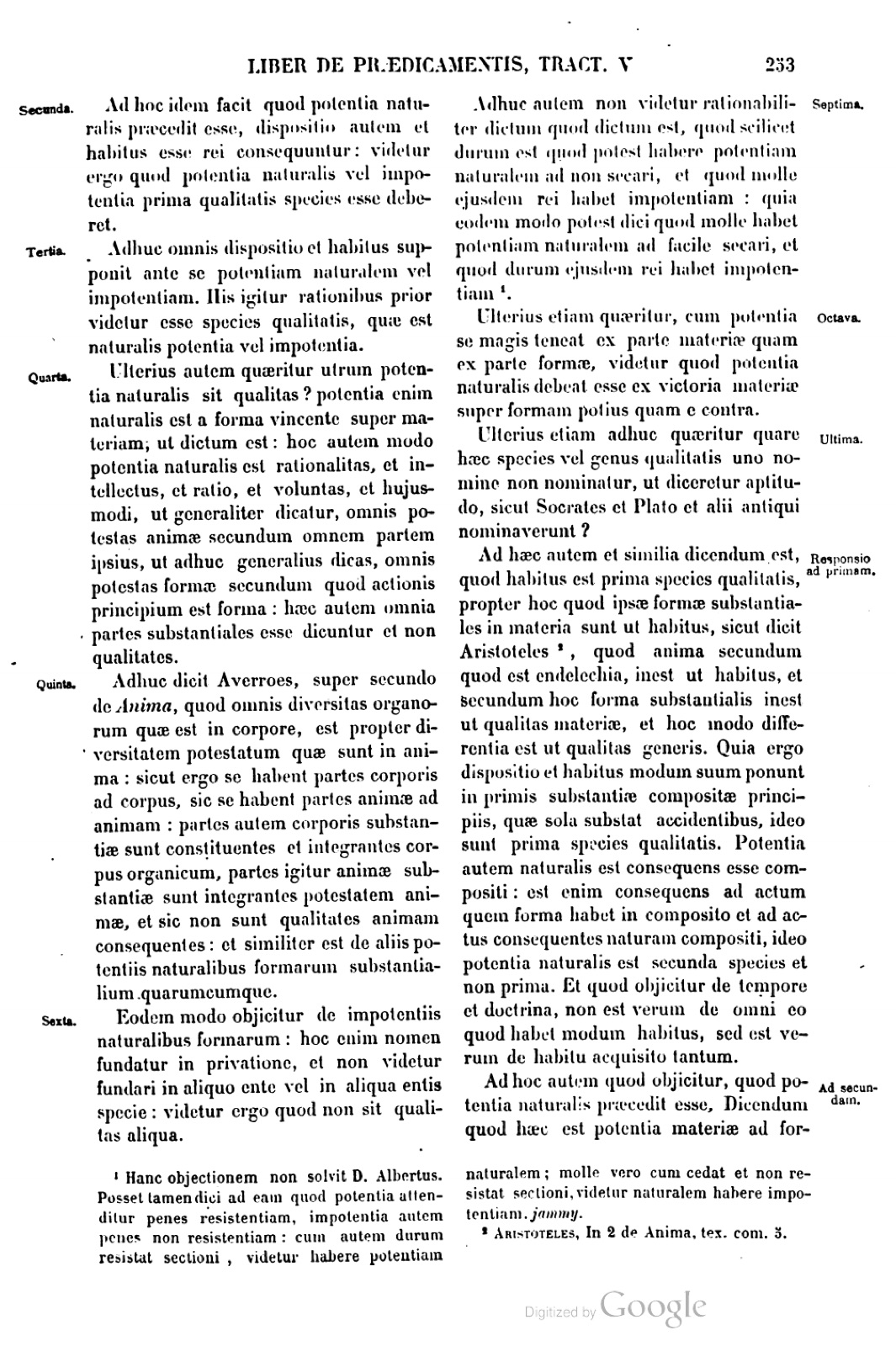
Ad hoc idem facit quod potentia naturalis præcedit esse, dispositio autem et habitus esse rei consequuntur: videtur ergo quod potentia naturalis vel impotentia prima qualitatis species esse deberet.
Adhuc omnis dispositio et habitus supponit ante se potentiam naturalem vel impotentiam. His igitur rationibus prior videtur esse species qualitatis, quæ est naturalis potentia vel impotentia.
Ulterius autem quæritur utrum potentia naturalis sit qualitas? potentia enim naturalis est a forma vincente super materiam, ut dictum est: hoc autem modo potentia naturalis est rationalitas, et intellectus, et ratio, et voluntas, et hujusmodi, ut generaliter dicatur, omnis potestas animæ secundum omnem partem ipsius, ut adhuc generalius dicas, omnis potestas formæ secundum quod actionis principium est forma: hæc autem omnia partes substantiales esse dicuntur et non qualitates.
Adhuc dicit Averroes, super secundo de Anima, quod omnis diversitas organorum quæ est in corpore, est propter diversitatem potestatum quæ sunt in anima: sicut ergo se habent partes corporis ad corpus, sic se habent partes animæ ad animam: partes autem corporis substantiæ sunt constituentes et integrantes corpus organicum, partes igitur animæ substantiæ sunt integrantes potestatem animæ, et sic non sunt qualitates animam consequentes: et similiter est de aliis potentiis naturalibus formarum substantialium quarumcumque.
Eodem modo objicitur de impotentiis naturalibus formarum: hoc enim nomen fundatur in privatione, et non videtur fundari in aliquo ente vel in aliqua entis specie: videtur ergo quod non sit qualitas aliqua.
Adhuc autem non videtur rationabiliter dictum quod dictum est, quod scilicet durum est quod potest habere potentiam naturalem ad non secari, et quod molle ejusdem rei habet impotentiam: quia eodem modo potest dici quod molle habet potentiam naturalem ad facile secari, et quod durum ejusdem rei habet impotentiam 1.
Ulterius etiam quæritur, cum potentia se magis teneat ex parte materiæ quam ex parte formæ, videtur quod potentia naturalis debeat esse ex victoria materiæ super formam potius quam e contra.
Ulterius etiam adhuc quæritur quare hæc species vel genus qualitatis uno nomine non nominatur, ut diceretur aptitudo, sicut Socrates et Plato et alii antiqui nominaverunt?
Ad hæc autem et similia dicendum est, quod habitus est prima species qualitatis, propter hoc quod ipsæ formæ substantiales in materia sunt ut habitus, sicut dicit Aristoteles 2, quod anima secundum quod est endelechia, inest ut habitus, et secundum hoc forma substantialis inest ut qualitas materiæ, et hoc modo differentia est ut qualitas generis. Quia ergo dispositio et habitus modum suum ponunt in primis substantiæ compositæ principiis, quæ sola substat accidentibus, ideo sunt prima species qualitatis. Potentia autem naturalis est consequens esse compositi: est enim consequens ad actum quem forma habet in composito et ad actus consequentes naturam compositi, ideo potentia naturalis est secunda species et non prima. Et quod objicitur de tempore et doctrina, non est verum de omni eo quod habet modum habitus, sed est verum de habitu acquisito tantum.
Ad hoc autem quod objicitur, quod potentia naturalis præcedit esse, Dicendum quod hæc est potentia materiæ ad formam
The same point supports this: that natural potency precedes being, but disposition and habit follow the being of the thing; therefore it seems that natural potency or impotence ought to be the first species of quality.
Further, every disposition and habit presupposes before itself a natural potency or impotence. Therefore by these reasons the species of quality which is natural potency or impotence seems to be prior.
Further it is asked whether natural potency is a quality. For natural potency is from form conquering over matter, as has been said; but in this way natural potency is rationality, and intellect, and reason, and will, and things of this kind, so that, generally speaking, it is every power of the soul according to every part of it, or, to speak still more generally, every power of form insofar as form is the principle of action. But all these are said to be substantial parts and not qualities.
Further Averroes says, on the second book On the Soul, that every diversity of organs which is in the body exists on account of the diversity of powers which are in the soul. Therefore just as parts of the body have themselves to the body, so parts of the soul have themselves to the soul. But the parts of the body are substances constituting and integrating the organic body; therefore the parts of the soul are substances integrating the power of the soul, and thus they are not qualities following the soul; and it is similar concerning the other natural potencies of any substantial forms whatever.
In the same way an objection is made concerning the natural impotences of forms: for this name is founded in privation, and it does not seem to be founded in some being or in some species of being; therefore it seems that it is not any quality.
Further, what has been said does not seem to have been said reasonably, namely that hard is that which can have natural potency for not being cut, and that soft has impotence with respect to the same thing, because in the same way it can be said that soft has natural potency for being easily cut, and that hard has impotence with respect to the same thing 1.
Further it is also asked: since potency holds itself more on the part of matter than on the part of form, it seems that natural potency ought to be from the victory of matter over form rather than conversely.
Further still, it is also asked why this species or genus of quality is not named by one name, so that it would be called aptitude, as Socrates and Plato and the other ancients named it.
But to these and similar things it must be said that habit is the first species of quality because the substantial forms themselves in matter are as habits, as Aristotle says 2, that the soul, according as it is endelechy, is present as habit; and according to this a substantial form is present as the quality of matter, and in this mode difference is as the quality of a genus. Therefore because disposition and habit posit their mode in the first principles of composite substance, which alone stands under accidents, they are therefore the first species of quality. But natural potency follows upon the being of the composite, for it follows upon the act which form has in the composite and upon the acts consequent upon the nature of the composite; therefore natural potency is the second species and not the first. And what is objected about time and teaching is not true of everything that has the mode of habit, but is true only of acquired habit.
But to what is objected, that natural potency precedes being, it must be said that this is the potency of matter toward form
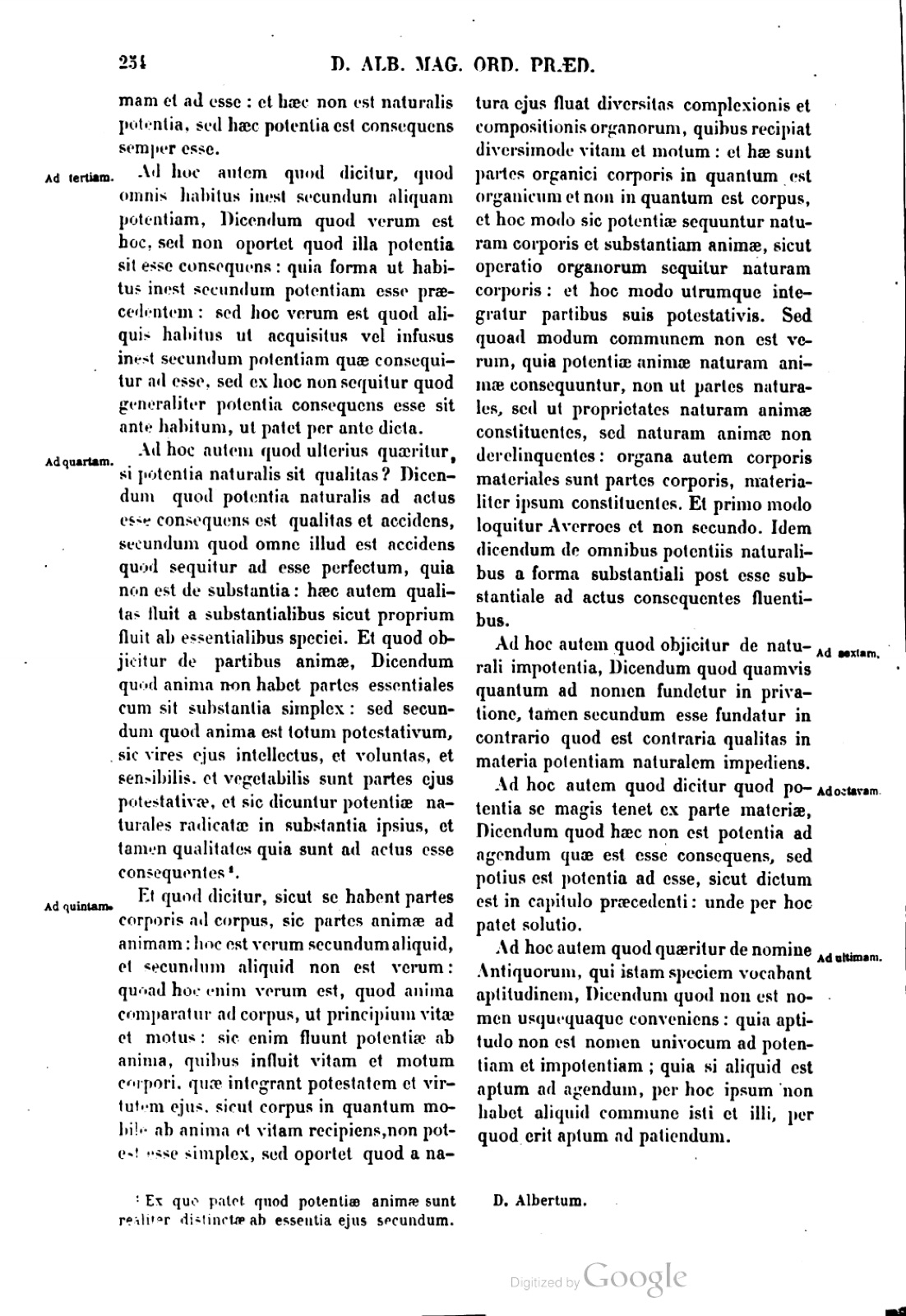
et ad esse: et hæc non est naturalis potentia, sed hæc potentia est consequens semper esse.
Ad hoc autem quod dicitur, quod omnis habitus inest secundum aliquam potentiam, Dicendum quod verum est hoc, sed non oportet quod illa potentia sit esse consequens: quia forma ut habitus inest secundum potentiam esse præcedentem: sed hoc verum est quod aliquis habitus ut acquisitus vel infusus inest secundum potentiam quæ consequitur ad esse, sed ex hoc non sequitur quod generaliter potentia consequens esse sit ante habitum, ut patet per ante dicta.
Ad hoc autem quod ulterius quæritur, si potentia naturalis sit qualitas? Dicendum quod potentia naturalis ad actus esse consequens est qualitas et accidens, secundum quod omne illud est accidens quod sequitur ad esse perfectum, quia non est de substantia: hæc autem qualitas fluit a substantialibus sicut proprium fluit ab essentialibus speciei. Et quod objicitur de partibus animæ, Dicendum quod anima non habet partes essentiales cum sit substantia simplex: sed secundum quod anima est totum potestativum, sic vires ejus intellectus, et voluntas, et sensibilis et vegetabilis sunt partes ejus potestativæ, et sic dicuntur potentiæ naturales radicatæ in substantia ipsius, et tamen qualitates quia sunt ad actus esse consequentes 3.
Et quod dicitur, sicut se habent partes corporis ad corpus, sic partes animæ ad animam: hoc est verum secundum aliquid, et secundum aliquid non est verum: quoad hoc enim verum est, quod anima comparatur ad corpus, ut principium vitæ et motus: sic enim fluunt potentiæ ab anima, quibus influit vitam et motum corpori, quæ integrant potestatem et virtutem ejus, sicut corpus in quantum mobile ab anima et vitam recipiens, non potest esse simplex, sed oportet quod a natura ejus fluat diversitas complexionis et compositionis organorum, quibus recipiat diversimode vitam et motum: et hæ sunt partes organici corporis in quantum est organicum et non in quantum est corpus, et hoc modo sic potentiæ sequuntur naturam corporis et substantiam animæ, sicut operatio organorum sequitur naturam corporis: et hoc modo utrumque integratur partibus suis potestativis. Sed quoad modum communem non est verum, quia potentiæ animæ naturam animæ consequuntur, non ut partes naturales, sed ut proprietates naturam animæ constituentes, sed naturam animæ non derelinquentes: organa autem corporis materiales sunt partes corporis, materialiter ipsum constituentes. Et primo modo loquitur Averroes et non secundo. Idem dicendum de omnibus potentiis naturalibus a forma substantiali post esse substantiale ad actus consequentes fluentibus.
Ad hoc autem quod objicitur de naturali impotentia, Dicendum quod quamvis quantum ad nomen fundetur in privatione, tamen secundum esse fundatur in contrario quod est contraria qualitas in materia potentiam naturalem impediens.
Ad hoc autem quod dicitur quod potentia se magis tenet ex parte materiæ, Dicendum quod hæc non est potentia ad agendum quæ est esse consequens, sed potius est potentia ad esse, sicut dictum est in capitulo præcedenti: unde per hoc patet solutio.
Ad hoc autem quod quæritur de nomine Antiquorum, qui istam speciem vocabant aptitudinem, Dicendum quod non est nomen usquequaque conveniens: quia aptitudo non est nomen univocum ad potentiam et impotentiam; quia si aliquid est aptum ad agendum, per hoc ipsum non habet aliquid commune isti et illi, per quod erit aptum ad patiendum.
and toward being; and this is not natural potency, but this potency is always consequent upon being.
To what is said, that every habit is present according to some potency, it must be said that this is true, but it is not necessary that that potency be consequent upon being, because form as habit is present according to a preceding potency for being. But this is true, that some habit, as acquired or infused, is present according to a potency which follows upon being; but from this it does not follow that generally potency consequent upon being is before habit, as is clear through what was said before.
To what is further asked, whether natural potency is a quality, it must be said that natural potency consequent upon being for acts is a quality and an accident, according as everything which follows upon perfected being is an accident, because it is not of substance. But this quality flows from substantial things as a property flows from the essentials of a species. And as to what is objected concerning the parts of the soul, it must be said that the soul does not have essential parts, since it is a simple substance; but according as the soul is a potestative whole, so its powers of intellect, and will, and the sensible and vegetative are its potestative parts, and thus they are called natural potencies rooted in its substance, and nevertheless qualities because they are consequent upon being for acts 3.
And as to what is said, that as parts of the body have themselves to the body, so parts of the soul have themselves to the soul: this is true in one respect, and in another respect it is not true. For as to this it is true, that soul is compared to body as the principle of life and motion; for thus powers flow from the soul, by which it pours life and motion into the body, and these integrate its power and strength, just as the body, insofar as it is movable by the soul and receiving life, cannot be simple, but the diversity of complexion and composition of organs must flow from its nature, by which it receives life and motion in diverse modes; and these are parts of the organic body insofar as it is organic and not insofar as it is body. And in this mode the potencies thus follow the nature of the body and the substance of the soul, just as the operation of organs follows the nature of the body; and in this mode each whole is integrated by its own potestative parts. But according to the common mode it is not true, because the potencies of the soul follow the nature of the soul, not as natural parts, but as properties constituting the nature of the soul, yet not abandoning the nature of the soul; but the organs of the body are material parts of the body, materially constituting it. And Averroes speaks in the first mode and not the second. The same must be said concerning all natural potencies flowing from substantial form after substantial being toward consequent acts.
To what is objected concerning natural impotence, it must be said that although, with respect to the name, it is founded in privation, nevertheless according to being it is founded in a contrary, which is a contrary quality in matter impeding natural potency.
To what is said, that potency holds itself more on the part of matter, it must be said that this is not potency for acting, which is consequent upon being, but rather is potency for being, as was said in the preceding chapter; hence through this the solution is clear.
To what is asked concerning the name of the Ancients, who called this species aptitude, it must be said that it is not a name altogether fitting, because aptitude is not a univocal name for potency and impotence; because if something is apt for acting, by this very fact it does not have anything common to this and that through which it will be apt for suffering.
Notes
- D. Albert does not solve this objection. Nevertheless it could be said to it that potency is attended according to resistance, but impotence according to non-resistance; but since hard resists cutting, it seems to have natural potency; but soft, since it yields and does not resist cutting, seems to have natural impotence. Jammy. (Hanc objectionem non solvit D. Albertus. Posset tamen dici ad eam quod potentia attenditur penes resistentiam, impotentia autem penes non resistentiam: cum autem durum resistat sectioni, videtur habere potentiam naturalem; molle vero cum cedat et non resistat sectioni, videtur naturalem habere impotentiam. jammy.) ↩
- Aristotle, On book 2 of On the Soul, text/comment 5. (Aristoteles, In 2 de Anima, tex. com. 5.) ↩
- From this it is clear that the potencies of the soul are really distinct from its essence according to D. Albert. (Ex quo patet quod potentiæ animæ sunt realiter distinctæ ab essentia ejus secundum D. Albertum.) ↩
If a page does not appear, its photograph has not been uploaded yet.