Volume 1 · p. 251
Chapter IV
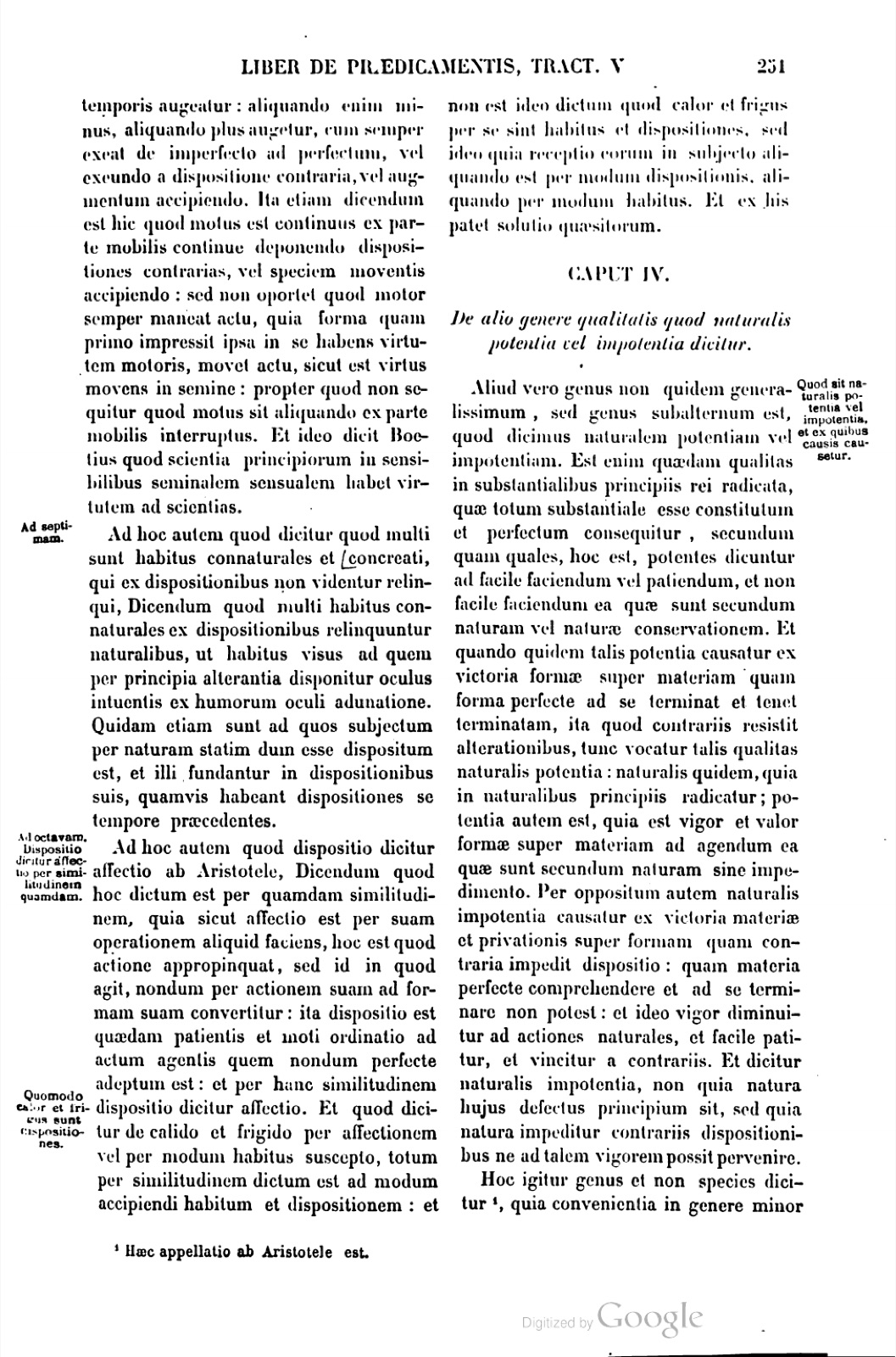
temporis augeatur: aliquando enim minus, aliquando plus augetur, cum semper exeat de imperfecto ad perfectum, vel exeundo a dispositione contraria, vel augmentum accipiendo. Ita etiam dicendum est hic quod motus est continuus ex parte mobilis continue deponendo dispositiones contrarias, vel speciem moventis accipiendo: sed non oportet quod motor semper maneat actu, quia forma quam primo impressit ipsa in se habens virtutem motoris, movet actu, sicut est virtus movens in semine: propter quod non sequitur quod motus sit aliquando ex parte mobilis interruptus. Et ideo dicit Boëtius quod scientia principiorum in sensibilibus seminalem sensualem habet virtutem ad scientias.
Ad hoc autem quod dicitur quod multi sunt habitus connaturales et concreati, qui ex dispositionibus non videntur relinqui, Dicendum quod multi habitus connaturales ex dispositionibus relinquuntur naturalibus, ut habitus visus ad quem per principia alterantia disponitur oculus intuentis ex humorum oculi adunatione. Quidam etiam sunt ad quos subjectum per naturam statim dum esse dispositum est, et illi fundantur in dispositionibus suis, quamvis habeant dispositiones se in tempore præcedentes.
Ad hoc autem quod dispositio dicitur affectio ab Aristotele, Dicendum quod hoc dictum est per quamdam similitudinem, quia sicut affectio est per suam operationem aliquid faciens, hoc est quod actione appropinquat, sed id in quod agit, nondum per actionem suam ad formam suam convertitur: ita dispositio est quædam patientis et moti ordinatio ad actum agentis quem nondum perfecte adeptum est: et per hanc similitudinem dispositio dicitur affectio. Et quod dicitur de calido et frigido per affectionem vel per modum habitus suscepto, totum per similitudinem dictum est ad modum accipiendi habitum et dispositionem: et non est ideo dictum quod calor et frigus per se sint habitus et dispositiones, sed ideo quia receptio eorum in subjecto aliquando est per modum dispositionis, aliquando per modum habitus. Et ex his patet solutio quæsitorum.
CAPUT IV.
De alio genere qualitatis quod naturalis potentia vel impotentia dicitur.
Aliud vero genus non quidem generalissimum, sed genus subalternum est, quod dicimus naturalem potentiam vel impotentiam. Est enim quædam qualitas in substantialibus principiis rei radicata, quæ totum substantiale esse constitutum et perfectum consequitur, secundum quam quales, hoc est, potentes dicuntur ad facile faciendum vel patiendum, et non facile faciendum ea quæ sunt secundum naturam vel naturæ conservationem. Et quando quidem talis potentia causatur ex victoria formæ super materiam quam forma perfecte ad se terminat et tenet terminatam, ita quod contrariis resistit alterationibus, tunc vocatur talis qualitas naturalis potentia: naturalis quidem, quia in naturalibus principiis radicatur; potentia autem est, quia est vigor et valor formæ super materiam ad agendum ea quæ sunt secundum naturam sine impedimento. Per oppositum autem naturalis impotentia causatur ex victoria materiæ et privationis super formam quam contraria impedit dispositio: quam materia perfecte comprehendere et ad se terminare non potest: et ideo vigor diminuitur ad actiones naturales, et facile patitur, et vincitur a contrariis. Et dicitur naturalis impotentia, non quia natura hujus defectus principium sit, sed quia natura impeditur contrariis dispositionibus ne ad talem vigorem possit pervenire.
Hoc igitur genus et non species dicitur 1, quia convenientia in genere minor
of time it is increased. For sometimes it is increased less, sometimes more, since it always goes out from the imperfect to the perfect, either by going out from a contrary disposition or by receiving increase. Thus also here it must be said that the motion is continuous on the part of the movable thing by continuously laying aside contrary dispositions, or by receiving the species of the mover; but it is not necessary that the mover always remain in act, because the form which it first impressed, itself having in itself the power of the mover, moves in act, just as there is a moving power in seed. On account of this it does not follow that the motion is sometimes interrupted on the part of the movable thing. And therefore Boethius says that knowledge of principles in sensible things has a seminal, sensible power toward knowledges.
To what is said, that many habits are connatural and concreated, which do not seem to be left behind from dispositions, it must be said that many connatural habits are left behind from natural dispositions, as the habit of sight, for which the eye of the beholder is disposed through altering principles from the uniting of the humors of the eye. There are also certain habits for which the subject by nature is immediately disposed while it is in being, and these are founded in their own dispositions, although they have dispositions preceding them in time.
To what is said, that disposition is called affection by Aristotle, it must be said that this was said through a certain similitude, because just as affection is something making through its operation, this is because it approaches by action, but that upon which it acts is not yet converted by its action to its own form; so disposition is a certain ordering of a patient and moved thing toward the act of an agent which it has not yet perfectly acquired; and through this similitude disposition is called affection. And what is said about hot and cold as received through affection or through the mode of habit, all of it was said by similitude with the mode of receiving habit and disposition; and it was not said therefore that heat and coldness per se are habits and dispositions, but because the reception of them in a subject is sometimes through the mode of disposition, sometimes through the mode of habit. And from these things the solution of the questions is clear.
CHAPTER IV.
Concerning another genus of quality, which is called natural potency or impotence.
But another genus, not indeed a most general genus, but a subalternate genus, is what we call natural potency or impotence. For it is a certain quality rooted in the substantial principles of a thing, which follows upon the whole substantial being as constituted and perfected, according to which things are called qualia, that is, powerful for easily doing or suffering, and not easily doing those things which are according to nature or the conservation of nature. And when such a potency is caused from the victory of form over matter, which form perfectly terminates to itself and holds as terminated, so that it resists contrary alterations, then such a quality is called natural potency: natural, indeed, because it is rooted in natural principles; but it is potency because it is the vigor and strength of form over matter for doing those things which are according to nature without impediment. But by opposition natural impotence is caused from the victory of matter and privation over form, which a contrary disposition impedes; matter cannot perfectly comprehend it and terminate it to itself, and therefore vigor is diminished for natural actions, and it easily suffers and is conquered by contraries. And it is called natural impotence, not because nature is the principle of this defect, but because nature is impeded by contrary dispositions from being able to arrive at such vigor.
Therefore this is called a genus and not a species 1, because agreement in genus is less
Notes
- This appellation is from Aristotle. (Hæc appellatio ab Aristotele est.) ↩
If a page does not appear, its photograph has not been uploaded yet.