Volume 1 · pp. 245–247
Chapter II
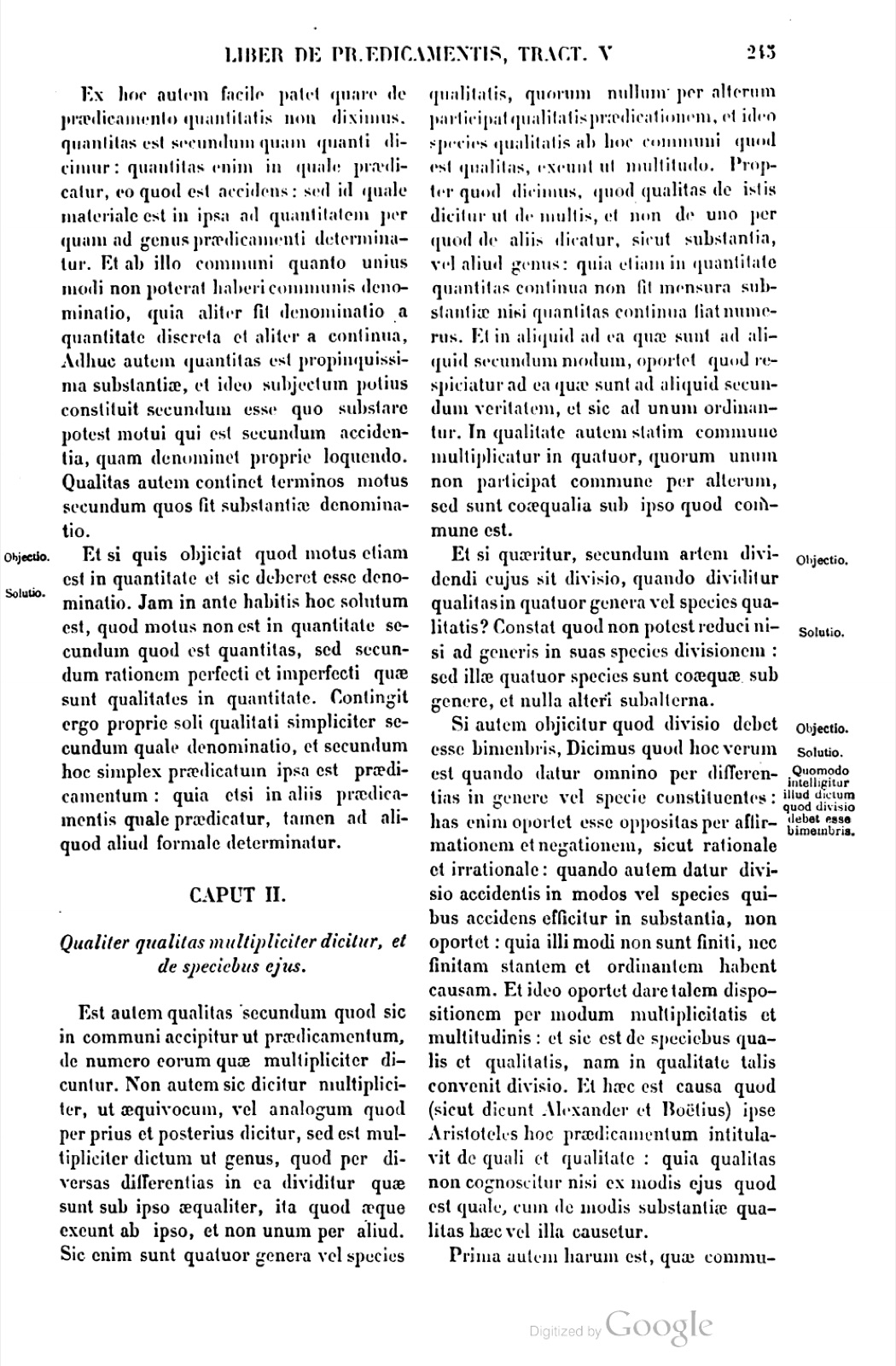
Ex hoc autem facile patet quare de prædicamento quantitatis non diximus, quantitas est secundum quam quanti dicimur: quantitas enim in quale prædicatur, eo quod est accidens: sed id quale materiale est in ipsa ad quantitatem per quam ad genus prædicamenti determinatur. Et ab illo communi quanto unius modi non poterat haberi communis denominatio, quia aliter fit denominatio a quantitate discreta et aliter a continua. Adhuc autem quantitas est propinquissima substantiæ, et ideo subjectum potius constituit secundum esse quo substare potest motui qui est secundum accidentia, quam denominet proprie loquendo. Qualitas autem continet terminos motus secundum quos fit substantiæ denominatio.
Et si quis objiciat quod motus etiam est in quantitate et sic deberet esse denominatio. Jam in ante habitis hoc solutum est, quod motus non est in quantitate secundum quod est quantitas, sed secundum rationem perfecti et imperfecti quæ sunt qualitates in quantitate. Contingit ergo proprie soli qualitati simpliciter secundum quale denominatio, et secundum hoc simplex prædicatum ipsa est prædicamentum: quia etsi in aliis prædicamentis quale prædicatur, tamen ad aliquid aliud formale determinatur.
CAPUT II.
Qualiter qualitas multipliciter dicitur, et de speciebus ejus.
Est autem qualitas secundum quod sic in communi accipitur ut prædicamentum, de numero eorum quæ multipliciter dicuntur. Non autem sic dicitur multipliciter, ut æquivocum, vel analogum quod per prius et posterius dicitur, sed est multipliciter dictum ut genus, quod per diversas differentias in ea dividitur quæ sunt sub ipso æqualiter, ita quod æque exeunt ab ipso, et non unum per aliud. Sic enim sunt quatuor genera vel species qualitatis, quorum nullum per alterum participat qualitatis prædicationem, et ideo species qualitatis ab hoc communi quod est qualitas, exeunt ut multitudo. Propter quod dicimus, quod qualitas de istis dicitur ut de multis, et non de uno per quod de aliis dicatur, sicut substantia, vel aliud genus: quia etiam in quantitate quantitas continua non fit mensura substantiæ nisi quantitas continua fiat numerus. Et in aliquid ad ea quæ sunt ad aliquid secundum modum, oportet quod respiciatur ad ea quæ sunt ad aliquid secundum veritatem, et sic ad unum ordinantur. In qualitate autem statim commune multiplicatur in quatuor, quorum unum non participat commune per alterum, sed sunt coæqualia sub ipso quod commune est.
Et si quæritur, secundum artem dividendi cujus sit divisio, quando dividitur qualitas in quatuor genera vel species qualitatis? Constat quod non potest reduci nisi ad generis in suas species divisionem: sed illæ quatuor species sunt coæquæ sub genere, et nulla alteri subalterna.
Si autem objicitur quod divisio debet esse bimembris, Dicimus quod hoc verum est quando datur omnino per differentias in genere vel specie constituentes: has enim oportet esse oppositas per affirmationem et negationem, sicut rationale et irrationale: quando autem datur divisio accidentis in modos vel species quibus accidens efficitur in substantia, non oportet: quia illi modi non sunt finiti, nec finitam stantem et ordinantem habent causam. Et ideo oportet dare talem dispositionem per modum multiplicitatis et multitudinis: et sic est de speciebus qualis et qualitatis, nam in qualitate talis convenit divisio. Et hæc est causa quod (sicut dicunt Alexander et Boëtius) ipse Aristoteles hoc prædicamentum intitulavit de quali et qualitate: quia qualitas non cognoscitur nisi ex modis ejus quod est quale, cum de modis substantiæ qualitas hæc vel illa causetur.
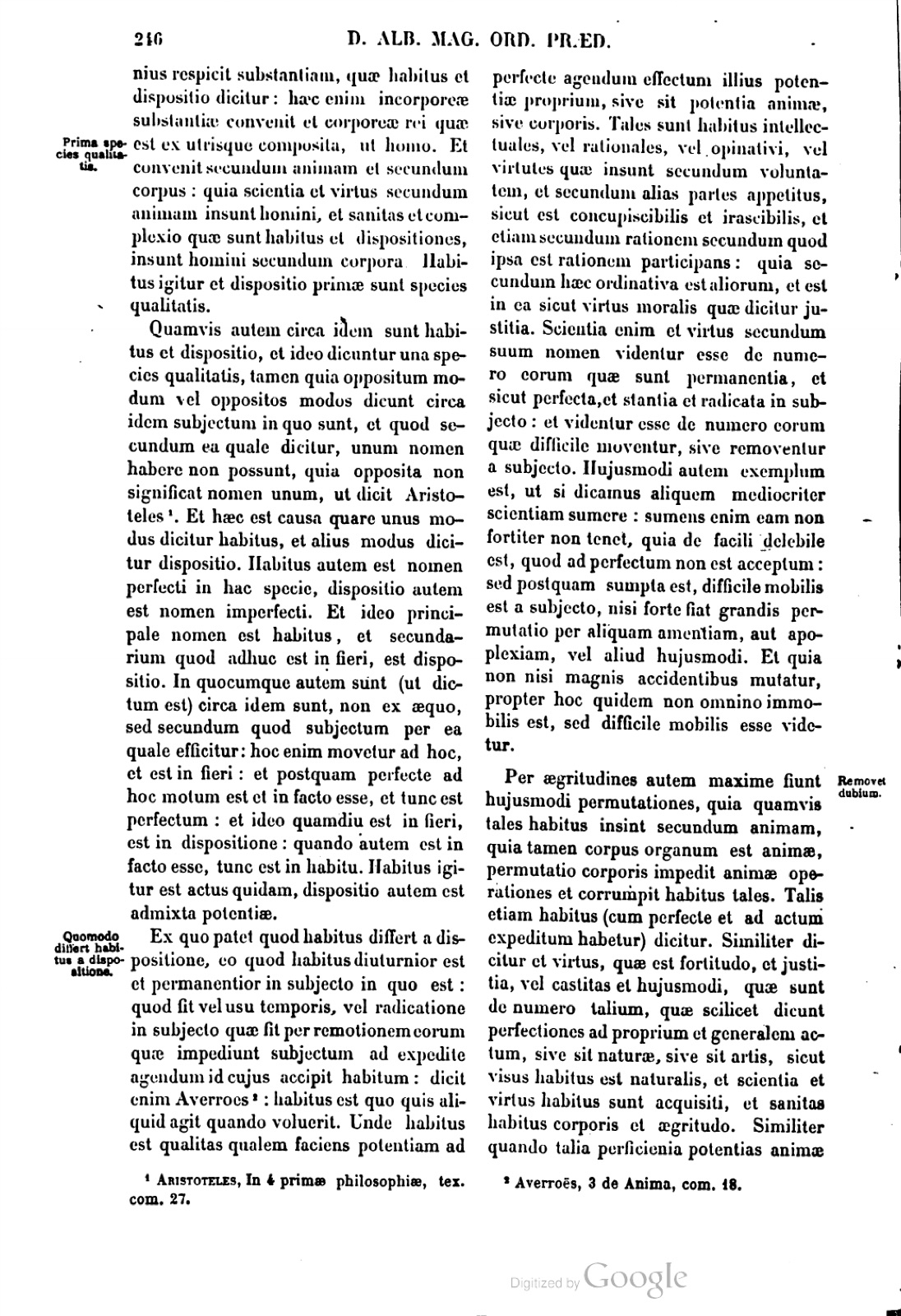
Prima autem harum est, quæ communis
But from this it is easily clear why, concerning the predicament of quantity, we did not say that quantity is that according to which we are called quantified: for quantity is predicated in quale, because it is an accident; but that quale is material in it with respect to quantity, through which it is determined to the genus of the predicament. And from that common quantum of one mode a common denomination could not be had, because denomination is made in one way from discrete quantity and in another way from continuous quantity. Further, quantity is nearest to substance, and therefore it rather constitutes the subject according to the being by which it can stand under motion which is according to accidents, than denominates it, properly speaking. But quality contains the termini of motion according to which the denomination of substance occurs.
And if someone objects that motion also is in quantity, and thus there ought to be denomination, this has already been solved in what was had before: that motion is not in quantity according as it is quantity, but according to the account of perfect and imperfect, which are qualities in quantity. Therefore denomination according to quale belongs properly and simply to quality alone, and according to this it itself is a predicament as a simple predicate, because although in the other predicaments quale is predicated, nevertheless it is determined toward something else formal.
CHAPTER II.
How quality is said in many ways, and concerning its species.
Now quality, according as it is taken thus in common as a predicament, is of the number of those things which are said in many ways. But it is not said in many ways as an equivocal term, or as an analogous term which is said according to prior and posterior, but it is something said in many ways as a genus, which through diverse differences is divided into those things which are equally under it, so that they issue equally from it and not one through another. For thus there are four genera or species of quality, of which none participates the predication of quality through another; and therefore the species of quality issue from this common thing which is quality as a multitude. On account of this we say that quality is said of these as of many, and not of one through which it is said of the others, as substance, or another genus is said, because even in quantity continuous quantity does not become the measure of substance unless continuous quantity becomes number. And in relation to those things which are toward something according to mode, one must look back to those things which are toward something according to truth, and thus they are ordered to one. But in quality the common thing is immediately multiplied into four, of which one does not participate the common thing through another, but they are coequal under that which is common.
And if it is asked, according to the art of dividing, whose division it is when quality is divided into four genera or species of quality, it is agreed that it cannot be reduced except to the division of a genus into its species; but those four species are coequal under the genus, and none is subalternate to another.
But if it is objected that division ought to be bimembered, we say that this is true when it is given wholly through differences constituting in genus or species; for these must be opposed through affirmation and negation, as rational and irrational. But when the division of an accident into modes or species is given, by which an accident is effected in substance, it is not necessary, because those modes are not finite, nor do they have a finite cause standing and ordering. And therefore one must give such a disposition by the mode of multiplicity and multitude; and thus it is concerning the species of quale and of quality, for such a division befits quality. And this is the cause why, as Alexander and Boethius say, Aristotle himself entitled this predicament concerning quale and quality: because quality is not known except from the modes of that which is quale, since this or that quality is caused from the modes of substance.
Now the first of these is that which is common
respicit substantiam, quæ habitus et dispositio dicitur: hæc enim incorporeæ substantiæ convenit et corporeæ rei quæ est ex utrisque composita, ut homo. Et convenit secundum animam et secundum corpus: quia scientia et virtus secundum animam insunt homini, et sanitas et complexio quæ sunt habitus et dispositiones, insunt homini secundum corpora. Habitus igitur et dispositio primæ sunt species qualitatis.
Quamvis autem circa idem sunt habitus et dispositio, et ideo dicuntur una species qualitatis, tamen quia oppositum modum vel oppositos modos dicunt circa idem subjectum in quo sunt, et quod secundum ea quale dicitur, unum nomen habere non possunt, quia opposita non significat nomen unum, ut dicit Aristoteles 1. Et hæc est causa quare unus modus dicitur habitus, et alius modus dicitur dispositio. Habitus autem est nomen perfecti in hac specie, dispositio autem est nomen imperfecti. Et ideo principale nomen est habitus, et secundarium quod adhuc est in fieri, est dispositio. In quocumque autem sunt (ut dictum est) circa idem sunt, non ex æquo, sed secundum quod subjectum per ea quale efficitur: hoc enim movetur ad hoc, et est in fieri: et postquam perfecte ad hoc motum est et in facto esse, et tunc est perfectum: et ideo quamdiu est in fieri, est in dispositione: quando autem est in facto esse, tunc est in habitu. Habitus igitur est actus quidam, dispositio autem est admixta potentiæ.
Ex quo patet quod habitus differt a dispositione, eo quod habitus diuturnior est et permanentior in subjecto in quo est: quod fit vel usu temporis, vel radicatione in subjecto quæ fit per remotionem eorum quæ impediunt subjectum ad expedite agendum id cujus accipit habitum: dicit enim Averroes 2: habitus est quo quis aliquid agit quando voluerit. Unde habitus est qualitas qualem faciens potentiam ad perfecte agendum effectum illius potentiæ proprium, sive sit potentia animæ, sive corporis. Tales sunt habitus intellectuales, vel rationales, vel opinativi, vel virtutes quæ insunt secundum voluntatem, et secundum alias partes appetitus, sicut est concupiscibilis et irascibilis, et etiam secundum rationem secundum quod ipsa est rationem participans: quia secundum hæc ordinativa est aliorum, et est in ea sicut virtus moralis quæ dicitur justitia. Scientia enim et virtus secundum suum nomen videntur esse de numero eorum quæ sunt permanentia, et sicut perfecta, et stantia et radicata in subjecto: et videntur esse de numero eorum quæ difficile moventur, sive removentur a subjecto. Hujusmodi autem exemplum est, ut si dicamus aliquem mediocriter scientiam sumere: sumens enim eam non fortiter non tenet, quia de facili delebile est, quod ad perfectum non est acceptum: sed postquam sumpta est, difficile mobilis est a subjecto, nisi forte fiat grandis permutatio per aliquam amentiam, aut apoplexiam, vel aliud hujusmodi. Et quia non nisi magnis accidentibus mutatur, propter hoc quidem non omnino immobilis est, sed difficile mobilis esse videtur.
Per ægritudines autem maxime fiunt hujusmodi permutationes, quia quamvis tales habitus insint secundum animam, quia tamen corpus organum est animæ, permutatio corporis impedit animæ operationes et corrumpit habitus tales. Talis etiam habitus (cum perfecte et ad actum expeditum habetur) dicitur. Similiter dicitur et virtus, quæ est fortitudo, et justitia, vel castitas et hujusmodi, quæ sunt de numero talium, quæ scilicet dicunt perfectiones ad proprium et generalem actum, sive sit naturæ, sive sit artis, sicut visus habitus est naturalis, et scientia et virtus habitus sunt acquisiti, et sanitas habitus corporis et ægritudo. Similiter quando talia perficientia potentias animæ
regards substance, which is called habit and disposition; for this befits incorporeal substance and a corporeal thing which is composed from both, as man is. And it befits according to soul and according to body, because knowledge and virtue are in man according to soul, and health and complexion, which are habits and dispositions, are in man according to bodies. Therefore habit and disposition are the first species of quality.
But although habit and disposition are concerned with the same thing, and therefore are called one species of quality, nevertheless, because they state an opposite mode or opposite modes concerning the same subject in which they are, and which according to them is called quale, they cannot have one name, because one name does not signify opposites, as Aristotle says 1. And this is the cause why one mode is called habit, and another mode is called disposition. Now habit is the name of the perfect in this species, but disposition is the name of the imperfect. And therefore the principal name is habit, and the secondary one, which is still in becoming, is disposition. But in whatever they are, as has been said, they are concerned with the same thing, not equally, but according as the subject is made quale through them. For this is moved toward this and is in becoming; and after it has been perfectly moved toward this and is in accomplished being, then it is perfect; and therefore as long as it is in becoming, it is in disposition, but when it is in accomplished being, then it is in habit. Therefore habit is a certain act, but disposition is mixed with potency.
From this it is clear that habit differs from disposition in that habit is more lasting and more permanent in the subject in which it is. This occurs either by the use of time, or by a rooting in the subject, which occurs through the removal of those things which impede the subject from acting readily in that of which it receives the habit. For Averroes says 2: a habit is that by which someone does something when he has willed. Hence habit is a quality making a potency quale for perfectly doing the proper effect of that potency, whether it is a potency of soul or of body. Such are intellectual habits, or rational habits, or opinative habits, or virtues which are present according to the will and according to the other parts of appetite, as are the concupiscible and irascible, and also according to reason insofar as it itself is participating reason, because according to these it is directive of other things, and in it there is something like the moral virtue which is called justice. For knowledge and virtue, according to their own name, seem to be of the number of those things which are permanent, and as perfect things, and things standing and rooted in a subject; and they seem to be of the number of those things which are moved with difficulty, or removed from a subject. But an example of this kind is if we say that someone receives knowledge moderately; for one receiving it, because he does not hold it strongly, holds as easily erasable what has not been received to the perfect degree. But after it has been received, it is moved from the subject with difficulty, unless perhaps a great alteration comes about through some madness, or apoplexy, or something else of this kind. And because it is changed only by great accidents, for this reason indeed it is not altogether immovable, but seems to be movable with difficulty.
But alterations of this kind come about especially through sicknesses, because although such habits are present according to the soul, nevertheless because the body is the organ of the soul, alteration of the body impedes the operations of the soul and corrupts such habits. Such a thing also, when it is had perfectly and for an unhindered act, is called a habit. Similarly also virtue is so called, which is fortitude, and justice, or chastity and things of this kind, which are of the number of such things, namely those which state perfections toward a proper and general act, whether it is of nature or of art, just as sight is a natural habit, and knowledge and virtue are acquired habits, and health is a habit of the body, and sickness. Similarly, when such things perfecting the potencies of the soul
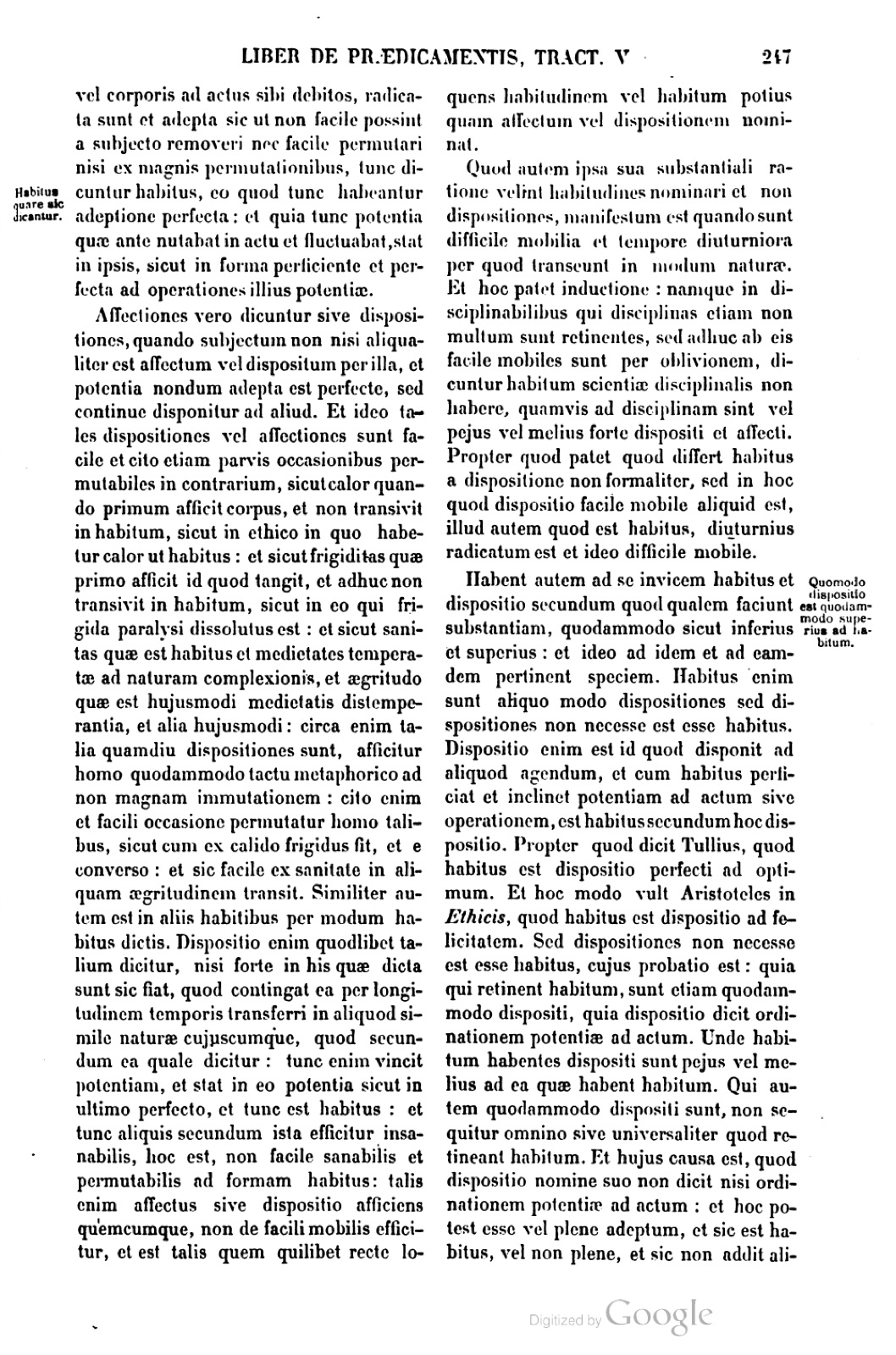
vel corporis ad actus sibi debitos, radicata sunt et adepta sic ut non facile possint a subjecto removeri nec facile permutari nisi ex magnis permutationibus, tunc dicuntur habitus, eo quod tunc habeantur adeptione perfecta: et quia tunc potentia quæ ante nutabat in actu et fluctuabat, stat in ipsis, sicut in forma perficiente et perfecta ad operationes illius potentiæ.
Affectiones vero dicuntur sive dispositiones, quando subjectum non nisi aliqualiter est affectum vel dispositum per illa, et potentia nondum adepta est perfecte, sed continue disponitur ad aliud. Et ideo tales dispositiones vel affectiones sunt facile et cito etiam parvis occasionibus permutabiles in contrarium, sicut calor quando primum afficit corpus, et non transivit in habitum, sicut in ethico in quo habetur calor ut habitus: et sicut frigiditas quæ primo afficit id quod tangit, et adhuc non transivit in habitum, sicut in eo qui frigida paralysi dissolutus est: et sicut sanitas quæ est habitus et medietas temperatæ ad naturam complexionis, et ægritudo quæ est hujusmodi medietatis distemperantia, et alia hujusmodi: circa enim talia quamdiu dispositiones sunt, afficitur homo quodammodo tactu metaphorico ad non magnam immutationem: cito enim et facili occasione permutatur homo talibus, sicut cum ex calido frigidus fit, et e converso: et sic facile ex sanitate in aliquam ægritudinem transit. Similiter autem est in aliis habitibus per modum habitus dictis. Dispositio enim quodlibet talium dicitur, nisi forte in his quæ dicta sunt sic fiat, quod contingat ea per longitudinem temporis transferri in aliquod simile naturæ cujuscumque, quod secundum ea quale dicitur: tunc enim vincit potentiam, et stat in eo potentia sicut in ultimo perfecto, et tunc est habitus: et tunc aliquis secundum ista efficitur insanabilis, hoc est, non facile sanabilis et permutabilis ad formam habitus: talis enim affectus sive dispositio afficiens quemcumque, non de facili mobilis efficitur, et est talis quem quilibet recte loquens habitudinem vel habitum potius quam affectum vel dispositionem nominat.
Quod autem ipsa sua substantiali ratione velint habitudines nominari et non dispositiones, manifestum est quando sunt difficile mobilia et tempore diuturniora per quod transeunt in modum naturæ. Et hoc patet inductione: namque in disciplinabilibus qui disciplinas etiam non multum sunt retinentes, sed adhuc ab eis facile mobiles sunt per oblivionem, dicuntur habitum scientiæ disciplinalis non habere, quamvis ad disciplinam sint vel pejus vel melius forte dispositi et affecti. Propter quod patet quod differt habitus a dispositione non formaliter, sed in hoc quod dispositio facile mobile aliquid est, illud autem quod est habitus, diuturnius radicatum est et ideo difficile mobile.
Habent autem ad se invicem habitus et dispositio secundum quod qualem faciunt substantiam, quodammodo sicut inferius et superius: et ideo ad idem et ad eamdem pertinent speciem. Habitus enim sunt aliquo modo dispositiones sed dispositiones non necesse est esse habitus. Dispositio enim est id quod disponit ad aliquod agendum, et cum habitus perficiat et inclinet potentiam ad actum sive operationem, est habitus secundum hoc dispositio. Propter quod dicit Tullius, quod habitus est dispositio perfecti ad optimum. Et hoc modo vult Aristoteles in Ethicis, quod habitus est dispositio ad felicitatem. Sed dispositiones non necesse est esse habitus, cujus probatio est: quia qui retinent habitum, sunt etiam quodammodo dispositi, quia dispositio dicit ordinationem potentiæ ad actum. Unde habitum habentes dispositi sunt pejus vel melius ad ea quæ habent habitum. Qui autem quodammodo dispositi sunt, non sequitur omnino sive universaliter quod retineant habitum. Et hujus causa est, quod dispositio nomine suo non dicit nisi ordinationem potentiæ ad actum: et hoc potest esse vel plene adeptum, et sic est habitus, vel non plene, et sic non addit aliquid
or of the body for acts due to themselves, are rooted and acquired so that they cannot easily be removed from the subject nor easily be altered except by great alterations, then they are called habits, because then they are possessed with a perfect acquisition; and because then the potency which before was wavering in act and fluctuating stands in them, as in a form perfecting and perfected for the operations of that potency.
But affections or dispositions are so called when the subject is only in some way affected or disposed through them, and the potency has not yet been acquired perfectly, but is continually disposed toward something else. And therefore such dispositions or affections are easily and quickly changeable into the contrary even by small occasions, as heat when it first affects a body and has not passed over into habit, as in the hectic in whom heat is had as a habit; and as coldness which first affects that which it touches and has not yet passed into habit, as in one who has been dissolved by cold paralysis; and as health, which is a habit and the mean of a complexion tempered according to nature, and sickness, which is the distempering of a mean of this kind, and other things of this kind. For concerning such things, as long as they are dispositions, a man is affected in a certain way by a metaphorical touch toward no great alteration; for by a quick and easy occasion a man is altered by such things, as when from hot he becomes cold, and conversely, and thus he easily passes from health into some sickness. But it is similar in other habits said according to the mode of habit. For disposition is said of any such thing, unless perhaps in those things which have been said it comes about thus, that they happen through length of time to be transferred into something similar to the nature of whatever is called quale according to them; for then it conquers potency, and the potency stands in it as in the ultimate perfect thing, and then it is habit; and then someone according to these things is made insanable, that is, not easily sanable and changeable with respect to the form of the habit. For such an affection or disposition affecting anyone is made not easily movable, and is such that anyone speaking rightly names it a disposition-to-have or a habit rather than an affection or disposition.
But that they themselves by their substantial account wish to be named dispositions-to-have and not dispositions is manifest when they are movable with difficulty and more lasting by time, through which they pass over into the mode of nature. And this is clear by induction: for in teachable persons who even do not retain disciplines very much, but are still easily movable from them through forgetfulness, they are said not to have the habit of disciplinary knowledge, although perhaps they are disposed and affected toward the discipline either worse or better. On account of this it is clear that habit differs from disposition not formally, but in this, that disposition is something easily movable, whereas that which is habit is more lastingly rooted and therefore movable with difficulty.
Now habit and disposition have themselves to one another, according as they make substance quale, in a certain way as inferior and superior; and therefore they belong to the same thing and to the same species. For habits are in some way dispositions, but dispositions need not be habits. For disposition is that which disposes toward doing something; and since habit perfects and inclines potency toward an act or operation, habit is according to this a disposition. On account of this Tullius says that habit is the disposition of a perfect thing toward the best. And in this way Aristotle means in the Ethics that habit is a disposition toward happiness. But dispositions need not be habits; the proof of this is that those who retain a habit are also disposed in some way, because disposition states an ordering of potency toward act. Hence those having a habit are disposed worse or better toward those things for which they have the habit. But those who are disposed in some way do not altogether or universally therefore retain a habit. And the cause of this is that disposition by its name states only the ordering of potency toward act; and this can be either fully acquired, and thus it is habit, or not fully, and thus it does not add anything
If a page does not appear, its photograph has not been uploaded yet.