Volume 1 · pp. 243–244
Tractate V, Chapter I
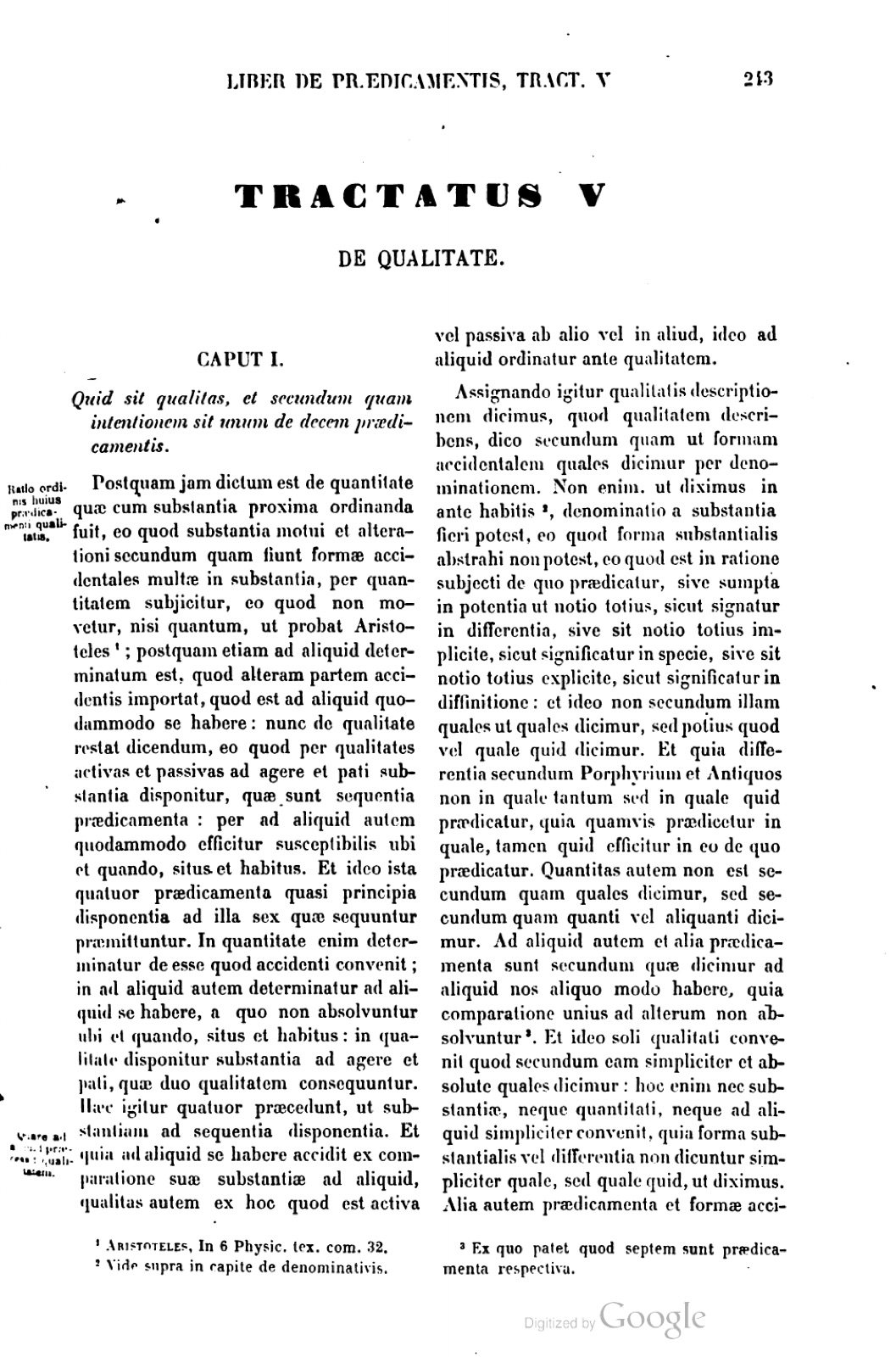
TRACTATUS V
DE QUALITATE.
CAPUT I.
Quid sit qualitas, et secundum quam intentionem sit unum de decem prædicamentis.
Postquam jam dictum est de quantitate quæ cum substantia proxima ordinanda fuit, eo quod substantia motui et alterationi secundum quam fiunt formæ accidentales multæ in substantia, per quantitatem subjicitur, eo quod non movetur, nisi quantum, ut probat Aristoteles 1; postquam etiam ad aliquid determinatum est, quod alteram partem accidentis importat, quod est ad aliquid quodammodo se habere: nunc de qualitate restat dicendum, eo quod per qualitates activas et passivas ad agere et pati substantia disponitur, quæ sunt sequentia prædicamenta: per ad aliquid autem quodammodo efficitur susceptibilis ubi et quando, situs et habitus. Et ideo ista quatuor prædicamenta quasi principia disponentia ad illa sex quæ sequuntur præmittuntur. In quantitate enim determinatur de esse quod accidenti convenit; in ad aliquid autem determinatur ad aliquid se habere, a quo non absolvuntur ubi et quando, situs et habitus 3: in qualitate disponitur substantia ad agere et pati, quæ duo qualitatem consequuntur. Hæc igitur quatuor præcedunt, ut substantiam ad sequentia disponentia. Et quia ad aliquid se habere accidit ex comparatione suæ substantiæ ad aliquid, qualitas autem ex hoc quod est activa vel passiva ab alio vel in aliud, ideo ad aliquid ordinatur ante qualitatem.
Assignando igitur qualitatis descriptionem dicimus, quod qualitatem describens, dico secundum quam ut formam accidentalem quales dicimur per denominationem. Non enim, ut diximus in ante habitis 2, denominatio a substantia fieri potest, eo quod forma substantialis abstrahi non potest, eo quod est in ratione subjecti de quo prædicatur, sive sumpta in potentia ut notio totius, sicut signatur in differentia, sive sit notio totius implicite, sicut significatur in specie, sive sit notio totius explicite, sicut significatur in diffinitione: et ideo non secundum illam quales ut quales dicimur, sed potius quod vel quale quid dicimur. Et quia differentia secundum Porphyrium et Antiquos non in quale tantum sed in quale quid prædicatur, quia quamvis prædicetur in quale, tamen quid efficitur in eo de quo prædicatur. Quantitas autem non est secundum quam quales dicimur, sed secundum quam quanti vel aliquanti dicimur. Ad aliquid autem et alia prædicamenta sunt secundum quæ dicimur ad aliquid nos aliquo modo habere, quia comparatione unius ad alterum non absolvuntur. Et ideo soli qualitati convenit quod secundum eam simpliciter et absolute quales dicimur: hoc enim nec substantiæ, neque quantitati, neque ad aliquid simpliciter convenit, quia forma substantialis vel differentia non dicuntur simpliciter quale, sed quale quid, ut diximus. Alia autem prædicamenta et formæ accidentales
TRACTATE V
ON QUALITY.
CHAPTER I.
What quality is, and according to what intention it is one of the ten predicaments.
After quantity has now been discussed, which had to be ordered as nearest to substance, because substance is subjected through quantity to motion and alteration according to which many accidental forms come to be in substance, because it is not moved except as quantified, as Aristotle proves 1; after what is toward something has also been determined, which imports the other part of accident, which is to have itself somehow toward something: now it remains to speak about quality, because through active and passive qualities substance is disposed toward acting and suffering, which are the following predicaments; but through what is toward something it is made in some way susceptible of where and when, position and habit. And therefore these four predicaments are set before as principles disposing to those six which follow. For in quantity there is determination concerning the being which belongs to accident; but in what is toward something there is determination of having itself toward something, from which where and when, position and habit are not absolved 3; in quality substance is disposed toward acting and suffering, which two follow quality. Therefore these four precede, as disposing substance to the following ones. And because to have itself toward something happens from the comparison of its substance to something, but quality from this, that it is active or passive from another or into another, therefore what is toward something is ordered before quality.
Therefore in assigning the description of quality we say that, describing quality, I say: according to which, as an accidental form, we are called qualified by denomination. For, as we said in what was had before 2, denomination cannot occur from substance, because a substantial form cannot be abstracted, since it is in the account of the subject of which it is predicated, whether taken in potency as the notion of the whole, as it is marked in difference, or whether it is the notion of the whole implicitly, as it is signified in species, or whether it is the notion of the whole explicitly, as it is signified in definition; and therefore according to that we are not called qualified as qualified, but rather what or qualified-what. And because difference according to Porphyry and the Ancients is predicated not only in what-qualified but in qualified-what, because although it is predicated in what-qualified, nevertheless it becomes what in that of which it is predicated. But quantity is not that according to which we are called qualified, but according to which we are called how-much or somewhat-how-much. But what is toward something and the other predicaments are those according to which we are said to have ourselves in some way toward something, because they are not absolved by the comparison of one to another. And therefore it belongs to quality alone that according to it we are called qualified simply and absolutely; for this belongs simply neither to substance, nor to quantity, nor to what is toward something, because substantial form or difference is not called simply qualified, but qualified-what, as we have said. But the other predicaments and accidental forms
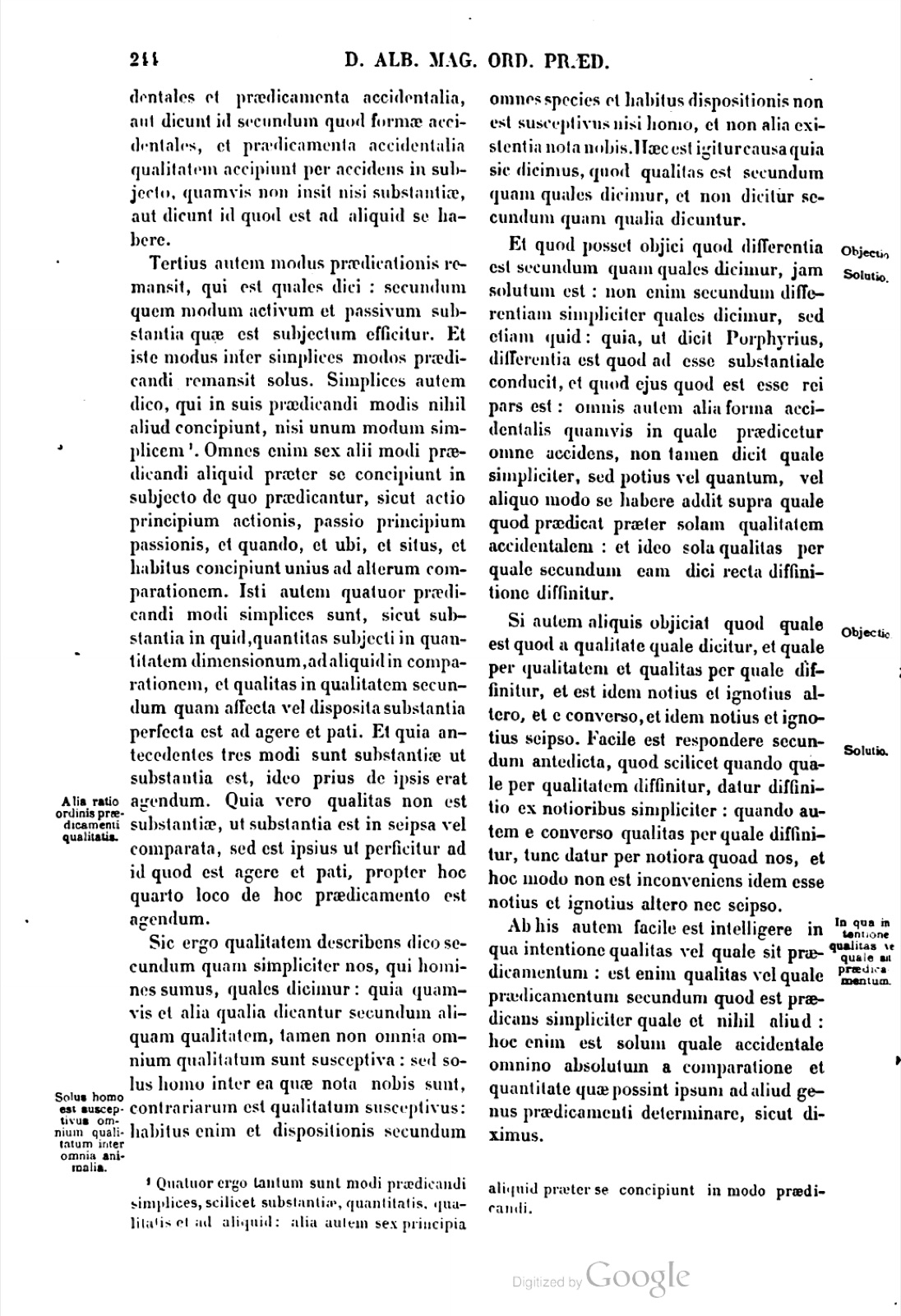
et prædicamenta accidentalia, aut dicunt id secundum quod formæ accidentales, et prædicamenta accidentalia qualitatem accipiunt per accidens in subjecto, quamvis non insit nisi substantiæ, aut dicunt id quod est ad aliquid se habere.
Tertius autem modus prædicationis remansit, qui est quales dici: secundum quem modum activum et passivum substantia quæ est subjectum efficitur. Et iste modus inter simplices modos prædicandi remansit solus. Simplices autem dico, qui in suis prædicandi modis nihil aliud concipiunt, nisi unum modum simplicem 4. Omnes enim sex alii modi prædicandi aliquid præter se concipiunt in subjecto de quo prædicantur, sicut actio principium actionis, passio principium passionis, et quando, et ubi, et situs, et habitus concipiunt unius ad alterum comparationem. Isti autem quatuor prædicandi modi simplices sunt, sicut substantia in quid, quantitas subjecti in quantitatem dimensionum, ad aliquid in comparationem, et qualitas in qualitatem secundum quam affecta vel disposita substantia perfecta est ad agere et pati. Et quia antecedentes tres modi sunt substantiæ ut substantia est, ideo prius de ipsis erat agendum. Quia vero qualitas non est substantiæ, ut substantia est in seipsa vel comparata, sed est ipsius ut perficitur ad id quod est agere et pati, propter hoc quarto loco de hoc prædicamento est agendum.
Sic ergo qualitatem describens dico secundum quam simpliciter nos, qui homines sumus, quales dicimur: quia quamvis et alia qualia dicantur secundum aliquam qualitatem, tamen non omnia omnium qualitatum sunt susceptiva: sed solus homo inter ea quæ nota nobis sunt, contrariarum est qualitatum susceptivus: habitus enim et dispositionis secundum omnes species et habitus dispositionis non est susceptivus nisi homo, et non alia existentia nota nobis. Hæc est igitur causa quia sic dicimus, quod qualitas est secundum quam quales dicimur, et non dicitur secundum quam qualia dicuntur.
Et quod posset objici quod differentia est secundum quam quales dicimur, jam solutum est: non enim secundum differentiam simpliciter quales dicimur, sed etiam quid: quia, ut dicit Porphyrius, differentia est quod ad esse substantiale conducit, et quod ejus quod est esse rei pars est: omnis autem alia forma accidentalis quamvis in quale prædicetur omne accidens, non tamen dicit quale simpliciter, sed potius vel quantum, vel aliquo modo se habere addit supra quale quod prædicat præter solam qualitatem accidentalem: et ideo sola qualitas per quale secundum eam dici recta diffinitione diffinitur.
Si autem aliquis objiciat quod quale est quod a qualitate quale dicitur, et quale per qualitatem et qualitas per quale diffinitur, et est idem notius et ignotius altero, et e converso, et idem notius et ignotius seipso. Facile est respondere secundum antedicta, quod scilicet quando quale per qualitatem diffinitur, datur diffinitio ex notioribus simpliciter: quando autem e converso qualitas per quale diffinitur, tunc datur per notiora quoad nos, et hoc modo non est inconveniens idem esse notius et ignotius altero nec seipso.
Ab his autem facile est intelligere in qua intentione qualitas vel quale sit prædicamentum: est enim qualitas vel quale prædicamentum secundum quod est prædicans simpliciter quale et nihil aliud: hoc enim est solum quale accidentale omnino absolutum a comparatione et quantitate quæ possint ipsum ad aliud genus prædicamenti determinare, sicut diximus.
and accidental predicaments either state that according to which accidental forms and accidental predicaments receive quality through accident in a subject, although it is present only in substance, or they state that which is to have itself toward something.
But the third mode of predication remained, which is to be called qualified; according to this mode the active and passive make the substance which is the subject. And this mode alone remained among the simple modes of predicating. But I call those simple which, in their modes of predicating, conceive nothing else except one simple mode 4. For all the other six modes of predicating conceive something besides themselves in the subject of which they are predicated, as action conceives the principle of action, passion the principle of passion, and when, and where, and position, and habit conceive the comparison of one to another. But these four modes of predicating are simple, as substance into what, quantity of a subject into quantity of dimensions, toward something into comparison, and quality into quality according to which a substance, affected or disposed, is perfected toward acting and suffering. And because the preceding three modes belong to substance as it is substance, therefore they had to be treated first. But because quality does not belong to substance as substance is in itself or compared, but belongs to it as it is perfected for that which is to act and to suffer, on account of this this predicament must be treated in the fourth place.
Thus therefore, describing quality, I say: that according to which simply we, who are men, are called qualified; because although other qualified things also are called according to some quality, nevertheless not all things are susceptible of all qualities, but man alone, among those things which are known to us, is susceptible of contrary qualities; for man alone is susceptible of habit and disposition according to all species and of the habit of disposition, and not other existents known to us. This therefore is the cause why we say thus, that quality is that according to which we are called qualified, and it is not said that according to which things are called qualified.
And what could be objected, that difference is that according to which we are called qualified, has already been solved: for according to difference we are not called simply qualified, but also what, because, as Porphyry says, difference is what contributes to substantial being, and what is part of that which is the being of the thing. But every other accidental form, although every accident is predicated in what-qualified, nevertheless does not state what-qualified simply, but rather adds either how much or to have itself in some mode beyond the what-qualified which it predicates besides accidental quality alone; and therefore quality alone is defined by the right definition through being called what-qualified according to it.
But if someone objects that what-qualified is that which is called what-qualified from quality, and what-qualified is defined through quality and quality through what-qualified, and the same thing is better known and less known than the other, and conversely, and the same thing is better known and less known than itself. It is easy to answer according to the things said before, namely that when what-qualified is defined through quality, a definition is given from things better known simply; but when conversely quality is defined through what-qualified, then it is given through things better known with respect to us, and in this mode it is not unfitting for the same thing to be better known and less known than another nor than itself.
But from these things it is easy to understand in what intention quality or what-qualified is a predicament: for quality or what-qualified is a predicament according as it predicates simply what-qualified and nothing else; for this alone is accidental what-qualified, wholly absolved from comparison and quantity which could determine it to another genus of predicament, as we have said.
Notes
- Aristotle, in book 6 of the Physics, text commentary 32. (Aristoteles, In 6 Physic. tex. com. 32.) ↩
- See above in the chapter on denominatives. (Vide supra in capite de denominativis.) ↩
- From this it is clear that seven predicaments are respective. (Ex quo patet quod septem sunt prædicamenta respectiva.) ↩
- Therefore there are only four simple modes of predicating, namely of substance, of quantity, of quality, and of what is toward something; but the other six principles conceive something besides themselves in the mode of predicating. (Quatuor ergo tantum sunt modi prædicandi simplices, scilicet substantiæ, quantitatis, qualitatis et ad aliquid: alia autem sex principia aliquid præter se concipiunt in modo prædicandi.) ↩
If a page does not appear, its photograph has not been uploaded yet.