Volume 1 · pp. 240–242
Chapter X
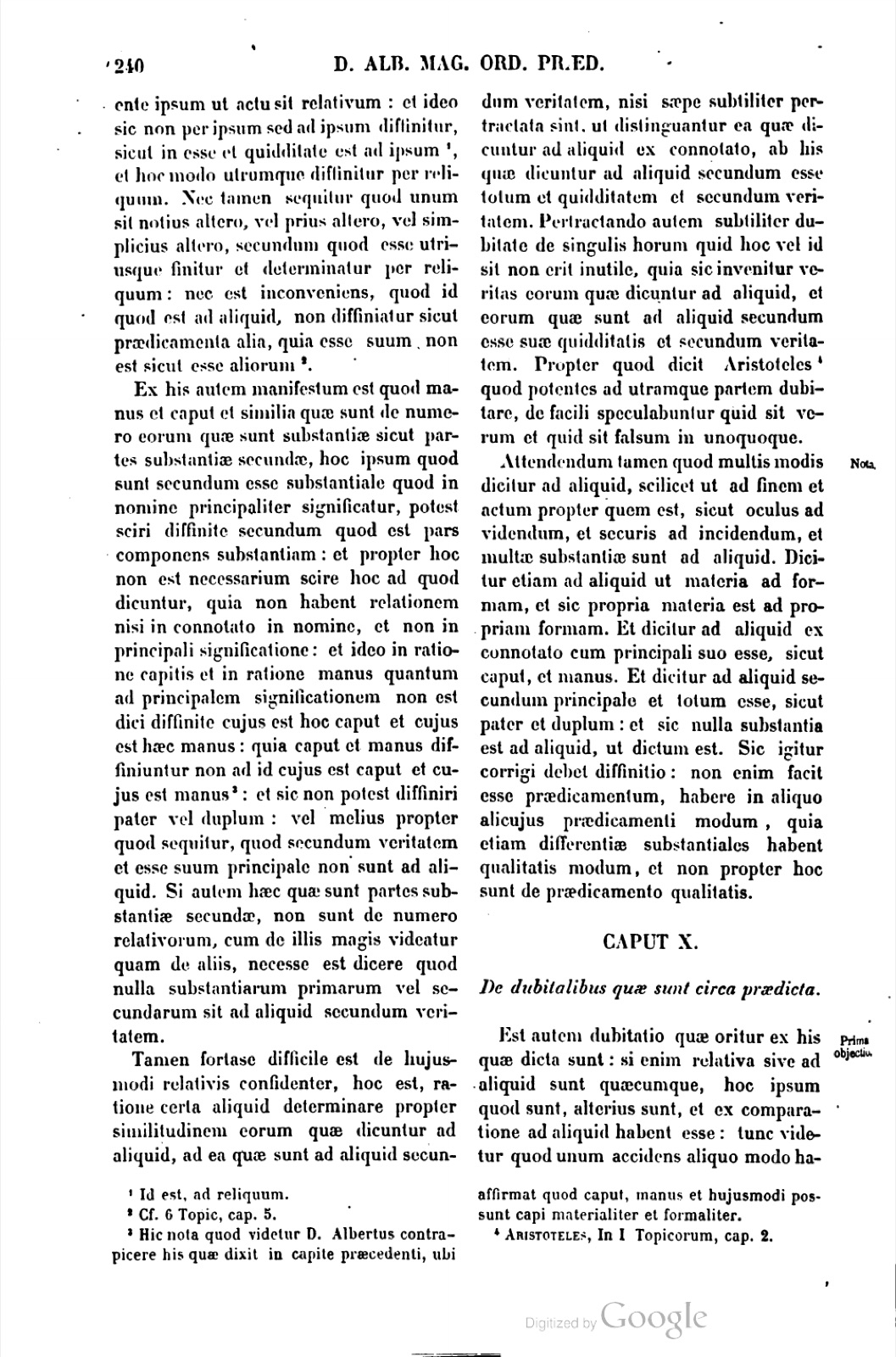
ipsum ut actu sit relativum: et ideo sic non per ipsum sed ad ipsum diffinitur, sicut in esse et quidditate est ad ipsum 1, et hoc modo utrumque diffinitur per reliquum. Nec tamen sequitur quod unum sit notius altero, vel prius altero, vel simplicius altero, secundum quod esse utriusque finitur et determinatur per reliquum: nec est inconveniens, quod id quod est ad aliquid, non diffiniatur sicut prædicamenta alia, quia esse suum non est sicut esse aliorum 2.
Ex his autem manifestum est quod manus et caput et similia quæ sunt de numero eorum quæ sunt substantiæ sicut partes substantiæ secundæ, hoc ipsum quod sunt secundum esse substantiale quod in nomine principaliter significatur, potest sciri diffinite secundum quod est pars componens substantiam: et propter hoc non est necessarium scire hoc ad quod dicuntur, quia non habent relationem nisi in connotato in nomine, et non in principali significatione: et ideo in ratione capitis et in ratione manus quantum ad principalem significationem non est dici diffinite cujus est hoc caput et cujus est hæc manus 3: quia caput et manus diffiniuntur non ad id cujus est caput et cujus est manus: et sic non potest diffiniri pater vel duplum: vel melius propter quod sequitur, quod secundum veritatem et esse suum principale non sunt ad aliquid. Si autem hæc quæ sunt partes substantiæ secundæ, non sunt de numero relativorum, cum de illis magis videatur quam de aliis, necesse est dicere quod nulla substantiarum primarum vel secundarum sit ad aliquid secundum veritatem.
Tamen fortasse difficile est de hujusmodi relativis confidenter, hoc est, ratione certa aliquid determinare propter similitudinem eorum quæ dicuntur ad aliquid, ad ea quæ sunt ad aliquid secundum veritatem, nisi sæpe subtiliter pertractata sint, ut distinguantur ea quæ dicuntur ad aliquid ex connotato, ab his quæ dicuntur ad aliquid secundum esse totum et quidditatem et secundum veritatem. Pertractando autem subtiliter dubitare de singulis horum quid hoc vel id sit non erit inutile, quia sic invenitur veritas eorum quæ dicuntur ad aliquid, et eorum quæ sunt ad aliquid secundum esse suæ quidditatis et secundum veritatem. Propter quod dicit Aristoteles 4 quod potentes ad utramque partem dubitare, de facili speculabuntur quid sit verum et quid sit falsum in unoquoque.
Attendendum tamen quod multis modis dicitur ad aliquid, scilicet ut ad finem et actum propter quem est, sicut oculus ad videndum, et securis ad incidendum, et multæ substantiæ sunt ad aliquid. Dicitur etiam ad aliquid ut materia ad formam, et sic propria materia est ad propriam formam. Et dicitur ad aliquid ex connotato cum principali suo esse, sicut caput, et manus. Et dicitur ad aliquid secundum principale et totum esse, sicut pater et duplum: et sic nulla substantia est ad aliquid, ut dictum est. Sic igitur corrigi debet diffinitio: non enim facit esse prædicamentum, habere in aliquo alicujus prædicamenti modum, quia etiam differentiæ substantiales habent qualitatis modum, et non propter hoc sunt de prædicamento qualitatis.
CAPUT X.
De dubitabilibus quæ sunt circa prædicta.
Est autem dubitatio quæ oritur ex his quæ dicta sunt: si enim relativa sive ad aliquid sunt quæcumque, hoc ipsum quod sunt, alterius sunt, et ex comparatione ad aliquid habent esse: tunc videtur quod unum accidens aliquo modo habet
it so that it is relative in act; and therefore in this way it is defined not through itself but toward it, just as in being and quiddity it is toward it 1, and in this mode each is defined through the remaining one. Nor nevertheless does it follow that one is better known than the other, or prior to the other, or simpler than the other, according as the being of each is bounded and determined through the remaining one; nor is it unfitting that that which is toward something is not defined like the other predicaments, because its being is not like the being of the others 2.
But from these things it is manifest that hand and head and similar things, which are of the number of those things which are substances as parts of second substance, can be known definitely as to this very thing that they are according to the substantial being which is principally signified in the name, according as it is a part composing substance; and on account of this it is not necessary to know that toward which they are said, because they do not have relation except in what is connoted in the name, and not in the principal signification. And therefore in the account of head and in the account of hand, as to the principal signification, it is not to be said definitely whose this head is and whose this hand is 3, because head and hand are defined not toward that whose head it is and whose hand it is; and thus father or double cannot be defined. Or, better, on account of what follows, they are not toward something according to truth and their principal being. But if these things which are parts of second substance are not of the number of relatives, although it seems so more about them than about others, it is necessary to say that no first or second substances are toward something according to truth.
Nevertheless perhaps it is difficult, concerning relatives of this kind, to determine something confidently, that is, by a certain reason, on account of the likeness of those things which are said toward something to those things which are toward something according to truth, unless they have often been treated subtly, so that those things which are said toward something from what is connoted may be distinguished from those which are said toward something according to whole being and quiddity and according to truth. But by treating subtly, to doubt about each of these, what this or that is, will not be useless, because thus the truth is found of those things which are said toward something and of those things which are toward something according to the being of their quiddity and according to truth. On account of this Aristotle says 4 that those able to doubt toward either side will easily contemplate what is true and what is false in each thing.
Nevertheless it must be attended to that toward something is said in many modes, namely as toward an end and act for the sake of which it is, as the eye is toward seeing, and the axe toward cutting, and many substances are toward something. It is also said toward something as matter to form, and thus proper matter is toward proper form. And it is said toward something from what is connoted with its principal being, as head and hand. And it is said toward something according to principal and whole being, as father and double; and thus no substance is toward something, as has been said. Thus therefore the definition must be corrected: for to have in something the mode of some predicament does not make it to be a predicament, because even substantial differences have the mode of quality, and on account of this they are not of the predicament of quality.
CHAPTER X.
On the doubtful matters which are about the aforesaid things.
But there is a doubt which arises from these things which have been said: for if relatives or things toward something are whatever things, this very thing that they are, are of another, and have being from comparison toward something, then it seems that one accident in some mode has
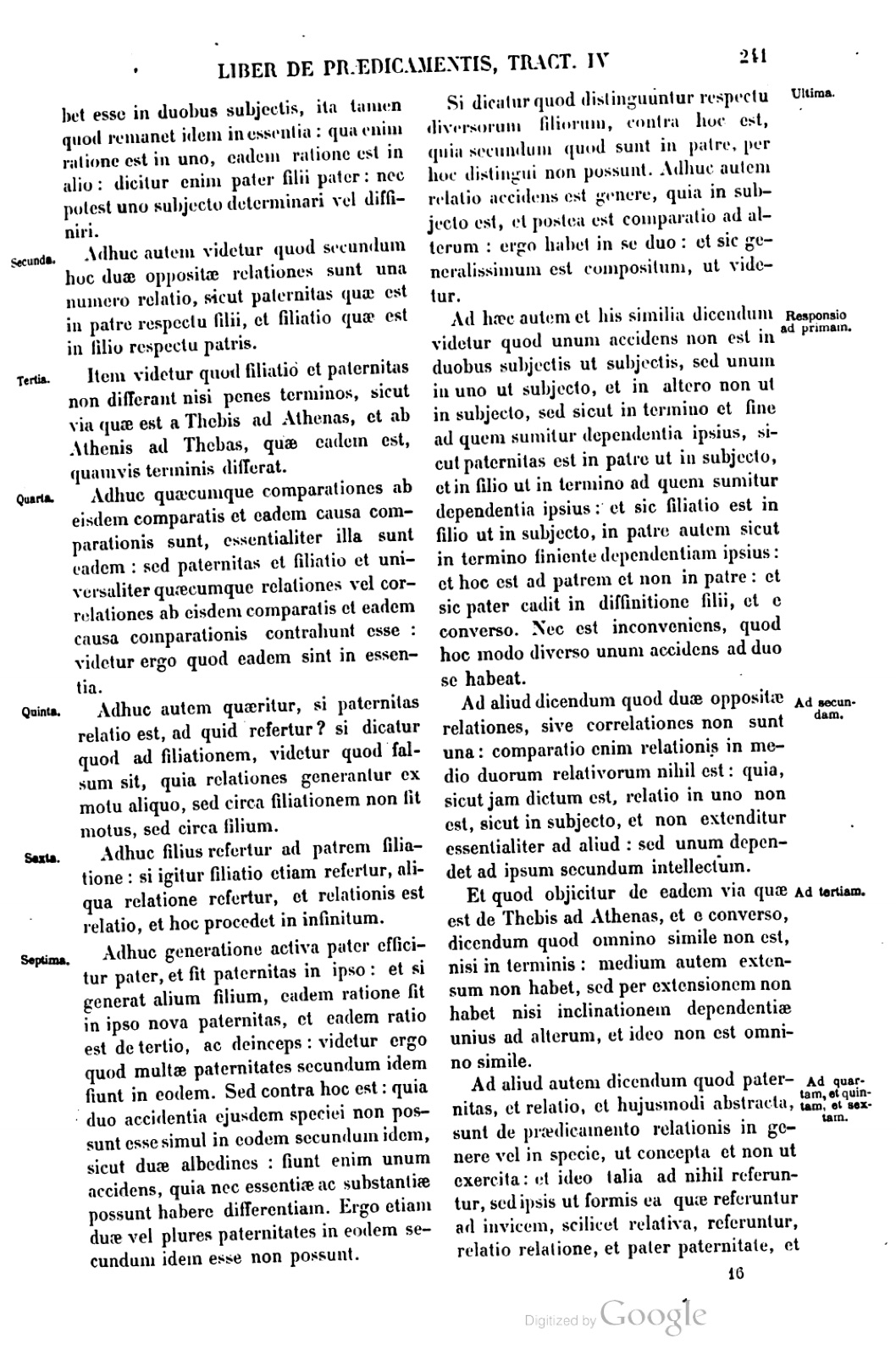
esse in duobus subjectis, ita tamen quod remanet idem in essentia: qua enim ratione est in uno, eadem ratione est in alio: dicitur enim pater filii pater: nec potest uno subjecto determinari vel diffiniri.
Adhuc autem videtur quod secundum hoc duæ oppositæ relationes sunt una numero relatio, sicut paternitas quæ est in patre respectu filii, et filiatio quæ est in filio respectu patris.
Item videtur quod filiatio et paternitas non differant nisi penes terminos, sicut via quæ est a Thebis ad Athenas, et ab Athenis ad Thebas, quæ eadem est, quamvis terminis differat.
Adhuc quæcumque comparationes ab eisdem comparatis et eadem causa comparationis sunt, essentialiter illa sunt eadem: sed paternitas et filiatio et universaliter quæcumque relationes vel correlationes ab eisdem comparatis et eadem causa comparationis contrahunt esse: videtur ergo quod eadem sint in essentia.
Adhuc autem quæritur, si paternitas relatio est, ad quid refertur? si dicatur quod ad filiationem, videtur quod falsum sit, quia relationes generantur ex motu aliquo, sed circa filiationem non fit motus, sed circa filium.
Adhuc filius refertur ad patrem filiatione: si igitur filiatio etiam refertur, aliqua relatione refertur, et relationis est relatio, et hoc procedet in infinitum.
Adhuc generatione activa pater efficitur pater, et fit paternitas in ipso: et si generat alium filium, eadem ratione fit in ipso nova paternitas, et eadem ratio est de tertio, ac deinceps: videtur ergo quod multæ paternitates secundum idem fiunt in eodem. Sed contra hoc est: quia duo accidentia ejusdem speciei non possunt esse simul in eodem secundum idem, sicut duæ albedines: fiunt enim unum accidens, quia nec essentiæ ac substantiæ possunt habere differentiam. Ergo etiam duæ vel plures paternitates in eodem secundum idem esse non possunt.
Si dicatur quod distinguuntur respectu diversorum filiorum, contra hoc est, quia secundum quod sunt in patre, per hoc distingui non possunt. Adhuc autem relatio accidens est ex genere, quia in subjecto est, et postea est comparatio ad alterum: ergo habet in se duo: et sic generalissimum est compositum, ut videtur.
Ad hæc autem et his similia dicendum videtur quod unum accidens non est in duobus subjectis ut subjectis, sed unum in uno ut subjecto, et in altero non ut in subjecto, sed sicut in termino et fine ad quem sumitur dependentia ipsius, sicut paternitas est in patre ut in subjecto, et in filio ut in termino ad quem sumitur dependentia ipsius: et sic filiatio est in filio ut in subjecto, in patre autem sicut in termino finiente dependentiam ipsius: et hoc est ad patrem et non in patre: et sic pater cadit in diffinitione filii, et e converso. Nec est inconveniens, quod hoc modo diverso unum accidens ad duo se habeat.
Ad aliud dicendum quod duæ oppositæ relationes, sive correlationes non sunt una: comparatio enim relationis in medio duorum relativorum nihil est: quia, sicut jam dictum est, relatio in uno est, sicut in subjecto, et non extenditur essentialiter ad aliud: sed unum dependet ad ipsum secundum intellectum.
Et quod objicitur de eadem via quæ est de Thebis ad Athenas, et e converso, dicendum quod omnino simile non est, nisi in terminis: medium autem extensum non habet, sed per extensionem non habet nisi inclinationem dependentiæ unius ad alterum, et ideo non est omnino simile.
Ad aliud autem dicendum quod paternitas, et relatio, et hujusmodi abstracta, sunt de prædicamento relationis in genere vel in specie, ut concepta et non ut exercita: et ideo talia ad nihil referuntur, sed ipsis ut formis ea quæ referuntur ad invicem, scilicet relativa, referuntur, relatio relatione, et pater paternitate, et
being in two subjects, yet in such a way that it remains the same in essence; for by whatever account it is in one, by the same account it is in the other. For a father is called the father of a son, and he cannot be determined or defined by one subject.
Further, according to this it seems that two opposed relations are one relation in number, as paternity which is in the father with respect to the son, and filiation which is in the son with respect to the father.
Likewise, it seems that filiation and paternity differ only according to the termini, as the road which is from Thebes to Athens and from Athens to Thebes is the same, although it differs in termini.
Further, whatever comparisons are from the same compared things and the same cause of comparison, those are essentially the same; but paternity and filiation and universally whatever relations or correlations draw their being from the same compared things and the same cause of comparison; therefore it seems that they are the same in essence.
Further, it is asked: if paternity is a relation, to what is it referred? If it is said that it is referred to filiation, it seems to be false, because relations are generated from some motion, but motion does not occur about filiation, but about the son.
Further, the son is referred to the father by filiation; therefore if filiation also is referred, it is referred by some relation, and there is a relation of a relation, and this will proceed to infinity.
Further, by active generation the father is made father, and paternity comes to be in him; and if he generates another son, by the same account a new paternity comes to be in him, and the same account applies concerning a third, and thenceforth. Therefore it seems that many paternities come to be in the same thing according to the same. But against this is that two accidents of the same species cannot exist at the same time in the same thing according to the same, as two whitenesses cannot; for they become one accident, because neither essences nor substances can have a difference. Therefore also two or more paternities cannot exist in the same thing according to the same.
If it is said that they are distinguished with respect to diverse sons, against this is that according as they are in the father, they cannot be distinguished through this. Further, relation is an accident from its genus, because it is in a subject, and afterward is a comparison to another; therefore it has two things in itself, and thus the most general genus is composite, as it seems.
But to these and similar things it seems one must say that one accident is not in two subjects as subjects, but is one in one as in a subject, and in the other not as in a subject, but as in a terminus and end toward which its dependency is taken; just as paternity is in the father as in a subject, and in the son as in the terminus toward which its dependency is taken. And thus filiation is in the son as in a subject, but in the father as in the terminus bounding its dependency; and this is toward the father and not in the father; and thus father falls in the definition of son, and conversely. Nor is it unfitting that in this diverse mode one accident has itself to two.
To the other it must be said that two opposed relations, or correlations, are not one: for the comparison of relation in the middle of two relatives is nothing, because, as has already been said, relation is in one, as in a subject, and is not extended essentially to the other; but one depends toward it according to intellect.
And to what is objected about the same road which is from Thebes to Athens, and conversely, it must be said that it is not wholly similar, except in the termini; but it does not have an extended middle, but through extension it has only an inclination of the dependency of one toward the other, and therefore it is not wholly similar.
But to the other it must be said that paternity, and relation, and abstracts of this kind, are of the predicament of relation in genus or in species, as conceived and not as exercised; and therefore such things are referred to nothing, but by them as forms those things which are referred to one another, namely relatives, are referred: relation by relation, and father by paternity, and
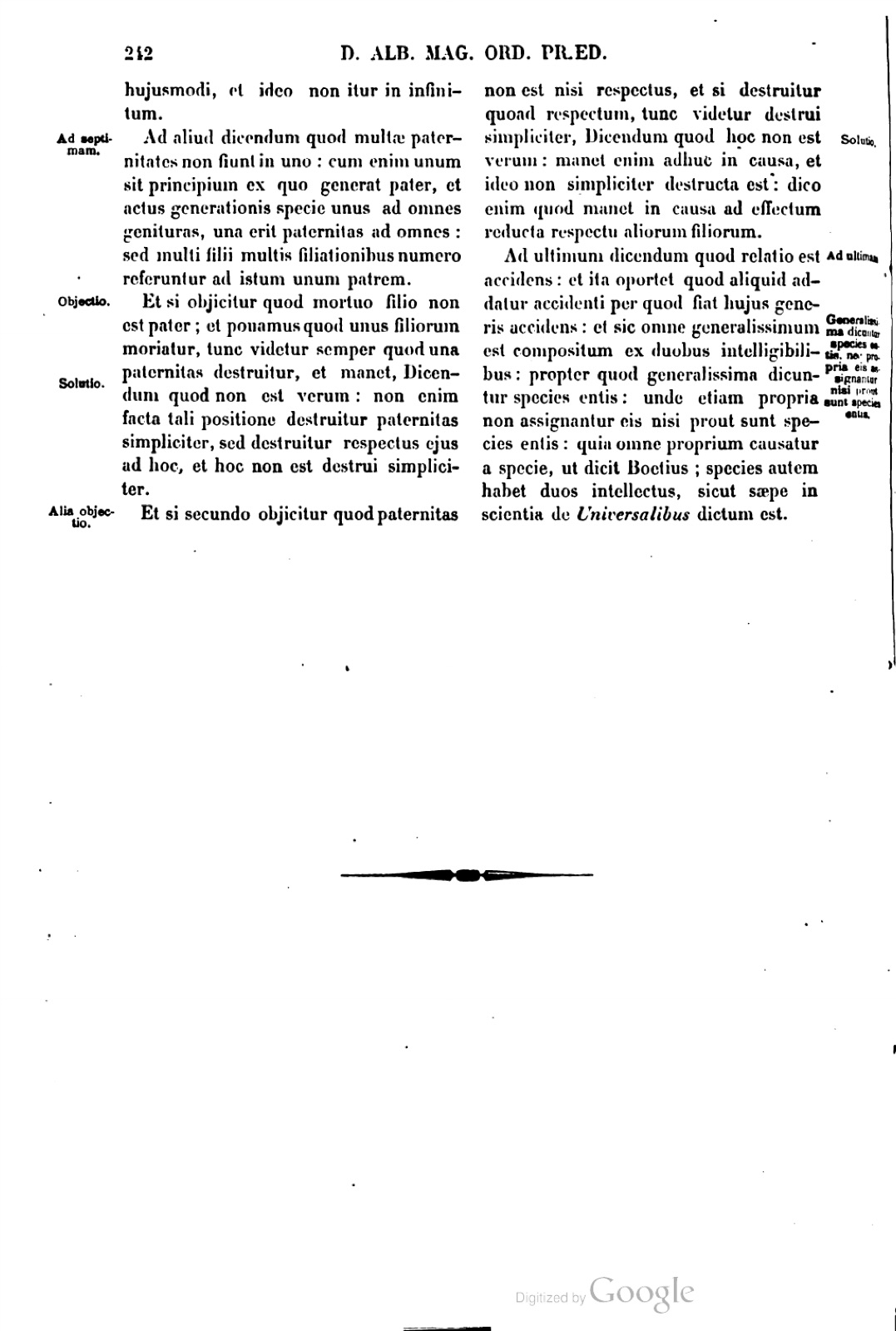
hujusmodi, et ideo non itur in infinitum.
Ad aliud dicendum quod multæ paternitates non fiunt in uno: cum enim unum sit principium ex quo generat pater, et actus generationis specie unus ad omnes genituras, una erit paternitas ad omnes: sed multi filii multis filiationibus numero referuntur ad istum unum patrem.
Et si objicitur quod mortuo filio non est pater; et ponamus quod unus filiorum moriatur, tunc videtur semper quod una paternitas destruitur, et manet, Dicendum quod non est verum: non enim facta tali positione destruitur paternitas simpliciter, sed destruitur respectus ejus ad hoc, et hoc non est destrui simpliciter.
Et si secundo objicitur quod paternitas non est nisi respectus, et si destruitur quoad respectum, tunc videtur destrui simpliciter, Dicendum quod hoc non est verum: manet enim adhuc in causa, et ideo non simpliciter destructa est: dico enim quod manet in causa ad effectum reducta respectu aliorum filiorum.
Ad ultimum dicendum quod relatio est accidens: et ita oportet quod aliquid addatur accidenti per quod fiat hujus generis accidens: et sic omne generalissimum est compositum ex duobus intelligibilibus: propter quod generalissima dicuntur species entis: unde etiam propria non assignantur eis nisi prout sunt species entis: quia omne proprium causatur a specie, ut dicit Boetius; species autem habet duos intellectus, sicut sæpe in scientia de Universalibus dictum est.
of this kind, and therefore one does not go to infinity.
To the other it must be said that many paternities do not come to be in one: for since there is one principle from which the father generates, and the act of generation is one in species toward all things generated, there will be one paternity toward all; but many sons are referred by many filiations in number to that one father.
And if it is objected that when the son has died there is no father, and let us posit that one of the sons dies, then it seems always that one paternity is destroyed and remains, It must be said that this is not true; for when such a position is made, paternity is not destroyed simply, but its respect toward this is destroyed, and this is not to be destroyed simply.
And if secondly it is objected that paternity is nothing except respect, and if it is destroyed as to respect, then it seems to be destroyed simply, It must be said that this is not true: for it still remains in the cause, and therefore it has not been destroyed simply; for I say that it remains in the cause reduced to act with respect to the other sons.
To the last it must be said that relation is an accident; and thus something must be added to accident through which it becomes an accident of this genus; and thus every most general genus is composed from two intelligibles, on account of which most general genera are called species of being. Hence also properties are not assigned to them except insofar as they are species of being, because every property is caused by species, as Boethius says; but species has two understandings, as has often been said in the science On Universals.
Notes
- That is, toward the remaining one. (Id est, ad reliquum.) ↩
- Compare book 6 of the Topics, chapter 5. (Cf. 6 Topic, cap. 5.) ↩
- Here note that D. Albert seems to contradict those things which he said in the preceding chapter, where he affirms that head, hand, and things of this kind can be taken materially and formally. (Hic nota quod videtur D. Albertus contradicere his quæ dixit in capite præcedenti, ubi affirmat quod caput, manus et hujusmodi possunt capi materialiter et formaliter.) ↩
- Aristotle, in book 1 of the Topics, chapter 2. (Aristoteles, In 1 Topicorum, cap. 2.) ↩
If a page does not appear, its photograph has not been uploaded yet.