Volume 1 · p. 239
Chapter IX
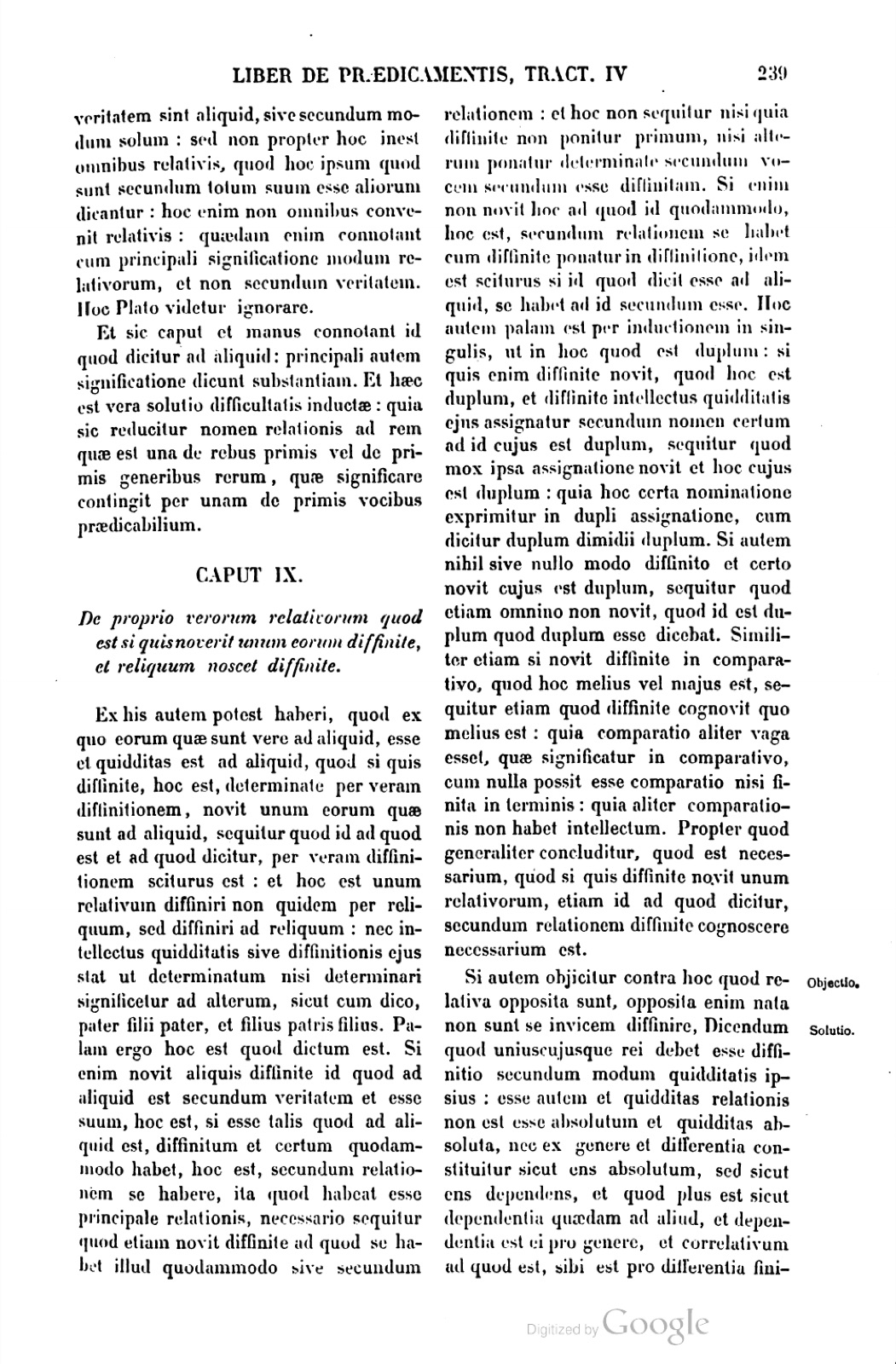
veritatem sint aliquid, sive secundum modum solum: sed non propter hoc inest omnibus relativis, quod hoc ipsum quod sunt secundum totum suum esse aliorum dicantur: hoc enim non omnibus convenit relativis: quædam enim connotant cum principali significatione modum relativorum, et non secundum veritatem. Hoc Plato videtur ignorare.
Et sic caput et manus connotant id quod dicitur ad aliquid: principali autem significatione dicunt substantiam. Et hæc est vera solutio difficultatis inductæ: quia sic reducitur nomen relationis ad rem quæ est una de rebus primis vel de primis generibus rerum, quæ significare contingit per unam de primis vocibus prædicabilium.
CAPUT IX.
De proprio verorum relativorum quod est si quis noverit unum eorum diffinite, et reliquum noscet diffinite.
Ex his autem potest haberi, quod ex quo eorum quæ sunt vere ad aliquid, esse et quidditas est ad aliquid, quod si quis diffinite, hoc est, determinate per veram diffinitionem, novit unum eorum quæ sunt ad aliquid, sequitur quod id ad quod est et ad quod dicitur, per veram diffinitionem sciturus est: et hoc est unum relativum diffiniri non quidem per reliquum, sed diffiniri ad reliquum: nec intellectus quidditatis sive diffinitionis ejus stat ut determinatum nisi determinari significetur ad alterum, sicut cum dico, pater filii pater, et filius patris filius. Palam ergo hoc est quod dictum est. Si enim novit aliquis diffinite id quod ad aliquid est secundum veritatem et esse suum, hoc est, si esse talis quod ad aliquid est, diffinitum et certum quodammodo habet, hoc est, secundum relationem se habere, ita quod habeat esse principale relationis, necessario sequitur quod etiam novit diffinite ad quod se habet illud quodammodo sive secundum relationem: et hoc non sequitur nisi quia diffinite non ponitur primum, nisi alterum ponatur determinate secundum vocem secundum esse diffinitam. Si enim non novit hoc ad quod id quodammodo, hoc est, secundum relationem se habet cum diffinite ponatur in diffinitione, idem est sciturus si id quod dicit esse ad aliquid, se habet ad id secundum esse. Hoc autem palam est per inductionem in singulis, ut in hoc quod est duplum: si quis enim diffinite novit, quod hoc est duplum, et diffinite intellectus quidditatis ejus assignatur secundum nomen certum ad id cujus est duplum, sequitur quod mox ipsa assignatione novit et hoc cujus est duplum: quia hoc certa nominatione exprimitur in dupli assignatione, cum dicitur duplum dimidii duplum. Si autem nihil sive nullo modo diffinito et certo novit cujus est duplum, sequitur quod etiam omnino non novit, quod id est duplum quod duplum esse dicebat. Similiter etiam si novit diffinite in comparativo, quod hoc melius vel majus est, sequitur etiam quod diffinite cognovit quo melius est: quia comparatio aliter vaga esset, quæ significatur in comparativo, cum nulla possit esse comparatio nisi finita in terminis: quia aliter comparationis non habet intellectum. Propter quod generaliter concluditur, quod est necessarium, quod si quis diffinite novit unum relativorum, etiam id ad quod dicitur, secundum relationem diffinite cognoscere necessarium est.
Si autem objicitur contra hoc quod relativa opposita sunt, opposita enim nata non sunt se invicem diffinire, Dicendum quod uniuscujusque rei debet esse diffinitio secundum modum quidditatis ipsius: esse autem et quidditas relationis non est esse absolutum et quidditas absoluta, nec ex genere et differentia constituitur sicut ens absolutum, sed sicut ens dependens, et quod plus est sicut dependentia quædam ad aliud, et dependentia est ei pro genere, et correlativum ad quod est, sibi est pro differentia finiente
truth they are something, or according to mode alone; but on account of this it is not present in all relatives that this very thing that they are according to their whole being they are said to be of others; for this does not belong to all relatives. For certain things connote with the principal signification the mode of relatives, and not according to truth. Plato seems to be ignorant of this.
And thus head and hand connote that which is said toward something, but in their principal signification they state substance. And this is the true solution of the difficulty introduced, because thus the name of relation is reduced to a thing which is one of the first things or of the first genera of things, which it happens to signify through one of the first utterances of predicables.
CHAPTER IX.
On the property of true relatives, which is that if someone has known one of them definitely, he will also know the remaining one definitely.
But from these things it can be had that, since the being and quiddity of those things which are truly toward something is toward something, if someone definitely, that is, determinately through a true definition, knows one of those things which are toward something, it follows that he will know through a true definition that toward which it is and toward which it is said; and this is for one relative to be defined, not indeed by the remaining one, but to be defined toward the remaining one. Nor does the understanding of its quiddity or definition stand as determinate unless it is signified as determined toward another, as when I say, father the father of a son, and son the son of a father. Therefore this which has been said is plain. For if someone definitely knows that which is toward something according to truth and its being, that is, if he has the being of such a thing which is toward something as defined and certain in some mode, that is, to have itself according to relation, so that it has the principal being of relation, it necessarily follows that he also definitely knows that to which that thing has itself in some mode or according to relation. And this follows only because the first is not posited definitely unless the other is posited determinately according to an utterance defined according to being. For if he does not know this to which it has itself in some mode, that is, according to relation, when it is definitely posited in the definition, he will know the same if that which he says is toward something has itself to that according to being. But this is plain through induction in individual cases, as in that which is double: for if someone definitely knows that this is double, and definitely the understanding of its quiddity is assigned according to a certain name to that whose double it is, it follows that immediately from the assignment itself he also knows this whose double it is, because this is expressed by a certain naming in the assignment of double, when double is called the double of half. But if he knows nothing, or in no defined and certain mode, of whose it is the double, it follows that he also altogether does not know that this is double which he was saying to be double. Similarly also, if he knows definitely in the comparative that this is better or greater, it follows also that he has definitely known than what it is better, because otherwise the comparison which is signified in the comparative would be vague, since there can be no comparison unless bounded in termini, because otherwise it does not have an understanding of comparison. On account of this it is concluded generally that it is necessary that, if someone definitely knows one of the relatives, it is also necessary definitely to know that toward which it is said according to relation.
But if it is objected against this that relatives are opposites, and opposites by nature are not to define one another, It must be said that the definition of each thing ought to be according to the mode of its quiddity. But the being and quiddity of relation is not absolute being and absolute quiddity, nor is it constituted from genus and difference as an absolute being is, but as a dependent being, and, what is more, as a certain dependency toward another; and dependency is for it as genus, and the correlative toward which it is is for it as a terminating difference
If a page does not appear, its photograph has not been uploaded yet.