Volume 1 · pp. 236–238
Chapter VIII
actum facti in corpore aliquo sensibili sunt quidem per qualitates sensibiles quæ sensum faciunt secundum actum. Cum ergo corpus sensibile nullum sit, necesse est quod nullus sensus sit secundum actum factus: perempto ergo sensibili perimitur sensus secundum actum factus: ergo sensibile peremptum simul secum perimit sensum. Sensus vero peremptus non necessario perimit sensibile, quia nullo sensu secundum actum existente, multa adhuc sensibilia sunt.
Et hoc patet iterum a minori arguendo: quia minus videtur quod animali perempto remaneat sensibile non peremptum, quam quod perempto sensu sensibile perimatur: animali autem perempto omnis sensus perimitur: sensibile autem adhuc est et permanet: multa enim adhuc remanent corpora calida, et dulcia et amara et omnia alia quæ sunt secundum qualitates sensibiles disposita: quæ omnia sunt sensibilia.
Amplius ad hoc idem facit quod sensus fit cum sensato sive cum eo quod habet sensum, hoc enim sensatum dicimus: simul enim fit animal cum sensu, quia propter sensum dicitur et est animal, ut dicit Avicenna. Sensibile autem ante est per naturam quam esset animal vel sensus, quia ex sensibilibus generatur animal et sensus: ignis enim et aqua et hujusmodi elementa ex quibus constat materialiter secundum naturam sunt antequam sit animal. Ergo sensibile videtur esse prius quam sensus.
Attendendum autem quod omnia relativa, sicut dictum est, sunt simul natura secundum quod sunt relativa, quamvis non sint simul secundum quod simpliciter sunt. Sunt enim relativa ea quæ sunt prius et posterius, quæ quidem secundum esse suum nunquam possunt simul esse, tamen prius in ratione prioris simul est cum eo quod eo est posterius in ratione posterioris, et hoc modo posita se ponunt et perempta se perimunt.
Hoc autem quod de scibili et scientia dictum est et de sensibili et sensu, sic intelligendum est quod scibile quidem et sensibile possunt accipi secundum hoc quod stant in esse substantiali, vel secundum hoc quod stant sub forma scientiæ et sensus: et hoc est dicere quod possunt accipi materialiter, vel formaliter. Si accipiuntur materialiter, tunc scibile præcedit scientiam, et sensibile sensum, sicut in ante habitis dictum est, quia scibile est causa scientiæ et sensibile causa est sensus secundum actum facti. Si autem accipiuntur hæc formaliter secundum quod scibile quidem stat sub forma scientiæ, sensibile autem sub forma sensus, sic sunt simul natura, et hoc solo modo sunt correlativa et non aliter. Et similiter est de causa et causato, et principio et principiato, et multis aliis.
Attendendum etiam est, quod natura (cum dicitur quod relativa sunt simul natura) non supponit nisi formam relationis: unde simul sunt natura, quæ simul sunt secundum formam sive secundum naturam relationis: quia ad naturam eorum quæ sunt relata ad invicem, non sunt simul, et secundum naturam illam aliquando unum est prius, et alterum posterius, ut dictum est de causa et causato, et principio et principiato, et patre et filio, et præcipue in hoc quod est prius et in hoc quod est posterius.
Adhuc autem scias, quod hoc argumentum non valet: scibile dicitur secundum potentiam: potentia refertur ad actum, ut dicit Aristoteles in decimo primæ philosophiæ: ergo scibile refertur ad scientiam secundum actum: quia multa sunt relativa in genere, quæ non sunt relativa in specie, ut patet in scientia quæ refertur, et grammatica quæ non est relata.
CAPUT VIII.
De disputatione contra diffinitionem Platonis inductam et correctionem ejus dicti.
Habet autem quæstionem sive dubitationem, utrum secundum superius inductam
the act made in some sensible body are indeed through sensible qualities which make sense according to act. Therefore when there is no sensible body, it is necessary that no sense be made according to act; therefore when the sensible is destroyed, sense made according to act is destroyed; therefore the sensible, when destroyed, at the same time destroys sense with itself. But sense, when destroyed, does not necessarily destroy the sensible, because with no sense existing according to act, many sensible things still exist.
And this is again clear by arguing from the lesser, because it seems less that when animal is destroyed the sensible remains not destroyed than that when sense is destroyed the sensible is destroyed; but when animal is destroyed every sense is destroyed, while the sensible still exists and remains: for many bodies still remain, hot, and sweet and bitter, and all other things that are disposed according to sensible qualities; all of these are sensible.
Further, for this same thing it contributes that sense comes to be with the sensed, or with that which has sense; for we call this the sensed. For animal comes to be together with sense, because on account of sense it is called and is animal, as Avicenna says. But the sensible is before, through nature, than animal or sense would be, because from sensibles animal and sense are generated; for fire and water and elements of this kind, from which it consists materially, are according to nature before animal exists. Therefore the sensible seems to be prior to sense.
But it must be attended to that all relatives, as has been said, are together by nature insofar as they are relatives, although they are not together according to the fact that they are simply. For those things are relatives which are prior and posterior; these indeed according to their being can never be together, nevertheless the prior in the account of prior is together with that which is posterior to it in the account of posterior, and in this mode when posited they posit themselves and when destroyed they destroy themselves.
But what has been said about the knowable and knowledge and about the sensible and sense is to be understood thus: the knowable indeed and the sensible can be taken according to the fact that they stand in substantial being, or according to the fact that they stand under the form of knowledge and of sense; and this is to say that they can be taken materially or formally. If they are taken materially, then the knowable precedes knowledge, and the sensible precedes sense, as has been said in what was had before, because the knowable is the cause of knowledge and the sensible is the cause of sense made according to act. But if these are taken formally, according as the knowable indeed stands under the form of knowledge, and the sensible under the form of sense, thus they are together by nature, and in this mode alone are they correlatives and not otherwise. And it is similar concerning cause and caused, and principle and principled, and many others.
It must also be attended to that nature, when it is said that relatives are together by nature, supposes nothing except the form of relation; hence those things are together by nature which are together according to the form or according to the nature of relation, because as to the nature of those things which are related to one another, they are not together, and according to that nature sometimes one is prior and the other posterior, as has been said concerning cause and caused, and principle and principled, and father and son, and especially in that which is prior and in that which is posterior.
Further, you should know that this argument is not valid: the knowable is said according to potency; potency is referred to act, as Aristotle says in the tenth book of the First Philosophy; therefore the knowable is referred to knowledge according to act. For many things are relatives in genus which are not relative in species, as is clear in knowledge which is referred, and grammar which is not related.
CHAPTER VIII.
On the disputation against the introduced definition of Plato and on the correction of his saying.
But it has a question or doubt, whether according to the above introduced
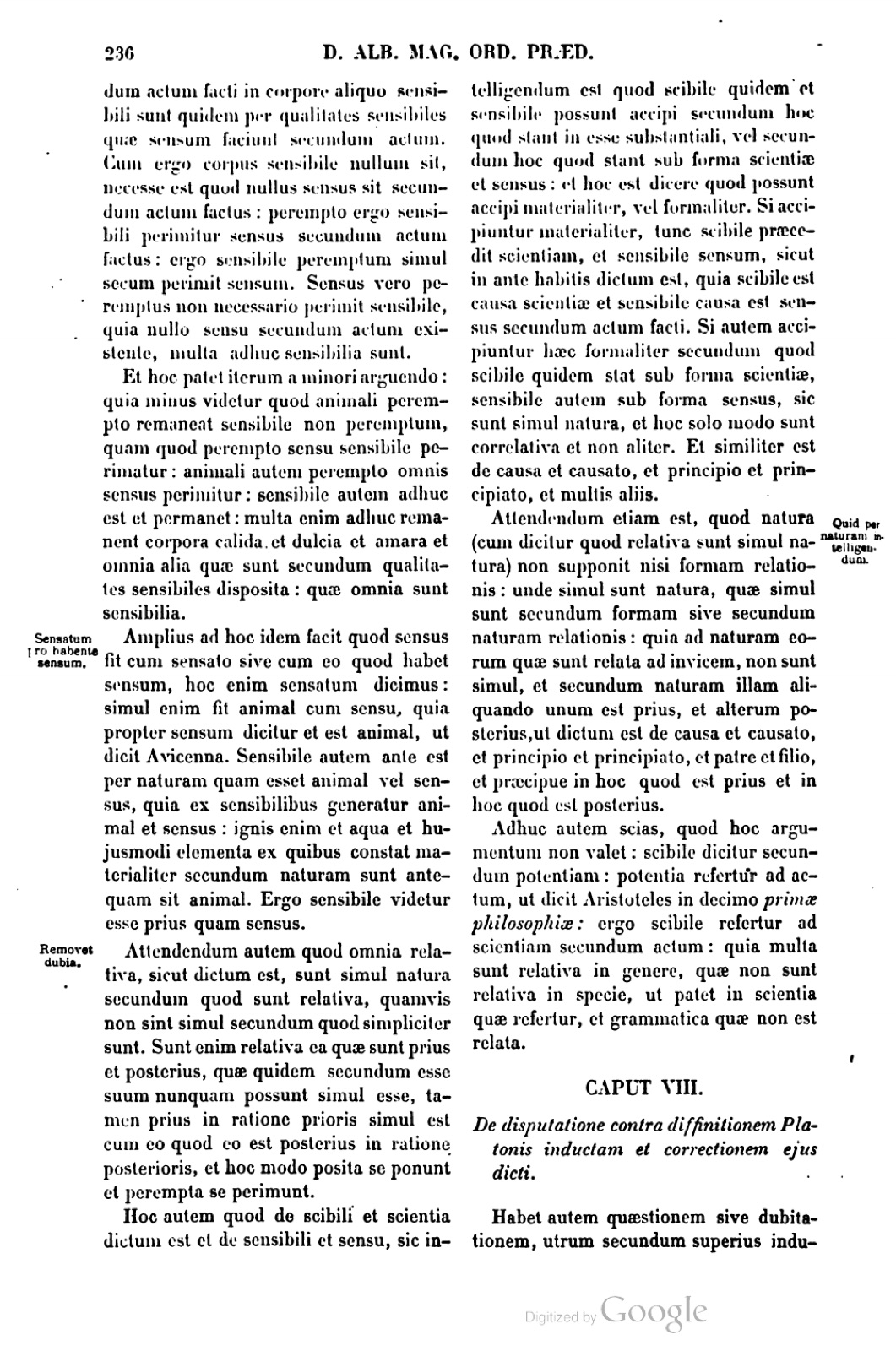
Platonis diffinitionem nulla substantia ad aliquid dicatur, quemadmodum videtur ex substantiæ ratione quæ est ens per se subsistens: et quod est per se subsistens, est absolutum, et sibi apud seipsum et esse suum non est ex hoc quod sit ad alterum. Sic ergo videtur quod nulla sit ad aliquid, sive sit prima substantia sive secunda: sive significetur substantia de toto sive de parte, suo nomine semper est ens per seipsum et non est alteri.
Si autem hoc conceditur esse verum, tunc adhuc remanet ad oppositum disputatio secundum superius inductam diffinitionem, quæ dicit ad aliquid esse, quæcumque hoc ipsum quod sunt, aliorum dicuntur: quia si hæc diffinitio est bene assignata, substantia videtur ad aliquid esse secundum quasdam substantias de parte et non de toto significantes. Cujus probatio est, quia in primis substantiis verum est quod non dicuntur ad aliquid, sive de toto sive de partibus significetur primarum substantiarum: aliquis enim homo non dicitur alicujus aliquis homo, cum tamen per genitivum maxime dicantur ad aliquid in his quæ sunt relativa 1: neque aliquis bos alicujus aliquis bos, quia homo et bos rationem substantiæ important in nominibus suis, et nihil additum dicunt substantiæ per quod ad aliquid referantur: et ideo etiam non grammatice dicitur, alicujus aliquis bos, nec alicujus aliquis homo: quia genitivus in talibus nullam habet notare habitudinem secundum quam fiat constructio. Similiter autem est etiam in partibus quæ sunt ut primæ substantiæ partes: quædam enim manus non dicitur alicujus quædam manus, sed simpliciter dicitur alicujus manus. Et illius causa est, quia quamvis dicat substantiam quæ est pars alicujus totius, et in nomine manus per rationem manus ut est organum intellectus et organum organorum, importetur comparatio ad motorem manus, per quod efficitur motor, ita quod non absoluta sit a relatione, tamen per hoc quod dicitur quædam manus, fit singularis manus: et est idem quædam manus, quod hæc manus demonstrata; et demonstratione determinatur ad hoc quod sub sensu est, quod secundum quod sub sensu est, non refertur ad alterum: et ideo nihil est dictu, alicujus quædam manus: et hæc est vera causa. Nec est curandum de hoc quod alii dicunt in loco isto.
Per eamdem etiam rationem quoddam caput non dicitur alicujus quoddam caput, quia quamvis caput sit dicens substantiam sub comparatione ad motorem cujus est caput, cum tamen refertur ad hoc singulare per hoc quod dicitur quoddam caput, quod idem est quod hoc caput, non dicitur nisi sub accidentibus quibus demonstratur: et per hoc non dicitur ad aliquid, quia comparatio quam dicit in nomine, non est demonstrabile accidens: et ideo non dicitur alicujus quoddam caput, sed dicitur alicujus caput sine determinatione ad hoc singulare propter comparationem quam importat nomen, quando absque determinatione ponitur ad singulare: tunc enim est nomen organi sive organicæ partis quæ semper secundum rationem sui nominis refertur ad aliquid cujus est organum: talia enim quæ talem in nomine important comparationem dicuntur ad aliquid, ut dixit Plato.
Similiter autem manifestum est in secundis substantiis quæ de toto significant, quod non dicuntur ad aliquid: et hoc patet inducendo in pluribus, ut homo non dicitur secundum nomen alicujus homo: quia homo absolute nominat substantiam, et per rationem nominis nullam addit supra substantiam comparationem quæ in nomine significetur. Et per eamdem rationem non dicitur bos alicujus bos sub nomine bovis, vel lignum alicujus lignum sub nomine ligni, sed hoc si alicujus dicitur, erit sub alio nomine, comparationem ad aliquid in modo significandi
definition of Plato no substance is called toward something, as seems from the account of substance, which is a being subsisting through itself; and what subsists through itself is absolute, and for itself in itself, and its being is not from this, that it is toward another. Thus therefore it seems that no substance is toward something, whether it is first substance or second; whether substance is signified of the whole or of a part, by its own name it is always being through itself and is not another's.
But if this is conceded to be true, then there still remains a disputation to the opposite according to the definition introduced above, which says that those things are toward something, whatever things, this very thing that they are, are said to be of others; because if this definition is well assigned, substance seems to be toward something according to certain substances signifying a part and not a whole. The proof of this is that in first substances it is true that they are not said toward something, whether it is signified of the whole or of the parts of first substances; for some man is not called some man of someone, although by the genitive things are especially said toward something in those things which are relative 1; nor is some ox some ox of someone, because man and ox import the account of substance in their names, and say nothing added to substance through which they are referred toward something. And therefore it is also not said grammatically, some ox of someone, nor some man of someone, because in such cases the genitive has no relation to mark according to which construction would occur. But it is similar also in the parts which are as parts of first substance: for some hand is not called some hand of someone, but is simply called the hand of someone. And the cause of this is that, although it states a substance which is part of some whole, and in the name hand, through the account of hand as it is an organ of intellect and an organ of organs, comparison to the mover of the hand is imported, through which it is made a mover, so that it is not absolute from relation, nevertheless through the fact that it is called some hand, it becomes a singular hand; and some hand is the same as this demonstrated hand, and by demonstration it is determined to that which is under sense, which, according as it is under sense, is not referred to another; and therefore it is nothing to say, some hand of someone; and this is the true cause. Nor must one care about what others say in this place.
By the same reason also some head is not called some head of someone, because although head states a substance under comparison to the mover whose head it is, nevertheless, when it is referred to this singular through the fact that it is called some head, which is the same as this head, it is said only under the accidents by which it is demonstrated; and through this it is not said toward something, because the comparison which it says in the name is not a demonstrable accident. And therefore it is not called some head of someone, but it is called someone's head without determination to this singular, on account of the comparison which the name imports when it is posited toward a singular without determination; for then it is the name of an organ or organic part which always according to the account of its name is referred toward something whose organ it is. For such things which import such comparison in their name are said toward something, as Plato said.
But it is similarly manifest in second substances which signify of the whole that they are not said toward something; and this is clear by inducing in many cases, as man is not called man of someone according to the name, because man names substance absolutely, and through the account of the name adds no comparison beyond substance which is signified in the name. And by the same reason ox is not called someone's ox under the name of ox, or wood someone's wood under the name of wood, but if this is said of someone, it will be under another name, importing comparison toward something in the mode of signifying
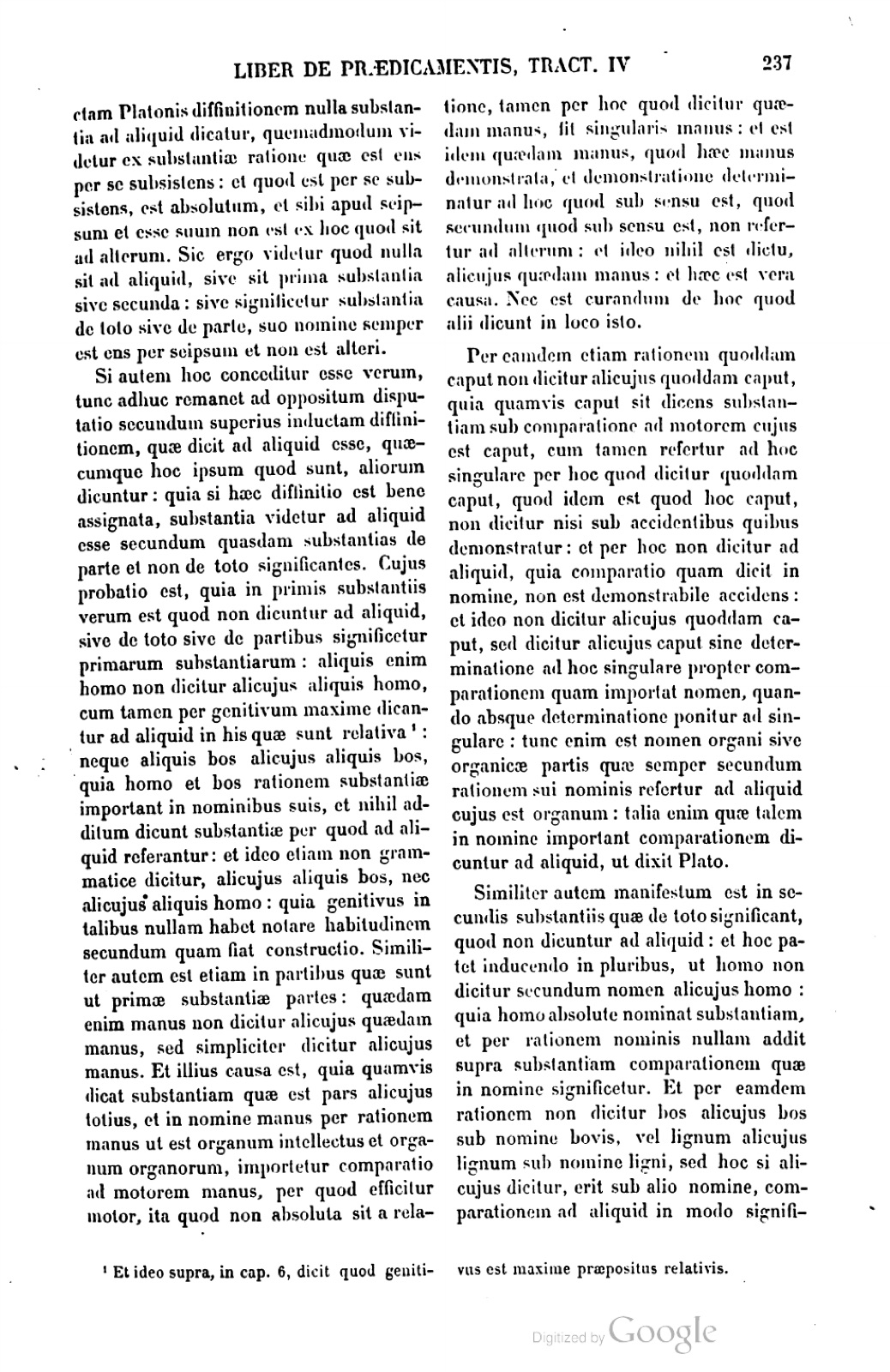
importante, ut si dicatur possessio, quia possessio importat ad possessorem comparationem, dicitur enim possessor possessionis possessor, et possessio possessoris possessio. In his igitur substantiis manifestum est quoniam sub nominibus primæ et secundæ substantiæ non sunt ad aliquid.
In aliquibus autem secundis substantiis de parte organica et non de toto significantibus habet aliquam dubitationem propter hoc quod nomen partis organicæ non dicit substantiam nisi stantem sub comparatione, quæ quia importatur in nomine, necesse est quod semper dicatur ad aliquid, quamvis secundum esse suum quod est substantiale, scilicet esse ex carnibus et ossibus non sint ad aliquid: talia ergo dicuntur ad aliquid et non sunt ad aliquid secundum id quod sunt sive secundum esse substantiale a quo imponitur nomen. Sic ergo caput dicitur alicujus caput, et manus alicujus manus, et singula nomina partium organicarum sunt hujusmodi secundum dici relata ad aliquid et non secundum esse: propter quod hoc nomina partium organicarum secundæ substantiæ fortasse ad aliquid esse alicui videbitur.
Videtur enim fortasse alicui quod sicut est in dici per nomen, ita sit secundum esse, quod tamen non est verum ut patebit inferius: cum hoc fuerit causa deceptionis Platonis, qui omnia talia dicebat esse ad aliquid propter modum eorum quæ sunt ad aliquid quæ important in dictione. Si ergo aliquis concedat quod diffinitio eorum quæ sunt ad aliquid, sufficienter est assignata, ita quod convertibilis sit cum his quæ sunt ad aliquid, aut nimis difficile aut impossibile est solvere quin secundum illam diffinitionem aliqua substantia sit ad aliquid. Si enim quæcumque ad aliquid dicuntur secundum nomen, et ad aliquid sunt secundum esse et veritatem, ut dixit Plato, impossibile est evadere quin pes, manus, et caput (quæ sunt secundæ substantiæ) sint ad aliquid, et præcipue si concedatur quod est idem dici ad aliquid et esse ad aliquid. Si autem dicatur quod dici ad aliquid secundum nomen connotans relationem, non sit esse ad aliquid secundum veritatem, adhuc difficile erit solvere vel evadere quin aliquæ secundæ substantiæ sint ad aliquid: quia nomen manus et nomen capitis et nomen pedis et hujusmodi, quamvis materialiter dicant substantias tanquam id cui imponitur nomen, tamen formaliter quantum ad proprietatem a qua imponitur nomen, dicunt id quod refertur ad aliud, quia dicunt id quod dicunt per modum organi et officialis membri ad actum aliquem: tale autem nomen dicit relationem ad aliquid, scilicet ad motorem cujus est tale organum. Boetius tamen et Alexander dicere videntur quod cum dicitur, aut nimis difficile, aut impossibile est solvere, quod unum dicitur ad alterius expressionem: ac si diceretur, nimis difficile est et, ut expressius dicatur, impossibile est solvere.
Si autem dicatur quod inducta diffinitio non sufficienter sive convertibiliter est assignata, sed sit corrigenda, quia sunt ad aliquid, quibus hoc ipsum esse est ad aliquid quodammodo se habere et non solum dici, tunc fortasse aliquid dicetur. Et dici potest contra illa, scilicet quod substantiæ secundæ sicut substantiæ non sunt ad aliquid nisi secundum modum quemdam qui est in dictione: quia tunc ista nomina, pes, manus, et caput, partes substantiæ principaliter significant, et substantia non est composita nisi ex substantiis, et secundario per modum significandi connotant cum principali significatione id quod dicitur ad aliquid: et hoc quidem est verum. Ea autem quæ sunt ad aliquid, in principali significatione dicunt id quod suum principale esse est ad aliquid, et esse suum habet ab eo ad quod est, et non a seipso, nec in seipso, sicut pater, et filius, et dimidium, et hujusmodi.
Hæc autem diffinitio differt ab alia quæ præinducta est: quia prior diffinitio sequitur omnia relativa, sive secundum
importing, as if possession is said, because possession imports comparison toward the possessor; for a possessor is called the possessor of a possession, and possession the possession of a possessor. Therefore in these substances it is manifest that under the names of first and second substance they are not toward something.
But in certain second substances signifying an organic part and not the whole, there is some doubt because the name of an organic part does not state substance except as standing under comparison; because this is imported in the name, it is necessary that it always be said toward something, although according to its own being, which is substantial, namely being from flesh and bones, they are not toward something. Therefore such things are said toward something and are not toward something according to that which they are, or according to the substantial being from which the name is imposed. Thus therefore head is called the head of someone, and hand the hand of someone, and the individual names of organic parts are related toward something in this way according to being said and not according to being; on account of which this will perhaps seem to someone, that the names of organic parts of second substance are toward something.
For it perhaps seems to someone that as it is in being said through the name, so it is according to being; nevertheless this is not true, as will be clear below, since this was the cause of Plato's deception, who said all such things to be toward something on account of the mode of those things which are toward something, which they import in diction. Therefore if someone concedes that the definition of those things which are toward something has been sufficiently assigned, so that it is convertible with those things which are toward something, it is either exceedingly difficult or impossible to solve that, according to that definition, some substance is toward something. For if whatever things are said toward something according to name are also toward something according to being and truth, as Plato said, it is impossible to escape that foot, hand, and head, which are second substances, are toward something, and especially if it is conceded that to be said toward something and to be toward something are the same. But if it is said that to be said toward something according to a name connoting relation is not to be toward something according to truth, it will still be difficult to solve or escape that some second substances are toward something, because the name of hand and the name of head and the name of foot and of things of this kind, although materially they state substances as that to which the name is imposed, nevertheless formally, with respect to the property from which the name is imposed, state that which is referred to another, because they state what they state through the mode of an organ and of an official member toward some act. But such a name states relation toward something, namely toward the mover whose such organ it is. Yet Boethius and Alexander seem to say that when it is said, either it is exceedingly difficult or impossible to solve, one is said for the expression of the other, as if it were said: it is exceedingly difficult and, to speak more expressly, impossible to solve.
But if it is said that the introduced definition has not been sufficiently or convertibly assigned, but must be corrected, because those things are toward something for which this very being is to stand somehow toward something and not only to be said, then perhaps something will be said. And it can be said against those things, namely that second substances as substances are not toward something except according to a certain mode which is in diction, because then these names, foot, hand, and head, principally signify parts of substance, and substance is not composed except from substances, and secondarily, through the mode of signifying, they connote with the principal signification that which is said toward something; and this indeed is true. But those things which are toward something, in their principal signification, state that whose principal being is toward something, and whose being it has from that toward which it is, and not from itself nor in itself, as father, and son, and half, and things of this kind.
But this definition differs from the other which was introduced before, because the prior definition follows all relatives, whether according to
Notes
- And therefore above, in chapter 6, he says that the genitive is most set before relatives. (Et ideo supra, in cap. 6, dicit quod genitivus est maxime præpositus relativis.) ↩
If a page does not appear, its photograph has not been uploaded yet.