Volume 1 · pp. 231–233
Chapter VI
dicta sunt de contrarietate, dicentes quod Aristoteles dicit, quod motus secundum accidens est in omnibus prædicamentis: ergo motus secundum accidens est etiam in ad aliquid: et ubi est motus, est aliquo modo contrarium: ergo quæ sunt ad aliquid secundum veritatem, etiam aliquo modo suscipiunt contrarium. Ad quod dicendum est quod quamvis motus secundum accidens sit in omnibus, tamen non est uno modo in omnibus. In ad aliquid ergo est motus, ut dicit Aristoteles 1, quia per motum inducitur, ut pater per generationem et hujusmodi, sicut per motum ad formam alii conformem.
Est autem attendendum quod hæc duo propria, suscipere contrarium, et suscipere magis et minus, ut in pluribus se concomitantur, quia suscipere magis et minus, ut dictum est, causatur ex hoc quod est plus vel minus habere de contrario. Unde contingit quod quamvis oppositio relativa non sit oppositio contrarietatis, nec e converso, quod contraria nunquam possunt simul esse relative opposita (quod ex hoc patet, quia contraria nata sunt fieri circa idem, relative autem opposita circa diversa: et contraria non possunt esse in eodem simul actu, relative autem opposita possunt, dummodo respectus fiat ad diversa: est enim idem pater et filius respectu diversorum) tamen relative opposita secundum modum et non secundum esse et veritatem, secundum id quod non sunt relativa, possunt habere contraria et suscipere magis et minus, quia non habent unam simplicem oppositionem, sicut contraria: sed sunt duo, et ratione unius suscipiunt contraria magis et minus, ratione autem alterius non.
Adhuc autem notandum quod inæquale recipit magis et minus, cum tamen quantitas supra quam fundatur ad aliquid, magis et minus non suscipiat: et hoc ideo quia hoc modo quo ad aliquid fundatur supra quantitatem, est magis et minus in quantitate, sicut in quantitate quæ est numerus, est major et minor, ita inæqualior est quæ in pluribus partibus mensuræ quantitatis ab æquali recedit, et ideo inæquale hoc modo dicitur magis et minus inæquale 2.
Si autem aliquis sic arguat, ubi est magis et minus, possibilis est motus; sed in ad aliquid non est motus, ergo etiam in ad aliquid non est magis et minus. Jam autem ad hoc satis responsum est: quia in his quæ sunt vere ad aliquid, non est motus, nisi sicut in his quæ per motum inducuntur, et non sic quod termini motus sint ad aliquid. In his autem quæ sunt ad aliquid secundum solum modum, potest esse motus, non secundum quod sunt ad aliquid, sed secundum quod sunt in genere qualitatis, ut dictum est: in talibus autem ad aliquid aliquando recipit magis et minus secundum genus, et non secundum speciem, quia inæquale est magis et minus: duplum autem et triplum non dicuntur secundum magis et minus, et hoc est ideo quia certa est dispositio in specie quæ non est in genere: non enim dicitur magis et minus duplum, quia certa mensura ponitur in specie quæ non ponebatur in genere inæqualitatis: certa enim mensura est dupli vel subtripli quæ non potest esse magis et minus, incerta autem importatur per inæquale, cui addi potest et minui. Hoc est igitur quod circa ista duo propria est notandum.
CAPUT VI.
De proprio relativorum quod est dici ad convertentiam.
Proprie autem proprium relativorum quod omni et soli et semper convenit ei quod est ad aliquid, sive secundum modum solum, sive secundum modum et veritatem sit ad aliquid, est ad convertentiam dici. Sed convertentia et convertibilitas et conversio in hoc differunt, quod
has been said concerning contrariety, saying that Aristotle says that motion according to accident is in all predicaments; therefore motion according to accident is also in what is toward something; and where there is motion, there is in some mode a contrary; therefore those things which are toward something according to truth also in some mode receive a contrary. To this it must be said that although motion according to accident is in all things, nevertheless it is not in one mode in all things. Therefore in what is toward something there is motion, as Aristotle says 1, because it is introduced through motion, as father through generation and things of this kind, just as through motion toward a form conforming to another.
But it must be attended to that these two properties, to receive a contrary and to receive more and less, for the most part accompany one another, because to receive more and less, as has been said, is caused from this, that it is to have more or less of a contrary. Hence it happens that, although relative opposition is not the opposition of contrariety, nor conversely, because contraries can never at the same time be relatively opposed (which is clear from this, because contraries are apt to come to be about the same thing, but relatively opposed things about diverse things; and contraries cannot be in the same thing at the same time in act, but relatively opposed things can, provided that the respect is made to diverse things; for the same person is father and son with respect to diverse persons), nevertheless things relatively opposed according to mode and not according to being and truth, according to that by which they are not relative, can have contraries and receive more and less, because they do not have one simple opposition, as contraries do, but are two things, and by reason of one they receive contraries, more and less, but by reason of the other they do not.
Still further it must be noted that the unequal receives more and less, although quantity, upon which what is toward something is founded, does not receive more and less; and this is so because in this mode in which what is toward something is founded upon quantity, there is more and less in quantity, just as in quantity which is number there is greater and lesser; so the more unequal is that which in more parts of the measure of quantity recedes from the equal, and therefore the unequal in this mode is said more and less unequal 2.
But if someone argues thus: where there is more and less, motion is possible; but in what is toward something there is no motion; therefore also in what is toward something there is not more and less. Now enough has been answered to this, because in those things which are truly toward something there is no motion, except as in those things which are introduced through motion, and not in such a way that the termini of motion are toward something. But in those things which are toward something according to mode alone, there can be motion, not according to the fact that they are toward something, but according to the fact that they are in the genus of quality, as has been said. But in such things toward something it sometimes receives more and less according to genus, and not according to species, because the unequal is more and less; but the double and triple are not said according to more and less, and this is therefore because there is a determinate disposition in the species which is not in the genus: for it is not said more and less double, because a determinate measure is posited in the species which was not posited in the genus of inequality; for there is a determinate measure of the double or subtriple which cannot be more and less, but an indeterminate one is imported through the unequal, to which something can be added and from which something can be diminished. This therefore is what must be noted concerning those two properties.
CHAPTER VI.
On the property of relatives which is to be said toward convertence.
But properly the property of relatives, which belongs to every and only and always to that which is toward something, whether it is toward something according to mode alone or according to mode and truth, is to be said toward convertence. But convertence and convertibility and conversion differ in this, that
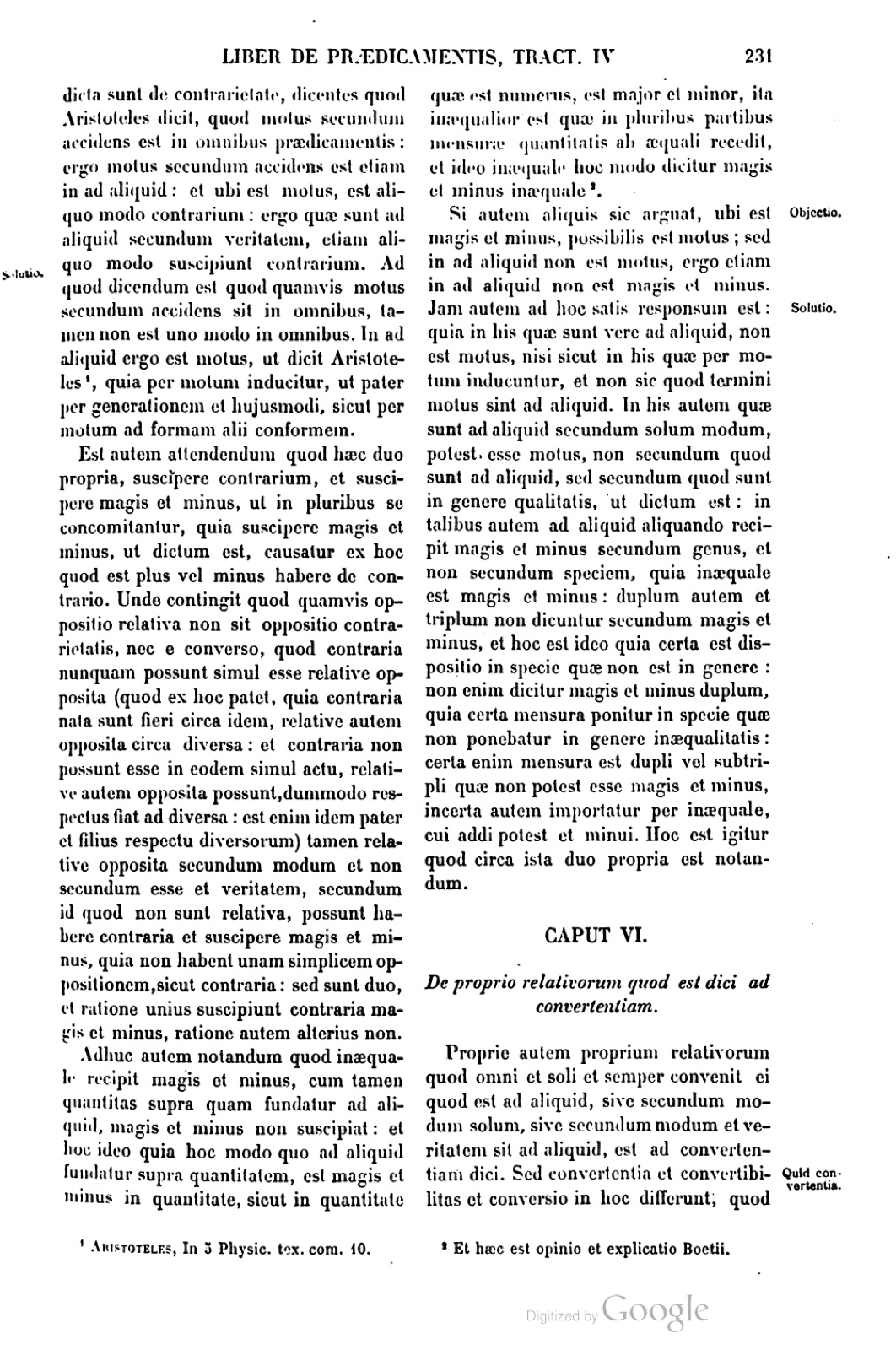
convertentia dicitur eorum quæ ad invicem referuntur per habitudinem, ut sicut primum refertur ad secundum, ita secundum refertur ad primum sub eodem casu vel diverso, sicut in ante habitis dictum est. Convertibilitas autem proprii et speciei cujus est proprium est, quod sicut unum sequitur ad alterum, ita sequetur alterum ad primum, ut utrumque sit antecedens et consequens ad alterum. Conversio autem in transpositione subjecti in prædicatum, et e converso, sub eadem qualitate, et quantitate, vel diversis.
Dici autem ad convertentiam convenit his quæ sunt ad aliquid secundum veritatem vel secundum modum tantum: quod convenit omni soli et semper, etiamsi non æqualiter sint ad aliquid, sed unum per se referatur ad aliquid, et aliud non per se sed mediante primo referatur ad primum: sicut scientia ad scibile per se refertur, scibile autem ad scientiam non refertur nisi mediante scientia. Hoc autem inferius declarabitur.
Declaratur autem per exempla et inductionem, quod ad aliquid ad convertentiam dicuntur, et primum in his quæ secundum veritatem sunt ad aliquid: dicitur enim servus domini servus, et dominus servi dominus, et duplum dimidii duplum, et e converso dimidium dupli dimidium: et hoc est secundum casum genitivum qui maxime præpositus est relativis. Quædam etiam ad convertentiam dicuntur secundum ablativum, ut majus minore majus, et minus majore minus. Similiter autem est in omnibus aliis quæ quocumque modo sunt ad aliquid: omnia enim dicuntur ad convertentiam, quamvis diverso casu referantur in relatione ad invicem secundum figuram locutionis, ut diximus, ut disciplina dicitur disciplinati disciplina secundum genitivum: sed e converso oportet mutare casum, ut dicatur disciplinatum disciplina disciplinatum secundum ablativum: disciplina enim refertur ad disciplinatum in habitudine genitivi, disciplinatum autem ad disciplinam in habitudine ablativi. Et similiter sensus dicitur sensati sensus: e converso autem secundum ablativum dicitur sensatum sensu sensatum, et scientia scibilis scientia, quia scibile non dependet per se ad scientiam nisi in quantum de ipso est scientia, propterea non refertur ad scientiam nisi mediante scientia, ut dicatur scibile scientia scibile. Et similiter se habet sensatum ad sensum, et in aliis talibus est simile. In relativis enim sic est, quod quandoque unum dependet ad aliud simpliciter, et alterum non secundum seipsum dependeat ad illud, nisi secundum quod stat sub forma primi: eo quod relatio non est æqualiter in utroque extremorum, sed in uno est secundum esse, et in alio non est nisi secundum rationem secundum quam primum refertur ad ipsum, ut dicitur scientia scibilis scientia, et scibile non dicitur scientiæ scibile, sed dicitur scibile scientia scibile: quæ propter diversam habitudinem necesse est mutare genitivum in ablativum. Et similiter sensus sensibilis sensus dicitur, sensibile autem e converso dicitur sensu sensibile.
Quod autem nunquam sub recto ad rectum sit convertentia, ratio est, quia rectus ad rectum non ponit transitum sive diversitatem quam semper exigunt relativa, sed rectus ad obliquum notat diversitatem. Si enim sic diceretur, scientia est scibile, falsa esset locutio, et e converso. Mutationis etiam casuum causa est multitudo habitudinum in casibus diversis assignatarum. Cum enim dicitur, scientia scibilis scientia, notatur quod scientia est scibilis ut subjecti vel objecti. Cum autem convertentia fit, ut dicatur, scibile scientia est scibile ut forma quæ ponitur circa ipsum, vel verius forma quæ a scibili causatur in sciente: quia scibile secundum formam efficitur in intellectu scientis.
Si quis autem objiciat, quod tales modos constructionum considerare habet grammaticus, et ad logicum non pertinet, Dicendum quod secundum quod hujusmodi habitudines ex diversa fiunt constructione,
convertence is said of those things which are referred to one another through a relation, so that just as the first is referred to the second, so the second is referred to the first under the same case or a diverse one, as was said in what was had before. But convertibility belongs to a property and to the species of which it is a property, because just as one follows upon the other, so the other will follow upon the first, so that each is antecedent and consequent to the other. But conversion consists in the transposition of subject into predicate, and conversely, under the same quality and quantity, or diverse ones.
But to be said toward convertence belongs to those things which are toward something according to truth or according to mode only; this belongs to every one, to it alone, and always, even if they are not toward something equally, but one is referred through itself toward something, and the other is referred to the first not through itself but by means of the first; just as knowledge is referred through itself to the knowable, but the knowable is not referred to knowledge except by means of knowledge. But this will be declared below.
But it is declared through examples and induction that things toward something are said toward convertence, and first in those things which according to truth are toward something: for a servant is called the servant of a master, and a master the master of a servant, and the double the double of the half, and conversely the half the half of the double; and this is according to the genitive case, which is most set before relatives. Certain things also are said toward convertence according to the ablative, as greater is greater than the lesser, and lesser less than the greater. But it is similar in all other things which in whatever mode are toward something: for all are said toward convertence, although they are referred by a diverse case in relation to one another according to the figure of speech, as we have said, as discipline is called the discipline of the disciplined according to the genitive; but conversely it is necessary to change the case, so that the disciplined is said disciplined by discipline according to the ablative. For discipline is referred to the disciplined in the relation of the genitive, but the disciplined to discipline in the relation of the ablative. And similarly sense is called the sense of the sensed; but conversely according to the ablative the sensed is called sensed by sense, and knowledge is knowledge of the knowable, because the knowable does not depend through itself toward knowledge except insofar as there is knowledge of it; for this reason it is not referred to knowledge except by means of knowledge, so that the knowable is called knowable by knowledge. And similarly the sensed stands toward sense, and in other such cases it is similar. For in relatives it is thus, that sometimes one depends toward another simply, and the other does not depend according to itself toward that, except according as it stands under the form of the first; because relation is not equally in both extremes, but in one it is according to being, and in the other it is only according to reason according to which the first is referred to it, as knowledge is called knowledge of the knowable, and the knowable is not called knowable of knowledge, but is called knowable by knowledge; because of this diverse relation it is necessary to change the genitive into the ablative. And similarly sense is called sense of the sensible, but the sensible conversely is called sensible by sense.
But the reason why there is never convertence under a direct case to a direct case is that the direct to the direct does not posit the transition or diversity which relatives always require, but the direct to the oblique marks diversity. For if it were said thus, knowledge is the knowable, the expression would be false, and conversely. The cause also of the changing of cases is the multitude of relations assigned in diverse cases. For when it is said, knowledge is knowledge of the knowable, it is marked that knowledge is of the knowable as of a subject or object. But when convertence is made, so that it is said, the knowable is knowable by knowledge, it is as a form which is placed around it, or more truly as the form which is caused by the knowable in the knower, because the knowable according to form is effected in the intellect of the knower.
But if someone objects that the grammarian has to consider such modes of constructions, and that it does not pertain to the logician, It must be said that according as relations of this kind come to be from diverse construction,
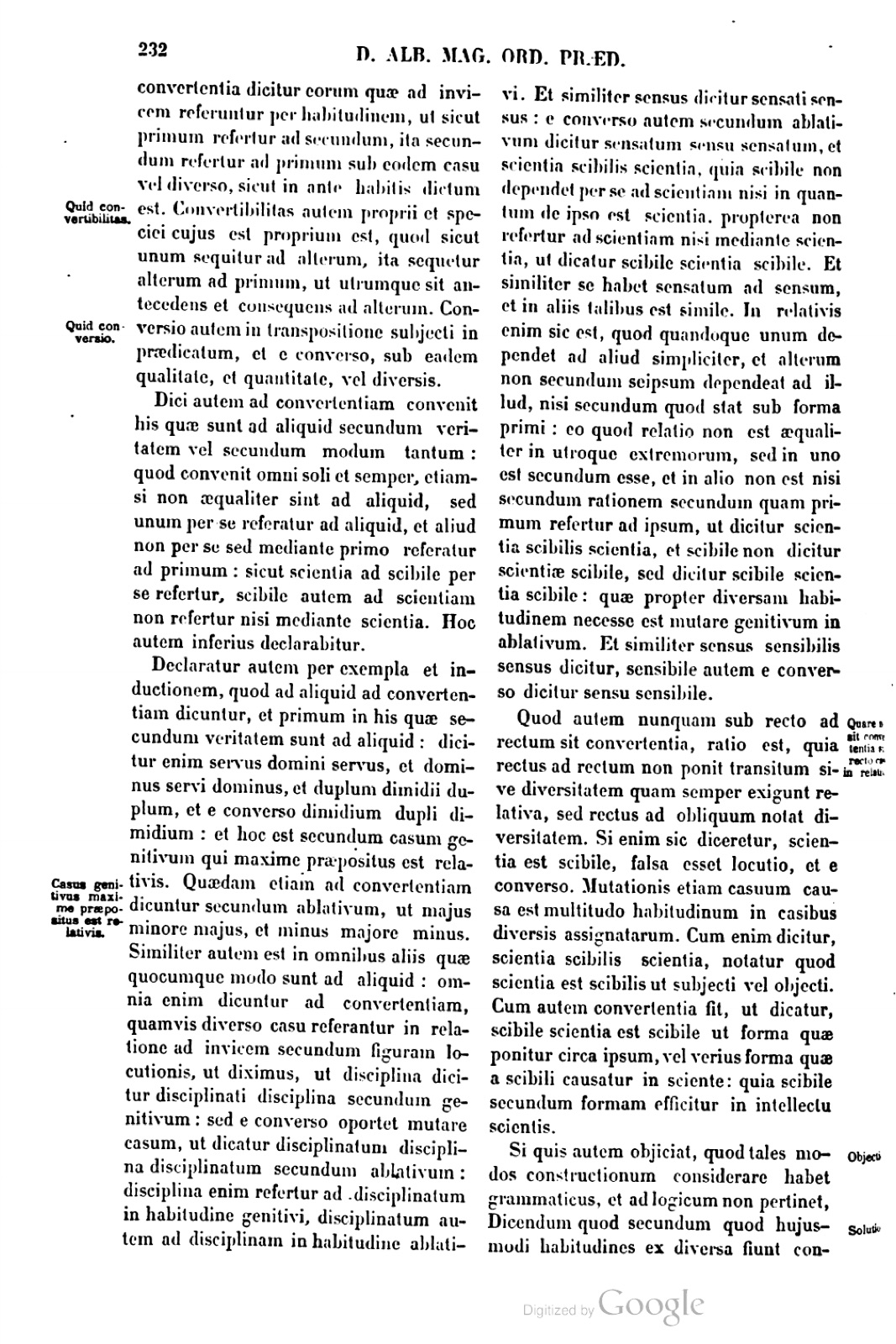
considerat eas grammaticus, secundum autem quod voces in hoc significant diversas rerum prædicationes et prædicabilium modos, eas habet considerare logicus. Sic igitur ad convertentiam dicuntur ea quæ sunt ad aliquid.
Est tamen in his aliquando in figura vocis impedimentum, quod aliquando removetur convertentia secundum dictionem: unde aliquoties videbitur esse non verum, quod relativa secundum convertentiam dicantur, nisi convenienter secundum nominis figuram et casum assignetur ad id ad quod dicitur secundum nomen et casum. Nisi ergo peccet is qui assignat, ita quod non referat ad hoc ad quod dicitur secundum nomen et casum, tunc videbitur converti, sicut manifestum est in ala, quæ quia organum volandi dicit ipso nomine, patet quod alterius est quod utitur ea ad volandum et non est absolute dicta: quia si esset absolute, etiam abscissa adhuc esset ala, quod falsum est. Quia igitur ala non sua sed alterius est, nec sibi sed alteri ala est, si assignetur quod sit avis ala, peccatum est in assignatione, et ideo non convertitur: quia prima assignatio non fuit conveniens, quando dicebatur ala avis ala: et ideo non convertitur, ut dicatur, avis alæ avis. Non enim in eo quod avis est, dicitur alæ avis, sed in eo quod alata est: multorum enim etiam animalium aliorum alæ sunt, quæ tamen non sunt aves, nec in genere avium continentur. Propter quod si convenienter secundum nomen et casum assignetur ala ad id cujus est, statim convertitur, ut si ala alati ala dicatur: tunc enim convertitur, ut dicatur secundum ablativum casum, alatum ala alatum.
Unde etiam in talibus in quibus nomina non sunt posita, aliqua necesse est fingere nomina secundum convenientem assignationem, ut in remo patet, quod quia instrumentum dicit id quod alterius est vel alteri est. Si igitur sic assignetur, ut dicatur remus navis remus, non erit secundum rem et nomen et casum conveniens assignatio: neque enim remus dicitur navis in eo quod navis: sunt enim naves quarum remi non sunt, sicut magnæ naves quas lintres vocant quæ malis moventur et velis, et remis impelli non possunt: et ideo quia non conveniens fuit assignatio, non convertitur, ut dicatur, navis remi navis. Sed forte convenienter erit facta assignatio, si sic dicendo assignetur, remus remitæ rei remus, aut quomodolibet aliter secundum convenientem vocis assignationem dictum sit. Ut si remitæ non placet, dicatur rematæ: ad placitum enim fingentis nomina talis fit assignatio, nomen enim in talibus non est positum, sed convertitur si nomen secundum figuram dictionis et secundum convenientem casum assignetur: sicut enim remus remiti remus est, ita remitum remo remitum est. Similiter autem est in aliis, quæ hoc ipsum quod sunt, aliorum sunt, et non absoluta sunt hoc quod sunt, nec sibi in se habent hoc quod sunt: in talibus enim omnibus convertentia fit si convenienter assignetur, ut caput, quod quia membrum et organum est, non sibi sed alteri et alterius est: ideo caput capitati est et non est caput animalis caput, quia non in eo quod aliquid animal est, caput est: multa enim animalia sunt capita non habentia, sicut omnia genera ostreorum conchiliorum, ut purpuræ, murices, et alia multa. Sic autem fortasse facilius sumitur convertentia, ut quando nomina non sunt posita, vel formetur ab illis quibus nomina posita sunt, vel fingatur et figuretur ab his quæ convertuntur, sicut patet in his quæ dicta sunt, sicut formatum est ab anima animatum et a remo remitum.
Ex his igitur universaliter concluditur, quod omnia quæ dicuntur ad aliquid, si convenienter secundum figuram appellationis et casum assignentur, ad convertentiam dicuntur: nam si ad quodcumque assignentur ad quod non dicuntur, et non assignentur ad id ad quod dicuntur, non fit convertentia. Quod sic probatur per locum a majori: quia etiam in his quæ indubitanter convertibilia dicuntur, et
the grammarian considers them, but insofar as utterances in this signify diverse predications of things and modes of predicables, the logician has to consider them. Thus therefore those things which are toward something are said toward convertence.
Nevertheless in these there is sometimes an impediment in the figure of speech, and on account of diction convertence is sometimes removed; hence sometimes it will seem not to be true that relatives are said according to convertence, unless it is assigned fittingly according to the figure of the name and the case to that toward which it is said according to name and case. Therefore unless the one who assigns errs, so that he does not refer it to that toward which it is said according to name and case, then it will seem to be converted, as is manifest in wing, which, because by its very name it states an organ of flying, is clearly of another which uses it for flying and is not said absolutely; because if it were absolute, even when cut off it would still be a wing, which is false. Therefore because a wing is not its own but another's, nor is it a wing for itself but for another, if it is assigned that it is the wing of a bird, there is error in the assignment, and therefore it is not converted, because the first assignment was not fitting, when it was said, a wing is the wing of a bird; and therefore it is not converted so that it is said, a bird is a bird of a wing. For not insofar as it is a bird is it called a bird of a wing, but insofar as it is winged; for there are wings also of many other animals, which nevertheless are not birds nor are contained in the genus of birds. On account of this, if the wing is fittingly assigned according to name and case to that whose it is, it is immediately converted, as if it is said, a wing is the wing of the winged; for then it is converted so that it is said according to the ablative case, the winged is winged by a wing.
Hence also in such things in which names have not been posited, it is necessary to fashion some names according to a fitting assignment, as is clear in oar, because an instrument states that which is of another or is for another. Therefore if it is assigned thus, so that it is said, an oar is the oar of a ship, the assignment will not be fitting according to thing and name and case; for an oar is not said of a ship insofar as it is a ship, since there are ships whose oars are not, such as great ships which they call barges, which are moved by masts and sails and cannot be driven by oars. And therefore, because the assignment was not fitting, it is not converted so that it is said, a ship is a ship of an oar. But perhaps the assignment will have been made fittingly if it is assigned by saying thus: an oar is the oar of an oared thing, or if it is said in any other way according to a fitting assignment of speech. As if remita does not please, let remata be said; for such an assignment is made according to the pleasure of the one fashioning names, since a name has not been posited in such cases. But it is converted if the name is assigned according to the figure of diction and according to a fitting case: for just as an oar is the oar of the oared thing, so the oared thing is oared by an oar. But it is similar in other things which, this very thing that they are, are of others, and are not absolute as to what they are, nor have in themselves for themselves what they are. For in all such things convertence occurs if it is fittingly assigned, as head, which because it is a member and an organ, is not for itself but for another and is of another; therefore a head belongs to a headed thing, and a head is not the head of an animal, because not insofar as something is an animal is it a head; for many animals do not have heads, as all the genera of oyster shellfish, such as purple-shells, murexes, and many others. But perhaps convertence is more easily taken thus: when names have not been posited, either it is formed from those for which names have been posited, or it is fashioned and shaped from those things which are converted, as is clear in these things which have been said, just as animated has been formed from soul, and oared from oar.
From these things therefore it is universally concluded that all things which are said toward something, if they are fittingly assigned according to the figure of appellation and case, are said toward convertence; for if they are assigned to anything whatever toward which they are not said, and are not assigned to that toward which they are said, convertence does not occur. This is proved thus through a locus from the greater: because even in those things which are indubitably called convertible, and
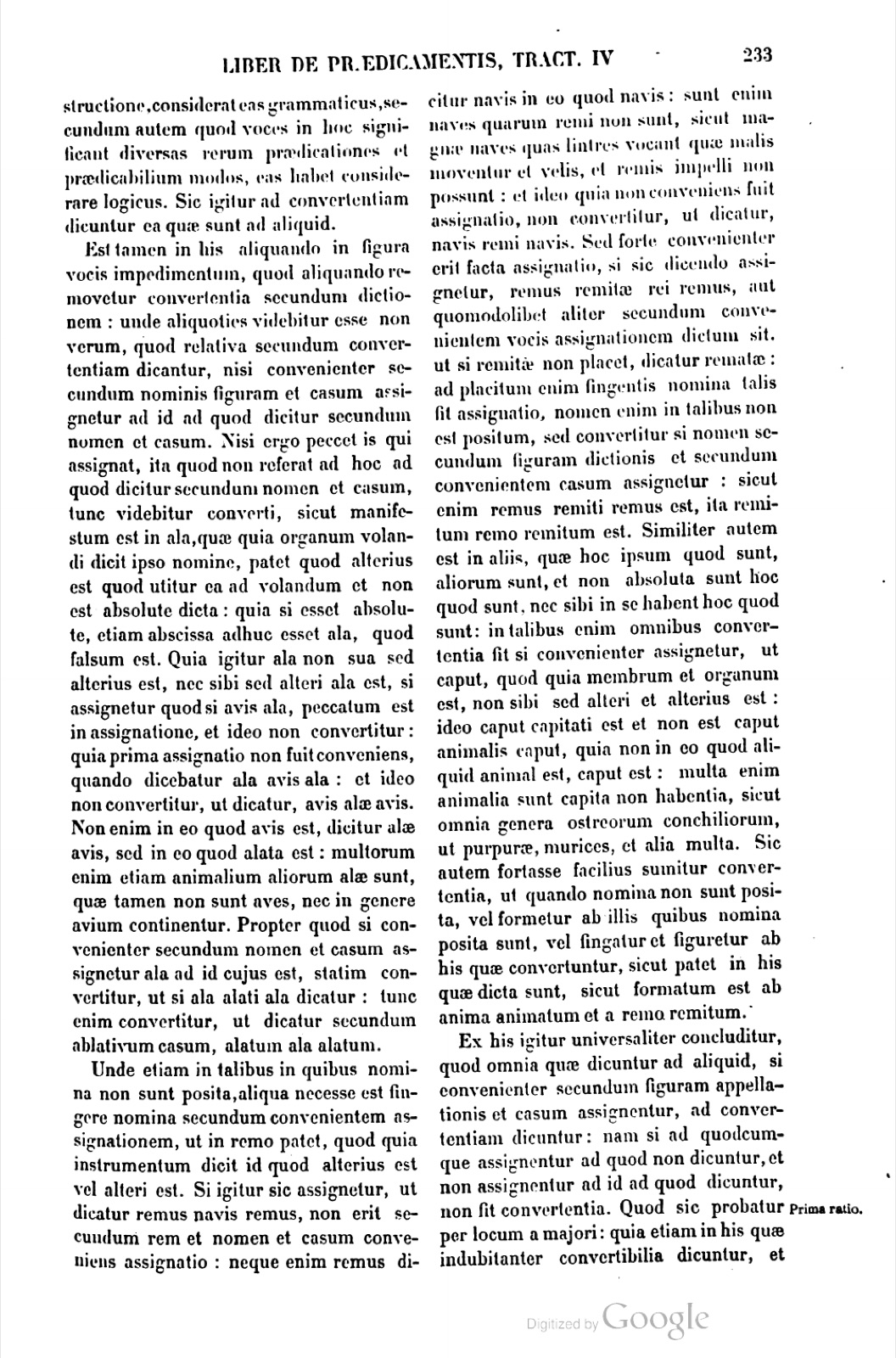
If a page does not appear, its photograph has not been uploaded yet.