Volume 1 · pp. 227–229
Chapter III. On the definition saying what what-is-toward-something is according to Plato and Chapter IV. On the property of what is toward something, which is to receive contrariety
A marker with ≈ is an approximate page boundary, placed by measure of the text; the page photographs remain the authority. In the paired views, clicking a page marker brings that page into view.
CAPUT III.
De diffinitione dicente quid est ad aliquid secundum Platonem.
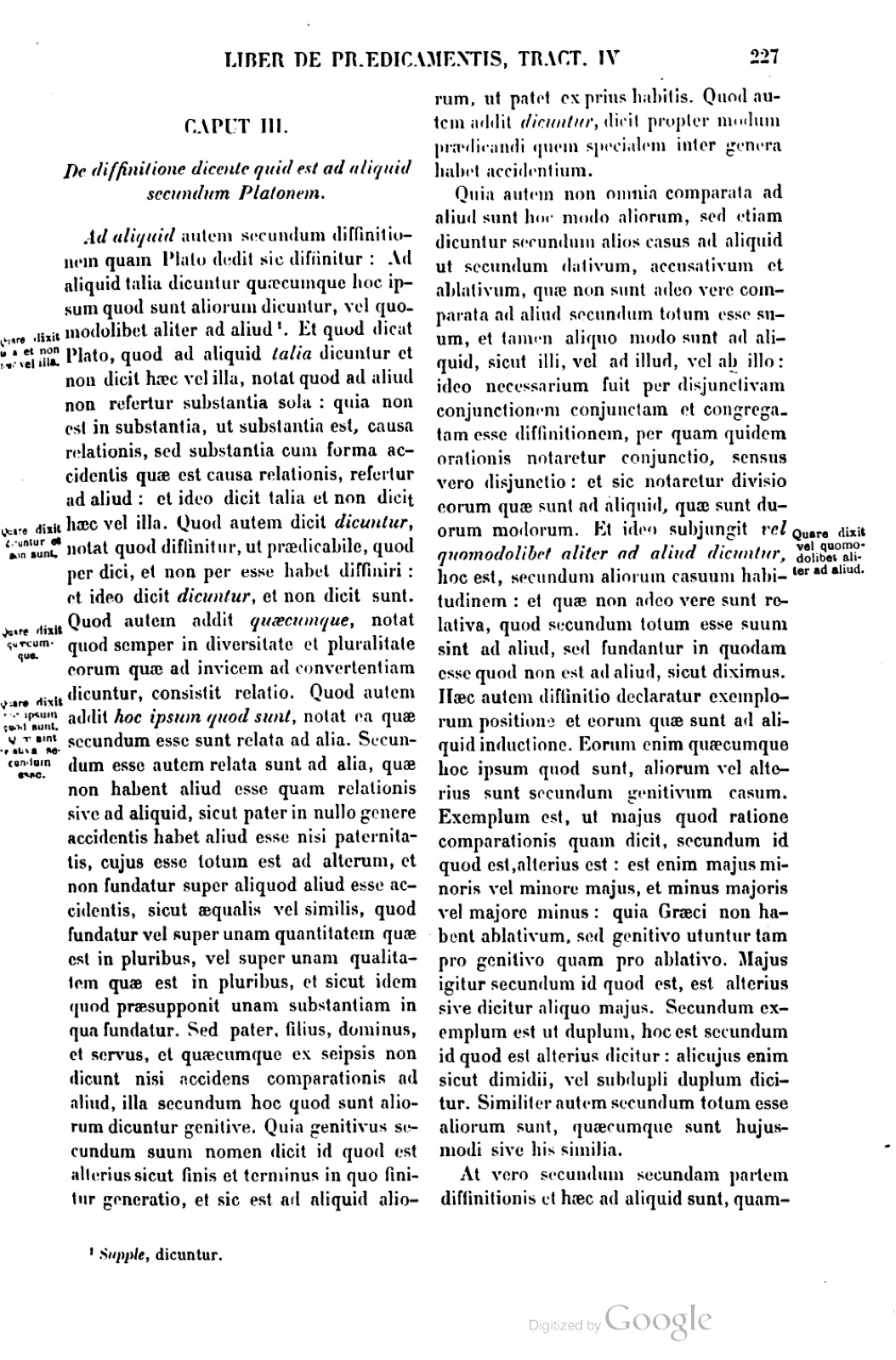
Ad aliquid autem secundum diffinitionem quam Plato dedit sic diffinitur: Ad aliquid talia dicuntur quæcumque hoc ipsum quod sunt aliorum dicuntur, vel quomodolibet aliter ad aliud 1. Et quod dicat Plato, quod ad aliquid talia dicuntur et non dicit hæc vel illa, notat quod ad aliud non refertur substantia sola: quia non est in substantia, ut substantia est, causa relationis, sed substantia cum forma accidentis quæ est causa relationis, refertur ad aliud: et ideo dicit talia et non dicit hæc vel illa. Quod autem dicit dicuntur, notat quod diffinitur, ut prædicabile, quod per dici, et non per esse habet diffiniri: et ideo dicit dicuntur, et non dicit sunt. Quod autem addit quæcumque, notat quod semper in diversitate et pluralitate eorum quæ ad invicem ad convertentiam dicuntur, consistit relatio. Quod autem addit hoc ipsum quod sunt, notat ea quæ secundum esse sunt relata ad alia. Secundum esse autem relata sunt ad alia, quæ non habent aliud esse quam relationis sive ad aliquid, sicut pater in nullo genere accidentis habet aliud esse nisi paternitatis, cujus esse totum est ad alterum, et non fundatur super aliquod aliud esse accidentis, sicut æqualis vel similis, quod fundatur vel super unam quantitatem quæ est in pluribus, vel super unam qualitatem quæ est in pluribus, et sicut idem quod præsupponit unam substantiam in qua fundatur. Sed pater, filius, dominus, et servus, et quæcumque ex seipsis non dicunt nisi accidens comparationis ad aliud, illa secundum hoc quod sunt aliorum dicuntur genitive. Quia genitivus secundum suum nomen dicit id quod est alterius sicut finis et terminus in quo finitur generatio, et sic est ad aliquid aliorum, ut patet ex prius habitis. Quod autem addit dicuntur, dicit propter modum prædicandi quem specialem inter genera habet accidentium.
Quia autem non omnia comparata ad aliud sunt hoc modo aliorum, sed etiam dicuntur secundum alios casus ad aliquid ut secundum dativum, accusativum et ablativum, quæ non sunt adeo vere comparata ad aliud secundum totum esse suum, et tamen aliquo modo sunt ad aliquid, sicut illi, vel ad illud, vel ab illo: ideo necessarium fuit per disjunctivam conjunctionem conjunctam et congregatam esse diffinitionem, per quam quidem orationis notaretur conjunctio, sensus vero disjunctio: et sic notaretur divisio eorum quæ sunt ad aliquid, quæ sunt duorum modorum. Et ideo subjungit vel quomodolibet aliter ad aliud dicuntur, hoc est, secundum aliorum casuum habitudinem: et quæ non adeo vere sunt relativa, quod secundum totum esse suum sint ad aliud, sed fundantur in quodam esse quod non est ad aliud, sicut diximus.
Hæc autem diffinitio declaratur exemplorum positione et eorum quæ sunt ad aliquid inductione. Eorum enim quæcumque hoc ipsum quod sunt, aliorum vel alterius sunt secundum genitivum casum. Exemplum est, ut majus quod ratione comparationis quam dicit, secundum id quod est, alterius est: est enim majus minoris vel minore majus, et minus majoris vel majore minus: quia Græci non habent ablativum, sed genitivo utuntur tam pro genitivo quam pro ablativo. Majus igitur secundum id quod est, est alterius sive dicitur aliquo majus. Secundum exemplum est ut duplum, hoc est secundum id quod est alterius dicitur: alicujus enim sicut dimidii, vel subdupli duplum dicitur. Similiter autem secundum totum esse aliorum sunt, quæcumque sunt hujusmodi sive his similia.
At vero secundum secundam partem diffinitionis et hæc ad aliquid sunt, quamvis non ita vere et ita perfecte sicut alia quæ dicta sunt, dicunturque exempla illorum, ut habitus, affectus, disciplina, positio: hæc enim omnia quæ exemplariter dicta sunt, hoc ipsum quod sunt, secundum ipsam comparationem aliorum dicuntur, et non dicuntur aliter ad aliud per hoc ipsum quod sunt, quia nomina eorum imposita sunt de tali comparatione, sed dicuntur secundum alios casus: habitus enim dicitur secundum genitivum casum: dicitur enim alicujus habitus, eo quod dicitur habentis habitus, et habens habitum, habens dicitur secundum accusativum; et disciplina alicujus disciplina est, sed convertentia secundum ablativum casum, dicitur enim disciplina disciplinati disciplina, sed disciplinatum non dicitur disciplinæ disciplinatum, sed dicitur disciplinatum disciplina disciplinatum per ablativum per quem notatur habitudo causæ formalis. Similiter positio alicujus positio est: est enim partium ordinatarum positio, et positæ partes sunt positione positæ, quia partes ordinatæ in toto positione sunt ordinatæ: et iterum sit conversio per ablativum, sed et alia similiter relativa se habent.
CHAPTER III.
On the definition saying what what-is-toward-something is according to Plato.
But what is toward something, according to the definition which Plato gave, is defined thus: those things are called toward something which, this very thing that they are, are called of others, or in any other way whatever toward another 1. And the fact that Plato says that toward-something things are called such, and does not say these or those, marks that substance alone is not referred toward another, because in substance, as it is substance, there is not the cause of relation; but substance with the form of an accident which is the cause of relation is referred toward another; and therefore he says such things and does not say these or those. But the fact that he says are called marks that it is defined as a predicable, which has to be defined through being-called and not through being; and therefore he says are called, and does not say are. But the fact that he adds whatever things marks that relation always consists in the diversity and plurality of those things which are said mutually toward convertibility. But the fact that he adds this very thing that they are marks those things which according to being are related to others. But related to others according to being are those things which have no other being than that of relation or what is toward something, as father in no genus of accident has another being except that of fatherhood, whose whole being is toward another, and is not founded upon some other being of accident, as equal or like is, which is founded either upon one quantity which is in several things, or upon one quality which is in several things, and as same is, which presupposes one substance in which it is founded. But father, son, lord, and servant, and whatever things from themselves state nothing except an accident of comparison toward another, those according to this which they are are said of others genitively. For the genitive according to its name states that which belongs to another as the end and term in which generation is finished, and thus it is toward something of others, as is clear from the things previously held. But the fact that he adds are called, he says on account of the mode of predicating which it has as special among the genera of accidents.
But because not all things compared toward another are of others in this mode, but are also called toward something according to other cases, as according to dative, accusative, and ablative, which are not so truly compared toward another according to their whole being, and nevertheless are in some mode toward something, as to that one, or toward that, or from that, therefore it was necessary that the definition be joined and gathered by a disjunctive conjunction, through which indeed the conjunction of the speech would be marked, but the disjunction of the sense; and thus the division of those things which are toward something, which are of two modes, would be marked. And therefore he adds or in any other way whatever they are called toward another, that is, according to the relation of other cases; and things which are not so truly relative that according to their whole being they are toward another, but are founded in a certain being which is not toward another, as we said.
But this definition is declared by the positing of examples and by induction of those things which are toward something. For of these, whatever things, this very thing that they are, are of others or of another, are according to the genitive case. The example is as greater, which by reason of the comparison which it states, according to that which it is, belongs to another; for greater is of the lesser, or greater than the lesser, and lesser is of the greater, or less than the greater, because the Greeks do not have the ablative, but use the genitive both for the genitive and for the ablative. Therefore greater according to that which it is belongs to another, or is said greater than something. The second example is as double, that is, according to that which it is, it is said to belong to another; for the double is said double of something, as of the half or of the subdouble. Similarly, according to their whole being, whatever things are of this sort or like these belong to others.
But according to the second part of the definition these too are toward something, although not so truly and so perfectly as the other things which have been said, and examples of those are stated, as habit, affection, discipline, position. For all these things which have been said by way of example, this very thing that they are, are said according to the very comparison of others, and are not called otherwise toward another through this very thing that they are, because their names have been imposed from such a comparison, but they are called according to other cases. For habit is said according to the genitive case: for it is said habit of someone, by the fact that it is called habit of a haver, and having a habit, the haver, is said according to the accusative; and discipline is discipline of someone, but the convertence is according to the ablative case, for a discipline is called the discipline of the disciplined, but the disciplined is not called the disciplined of discipline, but the disciplined is called disciplined by a discipline through the ablative, through which the relation of a formal cause is marked. Similarly position is the position of someone; for it is the position of ordered parts, and positioned parts are positioned by position, because parts ordered in a whole are ordered by position; and again let there be conversion through the ablative, but the other relatives have themselves similarly too.
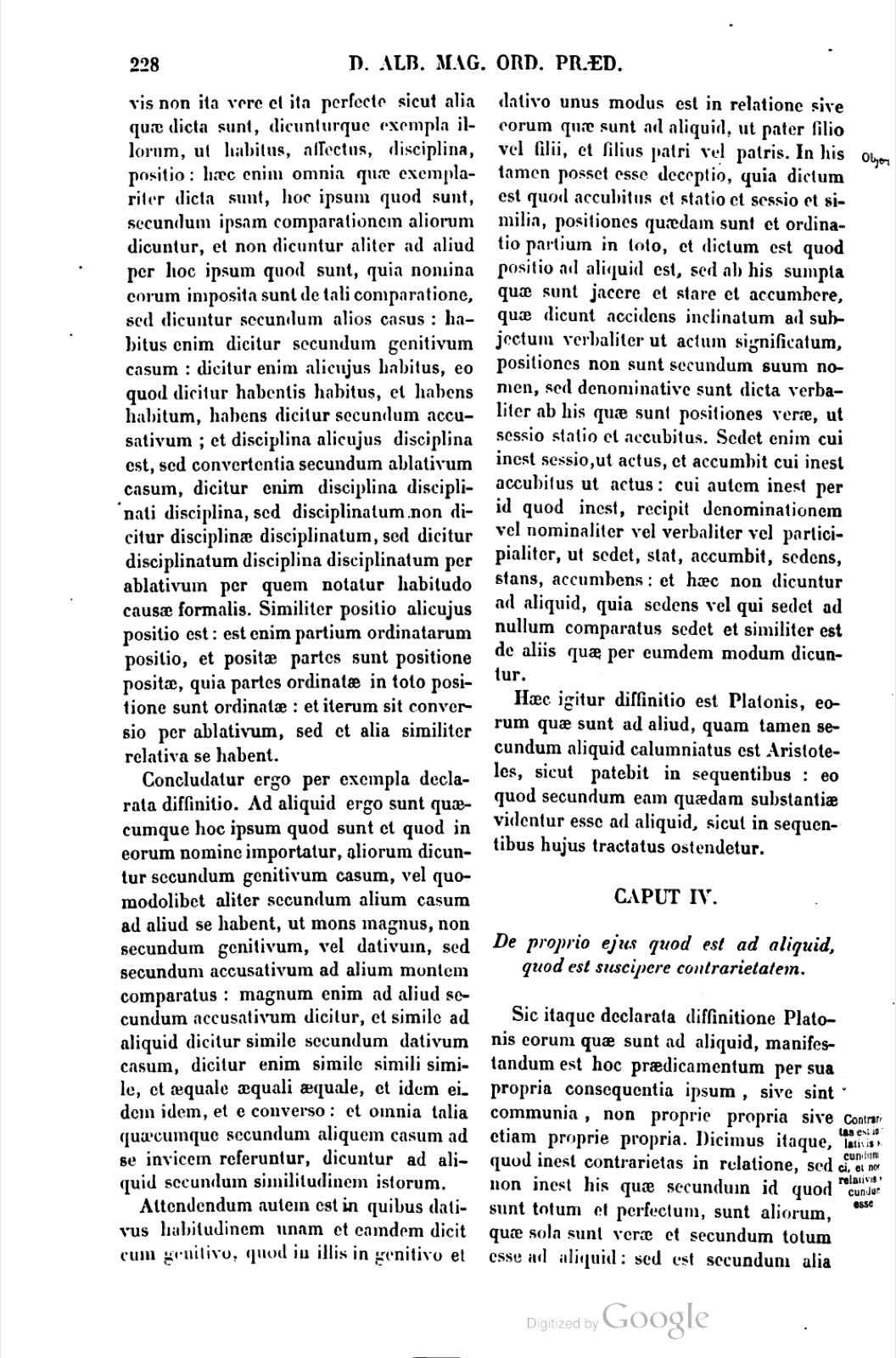
Concludatur ergo per exempla declarata diffinitio. Ad aliquid ergo sunt quæcumque hoc ipsum quod sunt et quod in eorum nomine importatur, aliorum dicuntur secundum genitivum casum, vel quomodolibet aliter secundum alium casum ad aliud se habent, ut mons magnus, non secundum genitivum, vel dativum, sed secundum accusativum ad alium montem comparatus: magnum enim ad aliud secundum accusativum dicitur, et simile ad aliquid dicitur simile secundum dativum casum, dicitur enim simile simili simile, et æquale æquali æquale, et idem eidem idem, et e converso: et omnia talia quæcumque secundum aliquem casum ad se invicem referuntur, dicuntur ad aliquid secundum similitudinem istorum.
Attendendum autem est in quibus dativus habitudinem unam et eamdem dicit cum genitivo, quod in illis in genitivo et dativo unus modus est in relatione sive eorum quæ sunt ad aliquid, ut pater filio vel filii, et filius patri vel patris. In his tamen posset esse deceptio, quia dictum est quod accubitus et statio et sessio et similia, positiones quædam sunt et ordinatio partium in toto, et dictum est quod positio ad aliquid est, sed ab his sumpta quæ sunt jacere et stare et accumbere, quæ dicunt accidens inclinatum ad subjectum verbaliter ut actum significatum, positiones non sunt secundum suum nomen, sed denominative sunt dicta verbaliter ab his quæ sunt positiones veræ, ut sessio statio et accubitus. Sedet enim cui inest sessio, ut actus, et accumbit cui inest accubitus ut actus: cui autem inest per id quod inest, recipit denominationem vel nominaliter vel verbaliter vel participialiter, ut sedet, stat, accumbit, sedens, stans, accumbens: et hæc non dicuntur ad aliquid, quia sedens vel qui sedet ad nullum comparatus sedet et similiter est de aliis quæ per eumdem modum dicuntur.
Hæc igitur diffinitio est Platonis, eorum quæ sunt ad aliud, quam tamen secundum aliquid calumniatus est Aristoteles, sicut patebit in sequentibus: eo quod secundum eam quædam substantiæ videntur esse ad aliquid, sicut in sequentibus hujus tractatus ostendetur.
CAPUT IV.
De proprio ejus quod est ad aliquid, quod est suscipere contrarietatem.
Sic itaque declarata diffinitione Platonis eorum quæ sunt ad aliquid, manifestandum est hoc prædicamentum per sua propria consequentia ipsum, sive sint communia, non proprie propria sive etiam proprie propria. Dicimus itaque, quod inest contrarietas in relatione, sed non inest his quæ secundum id quod sunt totum et perfectum, sunt aliorum, quæ sola sunt veræ et secundum totum esse ad aliquid: sed est secundum alia
Therefore let the definition declared through the examples be concluded. Therefore toward-something things are whatever things, this very thing that they are and what is imported in their name, are said of others according to the genitive case, or in any other way whatever according to another case have themselves toward another, as a large mountain, not according to the genitive or dative, but according to the accusative compared toward another mountain. For large is said toward another according to the accusative, and like is said like toward something according to the dative case; for like is called like to like, and equal equal to equal, and same same to same, and conversely; and all such things, whatever are referred to one another according to some case, are called toward something according to the likeness of these.
But it must be attended to in which things the dative states one and the same relation with the genitive, that in those things in the genitive and dative there is one mode in relation or of those things which are toward something, as father to son or of son, and son to father or of father. Yet in these there could be deception, because it has been said that lying-down and standing and sitting and like things are certain positions and an ordering of parts in a whole, and it has been said that position is toward something; but from those things taken which are to lie, to stand, and to recline, which state an accident inclined to a subject verbally as a signified act, they are not positions according to their name, but are said denominatively and verbally from those things which are true positions, as sitting, standing, and lying-down. For he sits to whom sitting is present as act, and he reclines to whom reclining is present as act; but he to whom it is present, through that which is present, receives denomination either nominally or verbally or participially, as he sits, stands, reclines, sitting, standing, reclining; and these are not called toward something, because one sitting or he who sits sits compared to nothing, and it is similar concerning the others which are said through the same mode.
Therefore this is Plato's definition of those things which are toward another, which nevertheless Aristotle in some respect attacked, as will be clear in what follows, because according to it certain substances seem to be toward something, as will be shown in what follows in this tractate.
CHAPTER IV.
On the property of that which is toward something, which is to receive contrariety.
Therefore, with Plato's definition of those things which are toward something thus declared, this predicament must be manifested through its own properties consequent upon it, whether they are common, not properly proper, or even properly proper. Therefore we say that contrariety is present in relation, but is not present in those things which, according to that which they are whole and perfect, belong to others, which alone are true and according to their whole being toward something; but it is according to other
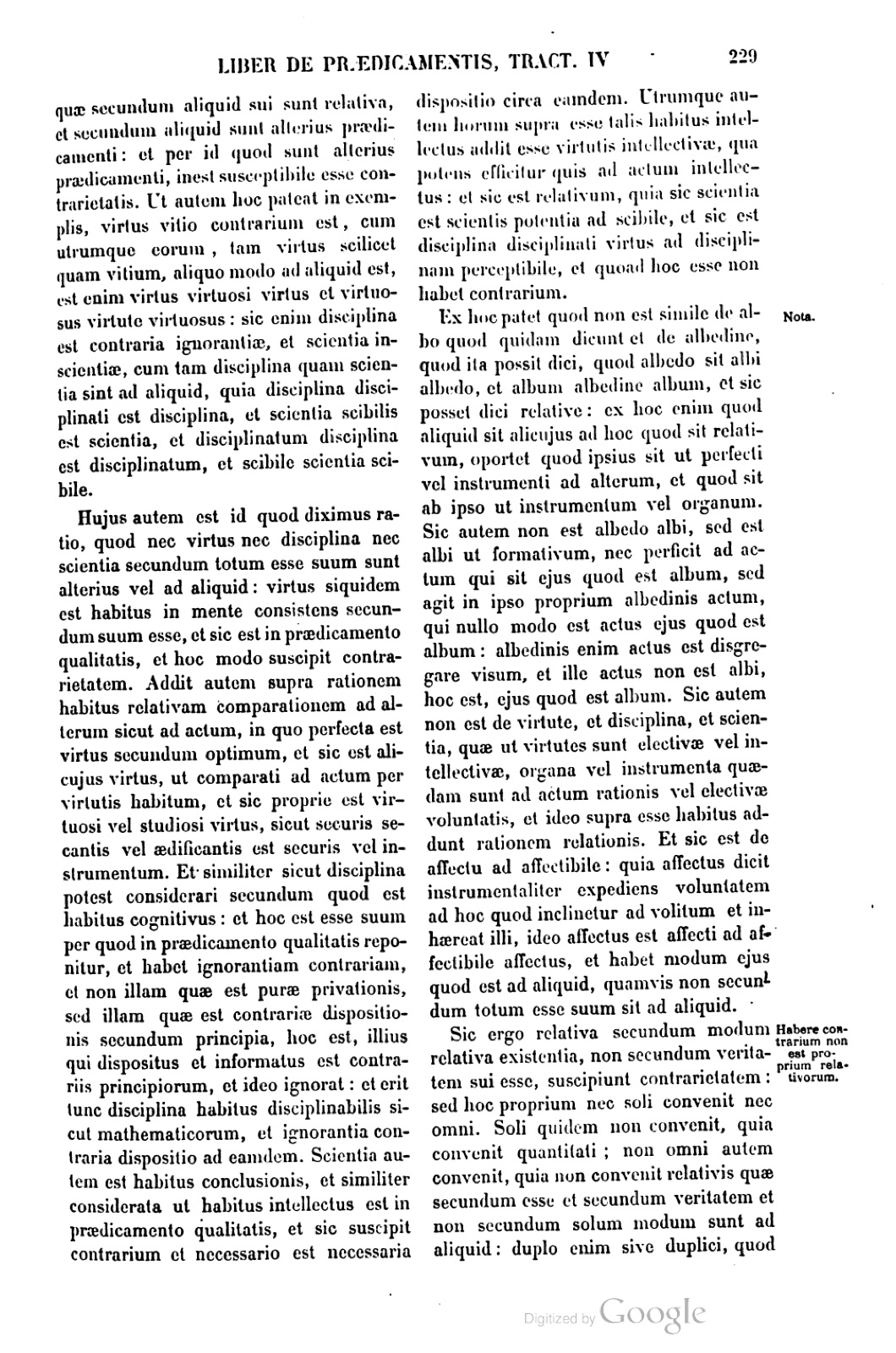
quæ secundum aliquid sui sunt relativa, et secundum aliquid sunt alterius prædicamenti: et per id quod sunt alterius prædicamenti, inest susceptibile esse contrarietatis. Ut autem hoc pateat in exemplis, virtus vitio contrarium est, cum utrumque eorum, tam virtus scilicet quam vitium, aliquo modo ad aliquid est, est enim virtus virtuosi virtus et virtuosus virtute virtuosus: sic enim disciplina est contraria ignorantiæ, et scientia inscientiæ, cum tam disciplina quam scientia sint ad aliquid, quia disciplina disciplinati est disciplina, et scientia scibilis est scientia, et disciplinatum disciplina est disciplinatum, et scibile scientia scibile.
Hujus autem est id quod diximus ratio, quod nec virtus nec disciplina nec scientia secundum totum esse suum sunt alterius vel ad aliquid: virtus siquidem est habitus in mente consistens secundum suum esse, et sic est in prædicamento qualitatis, et hoc modo suscipit contrarietatem. Addit autem supra rationem habitus relativam comparationem ad alterum sicut ad actum, in quo perfecta est virtus secundum optimum, et sic est alicujus virtus, ut comparati ad actum per virtutis habitum, et sic proprie est virtuosi vel studiosi virtus, sicut securis secantis vel ædificantis est securis vel instrumentum. Et similiter sicut disciplina potest considerari secundum quod est habitus cognitivus: et hoc est esse suum per quod in prædicamento qualitatis reponitur, et habet ignorantiam contrariam, et non illam quæ est puræ privationis, sed illam quæ est contrariæ dispositionis secundum principia, hoc est, illius qui dispositus et informatus est contrariis principiorum, et ideo ignorat: et erit tunc disciplina habitus disciplinabilis sicut mathematicorum, et ignorantia contraria dispositio ad eamdem. Scientia autem est habitus conclusionis, et similiter considerata ut habitus intellectus est in prædicamento qualitatis, et sic suscipit contrarium et necessario est necessaria dispositio circa eamdem. Utrumque autem horum supra esse talis habitus intellectus addit esse virtutis intellectivæ, qua potens efficitur quis ad actum intellectus: et sic est relativum, quia sic scientia est scientis potentia ad scibile, et sic est disciplina disciplinati virtus ad disciplinam perceptibile, et quoad hoc esse non habet contrarium.
Ex hoc patet quod non est simile de albo quod quidam dicunt et de albedine, quod ita possit dici, quod albedo sit albi albedo, et album albedine album, et sic posset dici relative: ex hoc enim quod aliquid sit alicujus ad hoc quod sit relativum, oportet quod ipsius sit ut perfecti vel instrumenti ad alterum, et quod sit ab ipso ut instrumentum vel organum. Sic autem non est albedo albi, sed est albi ut formativum, nec perficit ad actum qui sit ejus quod est album, sed agit in ipso proprium albedinis actum, qui nullo modo est actus ejus quod est album: albedinis enim actus est disgregare visum, et ille actus non est albi, hoc est, ejus quod est album. Sic autem non est de virtute, et disciplina, et scientia, quæ ut virtutes sunt electivæ vel intellectivæ, organa vel instrumenta quædam sunt ad actum rationis vel electivæ voluntatis, et ideo supra esse habitus addunt rationem relationis. Et sic est de affectu ad affectibile: quia affectus dicit instrumentaliter expediens voluntatem ad hoc quod inclinetur ad volitum et inhæreat illi, ideo affectus est affecti ad affectibile affectus, et habet modum ejus quod est ad aliquid, quamvis non secundum totum esse suum sit ad aliquid.
Sic ergo relativa secundum modum relativa existentia, non secundum veritatem sui esse, suscipiunt contrarietatem: sed hoc proprium nec soli convenit nec omni. Soli quidem non convenit, quia convenit quantitati; non omni autem convenit, quia non convenit relativis quæ secundum esse et secundum veritatem et non secundum solum modum sunt ad aliquid: duplo enim sive duplici, quod
things which according to something of themselves are relative, and according to something are of another predicament; and through that by which they are of another predicament, being susceptible of contrariety is present. But that this may be clear in examples, virtue is contrary to vice, since each of them, both virtue namely and vice, is in some mode toward something; for virtue is the virtue of the virtuous, and the virtuous is virtuous by virtue. Thus discipline is contrary to ignorance, and knowledge to nescience, since both discipline and knowledge are toward something, because discipline is the discipline of the disciplined, and knowledge is knowledge of the knowable, and the disciplined is disciplined by discipline, and the knowable is knowable by knowledge.
But the reason of this is what we have said, that neither virtue nor discipline nor knowledge according to its whole being belongs to another or is toward something. For virtue indeed is a habit consisting in the mind according to its being, and thus it is in the predicament of quality, and in this mode it receives contrariety. But beyond the account of habit it adds relative comparison to another as to act, in which virtue is perfected according to the best; and thus it is the virtue of someone, as of one compared to act through the habit of virtue, and thus properly it is the virtue of the virtuous or studious, just as an axe is the axe or instrument of one cutting or building. And similarly, discipline can be considered according as it is a cognitive habit, and this is its being through which it is placed in the predicament of quality, and it has ignorance contrary to it, and not that ignorance which is of pure privation, but that which is of a contrary disposition according to principles, that is, of the one who is disposed and informed by contraries of principles, and therefore is ignorant. And then discipline will be the habit of the disciplinable, as of mathematicians, and ignorance a contrary disposition to the same. But knowledge is a habit of a conclusion, and similarly considered as a habit of intellect it is in the predicament of quality, and thus it receives a contrary, and necessarily it is a necessary disposition concerning the same. But each of these, beyond being such a habit of intellect, adds being an intellective power, by which someone is made capable for the act of intellect; and thus it is relative, because in this way knowledge is the knower's potency toward the knowable, and in this way discipline is the disciplined person's virtue toward discipline as perceptible, and with respect to this being it has no contrary.
From this it is clear that it is not similar concerning white, which certain people state, and concerning whiteness, that it could be said in this way, that whiteness is the whiteness of white, and the white is white by whiteness, and thus it could be said relatively. For from this that something belongs to someone, in order that it be relative, it must belong to him as to one perfected or as an instrument toward another, and that it be from him as an instrument or organ. But whiteness is not of white in this way, but is of white as formative, nor does it perfect toward an act which belongs to that which is white, but it acts in it the proper act of whiteness, which in no way is the act of that which is white; for the act of whiteness is to disperse sight, and that act is not of the white, that is, of that which is white. But it is not so concerning virtue, and discipline, and knowledge, which, as they are elective or intellective powers, are certain organs or instruments toward the act of reason or of elective will, and therefore beyond being a habit they add the account of relation. And so it is concerning affection toward the affectible, because affection states that which instrumentally expedites the will to this, that it be inclined to the willed thing and adhere to it; therefore affection is an affection of the affected thing toward the affectible, and has the mode of that which is toward something, although according to its whole being it is not toward something.
Thus therefore relatives existing as relative according to mode, not according to the truth of their being, receive contrariety; but this property belongs neither to it alone nor to every one. It does not belong to it alone indeed, because it belongs to quantity; but it does not belong to every one, because it does not belong to relatives which according to being and according to truth, and not according to mode alone, are toward something. For to the double or duplicate, which
Notes
- Supply: are called. (Supple, dicuntur.) ↩
If a page does not appear, its photograph has not been uploaded yet.