Volume 1 · pp. 224–226
End of Chapter I and Chapter II. What this genus has of being, and what in it is most general, and what subalternate, and what most special, and what individual
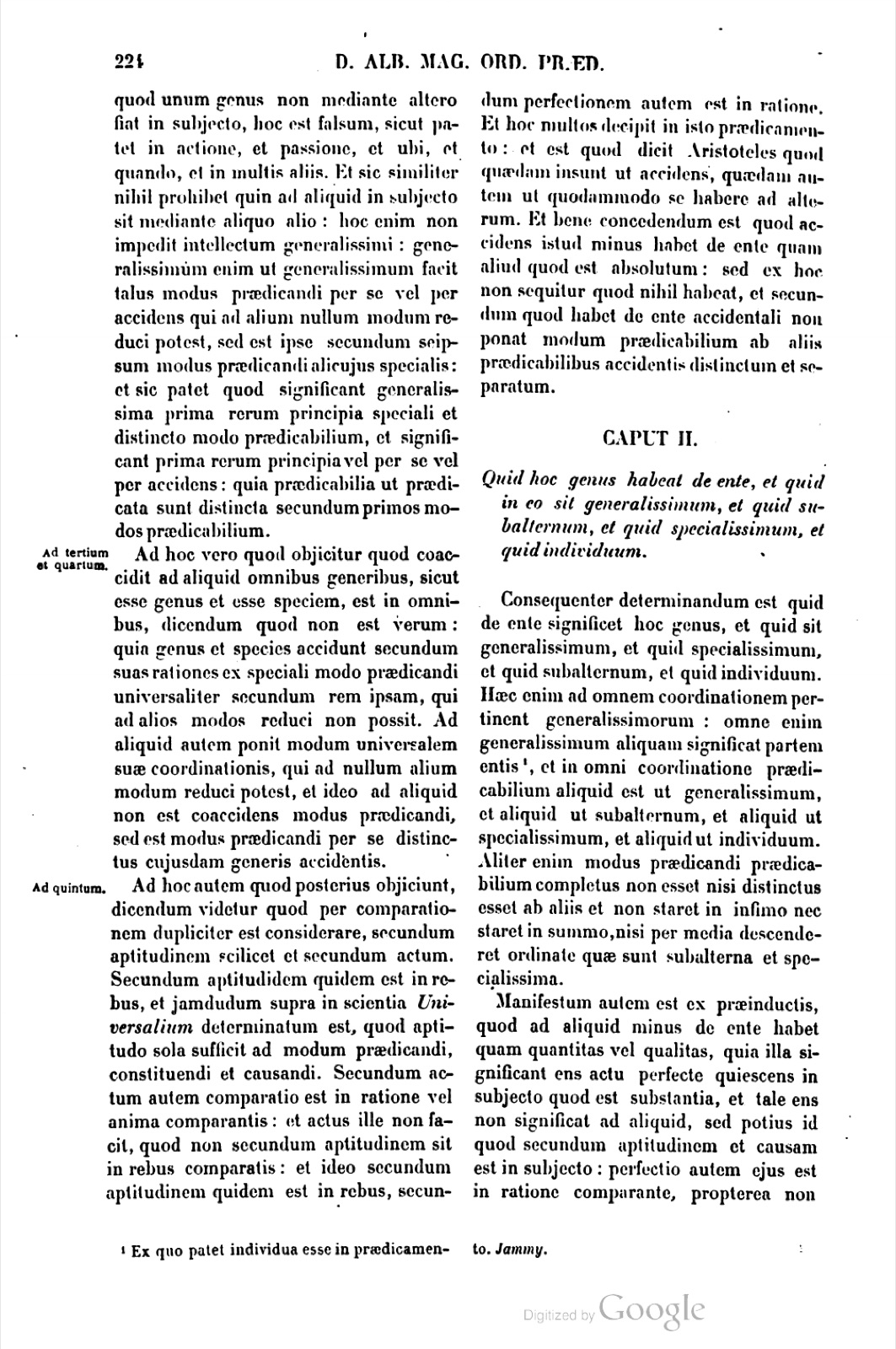
quod unum genus non mediante altero fiat in subjecto, hoc est falsum, sicut patet in actione, et passione, et ubi, et quando, et in multis aliis. Et sic similiter nihil prohibet quin ad aliquid in subjecto sit mediante aliquo alio: hoc enim non impedit intellectum generalissimi: generalissimum enim ut generalissimum facit talis modus prædicandi per se vel per accidens qui ad alium nullum modum reduci potest, sed est ipse secundum seipsum modus prædicandi alicujus specialis: et sic patet quod significant generalissima prima rerum principia speciali et distincto modo prædicabilium, et significant prima rerum principia vel per se vel per accidens: quia prædicabilia ut prædicata sunt distincta secundum primos modos prædicabilium.
Ad hoc vero quod objicitur quod coaccidit ad aliquid omnibus generibus, sicut esse genus et esse speciem, est in omnibus, dicendum quod non est verum: quia genus et species accidunt secundum suas rationes ex speciali modo prædicandi universaliter secundum rem ipsam, qui ad alios modos reduci non possit. Ad aliquid autem ponit modum universalem suæ coordinationis, qui ad nullum alium modum reduci potest, et ideo ad aliquid non est coaccidens modus prædicandi, sed est modus prædicandi per se distinctus cujusdam generis accidentis.
Ad hoc autem quod posterius objiciunt, dicendum videtur quod per comparationem dupliciter est considerare, secundum aptitudinem scilicet et secundum actum. Secundum aptitudinem quidem est in rebus, et jamdudum supra in scientia Universalium determinatum est, quod aptitudo sola sufficit ad modum prædicandi, constituendi et causandi. Secundum actum autem comparatio est in ratione vel anima comparantis: et actus ille non facit, quod non secundum aptitudinem sit in rebus comparatis: et ideo secundum aptitudinem quidem est in rebus, secundum perfectionem autem est in ratione. Et hoc multos decipit in isto prædicamento: et est quod dicit Aristoteles quod quædam insunt ut accidens, quædam autem ut quodammodo se habere ad alterum. Et bene concedendum est quod accidens istud minus habet de ente quam aliud quod est absolutum: sed ex hoc non sequitur quod nihil habeat, et secundum quod habet de ente accidentali non ponat modum prædicabilium ab aliis prædicabilibus accidentis distinctum et separatum.
CAPUT II.
Quid hoc genus habeat de ente, et quid in eo sit generalissimum, et quid subalternum, et quid specialissimum, et quid individuum.
Consequenter determinandum est quid de ente significet hoc genus, et quid sit generalissimum, et quid specialissimum, et quid subalternum, et quid individuum. Hæc enim ad omnem coordinationem pertinent generalissimorum: omne enim generalissimum aliquam significat partem entis 1, et in omni coordinatione prædicabilium aliquid est ut generalissimum, et aliquid ut subalternum, et aliquid ut specialissimum, et aliquid ut individuum. Aliter enim modus prædicandi prædicabilium completus non esset nisi distinctus esset ab aliis et non staret in infimo nec staret in summo, nisi per media descenderet ordinate quæ sunt subalterna et specialissima.
Manifestum autem est ex præinductis, quod ad aliquid minus de ente habet quam quantitas vel qualitas, quia illa significant ens actu perfecte quiescens in subjecto quod est substantia, et tale ens non significat ad aliquid, sed potius id quod secundum aptitudinem et causam est in subjecto: perfectio autem ejus est in ratione comparante, propterea non
that one genus is not made in a subject by means of another, this is false, as is clear in action and passion, and where and when, and in many other things. And thus similarly nothing prevents what is toward something from being in a subject by means of some other thing; for this does not impede the understanding of the most general. For such a mode of predicating through itself or by accident, which cannot be reduced to any other mode, makes the most general as most general, but is itself according to itself a mode of predicating of something special. And thus it is clear that the most general things signify the first principles of things by a special and distinct mode of predicables, and signify the first principles of things either through themselves or by accident, because predicables as predicates are distinct according to the first modes of predicables.
But to this which is objected, that what is toward something co-happens to all genera, just as to be a genus and to be a species is in all things, one must say that this is not true, because genus and species happen according to their accounts from a special mode of predicating universally according to the thing itself, which cannot be reduced to other modes. But what is toward something posits the universal mode of its own coordination, which can be reduced to no other mode, and therefore what is toward something is not a co-accidental mode of predicating, but is a mode of predicating through itself, distinct, of a certain genus of accident.
But to this which the later men object, it seems one must say that through comparison there is considering in two ways, namely according to aptitude and according to act. According to aptitude indeed it is in things, and long ago above in the science of Universals it was determined that aptitude alone suffices for the mode of predicating, constituting, and causing. But according to act comparison is in the account or soul of the one comparing; and that act does not make it not to be in the things compared according to aptitude. And therefore according to aptitude indeed it is in things, but according to perfection it is in reason. And this deceives many in this predicament; and it is what Aristotle says, that some things are in as an accident, but some as to have themselves in some way toward another. And it must well be conceded that this accident has less of being than another which is absolute; but from this it does not follow that it has nothing, and that according to what it has of accidental being it does not posit a mode of predicables distinct and separated from the other predicables of accident.
CHAPTER II.
What this genus has of being, and what in it is most general, and what subalternate, and what most special, and what individual.
Consequently it must be determined what of being this genus signifies, and what is most general, and what most special, and what subalternate, and what individual. For these things pertain to every coordination of most general things: for every most general thing signifies some part of being 1, and in every coordination of predicables something is as most general, and something as subalternate, and something as most special, and something as individual. For otherwise the mode of predicating of predicables would not be complete unless it were distinct from others and did not stand at the lowest nor stand at the highest, unless it descended in order through the middle things which are subalternate and most special.
But it is manifest from the things previously induced that what is toward something has less of being than quantity or quality, because those signify a being in act, perfectly resting in a subject which is substance, and what is toward something does not signify such a being, but rather that which according to aptitude and cause is in a subject; but its perfection is in the comparing reason, therefore it does not
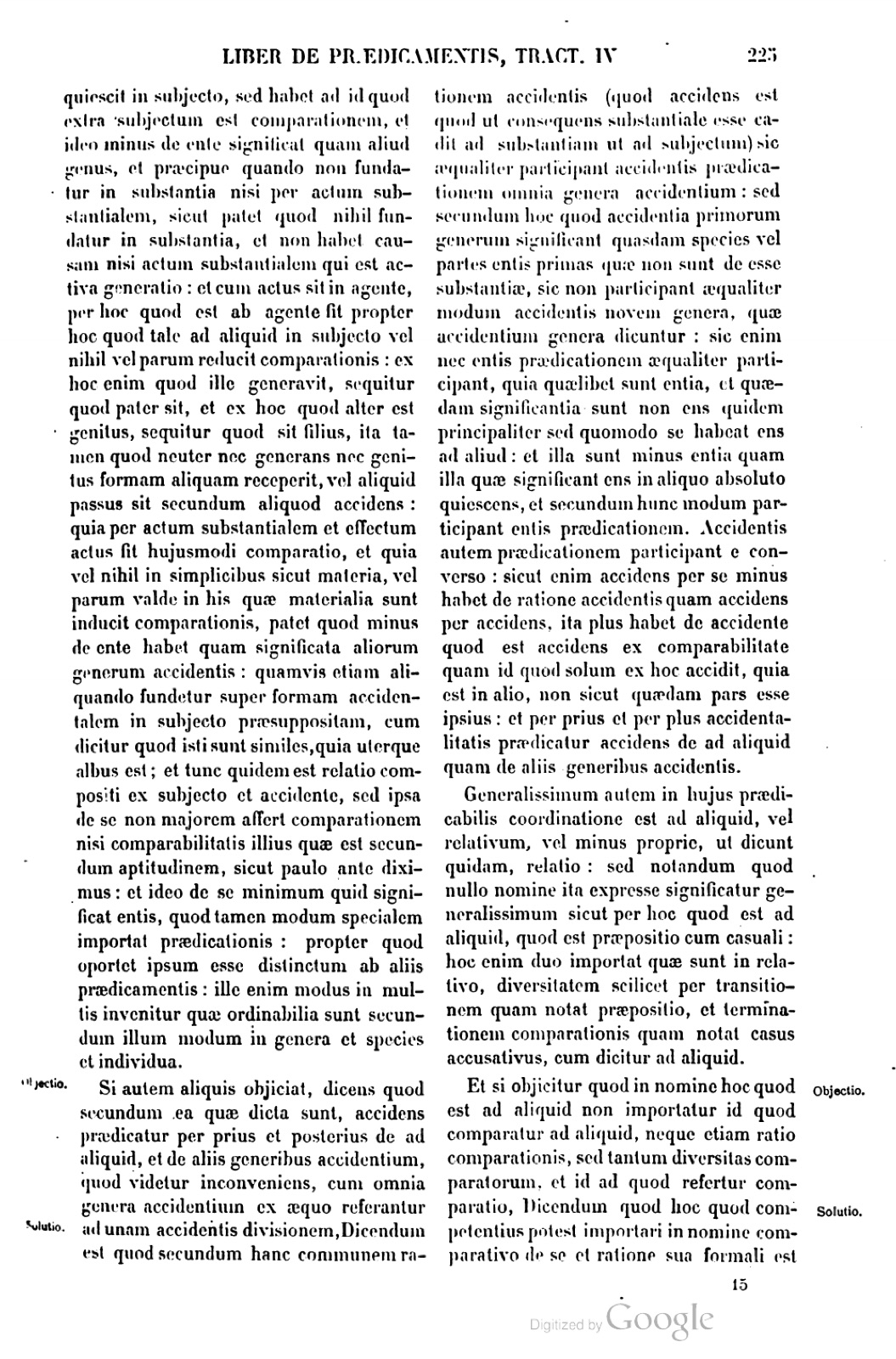
quiescit in subjecto, sed habet ad id quod extra subjectum est comparationem, et ideo minus de ente significat quam aliud genus, et præcipue quando non fundatur in substantia nisi per actum substantialem, sicut patet quod nihil fundatur in substantia, et non habet causam nisi actum substantialem qui est activa generatio: et cum actus sit in agente, per hoc quod est ab agente fit propter hoc quod tale ad aliquid in subjecto vel nihil vel parum reducit comparationis: ex hoc enim quod ille generavit, sequitur quod pater sit, et ex hoc quod alter est genitus, sequitur quod sit filius, ita tamen quod neuter nec generans nec genitus formam aliquam receperit, vel aliquid passus sit secundum aliquod accidens: quia per actum substantialem et effectum actus fit hujusmodi comparatio, et quia vel nihil in simplicibus sicut materia, vel parum valde in his quæ materialia sunt inducit comparationis, patet quod minus de ente habet quam significata aliorum generum accidentis: quamvis etiam aliquando fundetur super formam accidentalem in subjecto præsuppositam, cum dicitur quod isti sunt similes, quia uterque albus est; et tunc quidem est relatio compositi ex subjecto et accidente, sed ipsa de se non majorem affert comparationem nisi comparabilitatis illius quæ est secundum aptitudinem, sicut paulo ante diximus: et ideo de se minimum quid significat entis, quod tamen modum specialem importat prædicationis: propter quod oportet ipsum esse distinctum ab aliis prædicamentis: ille enim modus in multis invenitur quæ ordinabilia sunt secundum illum modum in genera et species et individua.
Si autem aliquis objiciat, dicens quod secundum ea quæ dicta sunt, accidens prædicatur per prius et posterius de ad aliquid, et de aliis generibus accidentium, quod videtur inconveniens, cum omnia genera accidentium ex æquo referantur ad unam accidentis divisionem, Dicendum est quod secundum hanc communem rationem accidentis (quod accidens est quod ut consequens substantiale esse cadit ad substantiam ut ad subjectum) sic æqualiter participant accidentis prædicationem omnia genera accidentium: sed secundum hoc quod accidentia primorum generum significant quasdam species vel partes entis primas quæ non sunt de esse substantiæ, sic non participant æqualiter modum accidentis novem genera, quæ accidentium genera dicuntur: sic enim nec entis prædicationem æqualiter participant, quia quælibet sunt entia, et quædam significantia sunt non ens quidem principaliter sed quomodo se habeat ens ad aliud: et illa sunt minus entia quam illa quæ significant ens in aliquo absoluto quiescens, et secundum hunc modum participant entis prædicationem. Accidentis autem prædicationem participant e converso: sicut enim accidens per se minus habet de ratione accidentis quam accidens per accidens, ita plus habet de accidente quod est accidens ex comparabilitate quam id quod solum ex hoc accidit, quia est in alio, non sicut quædam pars esse ipsius: et per prius et per plus accidentalitatis prædicatur accidens de ad aliquid quam de aliis generibus accidentis.
Generalissimum autem in hujus prædicabilis coordinatione est ad aliquid, vel relativum, vel minus proprie, ut dicunt quidam, relatio: sed notandum quod nullo nomine ita expresse significatur generalissimum sicut per hoc quod est ad aliquid, quod est præpositio cum casuali: hoc enim duo importat quæ sunt in relativo, diversitatem scilicet per transitionem quam notat præpositio, et terminationem comparationis quam notat casus accusativus, cum dicitur ad aliquid.
Et si objicitur quod in nomine hoc quod est ad aliquid non importatur id quod comparatur ad aliquid, neque etiam ratio comparationis, sed tantum diversitas comparatorum, et id ad quod refertur comparatio, Dicendum quod hoc quod competentius potest importari in nomine comparativo de se et ratione sua formali est
rest in a subject, but has a comparison to that which is outside the subject, and therefore it signifies less of being than another genus, and especially when it is not founded in substance except through a substantial act, as is clear because nothing is founded in substance and has no cause except a substantial act which is active generation. And since act is in the agent, through this that it is from the agent, it comes to be on account of this, that such a thing toward something in the subject brings back either nothing or little of comparison. For from this, that that one has generated, it follows that he is father, and from this, that the other has been generated, it follows that he is son, yet in such a way that neither the one generating nor the one generated has received some form or undergone something according to some accident; because through a substantial act and the effect of the act a comparison of this sort comes to be, and because it induces either nothing in simple things such as matter, or very little of comparison in those things which are material, it is clear that it has less of being than the signified things of the other genera of accident. Although also sometimes it is founded upon an accidental form presupposed in a subject, when it is said that these are alike because each is white; and then indeed there is a relation of the composite from subject and accident, but it of itself brings no greater comparison except of that comparability which is according to aptitude, as we said a little before. And therefore of itself it signifies the least something of being, which nevertheless imports a special mode of predication; on account of which it must be distinct from the other predicaments. For that mode is found in many things which are orderable according to that mode into genera and species and individuals.
But if someone objects, saying that according to those things which have been said, accident is predicated according to prior and posterior of what is toward something and of the other genera of accidents, which seems unfitting, since all the genera of accidents are referred equally to one division of accident, one must say that according to this common account of accident, namely that accident is what, as following upon substantial being, falls to substance as to a subject, in this way all the genera of accidents participate equally in the predication of accident. But according to this, that the accidents of the first genera signify certain first species or parts of being which are not of the being of substance, in this way the nine genera, which are called genera of accidents, do not participate equally in the mode of accident. For in this way neither do they participate equally in the predication of being, because each are beings, and certain signifying things are indeed not principally being, but how being has itself toward another; and those are less beings than those which signify being resting in something absolute, and according to this mode they participate in the predication of being. But they participate in the predication of accident conversely: for just as an accident through itself has less of the account of accident than an accident by accident, so it has more of the accident which is accident from comparability than that which happens only from this, that it is in another, not as a certain part of its being; and accident is predicated of what is toward something according to prior and according to more of accidentality than of the other genera of accident.
But the most general thing in the coordination of this predicable is what is toward something, or the relative, or less properly, as certain people say, relation. But it must be noted that by no name is the most general thing signified so expressly as through this which is what is toward something, which is a preposition with a case-word. For this imports two things which are in the relative, namely diversity through the transition which the preposition marks, and the termination of the comparison which the accusative case marks, when it is said toward something.
And if it is objected that in this name, what is toward something, that which is compared toward something is not imported, nor even the account of comparison, but only the diversity of the things compared, and that to which the comparison is referred, one must say that this which can more suitably be imported in a comparative name from itself and from its formal account is
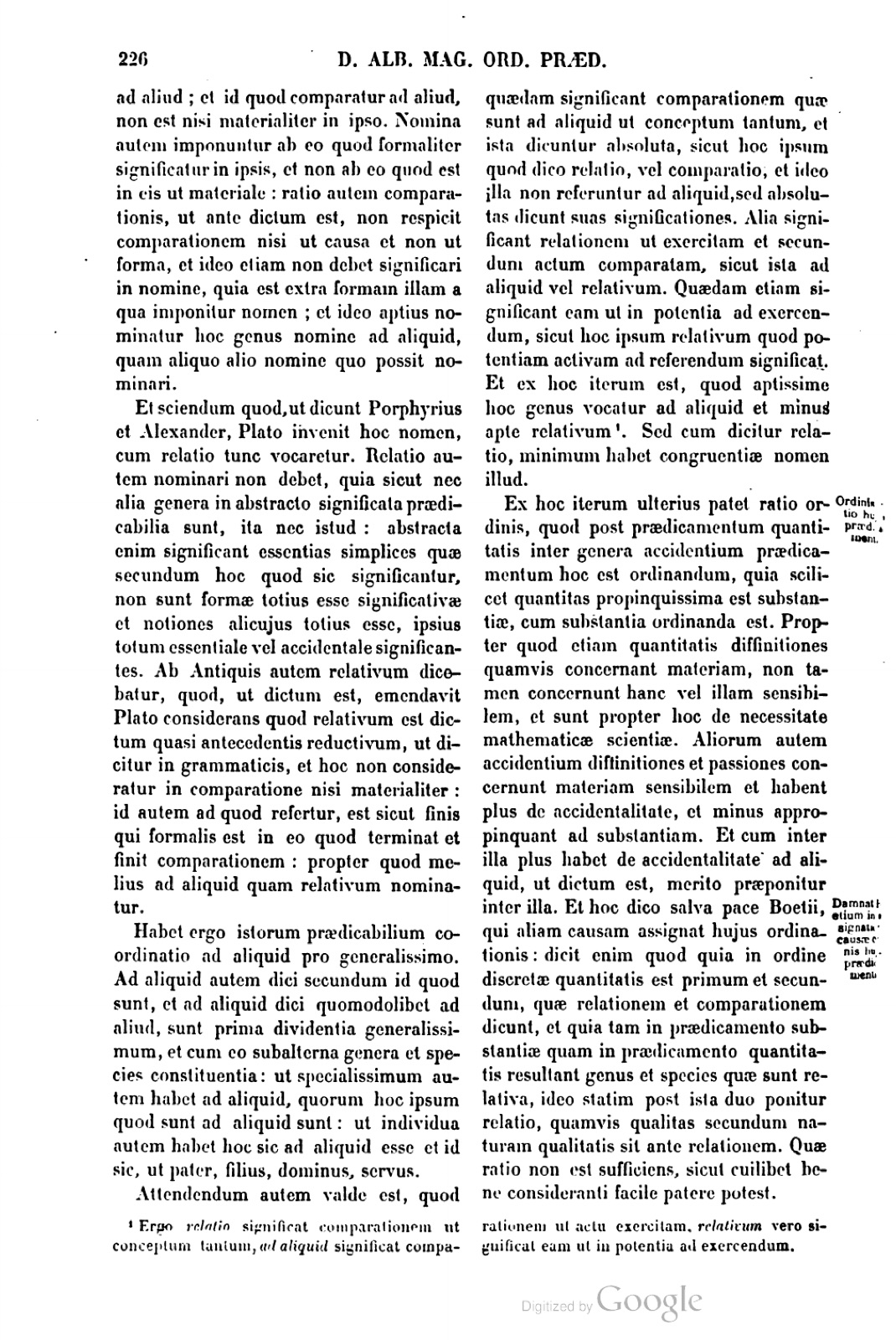
ad aliud; et id quod comparatur ad aliud, non est nisi materialiter in ipso. Nomina autem imponuntur ab eo quod formaliter significatur in ipsis, et non ab eo quod est in eis ut materiale: ratio autem comparationis, ut ante dictum est, non respicit comparationem nisi ut causa et non ut forma, et ideo etiam non debet significari in nomine, quia est extra formam illam a qua imponitur nomen; et ideo aptius nominatur hoc genus nomine ad aliquid, quam aliquo alio nomine quo possit nominari.
Et sciendum quod, ut dicunt Porphyrius et Alexander, Plato invenit hoc nomen, cum relatio tunc vocaretur. Relatio autem nominari non debet, quia sicut nec alia genera in abstracto significata prædicabilia sunt, ita nec istud: abstracta enim significant essentias simplices quæ secundum hoc quod sic significantur, non sunt formæ totius esse significativæ et notiones alicujus totius esse, ipsius totum essentiale vel accidentale significantes. Ab Antiquis autem relativum dicebatur, quod, ut dictum est, emendavit Plato considerans quod relativum est dictum quasi antecedentis reductivum, ut dicitur in grammaticis, et hoc non consideratur in comparatione nisi materialiter: id autem ad quod refertur, est sicut finis qui formalis est in eo quod terminat et finit comparationem: propter quod melius ad aliquid quam relativum nominatur.
Habet ergo istorum prædicabilium coordinatio ad aliquid pro generalissimo. Ad aliquid autem dici secundum id quod sunt, et ad aliquid dici quomodolibet ad aliud, sunt prima dividentia generalissimum, et cum eo subalterna genera et species constituentia: ut specialissimum autem habet ad aliquid, quorum hoc ipsum quod sunt ad aliquid sunt: ut individua autem habet hoc sic ad aliquid esse et id sic, ut pater, filius, dominus, servus.
Attendendum autem valde est, quod quædam significant comparationem quæ sunt ad aliquid ut conceptum tantum, et ista dicuntur absoluta, sicut hoc ipsum quod dico relatio, vel comparatio, et ideo illa non referuntur ad aliquid, sed absolutas dicunt suas significationes. Alia significant relationem ut exercitam et secundum actum comparatam, sicut ista ad aliquid vel relativum. Quædam etiam significant eam ut in potentia ad exercendum, sicut hoc ipsum relativum quod potentiam activam ad referendum significat. Et ex hoc iterum est, quod aptissime hoc genus vocatur ad aliquid et minus apte relativum 2. Sed cum dicitur relatio, minimum habet congruentiæ nomen illud.
Ex hoc iterum ulterius patet ratio ordinis, quod post prædicamentum quantitatis inter genera accidentium prædicamentum hoc est ordinandum, quia scilicet quantitas propinquissima est substantiæ, cum substantia ordinanda est. Propter quod etiam quantitatis diffinitiones quamvis concernant materiam, non tamen concernunt hanc vel illam sensibilem, et sunt propter hoc de necessitate mathematicæ scientiæ. Aliorum autem accidentium diffinitiones et passiones concernunt materiam sensibilem et habent plus de accidentalitate, et minus appropinquant ad substantiam. Et cum inter illa plus habet de accidentalitate ad aliquid, ut dictum est, merito præponitur inter illa. Et hoc dico salva pace Boetii, qui aliam causam assignat hujus ordinationis: dicit enim quod quia in ordine discretæ quantitatis est primum et secundum, quæ relationem et comparationem dicunt, et quia tam in prædicamento substantiæ quam in prædicamento quantitatis resultant genus et species quæ sunt relativa, ideo statim post ista duo ponitur relatio, quamvis qualitas secundum naturam qualitatis sit ante relationem. Quæ ratio non est sufficiens, sicut cuilibet bene consideranti facile patere potest.
toward another; and that which is compared toward another is in it only materially. But names are imposed from that which is formally signified in them, and not from that which is in them as material. But the account of comparison, as was said before, does not regard comparison except as cause and not as form, and therefore also it ought not be signified in the name, because it is outside that form from which the name is imposed; and therefore this genus is more aptly named by the name what is toward something than by any other name by which it could be named.
And it must be known that, as Porphyry and Alexander say, Plato found this name, when it was then called relation. But it ought not be named relation, because just as the other genera signified in the abstract are not predicables, so neither is this one; for abstracts signify simple essences which, according to this that they are signified in this way, are not forms signifying the whole being and notions of some whole being, signifying its essential or accidental whole. But by the Ancients it was called relative, which, as was said, Plato corrected, considering that relative is said as though reducible of an antecedent, as is said in grammar, and this is not considered in comparison except materially. But that to which it is referred is as an end which is formal in this, that it terminates and bounds the comparison; on account of which it is better named what is toward something than relative.
Therefore the coordination of these predicables has what is toward something as most general. But to be called toward something according to that which they are, and to be called toward something in any way whatever toward another, are the first things dividing the most general, and constituting with it the subalternate genera and species; but as the most special it has those toward-something things whose very being is that they are toward something; but as individuals it has this being toward something in this way and that in that way, as father, son, lord, servant.
But it must be very much attended to that certain things which are toward something signify comparison as only conceived, and these are called absolute, as this very thing which I call relation or comparison, and therefore those are not referred toward something, but state their significations as absolute. Others signify relation as exercised and compared according to act, as these, what is toward something or relative. Certain things also signify it as in potency to being exercised, as this very relative, which signifies active potency toward referring. And from this again it is that this genus is most aptly called what is toward something and less aptly relative 2. But when relation is said, that name has the least of congruence.
From this again further the account of the order is clear, that after the predicament of quantity, among the genera of accidents, this predicament must be ordered, because namely quantity is nearest to substance, when substance is to be ordered. On account of this also the definitions of quantity, although they concern matter, nevertheless do not concern this or that sensible matter, and on account of this they are of the necessity of mathematical science. But the definitions and passions of the other accidents concern sensible matter and have more of accidentality, and approach less to substance. And since among those, what is toward something has more of accidentality, as was said, it is deservedly placed before those. And this I say saving the peace of Boethius, who assigns another cause of this ordering: for he says that because in the order of discrete quantity there is first and second, which state relation and comparison, and because both in the predicament of substance and in the predicament of quantity there result genus and species which are relatives, therefore immediately after those two relation is placed, although quality according to the nature of quality is before relation. This reason is not sufficient, as can easily be clear to anyone considering well.
Notes
- From this it is clear that individuals are in the predicament. Jammy. (Ex quo patet individua esse in prædicamento. Jammy.) ↩
- Therefore relation signifies comparison as only conceived; what is toward something signifies comparison as actually exercised; but relative signifies it as in potency to being exercised. (Ergo relatio significat comparationem ut conceptum tantum, ad aliquid significat comparationem ut actu exercitam, relativum vero significat eam ut in potentia ad exercendum.) ↩
If a page does not appear, its photograph has not been uploaded yet.