Volume 1 · pp. 220–221
End of Chapter XIII and Chapter XIV. On the property of quantity, which is for equal or unequal to be said according to it
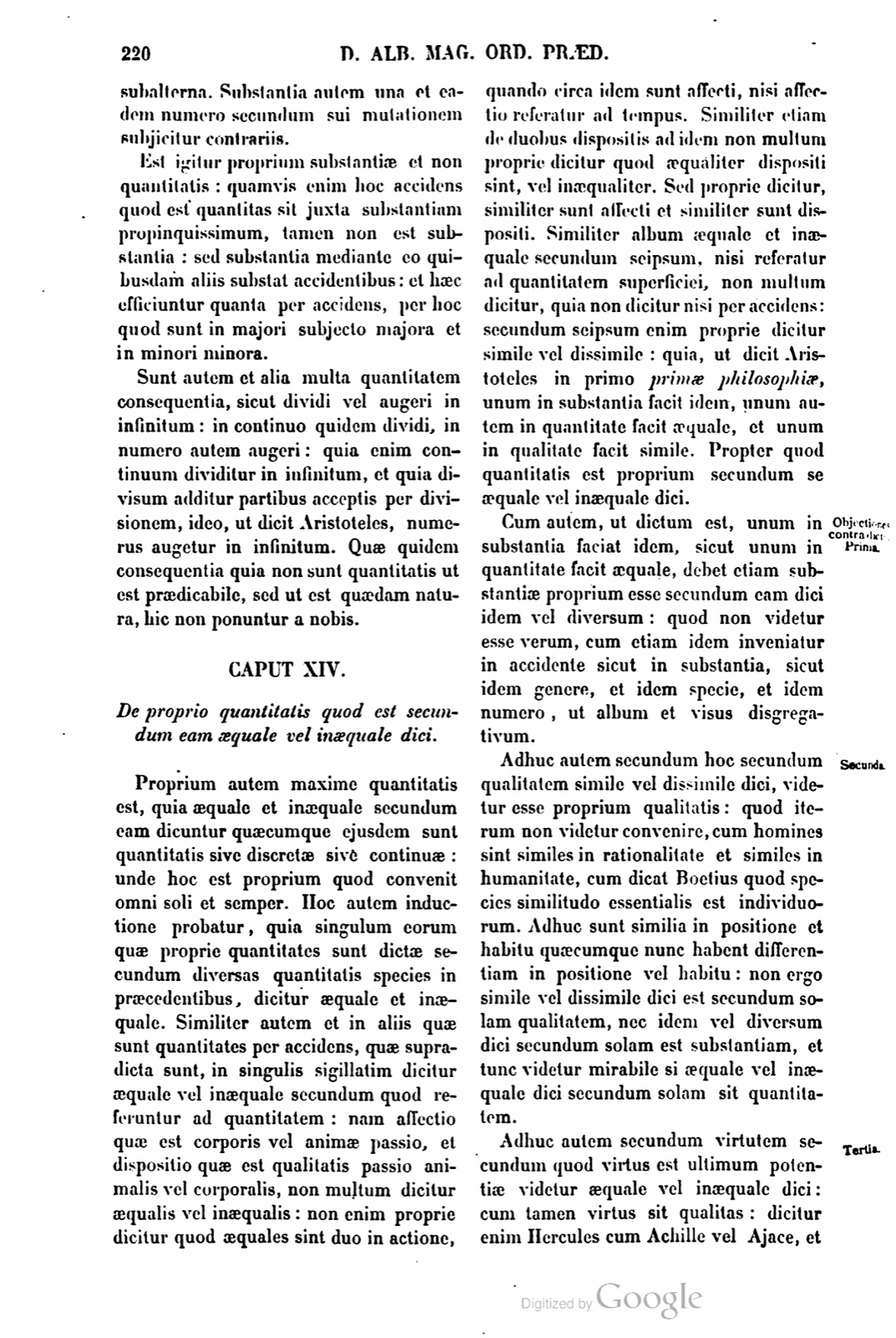
subalterna. Substantia autem una et eadem numero secundum sui mutationem subjicitur contrariis.
Est igitur proprium substantiæ et non quantitatis: quamvis enim hoc accidens quod est quantitas sit juxta substantiam propinquissimum, tamen non est substantia: sed substantia mediante eo quibusdam aliis substat accidentibus: et hæc efficiuntur quanta per accidens, per hoc quod sunt in majori subjecto majora et in minori minora.
Sunt autem et alia multa quantitatem consequentia, sicut dividi vel augeri in infinitum: in continuo quidem dividi, in numero autem augeri: quia enim continuum dividitur in infinitum, et quia divisum additur partibus acceptis per divisionem, ideo, ut dicit Aristoteles, numerus augetur in infinitum. Quæ quidem consequentia quia non sunt quantitatis ut est prædicabile, sed ut est quædam natura, hic non ponuntur a nobis.
CAPUT XIV.
De proprio quantitatis quod est secundum eam æquale vel inæquale dici.
Proprium autem maxime quantitatis est, quia æquale et inæquale secundum eam dicuntur quæcumque ejusdem sunt quantitatis sive discretæ sive continuæ: unde hoc est proprium quod convenit omni soli et semper. Hoc autem inductione probatur, quia singulum eorum quæ proprie quantitates sunt dictæ secundum diversas quantitatis species in præcedentibus, dicitur æquale et inæquale. Similiter autem et in aliis quæ sunt quantitates per accidens, quæ supradicta sunt, in singulis sigillatim dicitur æquale vel inæquale secundum quod referuntur ad quantitatem: nam affectio quæ est corporis vel animæ passio, et dispositio quæ est qualitatis passio animalis vel corporalis, non multum dicitur æqualis vel inæqualis: non enim proprie dicitur quod æquales sint duo in actione, quando circa idem sunt affecti, nisi affectio referatur ad tempus. Similiter etiam de duobus dispositis ad idem non multum proprie dicitur quod æqualiter dispositi sint, vel inæqualiter. Sed proprie dicitur, similiter sunt affecti et similiter sunt dispositi. Similiter album æquale et inæquale secundum seipsum, nisi referatur ad quantitatem superficiei, non multum dicitur, quia non dicitur nisi per accidens: secundum seipsum enim proprie dicitur simile vel dissimile: quia, ut dicit Aristoteles, in primo primæ philosophiæ, unum in substantia facit idem, unum autem in quantitate facit æquale, et unum in qualitate facit simile. Propter quod quantitatis est proprium secundum se æquale vel inæquale dici.
Cum autem, ut dictum est, unum in substantia faciat idem, sicut unum in quantitate facit æquale, debet etiam substantiæ proprium esse secundum eam dici idem vel diversum: quod non videtur esse verum, cum etiam idem inveniatur in accidente sicut in substantia, sicut idem genere, et idem specie, et idem numero, ut album et visus disgregativum.
Adhuc autem secundum hoc secundum qualitatem simile vel dissimile dici, videtur esse proprium qualitatis: quod iterum non videtur convenire, cum homines sint similes in rationalitate et similes in humanitate, cum dicat Boetius quod species similitudo essentialis est individuorum. Adhuc sunt similia in positione et habitu quæcumque nunc habent differentiam in positione vel habitu: non ergo simile vel dissimile dici est secundum solam qualitatem, nec idem vel diversum dici secundum solam est substantiam, et tunc videtur mirabile si æquale vel inæquale dici secundum solam sit quantitatem.
Adhuc autem secundum virtutem secundum quod virtus est ultimum potentiæ videtur æquale vel inæquale dici: cum tamen virtus sit qualitas: dicitur enim Hercules cum Achille vel Ajace, et
subalternate. But substance one and the same in number is subjected to contraries according to its mutation.
Therefore it is proper to substance and not to quantity. For although this accident which is quantity is nearest to substance next to substance, nevertheless it is not substance; but substance, by means of it, underlies certain other accidents; and these are made quantified by accident through this, that they are greater in a greater subject and lesser in a lesser subject.
But there are also many other things following quantity, as to be divided or to be increased to infinity: in the continuous indeed to be divided, but in number to be increased. For because the continuum is divided to infinity, and because what has been divided is added to the parts accepted through division, therefore, as Aristotle says, number is increased to infinity. These consequents indeed, because they are not of quantity as it is a predicable, but as it is a certain nature, are not placed here by us.
CHAPTER XIV.
On the property of quantity, which is for equal or unequal to be said according to it.
But the property especially of quantity is that equal and unequal are said according to it, whatever things are of the same quantity, whether discrete or continuous; whence this is a property which belongs to every, only, and always. But this is proved by induction, because each of those things which have been called properly quantities according to diverse species of quantity in the preceding things is called equal and unequal. Similarly also in the other things which are quantities by accident, which were stated above, in each singly equal or unequal is said according as they are referred to quantity. For affection, which is a passion of body or soul, and disposition, which is a passion of quality, animal or bodily, is not much called equal or unequal; for it is not properly said that two are equal in action when they are affected about the same thing, unless the affection is referred to time. Similarly also concerning two disposed toward the same thing, it is not much properly said that they are disposed equally or unequally. But it is properly said: they are similarly affected and similarly disposed. Similarly, white is not much called equal and unequal according to itself unless it is referred to the quantity of surface, because it is not said except by accident; for according to itself it is properly called like or unlike, because, as Aristotle says in the first book of First Philosophy, one in substance makes same, but one in quantity makes equal, and one in quality makes like. On account of this it is proper to quantity according to itself to be called equal or unequal.
But since, as has been said, one in substance makes same, just as one in quantity makes equal, it ought also to be proper to substance for same or diverse to be said according to it. This does not seem to be true, since same is also found in accident just as in substance, as the same in genus, and the same in species, and the same in number, as white and sight are dispersive.
Further, according to this, to be called like or unlike according to quality seems to be proper to quality. Again this does not seem to agree, since human beings are alike in rationality and alike in humanity, since Boethius says that species is the essential likeness of individuals. Further, whatever things now have difference in position or habit are alike in position and habit; therefore to be called like or unlike is not according to quality alone, nor is to be called same or diverse according only to substance, and then it seems wondrous if to be called equal or unequal is according to quantity alone.
Further, according to virtue according as virtue is the utmost of potency, equal or unequal seems to be said; although nevertheless virtue is quality. For Hercules is said with Achilles or Ajax, and
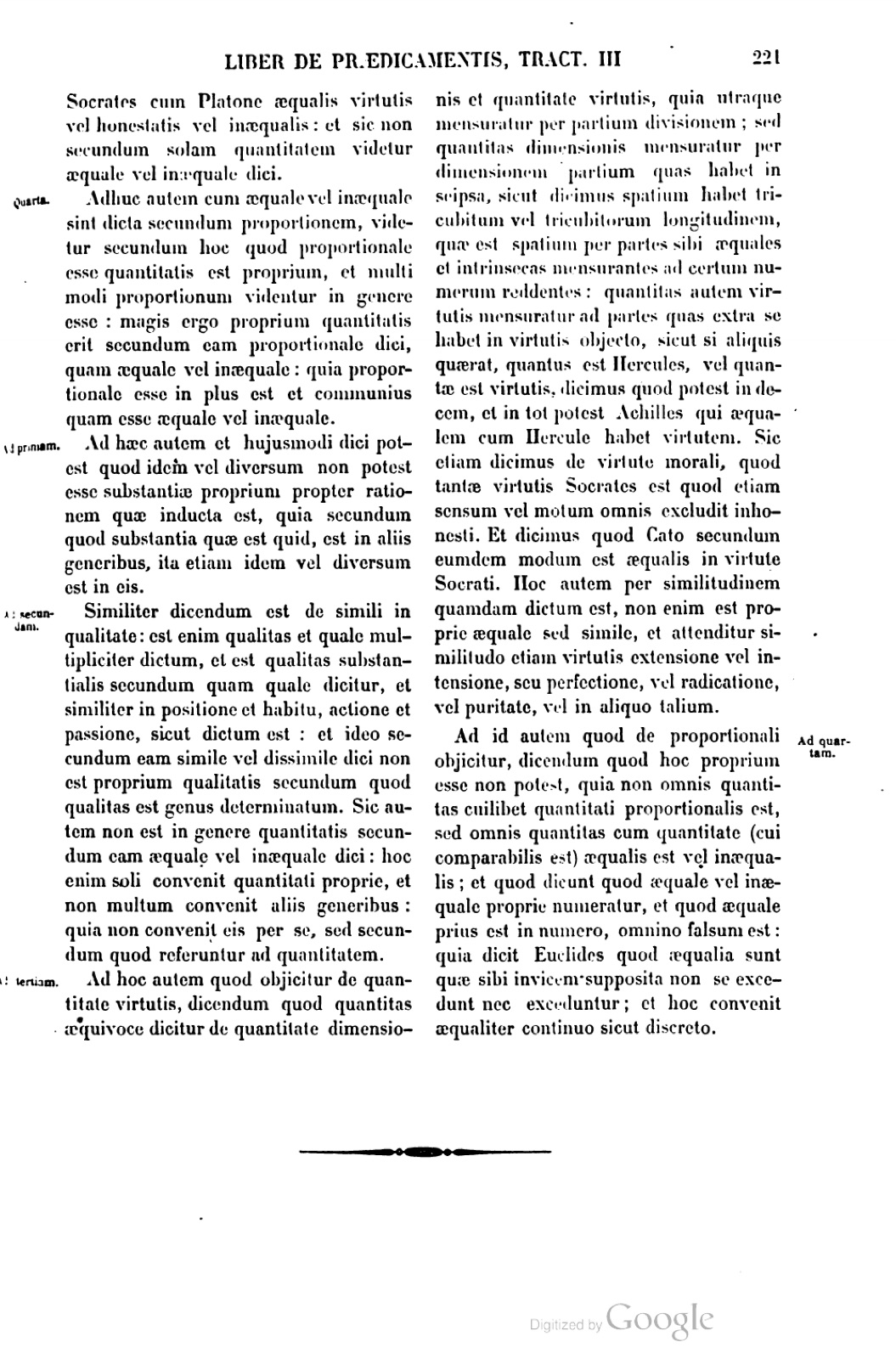
Socrates cum Platone æqualis virtutis vel honestatis vel inæqualis: et sic non secundum solam quantitatem videtur æquale vel inæquale dici.
Adhuc autem cum æquale vel inæquale sint dicta secundum proportionem, videtur secundum hoc quod proportionale esse quantitatis est proprium, et multi modi proportionum videntur in genere esse: magis ergo proprium quantitatis erit secundum eam proportionale dici, quam æquale vel inæquale: quia proportionale esse in plus est et communius quam esse æquale vel inæquale.
Ad hæc autem et hujusmodi dici potest quod idem vel diversum non potest esse substantiæ proprium propter rationem quæ inducta est, quia secundum quod substantia quæ est quid, est in aliis generibus, ita etiam idem vel diversum est in eis.
Similiter dicendum est de simili in qualitate: est enim qualitas et quale multipliciter dictum, et est qualitas substantialis secundum quam quale dicitur, et similiter in positione et habitu, actione et passione, sicut dictum est: et ideo secundum eam simile vel dissimile dici non est proprium qualitatis secundum quod qualitas est genus determinatum. Sic autem non est in genere quantitatis secundum eam æquale vel inæquale dici: hoc enim soli convenit quantitati proprie, et non multum convenit aliis generibus: quia non convenit eis per se, sed secundum quod referuntur ad quantitatem.
Ad hoc autem quod objicitur de quantitate virtutis, dicendum quod quantitas æquivoce dicitur de quantitate dimensionis et quantitate virtutis, quia utraque mensuratur per partium divisionem; sed quantitas dimensionis mensuratur per dimensionem partium quas habet in seipsa, sicut dicimus spatium habet tricubitum vel tricubitorum longitudinem, quæ est spatium per partes sibi æquales et intrinsecas mensurantes ad certum numerum reddentes: quantitas autem virtutis mensuratur ad partes quas extra se habet in virtutis objecto, sicut si aliquis quærat, quantus est Hercules, vel quantæ est virtutis, dicimus quod potest in decem, et in tot potest Achilles qui æqualem cum Hercule habet virtutem. Sic etiam dicimus de virtute morali, quod tantæ virtutis Socrates est quod etiam sensum vel motum omnis excludit inhonesti. Et dicimus quod Cato secundum eumdem modum est æqualis in virtute Socrati. Hoc autem per similitudinem quamdam dictum est, non enim est proprie æquale sed simile, et attenditur similitudo etiam virtutis extensione vel intensione, seu perfectione, vel radicatione, vel puritate, vel in aliquo talium.
Ad id autem quod de proportionali objicitur, dicendum quod hoc proprium esse non potest, quia non omnis quantitas cuilibet quantitati proportionalis est, sed omnis quantitas cum quantitate (cui comparabilis est) æqualis est vel inæqualis; et quod dicunt quod æquale vel inæquale proprie numeratur, et quod æquale prius est in numero, omnino falsum est: quia dicit Euclides quod æqualia sunt quæ sibi invicem supposita non se excedunt nec exceduntur; et hoc convenit æqualiter continuo sicut discreto.
Socrates with Plato is of equal virtue or honor, or unequal; and thus equal or unequal does not seem to be said according to quantity alone.
Further, since equal or unequal are said according to proportion, it seems according to this that to be proportional is proper to quantity, and many modes of proportions seem to be in the genus; therefore it will be more proper to quantity to be called proportional according to it than equal or unequal, because to be proportional is in more things and more common than to be equal or unequal.
But to these things and things of this sort it can be said that same or diverse cannot be proper to substance on account of the reasoning which has been induced, because according as substance, which is a what, is in other genera, so also same or diverse is in them.
Similarly one must speak about like in quality: for quality and qualified are said in many ways, and there is substantial quality according to which something is called qualified, and similarly in position and habit, action and passion, as has been said; and therefore according to it to be called like or unlike is not proper to quality according as quality is a determinate genus. But it is not so in the genus of quantity for equal or unequal to be said according to it; for this belongs only to quantity properly, and does not belong much to the other genera, because it does not belong to them through themselves, but according as they are referred to quantity.
To this, however, which is objected concerning the quantity of virtue, one must say that quantity is said equivocally of the quantity of dimension and the quantity of virtue, because each is measured through division of parts; but the quantity of dimension is measured through the dimension of parts which it has in itself, as we say a space has a three-cubit or three-cubits' length, which is a space through parts equal to itself and intrinsic, measuring and rendering it to a definite number. But the quantity of virtue is measured according to the parts which it has outside itself in the object of virtue, as if someone asks how great Hercules is, or of how much virtue he is, we say that he can do ten, and Achilles, who has equal virtue with Hercules, can do as many. Thus also we say concerning moral virtue that Socrates is of so much virtue that he excludes even every sense or movement of dishonor. And we say that Cato according to the same mode is equal in virtue to Socrates. But this has been said through a certain likeness, for it is not properly equal but like, and a likeness even of virtue is attended to by extension or intension, or perfection, or rootedness, or purity, or in some such thing.
But to that which is objected concerning the proportional, one must say that this cannot be proper, because not every quantity is proportional to every quantity, but every quantity is equal or unequal with the quantity to which it is comparable; and what they say, that equal or unequal is properly numbered, and that equal is prior in number, is altogether false, because Euclid says that equal things are those which, when placed upon one another, neither exceed nor are exceeded; and this belongs equally to the continuous as to the discrete.
If a page does not appear, its photograph has not been uploaded yet.