Volume 1 · pp. 218–219
End of Chapter XII and Chapter XIII. On this, that it belongs to quantity not to receive more and less
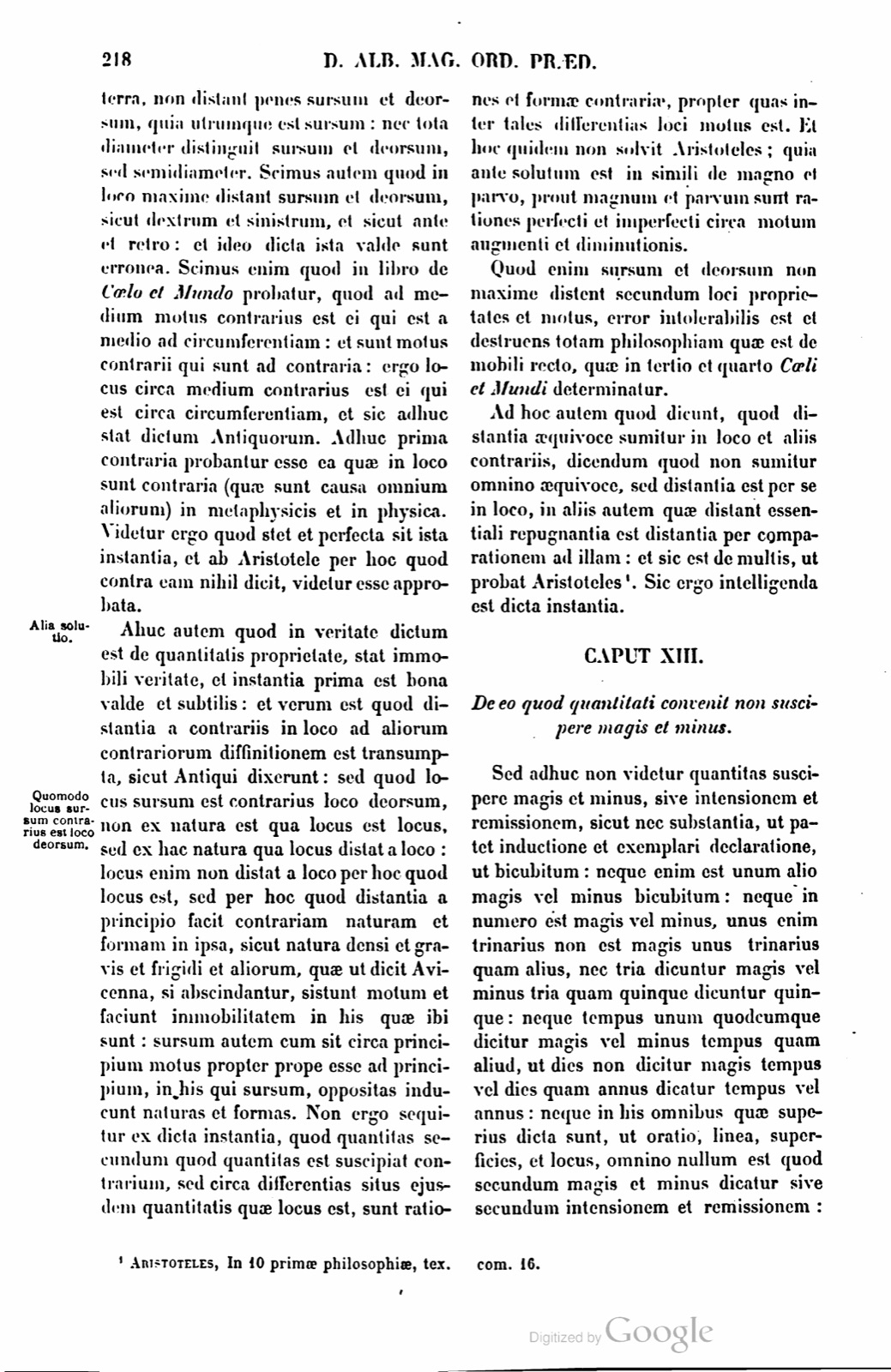
terra, non distant penes sursum et deorsum, quia utrumque est sursum: nec tota diameter distinguit sursum et deorsum, sed semidiameter. Scimus autem quod in loco maxime distant sursum et deorsum, sicut dextrum et sinistrum, et sicut ante et retro: et ideo dicta ista valde sunt erronea. Scimus enim quod in libro de Cælo et Mundo probatur, quod ad medium motus contrarius est ei qui est a medio ad circumferentiam: et sunt motus contrarii qui sunt ad contraria: ergo locus circa medium contrarius est ei qui est circa circumferentiam, et sic adhuc stat dictum Antiquorum. Adhuc prima contraria probantur esse ea quæ in loco sunt contraria (quæ sunt causa omnium aliorum) in metaphysicis et in physica. Videtur ergo quod stet et perfecta sit ista instantia, et ab Aristotele per hoc quod contra eam nihil dicit, videtur esse approbata.
Adhuc autem quod in veritate dictum est de quantitatis proprietate, stat immobili veritate, et instantia prima est bona valde et subtilis: et verum est quod distantia a contrariis in loco ad aliorum contrariorum diffinitionem est transumpta, sicut Antiqui dixerunt: sed quod locus sursum est contrarius loco deorsum, non ex natura est qua locus est locus, sed ex hac natura qua locus distat a loco: locus enim non distat a loco per hoc quod locus est, sed per hoc quod distantia a principio facit contrariam naturam et formam in ipsa, sicut natura densi et gravis et frigidi et aliorum, quæ ut dicit Avicenna, si abscindantur, sistunt motum et faciunt immobilitatem in his quæ ibi sunt: sursum autem cum sit circa principium motus propter prope esse ad principium, in his qui sursum, oppositas inducunt naturas et formas. Non ergo sequitur ex dicta instantia, quod quantitas secundum quod quantitas est suscipiat contrarium, sed circa differentias situs ejusdem quantitatis quæ locus est, sunt rationes et formæ contrariæ, propter quas inter tales differentias loci motus est. Et hoc quidem non solvit Aristoteles: quia ante solutum est in simili de magno et parvo, prout magnum et parvum sunt rationes perfecti et imperfecti circa motum augmenti et diminutionis.
Quod enim sursum et deorsum non maxime distent secundum loci proprietates et motus, error intolerabilis est et destruens totam philosophiam quæ est de mobili recto, quæ in tertio et quarto Cæli et Mundi determinatur.
Ad hoc autem quod dicunt, quod distantia æquivoce sumitur in loco et aliis contrariis, dicendum quod non sumitur omnino æquivoce, sed distantia est per se in loco, in aliis autem quæ distant essentiali repugnantia est distantia per comparationem ad illam: et sic est de multis, ut probat Aristoteles 1. Sic ergo intelligenda est dicta instantia.
CAPUT XIII.
De eo quod quantitati convenit non suscipere magis et minus.
Sed adhuc non videtur quantitas suscipere magis et minus, sive intensionem et remissionem, sicut nec substantia, ut patet inductione et exemplari declaratione, ut bicubitum: neque enim est unum alio magis vel minus bicubitum: neque in numero est magis vel minus, unus enim trinarius non est magis unus trinarius quam alius, nec tria dicuntur magis vel minus tria quam quinque dicuntur quinque: neque tempus unum quodcumque dicitur magis vel minus tempus quam aliud, ut dies non dicitur magis tempus vel dies quam annus dicatur tempus vel annus: neque in his omnibus quæ superius dicta sunt, ut oratio, linea, superficies, et locus, omnino nullum est quod secundum magis et minus dicatur sive secundum intensionem et remissionem:
the earth, are not distant with respect to upward and downward, because each is upward; nor does the whole diameter distinguish upward and downward, but the semidiameter does. But we know that in place upward and downward are maximally distant, just as right and left, and just as before and behind; and therefore those stated things are very erroneous. For we know that in the book On Heaven and the World it is proved that motion toward the middle is contrary to that which is from the middle to the circumference; and motions are contrary which are toward contraries. Therefore the place around the middle is contrary to that which is around the circumference, and thus the statement of the Ancients still stands. Further, the first contraries are proved in the Metaphysics and in the Physics to be those which are contrary in place, which are the cause of all the others. Therefore it seems that this objection-instance stands and is perfect, and from Aristotle, through this that he says nothing against it, it seems to be approved.
Further, however, what has been said in truth about the property of quantity stands with unmoved truth, and the first objection-instance is very good and subtle; and it is true that distance is transferred from contraries in place to the definition of other contraries, as the Ancients said. But that the upward place is contrary to the downward place is not from the nature by which place is place, but from this nature by which place is distant from place. For place is not distant from place through this that it is place, but through this that distance from the principle makes a contrary nature and form in it, as the nature of the dense and heavy and cold and of other things, which, as Avicenna says, if they are cut off, stop motion and make immobility in those things which are there. But upward, since it is around the principle of motion on account of being near to the principle, induces opposite natures and forms in those things which are upward. Therefore it does not follow from the stated objection-instance that quantity according as it is quantity receives a contrary, but around the differences of situation of the same quantity which is place, there are contrary accounts and forms, on account of which motion is between such differences of place. And Aristotle indeed does not solve this, because it was solved before in a similar case concerning great and small, insofar as great and small are accounts of perfect and imperfect around the motion of increase and decrease.
For that upward and downward are not maximally distant according to the properties and motions of place is an intolerable error and one destroying the whole philosophy which is about straight mobile body, which is determined in the third and fourth books of On Heaven and the World.
But to this which they say, that distance is taken equivocally in place and in other contraries, one must say that it is not taken altogether equivocally, but distance is through itself in place; but in other things which are distant by essential repugnance there is distance by comparison to that. And thus it is concerning many things, as Aristotle proves 1. Therefore the stated objection-instance must be understood in this way.
CHAPTER XIII.
On this, that it belongs to quantity not to receive more and less.
But still quantity does not seem to receive more and less, or intension and remission, just as neither does substance, as is clear by induction and by exemplary declaration, as the two-cubit: for one thing is not two-cubit more or less than another; nor in number is there more or less, for one ternary is not more one ternary than another, nor are three called more or less three than five are called five; nor is any one time whatever called more or less time than another, as a day is not called more time or more a day than a year is called time or year; nor in all these things which were stated above, as speech, line, surface, and place, is there altogether anything which is said according to more and less or according to intension and remission:
propter quod quantitas non potest recipere magis et minus.
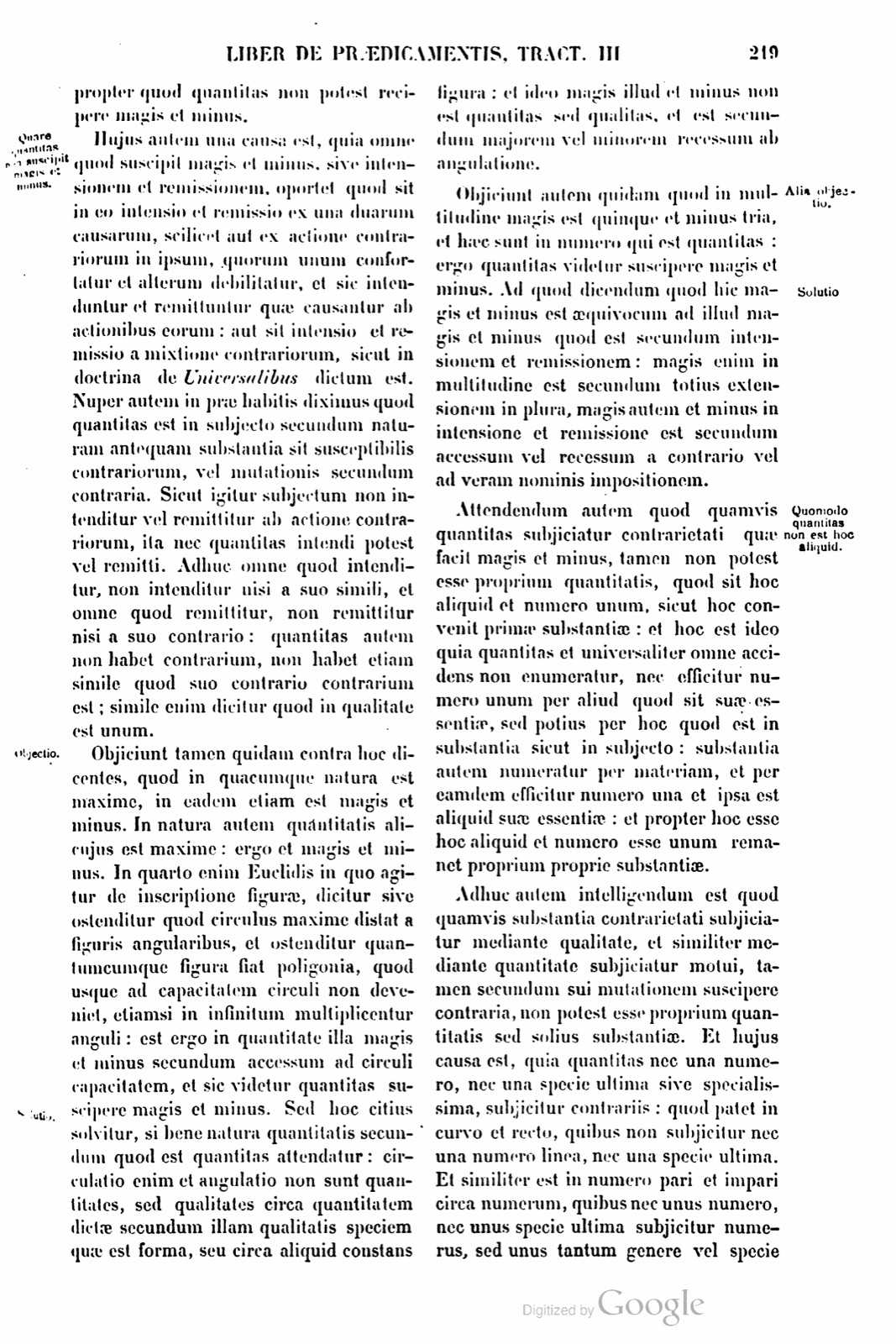
Hujus autem una causa est, quia omne quod suscipit magis et minus, sive intensionem et remissionem, oportet quod sit in eo intensio et remissio ex una duarum causarum, scilicet aut ex actione contrariorum in ipsum, quorum unum confortatur et alterum debilitatur, et sic intenduntur et remittuntur quæ causantur ab actionibus eorum: aut sit intensio et remissio a mixtione contrariorum, sicut in doctrina de Universalibus dictum est. Nuper autem in præ habitis diximus quod quantitas est in subjecto secundum naturam antequam substantia sit susceptibilis contrariorum, vel mutationis secundum contraria. Sicut igitur subjectum non intenditur vel remittitur ab actione contrariorum, ita nec quantitas intendi potest vel remitti. Adhuc omne quod intenditur, non intenditur nisi a suo simili, et omne quod remittitur, non remittitur nisi a suo contrario: quantitas autem non habet contrarium, non habet etiam simile quod suo contrario contrarium est; simile enim dicitur quod in qualitate est unum.
Objiciunt tamen quidam contra hoc dicentes, quod in quacumque natura est maxime, in eadem etiam est magis et minus. In natura autem quantitatis alicujus est maxime: ergo et magis et minus. In quarto enim Euclidis in quo agitur de inscriptione figuræ, dicitur sive ostenditur quod circulus maxime distat a figuris angularibus, et ostenditur quantumcumque figura fiat poligonia, quod usque ad capacitatem circuli non deveniet, etiamsi in infinitum multiplicentur anguli: est ergo in quantitate illa magis et minus secundum accessum ad circuli capacitatem, et sic videtur quantitas suscipere magis et minus. Sed hoc citius solvitur, si bene natura quantitatis secundum quod est quantitas attendatur: circulatio enim et angulatio non sunt quantitates, sed qualitates circa quantitatem dictæ secundum illam qualitatis speciem quæ est forma, seu circa aliquid constans figura: et ideo magis illud et minus non est quantitas sed qualitas, et est secundum majorem vel minorem recessum ab angulatione.
Objiciunt autem quidam quod in multitudine magis est quinque et minus tria, et hæc sunt in numero qui est quantitas: ergo quantitas videtur suscipere magis et minus. Ad quod dicendum quod hic magis et minus est æquivocum ad illud magis et minus quod est secundum intensionem et remissionem: magis enim in multitudine est secundum totius extensionem in plura, magis autem et minus in intensione et remissione est secundum accessum vel recessum a contrario vel ad veram nominis impositionem.
Attendendum autem quod quamvis quantitas subjiciatur contrarietati quæ facit magis et minus, tamen non potest esse proprium quantitatis, quod sit hoc aliquid et numero unum, sicut hoc convenit primæ substantiæ: et hoc est ideo quia quantitas et universaliter omne accidens non enumeratur, nec efficitur numero unum per aliud quod sit suæ essentiæ, sed potius per hoc quod est in substantia sicut in subjecto: substantia autem numeratur per materiam, et per eamdem efficitur numero una et ipsa est aliquid suæ essentiæ: et propter hoc esse hoc aliquid et numero esse unum remanet proprium proprie substantiæ.
Adhuc autem intelligendum est quod quamvis substantia contrarietati subjiciatur mediante qualitate, et similiter mediante quantitate subjiciatur motui, tamen secundum sui mutationem suscipere contraria, non potest esse proprium quantitatis sed solius substantiæ. Et hujus causa est, quia quantitas nec una numero, nec una specie ultima sive specialissima, subjicitur contrariis: quod patet in curvo et recto, quibus non subjicitur nec una numero linea, nec una specie ultima. Et similiter est in numero pari et impari circa numerum, quibus nec unus numero, nec unus specie ultima subjicitur numerus, sed unus tantum genere vel specie
on account of which quantity cannot receive more and less.
But one cause of this is that everything which receives more and less, or intension and remission, must have in it intension and remission from one of two causes, namely either from the action of contraries upon it, of which one is strengthened and the other weakened, and thus those things are intensified and remitted which are caused by their actions; or intension and remission is from the mixture of contraries, as was said in the doctrine On Universals. But lately, in the things held before, we said that quantity is in a subject according to nature before substance is susceptible of contraries or of mutation according to contraries. Therefore just as a subject is not intensified or remitted by the action of contraries, so neither can quantity be intensified or remitted. Further, everything which is intensified is intensified only by its like, and everything which is remitted is remitted only by its contrary; but quantity does not have a contrary, nor does it have a like which is contrary to its own contrary; for a like is said to be that which is one in quality.
Nevertheless certain people object against this, saying that in whatever nature there is most, in the same there is also more and less. But in the nature of some quantity there is most; therefore also more and less. For in the fourth book of Euclid, in which it is treated concerning the inscription of a figure, it is said or shown that a circle is maximally distant from angular figures, and it is shown that however much a figure is made polygonal, it will not come to the capacity of a circle, even if the angles are multiplied to infinity. Therefore in that quantity there is more and less according to access to the capacity of the circle, and thus quantity seems to receive more and less. But this is solved more quickly if the nature of quantity according as it is quantity is attended to well: for circularity and angularity are not quantities, but qualities around quantity, said according to that species of quality which is form, or around something standing as figure; and therefore that more and less is not quantity but quality, and is according to a greater or lesser withdrawal from angularity.
But certain people object that in multitude five is more and three is less, and these are in number, which is quantity; therefore quantity seems to receive more and less. To this one must say that here more and less is equivocal in relation to that more and less which is according to intension and remission; for more in multitude is according to the extension of the whole into more things, but more and less in intension and remission is according to access to or withdrawal from a contrary, or toward the true imposition of the name.
But it must be attended to that although quantity is subjected to contrariety which makes more and less, nevertheless it cannot be proper to quantity that it be this something and one in number, as this belongs to first substance. And this is for this reason: because quantity and universally every accident is not numbered, nor made one in number, through something else which belongs to its essence, but rather through this, that it is in substance as in a subject. But substance is numbered through matter, and through the same matter is made one in number, and it itself is something of its essence; and on account of this to be this something and to be one in number remains proper to proper substance.
Further it must be understood that although substance is subjected to contrariety by means of quality, and similarly is subjected to motion by means of quantity, nevertheless to receive contraries according to its mutation cannot be proper to quantity but only to substance. And the cause of this is that quantity, neither one in number nor one in ultimate or most special species, is subjected to contraries. This is clear in curved and straight, to which neither one line in number nor one ultimate species is subjected. And similarly it is in even and odd number around number, to which neither one number in number nor one number in ultimate species is subjected, but one only in genus or species
Notes
- ARISTOTLE, in book 10 of First Philosophy, text, commentary 16. (ARISTOTELES, In 10 primæ philosophiæ, tex. com. 16.) ↩
If a page does not appear, its photograph has not been uploaded yet.