Volume 1 · pp. 216–217
End of Chapter XI and Chapter XII. On doubts which concern the aforesaid things
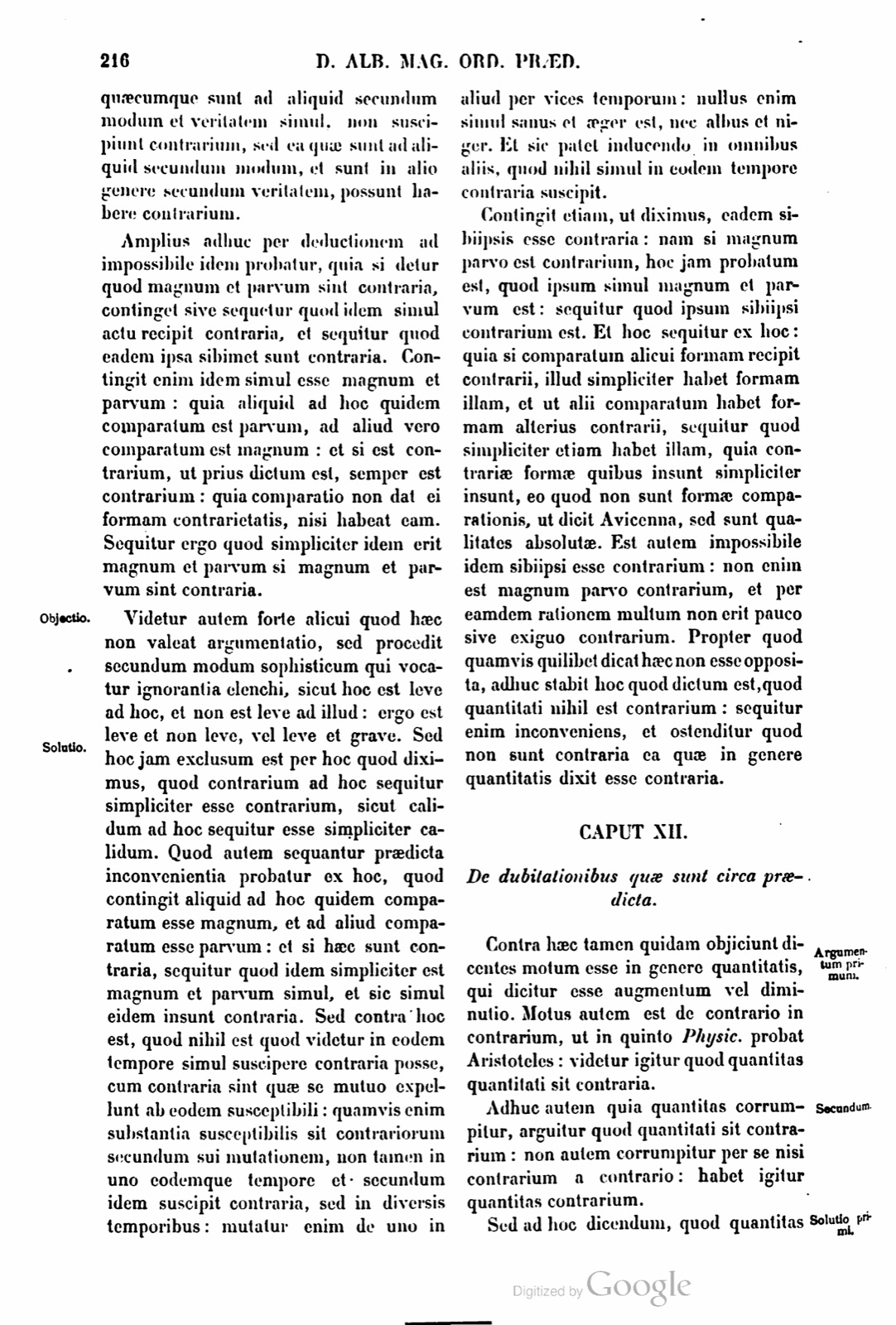
quæcumque sunt ad aliquid secundum modum et veritatem simul, non suscipiunt contrarium, sed ea quæ sunt ad aliquid secundum modum, et sunt in alio genere secundum veritatem, possunt habere contrarium.
Amplius adhuc per deductionem ad impossibile idem probatur, quia si detur quod magnum et parvum sint contraria, continget sive sequetur quod idem simul actu recipit contraria, et sequitur quod eadem ipsa sibimet sunt contraria. Contingit enim idem simul esse magnum et parvum: quia aliquid ad hoc quidem comparatum est parvum, ad aliud vero comparatum est magnum: et si est contrarium, ut prius dictum est, semper est contrarium: quia comparatio non dat ei formam contrarietatis, nisi habeat eam. Sequitur ergo quod simpliciter idem erit magnum et parvum si magnum et parvum sint contraria.
Videtur autem forte alicui quod hæc non valeat argumentatio, sed procedit secundum modum sophisticum qui vocatur ignorantia elenchi, sicut hoc est leve ad hoc, et non est leve ad illud: ergo est leve et non leve, vel leve et grave. Sed hoc jam exclusum est per hoc quod diximus, quod contrarium ad hoc sequitur simpliciter esse contrarium, sicut calidum ad hoc sequitur esse simpliciter calidum. Quod autem sequantur prædicta inconvenientia probatur ex hoc, quod contingit aliquid ad hoc quidem comparatum esse magnum, et ad aliud comparatum esse parvum: et si hæc sunt contraria, sequitur quod idem simpliciter est magnum et parvum simul, et sic simul eidem insunt contraria. Sed contra hoc est, quod nihil est quod videtur in eodem tempore simul suscipere contraria posse, cum contraria sint quæ se mutuo expellunt ab eodem susceptibili: quamvis enim substantia susceptibilis sit contrariorum secundum sui mutationem, non tamen in uno eodemque tempore et secundum idem suscipit contraria, sed in diversis temporibus: mutatur enim de uno in aliud per vices temporum: nullus enim simul sanus et æger est, nec albus et niger. Et sic patet inducendo in omnibus aliis, quod nihil simul in eodem tempore contraria suscipit.
Contingit etiam, ut diximus, eadem sibiipsis esse contraria: nam si magnum parvo est contrarium, hoc jam probatum est, quod ipsum simul magnum et parvum est: sequitur quod ipsum sibiipsi contrarium est. Et hoc sequitur ex hoc: quia si comparatum alicui formam recipit contrarii, illud simpliciter habet formam illam, et ut alii comparatum habet formam alterius contrarii, sequitur quod simpliciter etiam habet illam, quia contrariæ formæ quibus insunt simpliciter insunt, eo quod non sunt formæ comparationis, ut dicit Avicenna, sed sunt qualitates absolutæ. Est autem impossibile idem sibiipsi esse contrarium: non enim est magnum parvo contrarium, et per eamdem rationem multum non erit pauco sive exiguo contrarium. Propter quod quamvis quilibet dicat hæc non esse opposita, adhuc stabit hoc quod dictum est, quod quantitati nihil est contrarium: sequitur enim inconveniens, et ostenditur quod non sunt contraria ea quæ in genere quantitatis dixit esse contraria.
CAPUT XII.
De dubitationibus quæ sunt circa prædicta.
Contra hæc tamen quidam objiciunt dicentes motum esse in genere quantitatis, qui dicitur esse augmentum vel diminutio. Motus autem est de contrario in contrarium, ut in quinto Physic. probat Aristoteles: videtur igitur quod quantitas quantitati sit contraria.
Adhuc autem quia quantitas corrumpitur, arguitur quod quantitati sit contrarium: non autem corrumpitur per se nisi contrarium a contrario: habet igitur quantitas contrarium.
Sed ad hoc dicendum, quod quantitas
whatever things are relative according to mode and truth at once do not receive a contrary; but those things which are relative according to mode, and are in another genus according to truth, can have a contrary.
Further still, the same thing is proved by deduction to the impossible, because if it is granted that great and small are contraries, it will happen or follow that the same thing at the same time in act receives contraries, and it follows that the same things themselves are contrary to themselves. For the same thing happens to be at the same time great and small, because something compared to this indeed is small, but compared to another is great; and if it is a contrary, as was said before, it is always a contrary, because comparison does not give to it the form of contrariety unless it has that form. Therefore it follows that simply the same thing will be great and small if great and small are contraries.
But perhaps it seems to someone that this argumentation is not valid, but proceeds according to the sophistical mode which is called ignorance of refutation, as this is light in relation to this, and is not light in relation to that; therefore it is light and not light, or light and heavy. But this has already been excluded through this which we said, that being contrary in relation to this follows upon being a contrary simply, just as being hot in relation to this follows upon being simply hot. But that the aforesaid unfitting consequences follow is proved from this, that something happens to be great when compared to this, and small when compared to another; and if these are contraries, it follows that the same thing is simply great and small at once, and thus contraries are in the same thing at once. But against this there is that there is nothing which seems able to receive contraries at the same time at once, since contraries are those things which expel one another from the same susceptible thing. For although substance is susceptible of contraries according to its change, nevertheless it does not receive contraries in one and the same time and according to the same thing, but in diverse times; for it is changed from one into another through turns of times. For no one is at once healthy and sick, nor white and black. And thus it is clear by inducing in all other things that nothing receives contraries at the same time at once.
It also happens, as we said, that the same things are contrary to themselves; for if great is contrary to small, this has already been proved, that it is at once great and small; it follows that it is contrary to itself. And this follows from this: because if something compared to something receives the form of a contrary, it has that form simply; and when compared to another it has the form of the other contrary, it follows that it also has that form simply, because contrary forms are in those in which they are simply, by the fact that they are not forms of comparison, as Avicenna says, but are absolute qualities. But it is impossible that the same thing be contrary to itself; for great is not contrary to small, and by the same reasoning much will not be contrary to few or to scant. On account of this, although anyone should say that these are not opposites, still this which has been said will stand, that nothing is contrary to quantity; for an unfitting consequence follows, and it is shown that those things are not contrary which he said to be contrary in the genus of quantity.
CHAPTER XII.
On doubts which concern the aforesaid things.
Against these things, however, certain people object, saying that motion is in the genus of quantity, which is called increase or decrease. But motion is from contrary into contrary, as Aristotle proves in the fifth book of the Physics; therefore it seems that quantity is contrary to quantity.
Further, because quantity is corrupted, it is argued that there is something contrary to quantity; but one contrary is not corrupted through itself except by a contrary; therefore quantity has a contrary.
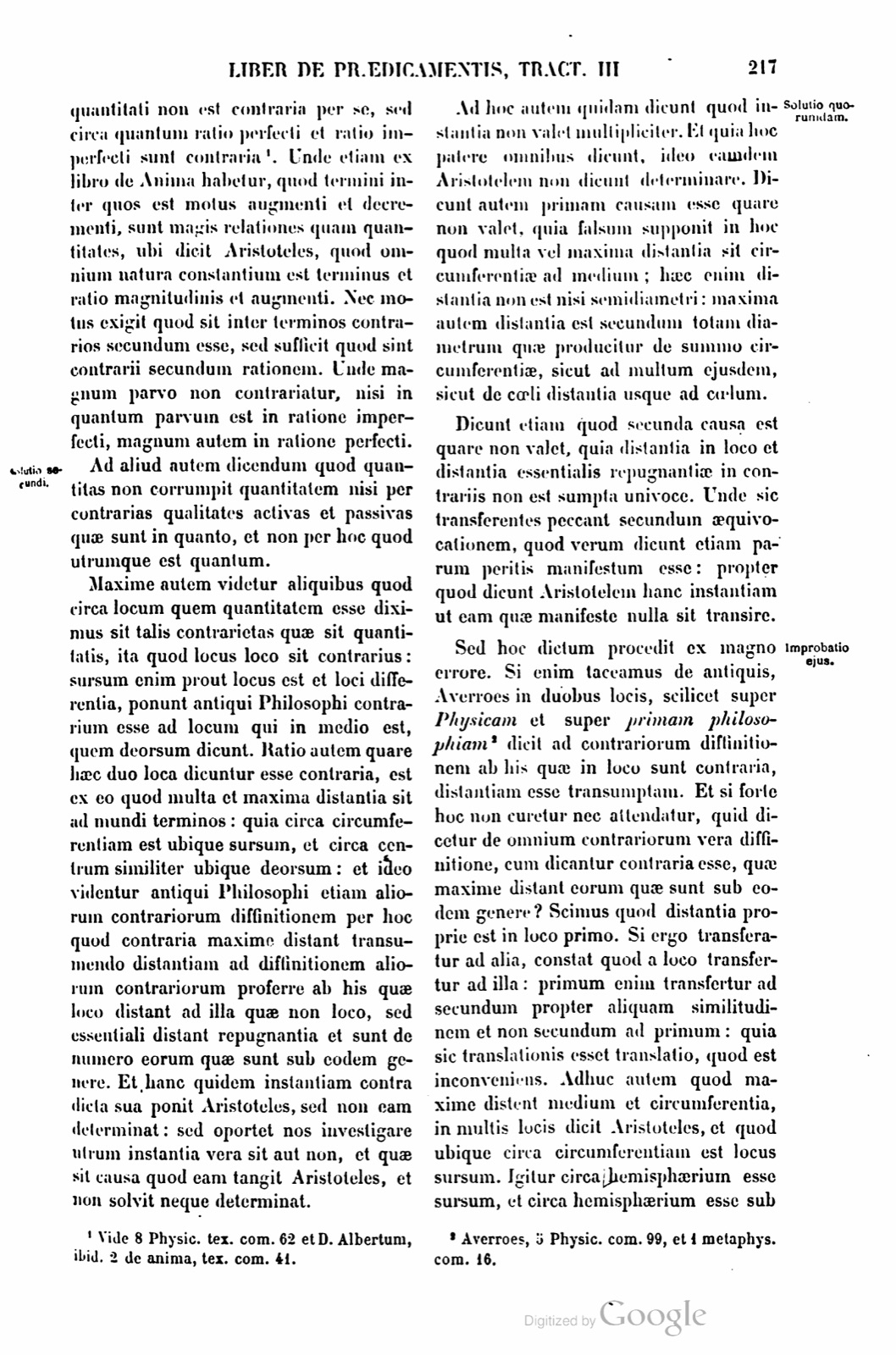
But to this one must say that quantity
quantitati non est contraria per se, sed circa quantum ratio perfecti et ratio imperfecti sunt contraria 1. Unde etiam ex libro de Anima habetur, quod termini inter quos est motus augmenti et decrementi, sunt magis relationes quam quantitates, ubi dicit Aristoteles, quod omnium natura constantium est terminus et ratio magnitudinis et augmenti. Nec motus exigit quod sit inter terminos contrarios secundum esse, sed sufficit quod sint contrarii secundum rationem. Unde magnum parvo non contrariatur, nisi in quantum parvum est in ratione imperfecti, magnum autem in ratione perfecti.
Ad aliud autem dicendum quod quantitas non corrumpit quantitatem nisi per contrarias qualitates activas et passivas quæ sunt in quanto, et non per hoc quod utrumque est quantum.
Maxime autem videtur aliquibus quod circa locum quem quantitatem esse diximus sit talis contrarietas quæ sit quantitatis, ita quod locus loco sit contrarius: sursum enim prout locus est et loci differentia, ponunt antiqui Philosophi contrarium esse ad locum qui in medio est, quem deorsum dicunt. Ratio autem quare hæc duo loca dicuntur esse contraria, est ex eo quod multa et maxima distantia sit ad mundi terminos: quia circa circumferentiam est ubique sursum, et circa centrum similiter ubique deorsum: et ideo videntur antiqui Philosophi etiam aliorum contrariorum diffinitionem per hoc quod contraria maxime distant transumendo distantiam ad diffinitionem aliorum contrariorum proferre ab his quæ loco distant ad illa quæ non loco, sed essentiali distant repugnantia et sunt de numero eorum quæ sunt sub eodem genere. Et hanc quidem instantiam contra dicta sua ponit Aristoteles, sed non eam determinat: sed oportet nos investigare utrum instantia vera sit aut non, et quæ sit causa quod eam tangit Aristoteles, et non solvit neque determinat.
Ad hoc autem quidam dicunt quod instantia non valet multipliciter. Et quia hoc patere omnibus dicunt, ideo eumdem Aristotelem non dicunt determinare. Dicunt autem primam causam esse quare non valet, quia falsum supponit in hoc quod multa vel maxima distantia sit circumferentiæ ad medium; hæc enim distantia non est nisi semidiametri: maxima autem distantia est secundum totam diametrum quæ producitur de summo circumferentiæ, sicut ad multum ejusdem, sicut de cæli distantia usque ad cælum.
Dicunt etiam quod secunda causa est quare non valet, quia distantia in loco et distantia essentialis repugnantiæ in contrariis non est sumpta univoce. Unde sic transferentes peccant secundum æquivocationem, quod verum dicunt etiam parum peritis manifestum esse: propter quod dicunt Aristotelem hanc instantiam ut eam quæ manifeste nulla sit transire.
Sed hoc dictum procedit ex magno errore. Si enim taceamus de antiquis, Averroes in duobus locis, scilicet super Physicam et super primam philosophiam 2 dicit ad contrariorum diffinitionem ab his quæ in loco sunt contraria, distantiam esse transumptam. Et si forte hoc non curetur nec attendatur, quid dicetur de omnium contrariorum vera diffinitione, cum dicantur contraria esse, quæ maxime distant eorum quæ sunt sub eodem genere? Scimus quod distantia proprie est in loco primo. Si ergo transferatur ad alia, constat quod a loco transfertur ad illa: primum enim transfertur ad secundum propter aliquam similitudinem et non secundum ad primum: quia sic translationis esset translatio, quod est inconveniens. Adhuc autem quod maxime distent medium et circumferentia, in multis locis dicit Aristoteles, et quod ubique circa circumferentiam est locus sursum. Igitur circa hemisphærium esse sursum, et circa hemisphærium esse sub
is not contrary to quantity through itself, but around the quantified thing the account of perfect and the account of imperfect are contraries 1. Whence also from the book On the Soul it is held that the terms between which there is a motion of increase and decrease are relations more than quantities, where Aristotle says that for all things constituted by nature there is a term and account of magnitude and increase. Nor does motion require that it be between contrary terms according to being, but it suffices that they be contrary according to account. Whence great is not contrary to small except insofar as small is in the account of the imperfect, but great in the account of the perfect.
But to the other one must say that quantity does not corrupt quantity except through contrary active and passive qualities which are in the quantified thing, and not through this that each is quantified.
But it especially seems to some that around place, which we have said to be quantity, there is such contrariety as belongs to quantity, so that place is contrary to place. For upward, insofar as it is place and a difference of place, the ancient Philosophers posit to be contrary to the place which is in the middle, which they call downward. But the reason why these two places are said to be contrary is from this, that there is much and maximal distance to the terms of the world, because around the circumference upward is everywhere, and around the center similarly downward is everywhere. And therefore the ancient Philosophers seem also to bring forward the definition of other contraries, through this that contraries are maximally distant, by transferring distance to the definition of other contraries from those things which are distant by place to those things which are distant not by place, but by essential repugnance, and are of the number of those things which are under the same genus. And Aristotle indeed posits this objection-instance against his own statements, but does not determine it; but it is necessary for us to investigate whether the objection-instance is true or not, and what is the cause that Aristotle touches it, and does not solve nor determine it.
But to this certain people say that the objection-instance is not valid in many ways. And because they say that this is plain to all, therefore they say that the same Aristotle does not determine it. But they say that the first cause why it is not valid is that it supposes something false in this, that there is much or maximal distance of the circumference to the middle; for this distance is only of a semidiameter, but the maximal distance is according to the whole diameter which is drawn from the top of the circumference, as to much of the same, as from the distance of heaven up to heaven.
They also say that the second cause why it is not valid is that distance in place and the distance of essential repugnance in contraries is not taken univocally. Whence those transferring in this way sin according to equivocation, which truth they say is manifest even to those little skilled; on account of which they say that Aristotle passes over this objection-instance as one which is manifestly nothing.
But this statement proceeds from a great error. For if we are silent about the ancients, Averroes in two places, namely on the Physics and on the First Philosophy 2, says that distance was transferred to the definition of contraries from those things which are contrary in place. And if perhaps this is not cared for nor attended to, what will be said about the true definition of all contraries, since those things are said to be contraries which are maximally distant among those things which are under the same genus? We know that distance properly is first in place. Therefore if it is transferred to other things, it is agreed that it is transferred from place to those things; for the first is transferred to the second on account of some likeness, and not the second to the first, because in that way there would be a transfer of a transfer, which is unfitting. Further, Aristotle says in many places that the middle and circumference are maximally distant, and that everywhere around the circumference there is the place upward. Therefore around the hemisphere there is upward, and around the hemisphere there is beneath
Notes
- See book 8 of the Physics, text, commentary 62, and D. Albert, in the same place, book 2 On the Soul, text, commentary 41. (Vide 8 Physic. tex. com. 62 et D. Albertum, ibid. 2 de anima, tex. com. 41.) ↩
- Averroes, book 5 of the Physics, commentary 99, and book 1 of the Metaphysics, commentary 16. (Averroes, 5 Physic. com. 99, et 1 metaphys. com. 16.) ↩
If a page does not appear, its photograph has not been uploaded yet.