Volume 1 · pp. 213–215
End of Chapter X and Chapter XI. On the property of quantity which is not to have a contrary
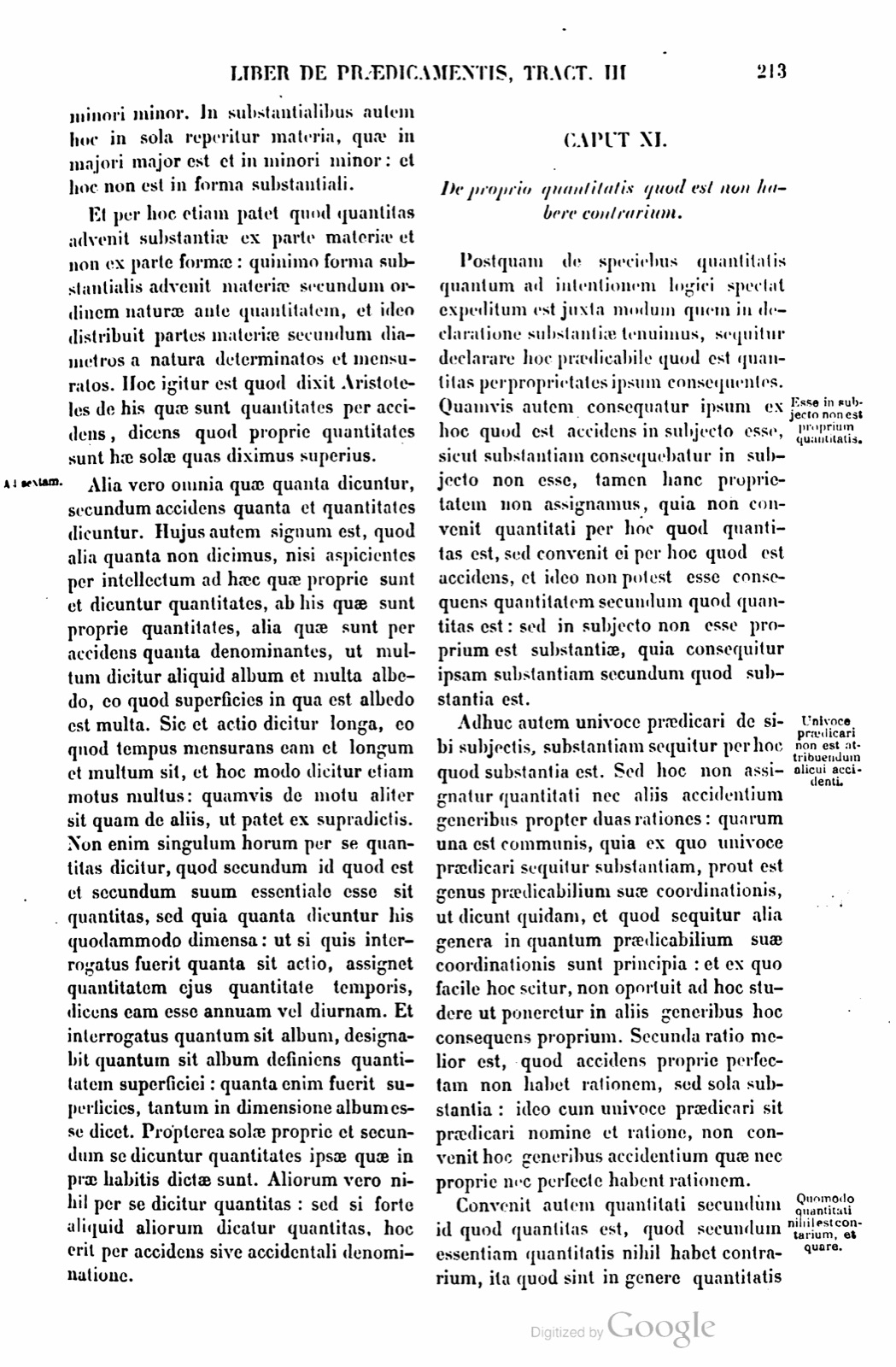
minori minor. In substantialibus autem hoc in sola reperitur materia, quæ in majori major est et in minori minor: et hoc non est in forma substantiali.
Et per hoc etiam patet quod quantitas advenit substantiæ ex parte materiæ et non ex parte formæ: quinimo forma substantialis advenit materiæ secundum ordinem naturæ ante quantitatem, et ideo distribuit partes materiæ secundum diametros a natura determinatos et mensuratos. Hoc igitur est quod dixit Aristoteles de his quæ sunt quantitates per accidens, dicens quod proprie quantitates sunt hæ solæ quas diximus superius.
Alia vero omnia quæ quanta dicuntur, secundum accidens quanta et quantitates dicuntur. Hujus autem signum est, quod alia quanta non dicimus, nisi aspicientes per intellectum ad hæc quæ proprie sunt et dicuntur quantitates, ab his quæ sunt proprie quantitates, alia quæ sunt per accidens quanta denominantes, ut multum dicitur aliquid album et multa albedo, eo quod superficies in qua est albedo est multa. Sic et actio dicitur longa, eo quod tempus mensurans eam et longum et multum sit, et hoc modo dicitur etiam motus multus: quamvis de motu aliter sit quam de aliis, ut patet ex supradictis. Non enim singulum horum per se quantitas dicitur, quod secundum id quod est et secundum suum essentiale esse sit quantitas, sed quia quanta dicuntur his quodammodo dimensa: ut si quis interrogatus fuerit quanta sit actio, assignet quantitatem ejus quantitate temporis, dicens eam esse annuam vel diurnam. Et interrogatus quantum sit album, designabit quantum sit album definiens quantitatem superficiei: quanta enim fuerit superficies, tantum in dimensione album esse dicet. Propterea solæ proprie et secundum se dicuntur quantitates ipsæ quæ in præ habitis dictæ sunt. Aliorum vero nihil per se dicitur quantitas: sed si forte aliquid aliorum dicatur quantitas, hoc erit per accidens sive accidentali denominatione.
CAPUT XI.
De proprio quantitatis quod est non habere contrarium.
Postquam de speciebus quantitatis quantum ad intentionem logici spectat expeditum est juxta modum quem in declaratione substantiæ tenuimus, sequitur declarare hoc prædicabile quod est quantitas per proprietates ipsum consequentes. Quamvis autem consequatur ipsum ex hoc quod est accidens in subjecto esse, sicut substantiam consequebatur in subjecto non esse, tamen hanc proprietatem non assignamus, quia non convenit quantitati per hoc quod quantitas est, sed convenit ei per hoc quod est accidens, et ideo non potest esse consequens quantitatem secundum quod quantitas est: sed in subjecto non esse proprium est substantiæ, quia consequitur ipsam substantiam secundum quod substantia est.
Adhuc autem univoce prædicari de sibi subjectis, substantiam sequitur per hoc quod substantia est. Sed hoc non assignatur quantitati nec aliis accidentium generibus propter duas rationes: quarum una est communis, quia ex quo univoce prædicari sequitur substantiam, prout est genus prædicabilium suæ coordinationis, ut dicunt quidam, et quod sequitur alia genera in quantum prædicabilium suæ coordinationis sunt principia: et ex quo facile hoc scitur, non oportuit ad hoc studere ut poneretur in aliis generibus hoc consequens proprium. Secunda ratio melior est, quod accidens proprie perfectam non habet rationem, sed sola substantia: ideo cum univoce prædicari sit prædicari nomine et ratione, non convenit hoc generibus accidentium quæ nec proprie nec perfecte habent rationem.
Convenit autem quantitati secundum id quod quantitas est, quod secundum essentiam quantitatis nihil habet contrarium, ita quod sint in genere quantitatis
lesser in a lesser thing. But in substantial things this is found in matter alone, which is greater in a greater thing and lesser in a lesser thing; and this is not in substantial form.
And through this it is also clear that quantity comes to substance from the part of matter and not from the part of form. Rather, substantial form comes to matter according to the order of nature before quantity, and therefore it distributes the parts of matter according to diameters determined and measured by nature. Therefore this is what Aristotle said about those things which are quantities by accident, saying that properly quantities are only these which we stated above.
But all other things which are called quantified are called quantified and quantities according to accident. And the sign of this is that we do not call other things quantified except by looking through understanding to these things which properly are and are called quantities, denominating from those things which are properly quantities the other things which are quantified by accident, as something white is called much and whiteness much because the surface in which the whiteness is is much. Thus also an action is called long because the time measuring it is both long and much, and in this mode motion also is called much, although concerning motion it is otherwise than concerning the others, as is clear from the things said above. For each of these is not called quantity through itself, as though according to that which it is and according to its essential being it were quantity, but because they are called quantified as in some way measured by these things; as, if someone has been asked how much an action is, he assigns its quantity by the quantity of time, saying that it is annual or daily. And when asked how much the white is, he will designate how much the white is by defining the quantity of the surface; for as great as the surface will have been, so much will he say the white to be in dimension. For this reason only those quantities themselves which have been stated in the things held before are properly and according to themselves called quantities. But nothing of the others is through itself called quantity; but if perhaps something of the others is called quantity, this will be by accident or by accidental denomination.
CHAPTER XI.
On the property of quantity which is not to have a contrary.
After it has been dispatched concerning the species of quantity, so far as pertains to the intention of the logician, according to the mode which we held in the declaration of substance, it follows to declare this predicable which is quantity through the properties following upon it. But although this follows upon it from this, that it is an accident to be in a subject, just as not to be in a subject followed upon substance, nevertheless we do not assign this property, because it does not belong to quantity through this, that it is quantity, but belongs to it through this, that it is an accident; and therefore it cannot be something following quantity according as it is quantity. But not to be in a subject is proper to substance, because it follows substance itself according as it is substance.
Further, to be predicated univocally of subjects subject to it follows substance through this, that it is substance. But this is not assigned to quantity nor to the other genera of accidents for two reasons. One of them is common, because, since to be predicated univocally follows substance insofar as it is the genus of the predicables of its coordination, as certain people say, and because it follows the other genera insofar as they are principles of the predicables of their coordination, and since this is easily known, it was not necessary to apply oneself to this, that this proper consequent should be posited in the other genera. The second reason is better: that an accident does not properly have a perfect account, but substance alone does; therefore, since to be predicated univocally is to be predicated by name and account, this does not belong to the genera of accidents, which do not have an account either properly or perfectly.
But it belongs to quantity according to that which quantity is, that according to the essence of quantity it has nothing contrary, so that there are in the genus of quantity
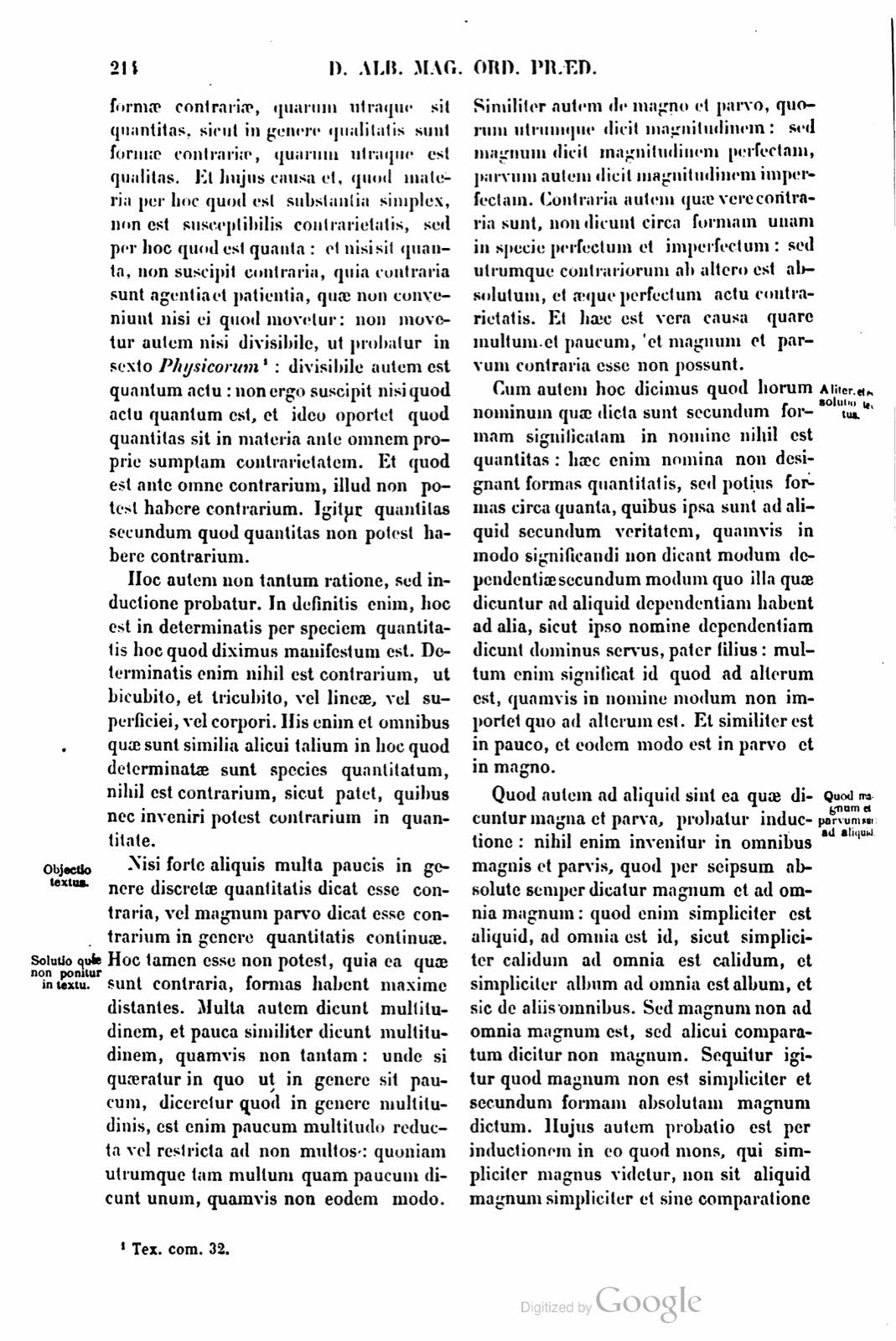
formæ contrariæ, quarum utraque sit quantitas, sicut in genere qualitatis sunt formæ contrariæ, quarum utraque est qualitas. Et hujus causa est, quod materia per hoc quod est substantia simplex, non est susceptibilis contrarietatis, sed per hoc quod est quanta: et nisi sit quanta, non suscipit contraria, quia contraria sunt agentia et patientia, quæ non conveniunt nisi ei quod movetur: non movetur autem nisi divisibile, ut probatur in sexto Physicorum 1: divisibile autem est quantum actu: non ergo suscipit nisi quod actu quantum est, et ideo oportet quod quantitas sit in materia ante omnem proprie sumptam contrarietatem. Et quod est ante omne contrarium, illud non potest habere contrarium. Igitur quantitas secundum quod quantitas non potest habere contrarium.
Hoc autem non tantum ratione, sed inductione probatur. In definitis enim, hoc est in determinatis per speciem quantitatis hoc quod diximus manifestum est. Determinatis enim nihil est contrarium, ut bicubito, et tricubito, vel lineæ, vel superficiei, vel corpori. His enim et omnibus quæ sunt similia alicui talium in hoc quod determinatæ sunt species quantitatum, nihil est contrarium, sicut patet, quibus nec inveniri potest contrarium in quantitate.
Nisi forte aliquis multa paucis in genere discretæ quantitatis dicat esse contraria, vel magnum parvo dicat esse contrarium in genere quantitatis continuæ. Hoc tamen esse non potest, quia ea quæ sunt contraria, formas habent maxime distantes. Multa autem dicunt multitudinem, et pauca similiter dicunt multitudinem, quamvis non tantam: unde si quæratur in quo ut in genere sit paucum, diceretur quod in genere multitudinis, est enim paucum multitudo reducta vel restricta ad non multos: quoniam utrumque tam multum quam paucum dicunt unum, quamvis non eodem modo.
Similiter autem de magno et parvo, quorum utrumque dicit magnitudinem: sed magnum dicit magnitudinem perfectam, parvum autem dicit magnitudinem imperfectam. Contraria autem quæ vere contrariæ sunt, non dicunt circa formam unam in specie perfectum et imperfectum: sed utrumque contrariorum ab altero est absolutum, et æque perfectum actu contrarietatis. Et hæc est vera causa quare multum et paucum, et magnum et parvum contraria esse non possunt.
Cum autem hoc dicimus quod horum nominum quæ dicta sunt secundum formam significatam in nomine nihil est quantitas: hæc enim nomina non designant formas quantitatis, sed potius formas circa quanta, quibus ipsa sunt ad aliquid secundum veritatem, quamvis in modo significandi non dicant modum dependentiæ secundum modum quo illa quæ dicuntur ad aliquid dependentiam habent ad alia, sicut ipso nomine dependentiam dicunt dominus servus, pater filius: multum enim significat id quod ad alterum est, quamvis in nomine modum non importet quo ad alterum est. Et similiter est in pauco, et eodem modo est in parvo et in magno.
Quod autem ad aliquid sint ea quæ dicuntur magna et parva, probatur inductione: nihil enim invenitur in omnibus magnis et parvis, quod per seipsum absolute semper dicatur magnum et ad omnia magnum: quod enim simpliciter est aliquid, ad omnia est id, sicut simpliciter calidum ad omnia est calidum, et simpliciter album ad omnia est album, et sic de aliis omnibus. Sed magnum non ad omnia magnum est, sed alicui comparatum dicitur non magnum. Sequitur igitur quod magnum non est simpliciter et secundum formam absolutam magnum dictum. Hujus autem probatio est per inductionem in eo quod mons, qui simpliciter magnus videtur, non sit aliquid magnum simpliciter et sine comparatione
contrary forms, each of which would be quantity, just as in the genus of quality there are contrary forms, each of which is quality. And the cause of this is that matter, through this that it is simple substance, is not susceptible of contrariety, but through this that it is quantified; and unless it is quantified, it does not receive contraries, because contraries are active and passive things, which do not belong except to that which is moved; but nothing is moved except what is divisible, as is proved in the sixth book of the Physics 1; but the divisible is quantified in act; therefore it receives nothing except what is quantified in act, and therefore it is necessary that quantity be in matter before every properly taken contrariety. And what is before every contrary cannot have a contrary. Therefore quantity according as it is quantity cannot have a contrary.
But this is proved not only by reason, but by induction. For in definite things, that is, in things determined by a species of quantity, this which we have said is manifest. For nothing is contrary to determined things, as to the two-cubit, and to the three-cubit, or to line, or to surface, or to body. For to these and to all things which are similar to any of such things in this, that they are determined species of quantities, nothing is contrary, as is clear, since for them a contrary cannot be found in quantity.
Unless perhaps someone should say that many things are contrary to few things in the genus of discrete quantity, or should say that great is contrary to small in the genus of continuous quantity. Yet this cannot be, because those things which are contrary have forms maximally distant. But many things say multitude, and few things similarly say multitude, although not so great a multitude; whence if it is asked in what, as in a genus, the few is, it would be said that it is in the genus of multitude. For few is a multitude reduced or restricted to not-many, since both much and few say one thing, although not in the same mode.
Similarly also concerning great and small, each of which says magnitude: but great says perfect magnitude, whereas small says imperfect magnitude. But contraries which are truly contraries do not say perfect and imperfect concerning one form in species; rather, each of the contraries is detached from the other, and equally perfect in the act of contrariety. And this is the true cause why much and few, and great and small, cannot be contraries.
But when we say this, that according to the form signified in the name none of the names that have been said is quantity: for these names do not designate forms of quantity, but rather forms around quantified things, by which they are relative according to truth, although in the mode of signifying they do not state a mode of dependence according to the mode by which those things that are said relatively have dependence on others, just as by the name itself lord and servant, father and son, state dependence. For much signifies that which is toward another, although in the name it does not import the mode by which it is toward another. And it is similar in few, and in the same mode in small and in great.
But that those things which are called great and small are relative is proved by induction: for nothing is found among all great and small things which by itself absolutely is always called great and great toward all things. For what is something simply, is that toward all things, just as the simply hot is hot toward all things, and the simply white is white toward all things, and so concerning all the others. But the great is not great toward all things, but compared to something it is called not great. Therefore it follows that great is not said to be great simply and according to an absolute form. But the proof of this is by induction in this, that a mountain, which seems great simply, is not something great simply and without comparison
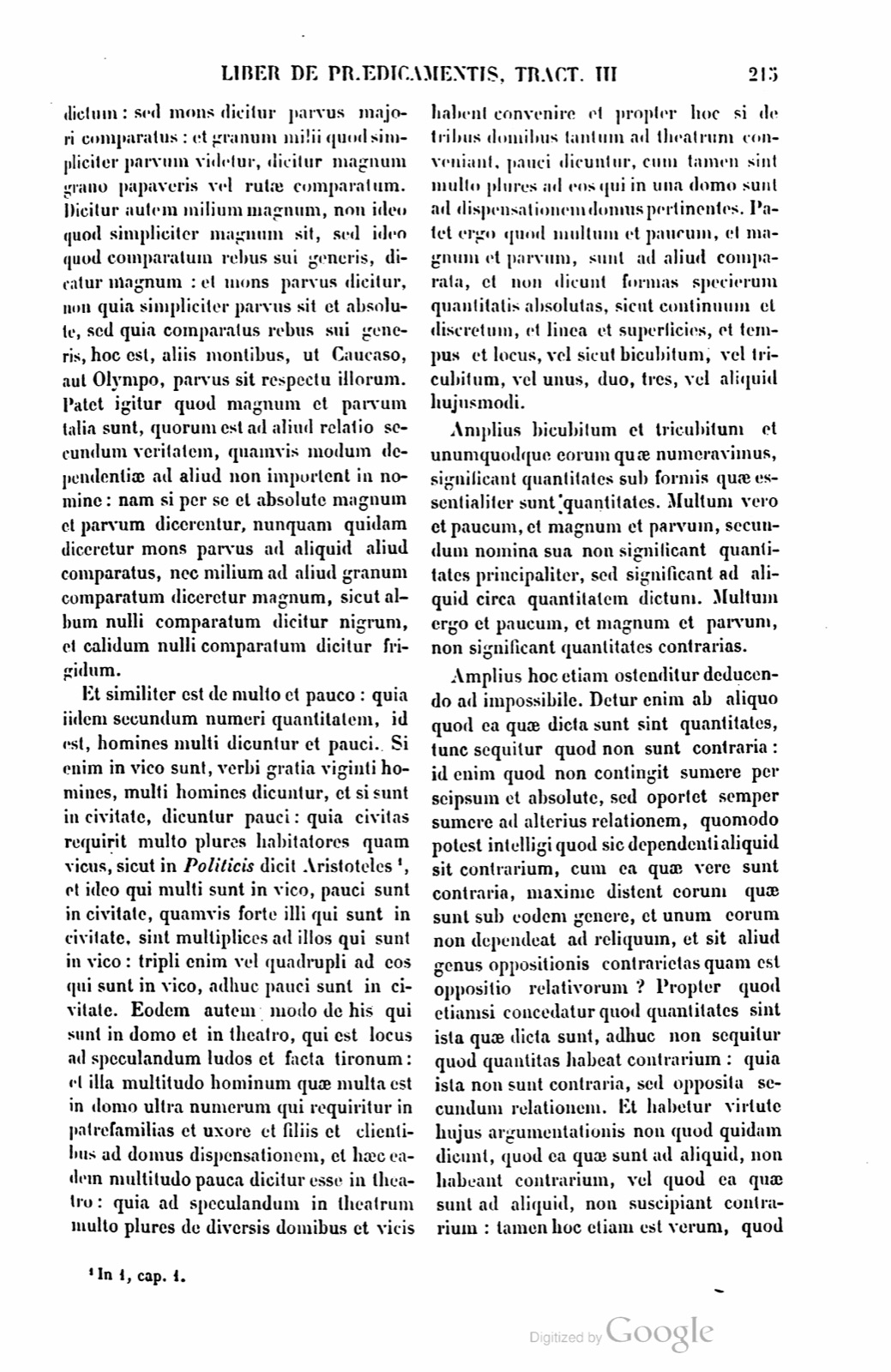
dictum: sed mons dicitur parvus majori comparatus: et granum milii quod simpliciter parvum videtur, dicitur magnum grano papaveris vel rutæ comparatum. Dicitur autem milium magnum, non ideo quod simpliciter magnum sit, sed ideo quod comparatum rebus sui generis, dicatur magnum: et mons parvus dicitur, non quia simpliciter parvus sit et absolute, sed quia comparatus rebus sui generis, hoc est, aliis montibus, ut Caucaso, aut Olympo, parvus sit respectu illorum. Patet igitur quod magnum et parvum talia sunt, quorum est ad aliud relatio secundum veritatem, quamvis modum dependentiæ ad aliud non importent in nomine: nam si per se et absolute magnum et parvum dicerentur, nunquam quidam diceretur mons parvus ad aliquid aliud comparatus, nec milium ad aliud granum comparatum diceretur magnum, sicut album nulli comparatum dicitur nigrum, et calidum nulli comparatum dicitur frigidum.
Et similiter est de multo et pauco: quia iidem secundum numeri quantitatem, id est, homines multi dicuntur et pauci. Si enim in vico sunt, verbi gratia viginti homines, multi homines dicuntur, et si sunt in civitate, dicuntur pauci: quia civitas requirit multo plures habitatores quam vicus, sicut in Politicis dicit Aristoteles 2, et ideo qui multi sunt in vico, pauci sunt in civitate, quamvis forte illi qui sunt in civitate, sint multiplices ad illos qui sunt in vico: tripli enim vel quadrupli ad eos qui sunt in vico, adhuc pauci sunt in civitate. Eodem autem modo de his qui sunt in domo et in theatro, qui est locus ad speculandum ludos et facta tironum: et illa multitudo hominum quæ multa est in domo ultra numerum qui requiritur in patrefamilias et uxore et filiis et clientibus ad domus dispensationem, et hæc eadem multitudo pauca dicitur esse in theatro: quia ad speculandum in theatrum multo plures de diversis domibus et vicis habent convenire et propter hoc si de tribus domibus tantum ad theatrum conveniant, pauci dicuntur, cum tamen sint multo plures ad eos qui in una domo sunt ad dispensationem domus pertinentes. Patet ergo quod multum et paucum, et magnum et parvum, sunt ad aliud comparata, et non dicunt formas specierum quantitatis absolutas, sicut continuum et discretum, et linea et superficies, et tempus et locus, vel sicut bicubitum, vel tricubitum, vel unus, duo, tres, vel aliquid hujusmodi.
Amplius bicubitum et tricubitum et unumquodque eorum quæ numeravimus, significant quantitates sub formis quæ essentialiter sunt quantitates. Multum vero et paucum, et magnum et parvum, secundum nomina sua non significant quantitates principaliter, sed significant ad aliquid circa quantitatem dictum. Multum ergo et paucum, et magnum et parvum, non significant quantitates contrarias.
Amplius hoc etiam ostenditur deducendo ad impossibile. Detur enim ab aliquo quod ea quæ dicta sunt sint quantitates, tunc sequitur quod non sunt contraria: id enim quod non contingit sumere per seipsum et absolute, sed oportet semper sumere ad alterius relationem, quomodo potest intelligi quod sic dependentia aliquid sit contrarium, cum ea quæ vere sunt contraria, maxime distent eorum quæ sunt sub eodem genere, et unum eorum non dependeat ad reliquum, et sit aliud genus oppositionis contrarietas quam est oppositio relativorum? Propter quod etiamsi concedatur quod quantitates sint ista quæ dicta sunt, adhuc non sequitur quod quantitas habeat contrarium: quia ista non sunt contraria, sed opposita secundum relationem. Et habetur virtute hujus argumentationis non quod quidam dicunt, quod ea quæ sunt ad aliquid, non habeant contrarium, vel quod ea quæ sunt ad aliquid, non suscipiant contrarium: tamen hoc etiam est verum, quod
said; but a mountain is called small when compared to something greater, and a grain of millet, which seems simply small, is called great when compared to a grain of poppy or of rue. But millet is called great not for this reason, that it is simply great, but for this reason, that, compared to things of its own genus, it is called great; and a mountain is called small, not because it is simply and absolutely small, but because, compared to things of its own genus, that is, to other mountains, as to Caucasus or Olympus, it is small with respect to them. Therefore it is clear that great and small are such things, to which there belongs a relation to another according to truth, although they do not import the mode of dependence on another in the name. For if great and small were said through themselves and absolutely, a certain mountain compared to some other thing would never be called small, nor would millet compared to another grain be called great, just as white compared to nothing is called black, and hot compared to nothing is called cold.
And it is similar concerning much and little, because the same things according to the quantity of number, that is, human beings, are called many and few. For if, for example, twenty human beings are in a village, they are called many human beings; and if they are in a city, they are called few, because a city requires many more inhabitants than a village, as Aristotle says in the Politics 2. And therefore those who are many in a village are few in a city, although perhaps those who are in the city are many times over in relation to those who are in the village; for those who are triple or quadruple in relation to those who are in the village are still few in a city. In the same mode concerning those who are in a house and in a theater, which is a place for watching games and the deeds of recruits: that multitude of human beings which is many in a house beyond the number which is required in a master of a household and wife and children and clients for the management of a house, this same multitude is said to be few in a theater, because for watching in a theater many more from diverse houses and villages have to come together, and on account of this, if they come together to the theater from only three houses, they are called few, although nevertheless they are many more in relation to those who are in one house and belong to the management of a house. Therefore it is clear that much and few, and great and small, are compared to another, and do not say absolute forms of the species of quantity, as continuous and discrete do, and line and surface, and time and place, or as two-cubit, or three-cubit, or one, two, three, or something of this sort.
Further, the two-cubit and the three-cubit and each of those things which we have numbered signify quantities under forms which are essentially quantities. But much and few, and great and small, according to their names do not principally signify quantities, but signify something relative said around quantity. Therefore much and few, and great and small, do not signify contrary quantities.
Further, this is also shown by leading to the impossible. For let it be granted by someone that those things which have been said are quantities; then it follows that they are not contraries. For that which does not happen to be taken through itself and absolutely, but which must always be taken in relation to another, how can it be understood that something thus by dependence is a contrary, since those things which are truly contraries are maximally distant among those things which are under the same genus, and one of them does not depend on the remaining one, and contrariety is another genus of opposition than the opposition of relatives? On account of this, even if it is granted that those things which have been said are quantities, still it does not follow that quantity has a contrary, because those things are not contraries but opposites according to relation. And by virtue of this argumentation there is not held what certain people say, that those things which are relative do not have a contrary, or that those things which are relative do not receive a contrary; nevertheless this also is true, that
If a page does not appear, its photograph has not been uploaded yet.