Volume 1 · pp. 211–212
Chapter X. On doubts concerning those things which have been said about place, and concerning those things which have position in parts, and those which do not
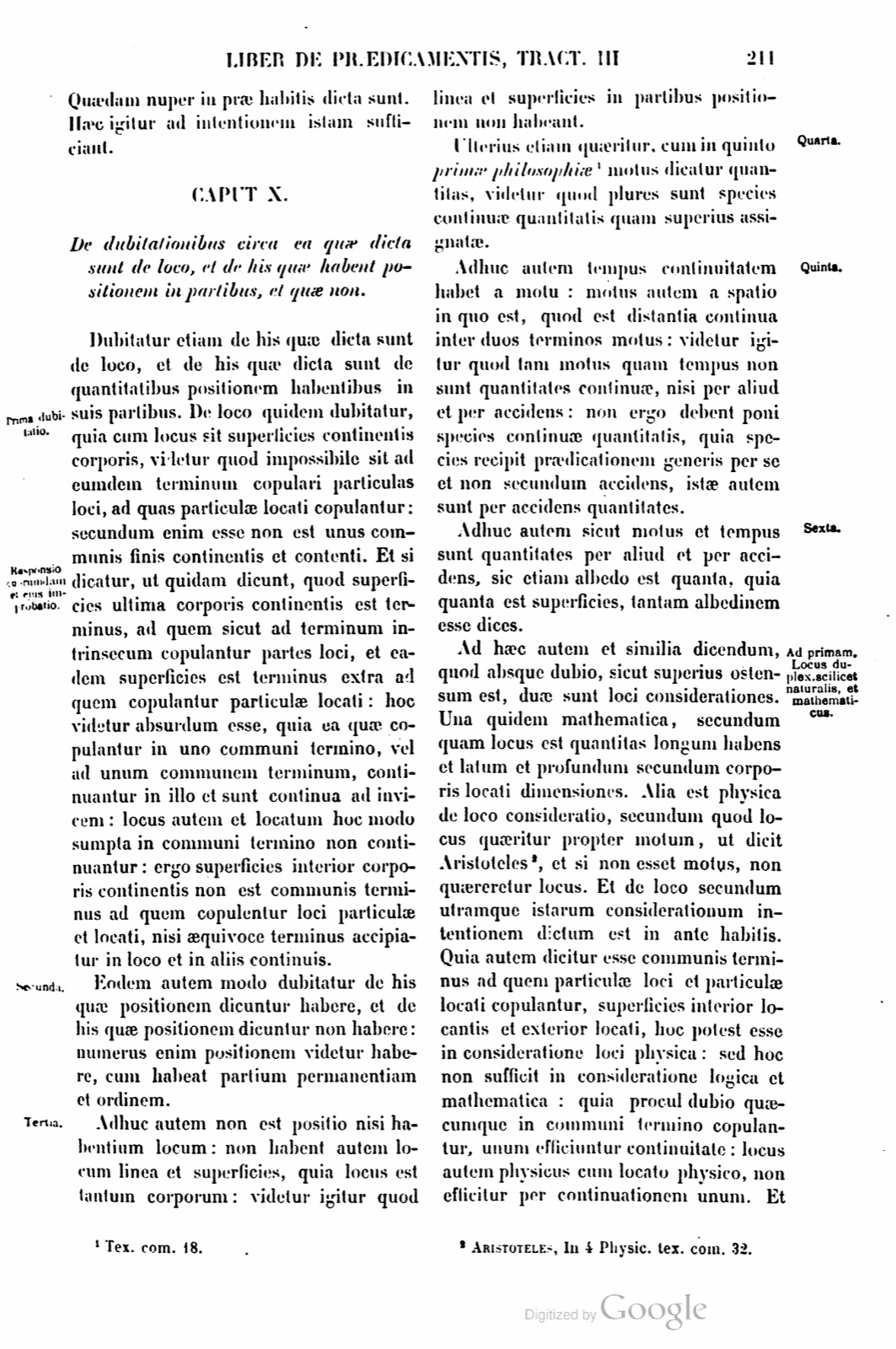
Quædam nuper in præ habitis dicta sunt. Hæc igitur ad intentionem istam sufficiant.
CAPUT X.
De dubitationibus circa ea quæ dicta sunt de loco, et de his quæ habent positionem in partibus, et quæ non.
Dubitatur etiam de his quæ dicta sunt de loco, et de his quæ dicta sunt de quantitatibus positionem habentibus in suis partibus. De loco quidem dubitatur, quia cum locus sit superficies continentis corporis, videtur quod impossibile sit ad eumdem terminum copulari particulas loci, ad quas particulæ locati copulantur: secundum enim esse non est unus communis finis continentis et contenti. Et si dicatur, ut quidam dicunt, quod superficies ultima corporis continentis est terminus, ad quem sicut ad terminum intrinsecum copulantur partes loci, et eadem superficies est terminus extra ad quem copulantur particulæ locati: hoc videtur absurdum esse, quia ea quæ copulantur in uno communi termino, vel ad unum communem terminum, continuantur in illo et sunt continua ad invicem: locus autem et locatum hoc modo sumpta in communi termino non continuantur: ergo superficies interior corporis continentis non est communis terminus ad quem copulentur loci particulæ et locati, nisi æquivoce terminus accipiatur in loco et in aliis continuis.
Eodem autem modo dubitatur de his quæ positionem dicuntur habere, et de his quæ positionem dicuntur non habere: numerus enim positionem videtur habere, cum habeat partium permanentiam et ordinem.
Adhuc autem non est positio nisi habentium locum: non habent autem locum linea et superficies, quia locus est tantum corporum: videtur igitur quod linea et superficies in partibus positionem non habeant.
Ulterius etiam quæritur, cum in quinto primæ philosophiæ 1 motus dicatur quantitas, videtur quod plures sunt species continuæ quantitatis quam superius assignatæ.
Adhuc autem tempus continuitatem habet a motu: motus autem a spatio in quo est, quod est distantia continua inter duos terminos motus: videtur igitur quod tam motus quam tempus non sunt quantitates continuæ, nisi per aliud et per accidens: non ergo debent poni species continuæ quantitatis, quia species recipit prædicationem generis per se et non secundum accidens, istæ autem sunt per accidens quantitates.
Adhuc autem sicut motus et tempus sunt quantitates per aliud et per accidens, sic etiam albedo est quanta, quia quanta est superficies, tantam albedinem esse dices.
Ad hæc autem et similia dicendum, quod absque dubio, sicut superius ostensum est, duæ sunt loci considerationes. Una quidem mathematica, secundum quam locus est quantitas longum habens et latum et profundum secundum corporis locati dimensiones. Alia est physica de loco consideratio, secundum quod locus quæritur propter motum, ut dicit Aristoteles 2, et si non esset motus, non quæreretur locus. Et de loco secundum utramque istarum considerationum intentionem dictum est in ante habitis. Quia autem dicitur esse communis terminus ad quem particulæ loci et particulæ locati copulantur, superficies interior locantis et exterior locati, hoc potest esse in consideratione loci physica: sed hoc non sufficit in consideratione logica et mathematica: quia procul dubio quæcumque in communi termino copulantur, unum efficiuntur continuitate: locus autem physicus cum locato physico, non efficitur per continuationem unum. Et
Certain things have lately been said in the things held before. Therefore let these things suffice for that intention.
CHAPTER X.
On doubts concerning those things which have been said about place, and concerning those things which have position in parts, and those which do not.
There is also doubt about those things which have been said about place, and about those things which have been said about quantities having position in their parts. Concerning place indeed there is doubt, because since place is the surface of a containing body, it seems impossible that the particles of place should be joined to the same term to which the particles of the located thing are joined; for according to being there is not one common end of containing thing and contained thing. And if it is said, as certain people say, that the outermost surface of the containing body is the term to which the parts of place are joined as to an intrinsic term, and the same surface is the external term to which the particles of the located thing are joined, this seems to be absurd, because those things which are joined in one common term, or to one common term, are continued in it and are continuous with one another. But place and the located thing, taken in this mode in a common term, are not continued; therefore the inner surface of the containing body is not the common term to which the particles of place and of the located thing are joined, unless term is taken equivocally in place and in other continuous things.
In the same mode there is doubt about those things which are said to have position, and about those things which are said not to have position; for number seems to have position, since it has permanence and order of parts.
Further, there is no position except of things having place; but line and surface do not have place, because place belongs only to bodies. Therefore it seems that line and surface do not have position in their parts.
Further also it is asked, since in the fifth book of First Philosophy 1 motion is called quantity, it seems that there are more species of continuous quantity than those assigned above.
Further, time has continuity from motion, but motion from the space in which it is, which is the continuous distance between two terms of motion; therefore it seems that both motion and time are not continuous quantities except through another and by accident. Therefore they ought not be posited as species of continuous quantity, because a species receives the predication of the genus through itself and not according to accident, but these are quantities by accident.
Further, just as motion and time are quantities through another and by accident, so also whiteness is quantified, because as great as the surface is, you will say the whiteness to be so great.
But to these things and similar things one must say that, without doubt, as was shown above, there are two considerations of place. One indeed is mathematical, according to which place is a quantity having length and breadth and depth according to the dimensions of the located body. The other is the physical consideration about place, according as place is sought on account of motion, as Aristotle says 2, and if there were no motion, place would not be sought. And concerning place, according to the intention of each of these considerations, it has been spoken in the things held before. But because it is said to be a common term to which the particles of place and the particles of the located thing are joined, the inner surface of the locating thing and the outer surface of the located thing: this can be in the physical consideration of place. But this does not suffice in the logical and mathematical consideration, because without doubt whatever things are joined in a common term are made one by continuity. But physical place with a physical located thing is not made one through continuation. And
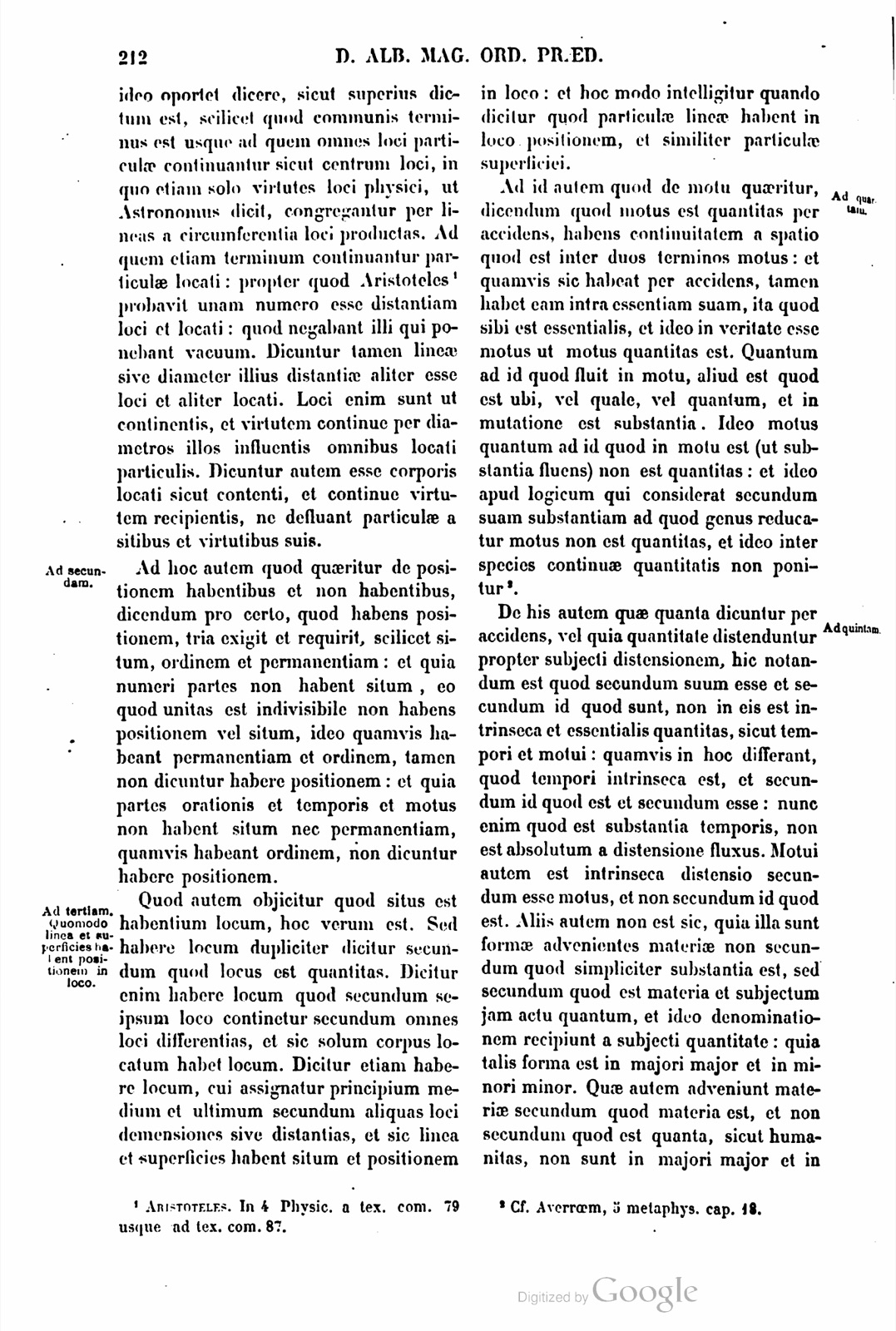
ideo oportet dicere, sicut superius dictum est, scilicet quod communis terminus est usque ad quem omnes loci particulæ continuantur sicut centrum loci, in quo etiam solo virtutes loci physici, ut Astronomus dicit, congregantur per lineas a circumferentia loci productas. Ad quem etiam terminum continuantur particulæ locati: propter quod Aristoteles 3 probavit unam numero esse distantiam loci et locati: quod negabant illi qui ponebant vacuum. Dicuntur tamen lineæ sive diameter illius distantiæ aliter esse loci et aliter locati. Loci enim sunt ut continentis, et virtutem continue per diametros illos influentis omnibus locati particulis. Dicuntur autem esse corporis locati sicut contenti, et continue virtutem recipientis, ne defluant particulæ a sitibus et virtutibus suis.
Ad hoc autem quod quæritur de positionem habentibus et non habentibus, dicendum pro certo, quod habens positionem, tria exigit et requirit, scilicet situm, ordinem et permanentiam: et quia numeri partes non habent situm, eo quod unitas est indivisibile non habens positionem vel situm, ideo quamvis habeant permanentiam et ordinem, tamen non dicuntur habere positionem: et quia partes orationis et temporis et motus non habent situm nec permanentiam, quamvis habeant ordinem, non dicuntur habere positionem.
Quod autem objicitur quod situs est habentium locum, hoc verum est. Sed habere locum dupliciter dicitur secundum quod locus est quantitas. Dicitur enim habere locum quod secundum seipsum loco continetur secundum omnes loci differentias, et sic solum corpus locatum habet locum. Dicitur etiam habere locum, cui assignatur principium medium et ultimum secundum aliquas loci dimensiones sive distantias, et sic linea et superficies habent situm et positionem in loco: et hoc modo intelligitur quando dicitur quod particulæ lineæ habent in loco positionem, et similiter particulæ superficiei.
Ad id autem quod de motu quæritur, dicendum quod motus est quantitas per accidens, habens continuitatem a spatio quod est inter duos terminos motus: et quamvis sic habeat per accidens, tamen habet eam intra essentiam suam, ita quod sibi est essentialis, et ideo in veritate esse motus ut motus quantitas est. Quantum ad id quod fluit in motu, aliud est quod est ubi, vel quale, vel quantum, et in mutatione est substantia. Ideo motus quantum ad id quod in motu est (ut substantia fluens) non est quantitas: et ideo apud logicum qui considerat secundum suam substantiam ad quod genus reducatur motus non est quantitas, et ideo inter species continuæ quantitatis non ponitur 4.
De his autem quæ quanta dicuntur per accidens, vel quia quantitate distenduntur propter subjecti distensionem, hic notandum est quod secundum suum esse et secundum id quod sunt, non in eis est intrinseca et essentialis quantitas, sicut tempori et motui: quamvis in hoc differant, quod tempori intrinseca est, et secundum id quod est et secundum esse: nunc enim quod est substantia temporis, non est absolutum a distensione fluxus. Motui autem est intrinseca distensio secundum esse motus, et non secundum id quod est. Aliis autem non est sic, quia illa sunt formæ advenientes materiæ non secundum quod simpliciter substantia est, sed secundum quod est materia et subjectum jam actu quantum, et ideo denominationem recipiunt a subjecti quantitate: quia talis forma est in majori major et in minori minor. Quæ autem adveniunt materiæ secundum quod materia est, et non secundum quod est quanta, sicut humanitas, non sunt in majori major et in
therefore it is necessary to say, as was said above, namely that there is a common term up to which all the particles of place are continued, as to the center of place, in which alone also the powers of physical place, as the Astronomer says, are gathered through lines drawn from the circumference of place. The particles of the located thing also are continued to that term; on account of this Aristotle 3 proved that the distance of place and of the located thing is one in number, which those who posited a void denied. Nevertheless the lines, or the diameter, of that distance are said to be of place in one way and of the located thing in another way. For they are of place as of the containing thing, and as of what continuously pours power through those diameters into all the particles of the located thing. But they are said to be of the located body as of the contained thing, and as of what continuously receives power, lest the particles flow down from their situations and powers.
But to this which is asked about things having and not having position, one must say as certain that what has position demands and requires three things, namely situation, order, and permanence; and because the parts of number do not have situation, since unity is an indivisible not having position or situation, therefore although they have permanence and order, nevertheless they are not said to have position. And because the parts of speech and time and motion do not have situation or permanence, although they have order, they are not said to have position.
But what is objected, that situation belongs to things having place, is true. But to have place is said in two ways according as place is quantity. For that is said to have place which according to itself is contained in place according to all the differences of place, and thus only the located body has place. That also is said to have place to which a beginning, middle, and end are assigned according to some dimensions or distances of place, and thus line and surface have situation and position in place; and in this mode it is understood when it is said that the particles of line have position in place, and similarly the particles of surface.
But to that which is asked about motion, one must say that motion is quantity by accident, having continuity from the space which is between two terms of motion; and although it has it in this way by accident, nevertheless it has it within its essence, so that it is essential to it, and therefore in truth the being of motion as motion is quantity. With regard to that which flows in motion, what is where, or a quality, or a quantity, is something other, and in change it is substance. Therefore motion, with regard to that which is in motion as flowing substance, is not quantity; and therefore for the logician who considers according to its substance to which genus motion is reduced, motion is not quantity, and therefore it is not placed among the species of continuous quantity 4.
But about those things which are said to be quantified by accident, or because they are stretched out by quantity on account of the stretching-out of the subject, here it must be noted that according to their being and according to that which they are, intrinsic and essential quantity is not in them, as it is in time and motion; although they differ in this, that for time it is intrinsic both according to that which it is and according to being. For the now, which is the substance of time, is not detached from the stretching-out of flux. But for motion stretching-out is intrinsic according to the being of motion, and not according to that which it is. But for the others it is not so, because those are forms coming to matter, not according as it is simply substance, but according as it is matter and a subject already quantified in act, and therefore they receive denomination from the quantity of the subject, because such a form is greater in a greater thing and lesser in a lesser thing. But things which come to matter according as it is matter, and not according as it is quantified, as humanity, are not greater in a greater thing and in
Notes
- Text, commentary 18. (Tex. com. 18.) ↩
- Aristotle, in book 4 of the Physics, text, commentary 32. (Aristoteles, In 4 Physic. tex. com. 32.) ↩
- Aristotle, in book 4 of the Physics, from text, commentary 79 up to text, commentary 87. (Aristoteles. In 4 Physic. a tex. com. 79 usque ad tex. com. 87.) ↩
- Compare Averroes, book 5 of the Metaphysics, chapter 18. (Cf. Averroem, 5 metaphys. cap. 18.) ↩
If a page does not appear, its photograph has not been uploaded yet.