Volume 1 · p. 194
Treatise III. On Quantity. Chapter I. On the division of quantity
TRACTATUS III. DE QUANTITATE.
CAPUT I.
De divisione quantitatis.
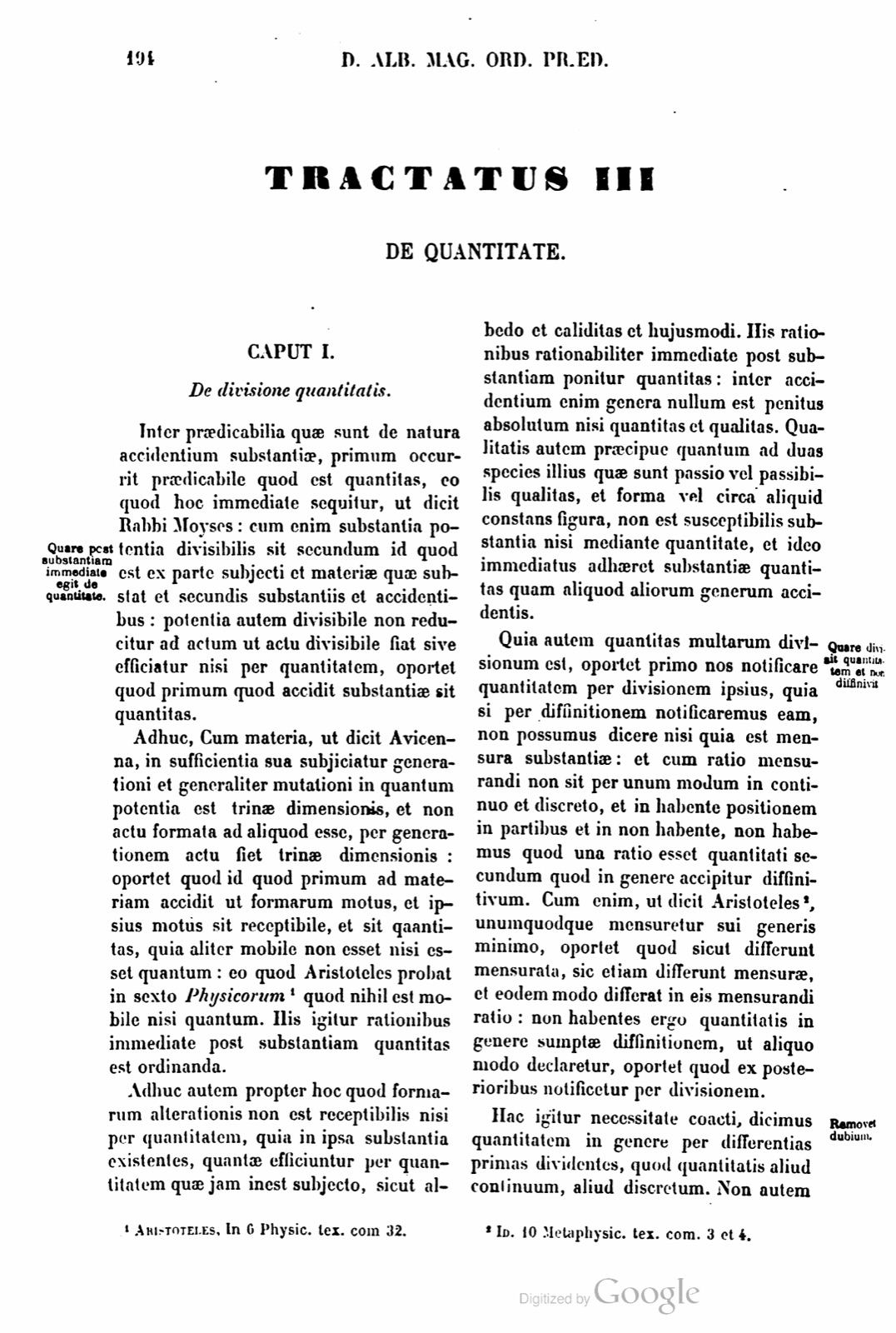
Inter prædicabilia quæ sunt de natura accidentium substantiæ, primum occurrit prædicabile quod est quantitas, eo quod hoc immediate sequitur, ut dicit Rabbi Moyses: cum enim substantia potentia divisibilis sit secundum id quod est ex parte subjecti et materiæ quæ substat et secundis substantiis et accidentibus: potentia autem divisibile non reducitur ad actum ut actu divisibile fiat sive efficiatur nisi per quantitatem, oportet quod primum quod accidit substantiæ sit quantitas.
Adhuc, Cum materia, ut dicit Avicenna, in sufficientia sua subjiciatur generationi et generaliter mutationi in quantum potentia est trinæ dimensionis, et non actu formata ad aliquod esse, per generationem actu fiet trinæ dimensionis: oportet quod id quod primum ad materiam accidit ut formarum motus, et ipsius motus sit receptibile, et sit quantitas, quia aliter mobile non esset nisi esset quantum: eo quod Aristoteles probat in sexto Physicorum 1 quod nihil est mobile nisi quantum. His igitur rationibus immediate post substantiam quantitas est ordinanda.
Adhuc autem propter hoc quod formarum alterationis non est receptibilis nisi per quantitatem, quia in ipsa substantia existentes, quantæ efficiuntur per quantitatem quæ jam inest subjecto, sicut albedo et caliditas et hujusmodi. His rationibus rationabiliter immediate post substantiam ponitur quantitas: inter accidentium enim genera nullum est penitus absolutum nisi quantitas et qualitas. Qualitatis autem præcipue quantum ad duas species illius quæ sunt passio vel passibilis qualitas, et forma vel circa aliquid constans figura, non est susceptibilis substantia nisi mediante quantitate, et ideo immediatius adhæret substantiæ quantitas quam aliquod aliorum generum accidentis.
Quia autem quantitas multarum divisionum est, oportet primo nos notificare quantitatem per divisionem ipsius, quia si per diffinitionem notificaremus eam, non possumus dicere nisi quia est mensura substantiæ: et cum ratio mensurandi non sit per unum modum in continuo et discreto, et in habente positionem in partibus et in non habente, non habemus quod una ratio esset quantitati secundum quod in genere accipitur diffinitivum. Cum enim, ut dicit Aristoteles 2, unumquodque mensuretur sui generis minimo, oportet quod sicut differunt mensurata, sic etiam differunt mensuræ, et eodem modo differat in eis mensurandi ratio: non habentes ergo quantitatis in genere sumptæ diffinitionem, ut aliquo modo declaretur, oportet quod ex posterioribus notificetur per divisionem.
Hac igitur necessitate coacti, dicimus quantitatem in genere per differentias primas dividentes, quod quantitatis aliud continuum, aliud discretum. Non autem
TREATISE III. ON QUANTITY.
CHAPTER I.
On the division of quantity.
Among the predicables which are of the nature of the accidents of substance, the first predicable that occurs is quantity, because this immediately follows it, as Rabbi Moses says: for since substance is divisible in potency according to that which is from the part of the subject and of the matter which underlies both second substances and accidents, but what is divisible in potency is not reduced to act so that it may become or be made divisible in act except through quantity, it is necessary that the first thing which accrues to substance should be quantity.
Moreover, since matter, as Avicenna says, in its sufficiency is subjected to generation and generally to change insofar as it is in potency to threefold dimension, and is not formed in act to some being, through generation it will become in act of threefold dimension. It is necessary that that which first accrues to matter, so that it may be receptive of the motion of forms and of its own motion, should be quantity, because otherwise the mobile would not exist unless it were quantified, since Aristotle proves in the sixth book of the Physics 1 that nothing is movable unless it is quantified. Therefore by these reasons quantity must be ordered immediately after substance.
Moreover, also on account of this, that it is not receptive of the alteration of forms except through quantity, because forms existing in substance itself are made quantified through the quantity which already inheres in the subject, such as whiteness and heat and things of this sort. By these reasons quantity is reasonably placed immediately after substance; for among the genera of accidents none is altogether absolute except quantity and quality. But substance is not susceptible of quality, especially with respect to two species of it, which are passion or passible quality, and form or figure consisting around something, except by means of quantity; and therefore quantity adheres more immediately to substance than anything of the other genera of accident.
But because quantity is of many divisions, first it is necessary for us to make quantity known through its division, because if we made it known through definition, we could say only that it is the measure of substance. And since the account of measuring is not in one mode in the continuous and the discrete, and in that which has position in its parts and in that which does not have it, we do not have one account which would be definitive for quantity according as it is taken in the genus. For since, as Aristotle says 2, each thing is measured by the minimum of its own genus, it is necessary that just as the measured things differ, so also the measures differ, and that in the same mode the account of measuring differs in them. Therefore, not having a definition of quantity taken in the genus, in order that it may be declared in some mode, it is necessary that it be made known from posterior things through division.
Therefore, compelled by this necessity, dividing quantity in general through the first differences, we say that of quantity one kind is continuous, another discrete. But not
If a page does not appear, its photograph has not been uploaded yet.