Volume 1 · pp. 195–196
End of Chapter I and Chapter II. How number and speech are discrete quantities
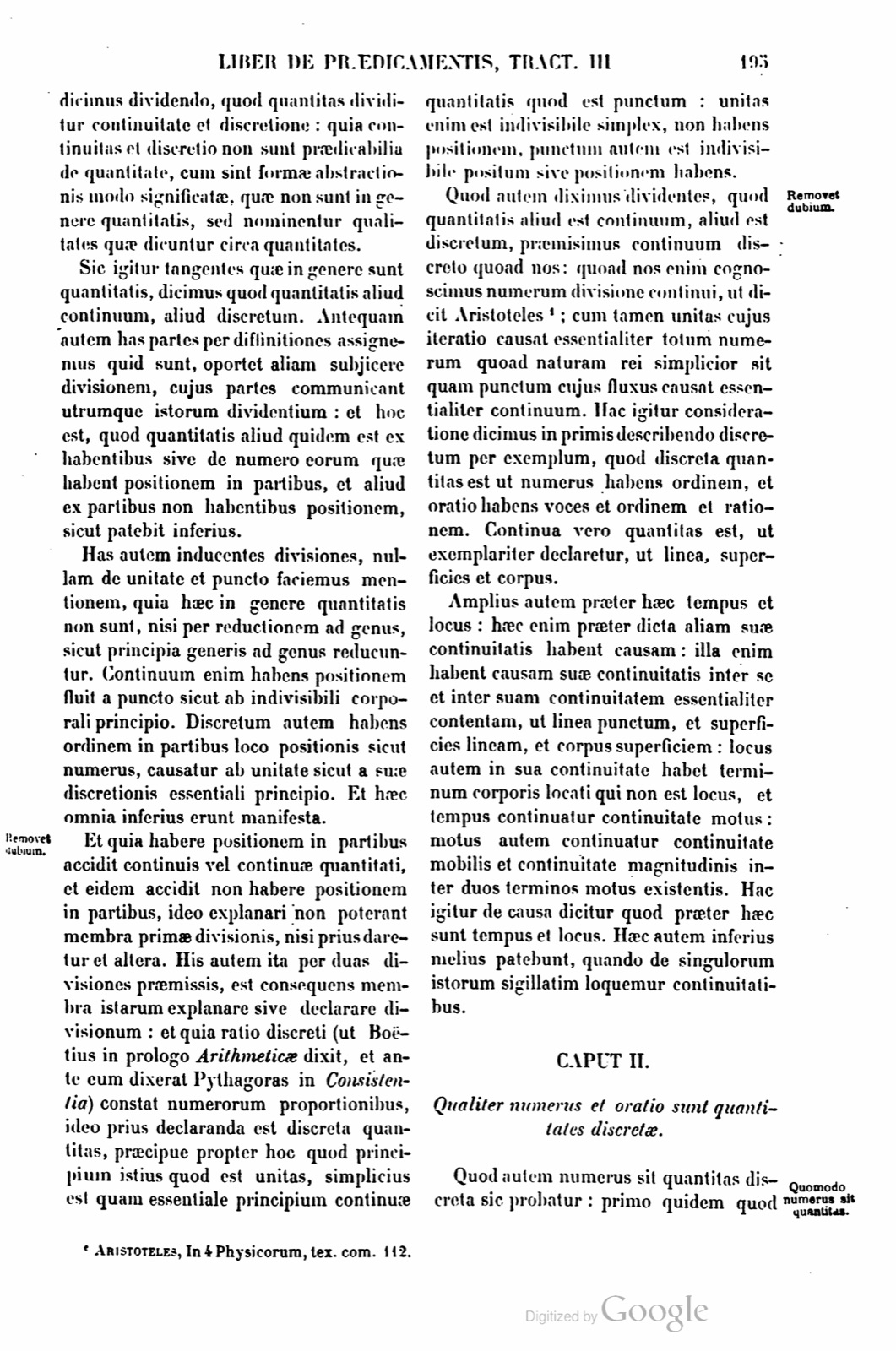
dicimus dividendo, quod quantitas dividitur continuitate et discretione: quia continuitas et discretio non sunt prædicabilia de quantitate, cum sint formæ abstractionis modo significatæ, quæ non sunt in genere quantitatis, sed nominentur qualitates quæ dicuntur circa quantitates.
Sic igitur tangentes quæ in genere sunt quantitatis, dicimus quod quantitatis aliud continuum, aliud discretum. Antequam autem has partes per diffinitiones assignemus quid sunt, oportet aliam subjicere divisionem, cujus partes communicant utrumque istorum dividentium: et hoc est, quod quantitatis aliud quidem est ex habentibus sive de numero eorum quæ habent positionem in partibus, et aliud ex partibus non habentibus positionem, sicut patebit inferius.
Has autem inducentes divisiones, nullam de unitate et puncto faciemus mentionem, quia hæc in genere quantitatis non sunt, nisi per reductionem ad genus, sicut principia generis ad genus reducuntur. Continuum enim habens positionem fluit a puncto sicut ab indivisibili corporali principio. Discretum autem habens ordinem in partibus loco positionis sicut numerus, causatur ab unitate sicut a suæ discretionis essentiali principio. Et hæc omnia inferius erunt manifesta.
Et quia habere positionem in partibus accidit continuis vel continuæ quantitati, et eidem accidit non habere positionem in partibus, ideo explanari non poterant membra primæ divisionis, nisi prius daretur et altera. His autem ita per duas divisiones præmissis, est consequens membra istarum explanare sive declarare divisionum: et quia ratio discreti (ut Boëtius in prologo Arithmeticæ dixit, et ante eum dixerat Pythagoras in Consistentia) constat numerorum proportionibus, ideo prius declaranda est discreta quantitas, præcipue propter hoc quod principium istius quod est unitas, simplicius est quam essentiale principium continuæ quantitatis quod est punctum: unitas enim est indivisibile simplex, non habens positionem, punctum autem est indivisibile positum sive positionem habens.
Quod autem diximus dividentes, quod quantitatis aliud est continuum, aliud est discretum, præmisimus continuum discreto quoad nos: quoad nos enim cognoscimus numerum divisione continui, ut dicit Aristoteles 1; cum tamen unitas cujus iteratio causat essentialiter totum numerum quoad naturam rei simplicior sit quam punctum cujus fluxus causat essentialiter continuum. Hac igitur consideratione dicimus in primis describendo discretum per exemplum, quod discreta quantitas est ut numerus habens ordinem, et oratio habens voces et ordinem et rationem. Continua vero quantitas est, ut exemplariter declaretur, ut linea, superficies et corpus.
Amplius autem præter hæc tempus et locus: hæc enim præter dicta aliam suæ continuitatis habent causam: illa enim habent causam suæ continuitatis inter se et inter suam continuitatem essentialiter contentam, ut linea punctum, et superficies lineam, et corpus superficiem: locus autem in sua continuitate habet terminum corporis locati qui non est locus, et tempus continuatur continuitate motus: motus autem continuatur continuitate mobilis et continuitate magnitudinis inter duos terminos motus existentis. Hac igitur de causa dicitur quod præter hæc sunt tempus et locus. Hæc autem inferius melius patebunt, quando de singulorum istorum sigillatim loquemur continuitatibus.
CAPUT II.
Qualiter numerus et oratio sunt quantitates discretæ.
Quod autem numerus sit quantitas discreta sic probatur: primo quidem quod
we say in dividing that quantity is divided by continuity and discreteness, because continuity and discreteness are not predicables of quantity, since they are forms signified in the mode of abstraction, which are not in the genus of quantity, but are named qualities which are said to be about quantities.
Thus therefore, touching upon the things which are in the genus of quantity, we say that of quantity one kind is continuous, another discrete. But before we assign what these parts are through definitions, it is necessary to set down another division, whose parts communicate with both of those things dividing; and this is that of quantity one kind is from things having, or from the number of those things which have, position in their parts, and another kind is from parts not having position, as will be clear below.
But in bringing in these divisions, we will make no mention of unity and point, because these are not in the genus of quantity except by reduction to the genus, as the principles of a genus are reduced to the genus. For the continuous having position flows from a point as from an indivisible bodily principle. But the discrete having order in its parts in place of position, as number does, is caused by unity as by the essential principle of its discreteness. And all these things will be manifest below.
And because to have position in parts belongs to continuous things or to continuous quantity, and not to have position in parts belongs to the same thing, therefore the members of the first division could not be explained unless the other division also were first given. But with these two divisions thus set down beforehand, it follows to explain or declare the members of these divisions; and because the account of the discrete, as Boethius said in the prologue of Arithmetic, and before him Pythagoras had said in Consistentia, consists in the proportions of numbers, therefore discrete quantity must be declared first, especially on account of this, that the principle of that, which is unity, is simpler than the essential principle of continuous quantity, which is point. For unity is an indivisible simple thing, not having position; but a point is an indivisible thing placed, or having position.
But what we said in dividing, that of quantity one kind is continuous and another is discrete, we set the continuous before the discrete as regards us: for as regards us we know number by division of the continuous, as Aristotle says 1, although nevertheless unity, whose repetition essentially causes the whole number as regards the nature of the thing, is simpler than point, whose flowing essentially causes the continuous. Therefore by this consideration we say first, in describing the discrete by example, that discrete quantity is as number having order, and speech having utterances and order and account. But continuous quantity is, so that it may be declared by example, as line, surface, and body.
But besides these there are further time and place; for these besides the things said have another cause of their continuity. For those things have the cause of their continuity among themselves and among their own continuity essentially contained, as line has point, and surface line, and body surface; but place in its own continuity has the boundary of the located body, which is not place, and time is continued by the continuity of motion; but motion is continued by the continuity of the movable thing and by the continuity of magnitude between two termini of the existing motion. Therefore for this cause it is said that besides these there are time and place. But these things will be clearer below, when we speak separately about the continuities of each of those things.
CHAPTER II.
How number and speech are discrete quantities.
But that number is discrete quantity is proved thus: first indeed because
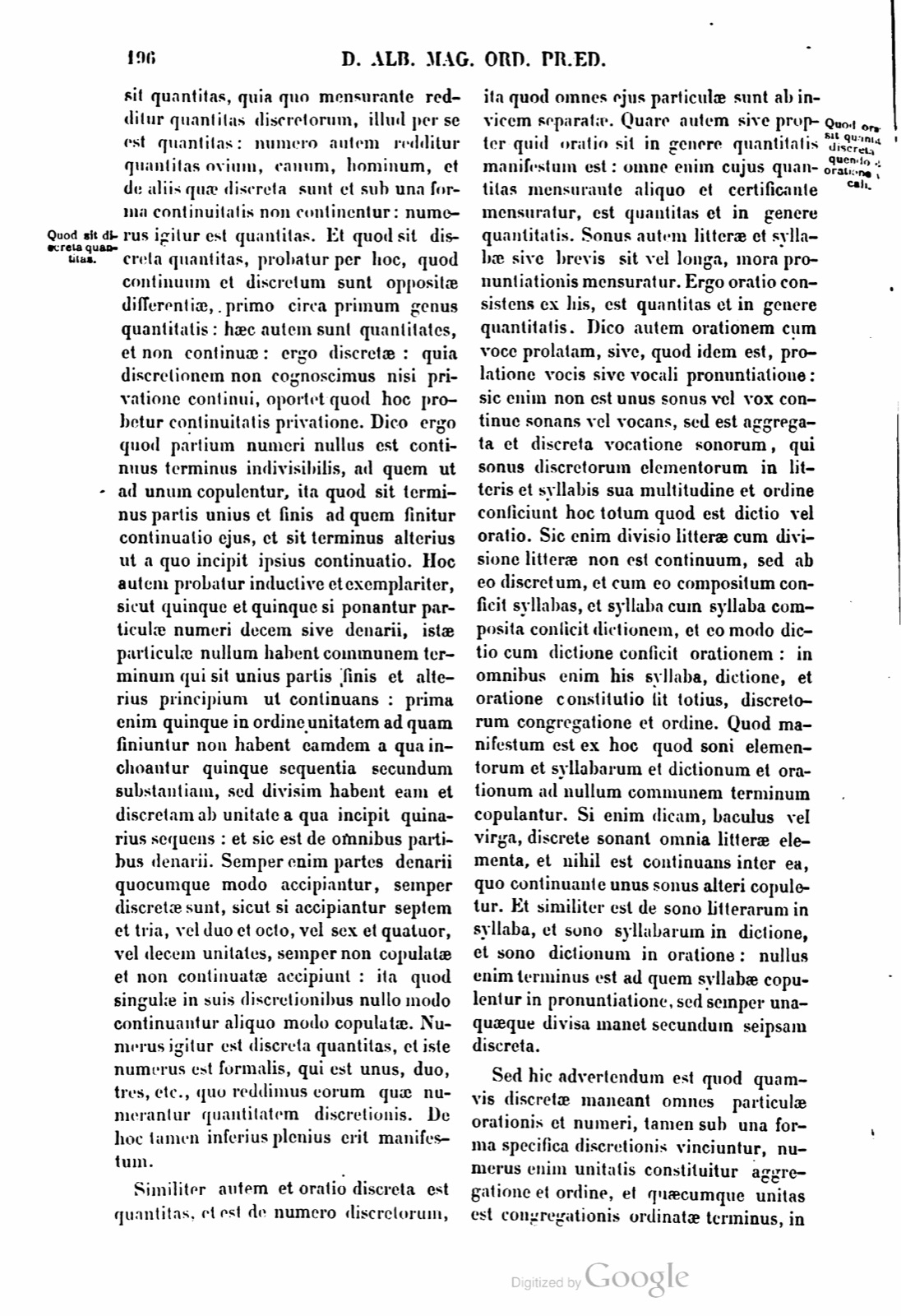
sit quantitas, quia quo mensurante redditur quantitas discretorum, illud per se est quantitas: numero autem redditur quantitas ovium, canum, hominum, et de aliis quæ discreta sunt et sub una forma continuitatis non continentur: numerus igitur est quantitas. Et quod sit discreta quantitas, probatur per hoc, quod continuum et discretum sunt oppositæ differentiæ, primo circa primum genus quantitatis: hæc autem sunt quantitates, et non continuæ: ergo discretæ: quia discretionem non cognoscimus nisi privatione continui, oportet quod hoc probetur continuitatis privatione. Dico ergo quod partium numeri nullus est continuus terminus indivisibilis, ad quem ut ad unum copulentur, ita quod sit terminus partis unius et finis ad quem finitur continuatio ejus, et sit terminus alterius ut a quo incipit ipsius continuatio. Hoc autem probatur inductive et exemplariter, sicut quinque et quinque si ponantur particulæ numeri decem sive denarii, istæ particulæ nullum habent communem terminum qui sit unius partis finis et alterius principium ut continuans: prima enim quinque in ordine unitatem ad quam finiuntur non habent eamdem a qua inchoantur quinque sequentia secundum substantiam, sed divisim habent eam et discretam ab unitate a qua incipit quinarius sequens: et sic est de omnibus partibus denarii. Semper enim partes denarii quocumque modo accipiantur, semper discretæ sunt, sicut si accipiantur septem et tria, vel duo et octo, vel sex et quatuor, vel decem unitates, semper non copulatæ et non continuatæ accipiuntur: ita quod singulæ in suis discretionibus nullo modo continuantur aliquo modo copulatæ. Numerus igitur est discreta quantitas, et iste numerus est formalis, qui est unus, duo, tres, etc., quo reddimus eorum quæ numerantur quantitatem discretionis. De hoc tamen inferius plenius erit manifestum.
Similiter autem et oratio discreta est quantitas, et est de numero discretorum, ita quod omnes ejus particulæ sunt ab invicem separatæ. Quare autem sive propter quid oratio sit in genere quantitatis manifestum est: omne enim cujus quantitas mensurante aliquo et certificante mensuratur, est quantitas et in genere quantitatis. Sonus autem litteræ et syllabæ sive brevis sit vel longa, mora pronuntiationis mensuratur. Ergo oratio consistens ex his, est quantitas et in genere quantitatis. Dico autem orationem cum voce prolatam, sive, quod idem est, prolatione vocis sive vocali pronuntiatione: sic enim non est unus sonus vel vox continue sonans vel vocans, sed est aggregata et discreta vocatione sonorum, qui soni discretorum elementorum in litteris et syllabis sua multitudine et ordine conficiunt hoc totum quod est dictio vel oratio. Sic enim divisio litteræ cum divisione litteræ non est continuum, sed ab eo discretum, et cum eo compositum conficit syllabas, et syllaba cum syllaba composita conficit dictionem, et eo modo dictio cum dictione conficit orationem: in omnibus enim his syllaba, dictione, et oratione constitutio fit totius, discretorum congregatione et ordine. Quod manifestum est ex hoc quod soni elementorum et syllabarum et dictionum et orationum ad nullum communem terminum copulantur. Si enim dicam, baculus vel virga, discrete sonant omnia litteræ elementa, et nihil est continuans inter ea, quo continuante unus sonus alteri copuletur. Et similiter est de sono litterarum in syllaba, et sono syllabarum in dictione, et sono dictionum in oratione: nullus enim terminus est ad quem syllabæ copulentur in pronuntiatione, sed semper unaquæque divisa manet secundum seipsam discreta.
Sed hic advertendum est quod quamvis discretæ maneant omnes particulæ orationis et numeri, tamen sub una forma specifica discretionis vinciuntur, numerus enim unitatis constituitur aggregatione et ordine, et quæcumque unitas est congregationis ordinatæ terminus, in
it is quantity, because that by which, as measuring, the quantity of discrete things is rendered, that is quantity through itself; but by number the quantity of sheep, dogs, men, and of other things which are discrete and are not contained under one form of continuity is rendered. Therefore number is quantity. And that it is discrete quantity is proved through this, that the continuous and the discrete are opposed differences, first concerning the first genus of quantity; but these are quantities, and not continuous; therefore they are discrete. Because we do not know discreteness except by privation of the continuous, it is necessary that this be proved by privation of continuity. Therefore I say that of the parts of number there is no continuous indivisible term to which they may be joined as to one, so that it is the term of one part and the end at which its continuation is ended, and is the term of another as that from which its continuation begins. But this is proved inductively and by example, as if five and five are posited as parts of the number ten or of the denary, those parts have no common term which is the end of one part and the principle of the other as continuing. For the first five in order do not have the same unity at which they are ended as that from which the following five are begun according to substance, but they have it dividedly and discrete from the unity from which the following quinary begins; and thus it is concerning all parts of the denary. For always the parts of the denary, in whatever mode they are taken, are always discrete, as if seven and three, or two and eight, or six and four, or ten unities are taken, they are always taken as not joined and not continued, so that the several parts in their discretions are in no way continued as joined in any way. Therefore number is discrete quantity, and this number is formal, which is one, two, three, etc., by which we render the quantity of discreteness of those things which are numbered. But concerning this it will be more fully manifest below.
Similarly also speech is discrete quantity, and is of the number of discrete things, so that all its parts are separated from one another. But why or on account of what speech is in the genus of quantity is manifest: for everything whose quantity is measured by something measuring and certifying it is quantity and is in the genus of quantity. But the sound of a letter and of a syllable, whether it is short or long, is measured by the delay of pronunciation. Therefore speech, consisting of these, is quantity and is in the genus of quantity. But I mean speech uttered with voice, or, what is the same, by prolation of voice or by vocal pronunciation; for thus it is not one sound or voice sounding or calling continuously, but it is aggregated and discrete by the vocalization of sounds, which sounds of discrete elements in letters and syllables, by their multitude and order, make up this whole which is diction or speech. For thus the division of a letter with the division of a letter is not continuous, but discrete from it, and composed with it makes syllables; and a syllable composed with a syllable makes a diction, and in that mode diction with diction makes speech. For in all these, syllable, diction, and speech, the constitution of the whole is made by the congregation and order of discrete things. This is manifest from this, that the sounds of elements and of syllables and of dictions and of speeches are joined to no common term. For if I say, baculus or virga, all the elements of the letter sound discretely, and there is nothing continuing between them, by whose continuing one sound is joined to another. And similarly it is concerning the sound of letters in a syllable, and the sound of syllables in a diction, and the sound of dictions in speech: for there is no term to which syllables are joined in pronunciation, but each one always remains divided according to itself, discrete.
But here it must be noticed that although all the parts of speech and of number remain discrete, nevertheless they are bound under one specific form of discreteness; for number of unity is constituted by aggregation and order, and whatever unity is the term of an ordered congregation, in
Notes
- Aristotle, in book 4 of the Physics, text, commentary 112. (Aristoteles, In 4 Physicorum, tex. com. 112.) ↩
If a page does not appear, its photograph has not been uploaded yet.