Volume 1 · pp. 188–190
Chapter XII. On doubts concerning the things that have been said, that substance receives contraries
A marker with ≈ is an approximate page boundary, placed by measure of the text; the page photographs remain the authority. In the paired views, clicking a page marker brings that page into view.
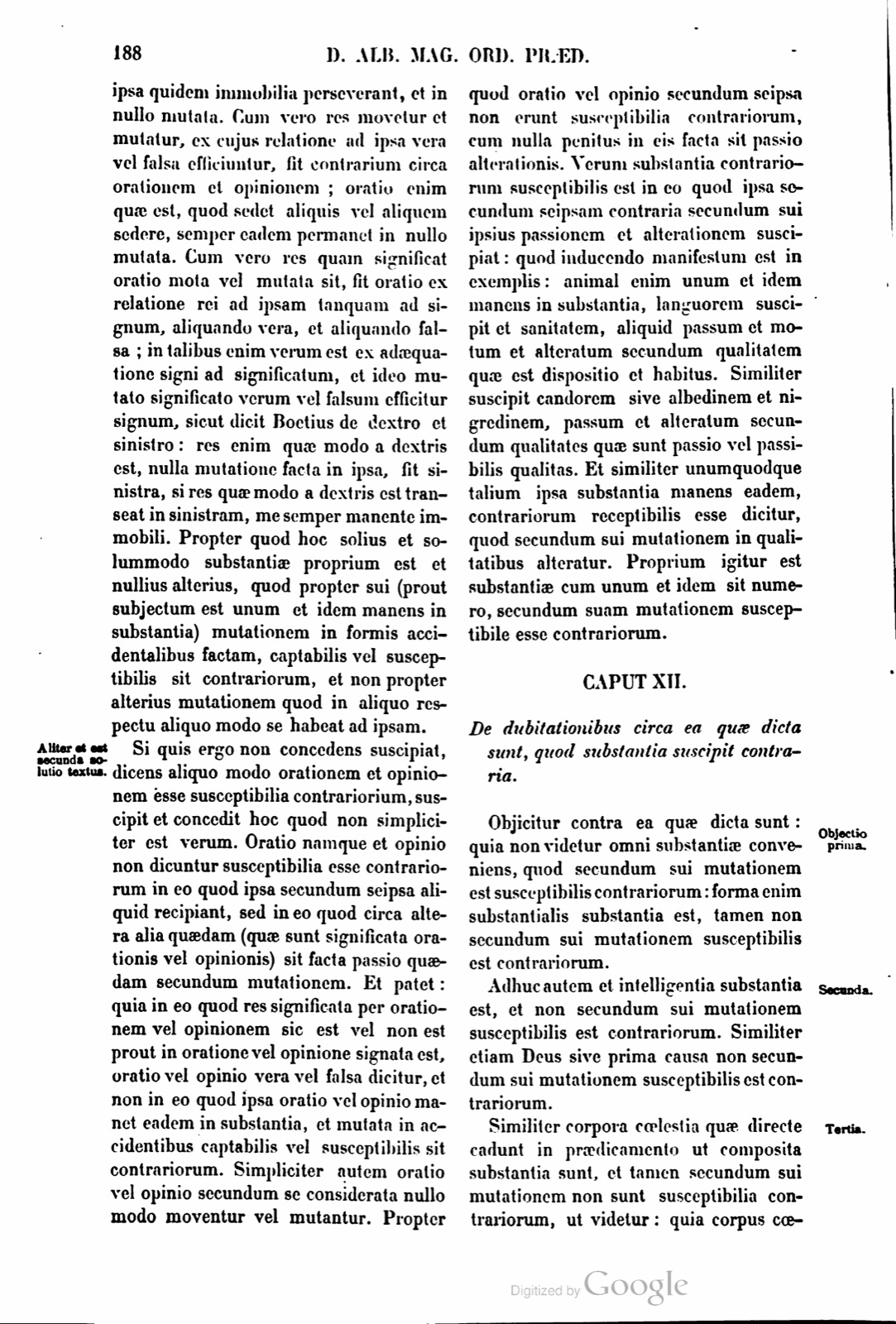
ipsa quidem immobilia perseverant, et in nullo mutata. Cum vero res movetur et mutatur, ex cujus relatione ad ipsa vera vel falsa efficiuntur, fit contrarium circa orationem et opinionem; oratio enim quæ est, quod sedet aliquis vel aliquem sedere, semper eadem permanet in nullo mutata. Cum vero res quam significat oratio mota vel mutata sit, fit oratio ex relatione rei ad ipsam tanquam ad signum, aliquando vera, et aliquando falsa; in talibus enim verum est ex adæquatione signi ad significatum, et ideo mutato significato verum vel falsum efficitur signum, sicut dicit Boetius de dextro et sinistro: res enim quæ modo a dextris est, nulla mutatione facta in ipsa, fit sinistra, si res quæ modo a dextris est transeat in sinistram, me semper manente immobili. Propter quod hoc solius et solummodo substantiæ proprium est et nullius alterius, quod propter sui, prout subjectum est unum et idem manens in substantia, mutationem in formis accidentalibus factam, captabilis vel susceptibilis sit contrariorum, et non propter alterius mutationem quod in aliquo respectu aliquo modo se habeat ad ipsam.
Si quis ergo non concedens suscipiat, dicens aliquo modo orationem et opinionem esse susceptibilia contrariorum, suscipit et concedit hoc quod non simpliciter est verum. Oratio namque et opinio non dicuntur susceptibilia esse contrariorum in eo quod ipsa secundum seipsa aliquid recipiant, sed in eo quod circa altera alia quædam, quæ sunt significata orationis vel opinionis, sit facta passio quædam secundum mutationem. Et patet: quia in eo quod res significata per orationem vel opinionem sic est vel non est prout in oratione vel opinione signata est, oratio vel opinio vera vel falsa dicitur, et non in eo quod ipsa oratio vel opinio manet eadem in substantia, et mutata in accidentibus captabilis vel susceptibilis sit contrariorum. Simpliciter autem oratio vel opinio secundum se considerata nullo modo moventur vel mutantur. Propter quod oratio vel opinio secundum seipsa non erunt susceptibilia contrariorum, cum nulla penitus in eis facta sit passio alterationis. Verum substantia contrariorum susceptibilis est in eo quod ipsa secundum seipsam contraria secundum sui ipsius passionem et alterationem suscipiat: quod inducendo manifestum est in exemplis: animal enim unum et idem manens in substantia, languorem suscipit et sanitatem, aliquid passum et motum et alteratum secundum qualitatem quæ est dispositio et habitus. Similiter suscipit candorem sive albedinem et nigredinem, passum et alteratum secundum qualitates quæ sunt passio vel passibilis qualitas. Et similiter unumquodque talium ipsa substantia manens eadem, contrariorum receptibilis esse dicitur, quod secundum sui mutationem in qualitatibus alteratur. Proprium igitur est substantiæ cum unum et idem sit numero, secundum suam mutationem susceptibile esse contrariorum.
CAPUT XII. De dubitationibus circa ea quæ dicta sunt, quod substantia suscipit contraria.
Objicitur contra ea quæ dicta sunt: quia non videtur omni substantiæ conveniens, quod secundum sui mutationem est susceptibilis contrariorum: forma enim substantialis substantia est, tamen non secundum sui mutationem susceptibilis est contrariorum.
Adhuc autem et intelligentia substantia est, et non secundum sui mutationem susceptibilis est contrariorum. Similiter etiam Deus sive prima causa non secundum sui mutationem susceptibilis est contrariorum.
Similiter corpora cœlestia quæ directe cadunt in prædicamento ut composita substantia sunt, et tamen secundum sui mutationem non sunt susceptibilia contrariorum, ut videtur: quia corpus
they indeed persist immobile and changed in nothing. But when the thing is moved and changed, from relation to which they are made true or false, contrariety comes to be concerning statement and opinion; for the statement which is that someone sits, or that someone is sitting, always remains the same, changed in nothing. But when the thing which the statement signifies has been moved or changed, the statement, from the relation of the thing to it as to a sign, becomes at one time true and at another time false; for in such things truth is from the adequation of sign to thing signified, and therefore when the signified has been changed the sign becomes true or false, as Boethius says concerning right and left: for the thing which now is on the right, with no change made in it, becomes left, if the thing which now is on the right passes over to the left, while I always remain immobile. On account of this it is proper to substance alone and only, and to no other thing, that on account of its own change, insofar as the subject is one and the same remaining in substance, made in accidental forms, it is capable or susceptible of contraries, and not on account of a change of another thing which in some respect has itself in some mode toward it.
Therefore if someone, not conceding, should receive this, saying that in some mode statement and opinion are susceptible of contraries, he receives and concedes what is not simply true. For statement and opinion are not said to be susceptible of contraries in that they according to themselves receive something, but in that concerning certain other things, which are the things signified by statement or opinion, a certain passion according to change has been made. And this is clear: because in that the thing signified through statement or opinion is thus or is not as it is marked in the statement or opinion, the statement or opinion is said to be true or false, and not in that the statement or opinion itself remains the same in substance and, changed in accidents, is capable or susceptible of contraries. But simply considered according to themselves, statement or opinion are in no way moved or changed. On account of this, statement or opinion according to themselves will not be susceptible of contraries, since no passion of alteration at all has been made in them. But substance is susceptible of contraries in that it according to itself receives contraries according to its own passion and alteration; this is manifest by induction in examples: for animal, remaining one and the same in substance, receives sickness and health, something having undergone and been moved and altered according to quality which is disposition and habit. Similarly it receives brightness or whiteness and blackness, having undergone and been altered according to qualities which are passion or passible quality. And similarly each one of such things, while substance itself remains the same, is said to be receptive of contraries, because according to its own change it is altered in qualities. Therefore it is proper to substance, since it is one and the same in number, to be susceptible of contraries according to its own change.
CHAPTER XII. On doubts concerning the things that have been said, that substance receives contraries.
An objection is raised against the things that have been said: because it does not seem to belong to every substance, that according to its own change it is susceptible of contraries. For substantial form is substance, and yet it is not susceptible of contraries according to its own change.
Moreover, intelligence also is substance, and it is not susceptible of contraries according to its own change. Similarly also God or the first cause is not susceptible of contraries according to his own change.
Similarly, heavenly bodies which directly fall in the predicament as composite substances are substances, and yet according to their own change they are not susceptible of contraries, as it seems, because a body
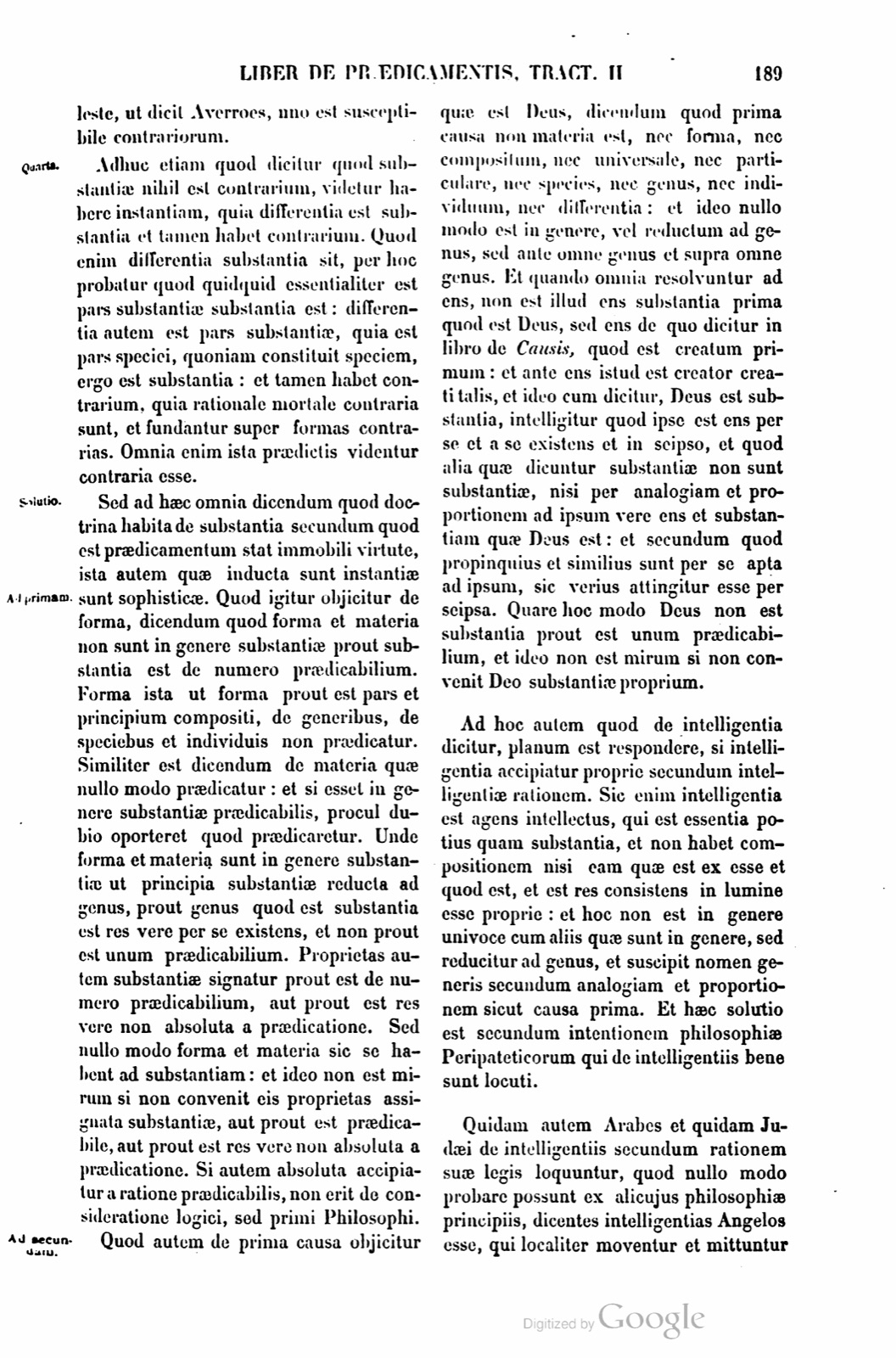
cœleste, ut dicit Averroes, non est susceptibile contrariorum.
Adhuc etiam quod dicitur quod substantiæ nihil est contrarium, videtur habere instantiam, quia differentia est substantia et tamen habet contrarium. Quod enim differentia substantia sit, per hoc probatur quod quidquid essentialiter est pars substantiæ substantia est: differentia autem est pars substantiæ, quia est pars speciei, quoniam constituit speciem, ergo est substantia: et tamen habet contrarium, quia rationale mortale contraria sunt, et fundantur super formas contrarias. Omnia enim ista prædictis videntur contraria esse.
Sed ad hæc omnia dicendum quod doctrina habita de substantia secundum quod est prædicamentum stat immobili virtute, ista autem quæ inducta sunt instantiæ sunt sophisticæ. Quod igitur objicitur de forma, dicendum quod forma et materia non sunt in genere substantiæ prout substantia est de numero prædicabilium. Forma ista ut forma prout est pars et principium compositi, de generibus, de speciebus et individuis non prædicatur. Similiter est dicendum de materia quæ nullo modo prædicatur: et si esset in genere substantiæ prædicabilis, procul dubio oporteret quod prædicaretur. Unde forma et materia sunt in genere substantiæ ut principia substantiæ reducta ad genus, prout genus quod est substantia est res vere per se existens, et non prout est unum prædicabilium. Proprietas autem substantiæ signatur prout est de numero prædicabilium, aut prout est res vere non absoluta a prædicatione. Sed nullo modo forma et materia sic se habent ad substantiam: et ideo non est mirum si non convenit eis proprietas assignata substantiæ, aut prout est prædicabile, aut prout est res vere non absoluta a prædicatione. Si autem absoluta accipiatur a ratione prædicabilis, non erit de consideratione logici, sed primi Philosophi.
Quod autem de prima causa objicitur quæ est Deus, dicendum quod prima causa non materia est, nec forma, nec compositum, nec universale, nec particulare, nec species, nec genus, nec individuum, nec differentia: et ideo nullo modo est in genere, vel reductum ad genus, sed ante omne genus et supra omne genus. Et quando omnia resolvuntur ad ens, non est illud ens substantia prima quod est Deus, sed ens de quo dicitur in libro de Causis, quod est creatum primum: et ante ens istud est creator creati talis, et ideo cum dicitur, Deus est substantia, intelligitur quod ipse est ens per se et a se existens et in seipso, et quod alia quæ dicuntur substantiæ non sunt substantiæ, nisi per analogiam et proportionem ad ipsum vere ens et substantiam quæ Deus est: et secundum quod propinquius et similius sunt per se apta ad ipsum, sic verius attingitur esse per seipsa. Quare hoc modo Deus non est substantia prout est unum prædicabilium, et ideo non est mirum si non convenit Deo substantiæ proprium.
celestial, as Averroes says, is not susceptible of contraries.
Moreover, also what is said, that nothing is contrary to substance, seems to have an objection, because difference is substance and yet has a contrary. For that difference is substance is proved through this, that whatever is essentially a part of substance is substance; but difference is a part of substance, because it is a part of species, since it constitutes the species; therefore it is substance. And yet it has a contrary, because rational mortal are contraries, and are founded upon contrary forms. For all these things seem to be contrary to the things said before.
But to all these one must say that the doctrine held concerning substance according as it is a predicament stands with immobile force, but those things which have been brought in as objections are sophistical. Therefore, as to what is objected concerning form, one must say that form and matter are not in the genus of substance insofar as substance is of the number of predicables. This form as form, insofar as it is a part and principle of the composite, is not predicated of genera, of species, and of individuals. Similarly one must speak of matter, which is predicated in no way; and if it were in the predicable genus of substance, beyond doubt it would have to be predicated. Hence form and matter are in the genus of substance as principles of substance reduced to the genus, insofar as the genus which is substance is a thing truly existing through itself, and not insofar as it is one of the predicables. But the property of substance is marked insofar as it is of the number of predicables, or insofar as it is a thing truly not detached from predication. But form and matter are in no way related thus to substance; and therefore it is not strange if the property assigned to substance does not belong to them, either insofar as it is a predicable, or insofar as it is a thing truly not detached from predication. But if it is taken detached from the account of the predicable, it will not belong to the consideration of the logician, but of the first Philosopher.
But as to what is objected concerning the first cause, which is God, one must say that the first cause is not matter, nor form, nor composite, nor universal, nor particular, nor species, nor genus, nor individual, nor difference; and therefore in no way is it in a genus, or reduced to a genus, but before every genus and above every genus. And when all things are resolved to being, that being is not first substance, which is God, but the being of which it is said in the book On Causes that it is the first created thing; and before that being is the creator of such a created thing. And therefore when it is said, God is substance, it is understood that he is a being existing through himself and from himself and in himself, and that the other things which are called substances are not substances except by analogy and proportion to him, truly being and the substance which God is; and according as they are nearer and more similar, apt through themselves for him, thus being through themselves is more truly attained. Therefore in this mode God is not substance insofar as it is one of the predicables, and therefore it is not strange if the property of substance does not belong to God.
Ad hoc autem quod de intelligentia dicitur, planum est respondere, si intelligentia accipiatur proprie secundum intelligentiæ rationem. Sic enim intelligentia est agens intellectus, qui est essentia potius quam substantia, et non habet compositionem nisi eam quæ est ex esse et quod est, et est res consistens in lumine esse proprie: et hoc non est in genere univoce cum aliis quæ sunt in genere, sed reducitur ad genus, et suscipit nomen generis secundum analogiam et proportionem sicut causa prima. Et hæc solutio est secundum intentionem philosophiæ Peripateticorum qui de intelligentiis bene sunt locuti.
Quidam autem Arabes et quidam Judæi de intelligentiis secundum rationem suæ legis loquuntur, quod nullo modo probare possunt ex alicujus philosophiæ principiis, dicentes intelligentias Angelos esse, qui localiter moventur et mittuntur
But to this which is said concerning intelligence, it is clear to respond if intelligence is taken properly according to the account of intelligence. For in this way intelligence is the agent intellect, which is essence rather than substance, and it has no composition except that which is from being and what is, and it is a thing consisting in the light of being properly; and this is not in a genus univocally with the other things which are in a genus, but is reduced to a genus, and receives the name of the genus according to analogy and proportion, like the first cause. And this solution is according to the intention of the philosophy of the Peripatetics, who have spoken well concerning intelligences.
But certain Arabs and certain Jews speak concerning intelligences according to the account of their law, which in no way they can prove from the principles of any philosophy, saying that intelligences are Angels who are moved locally and are sent
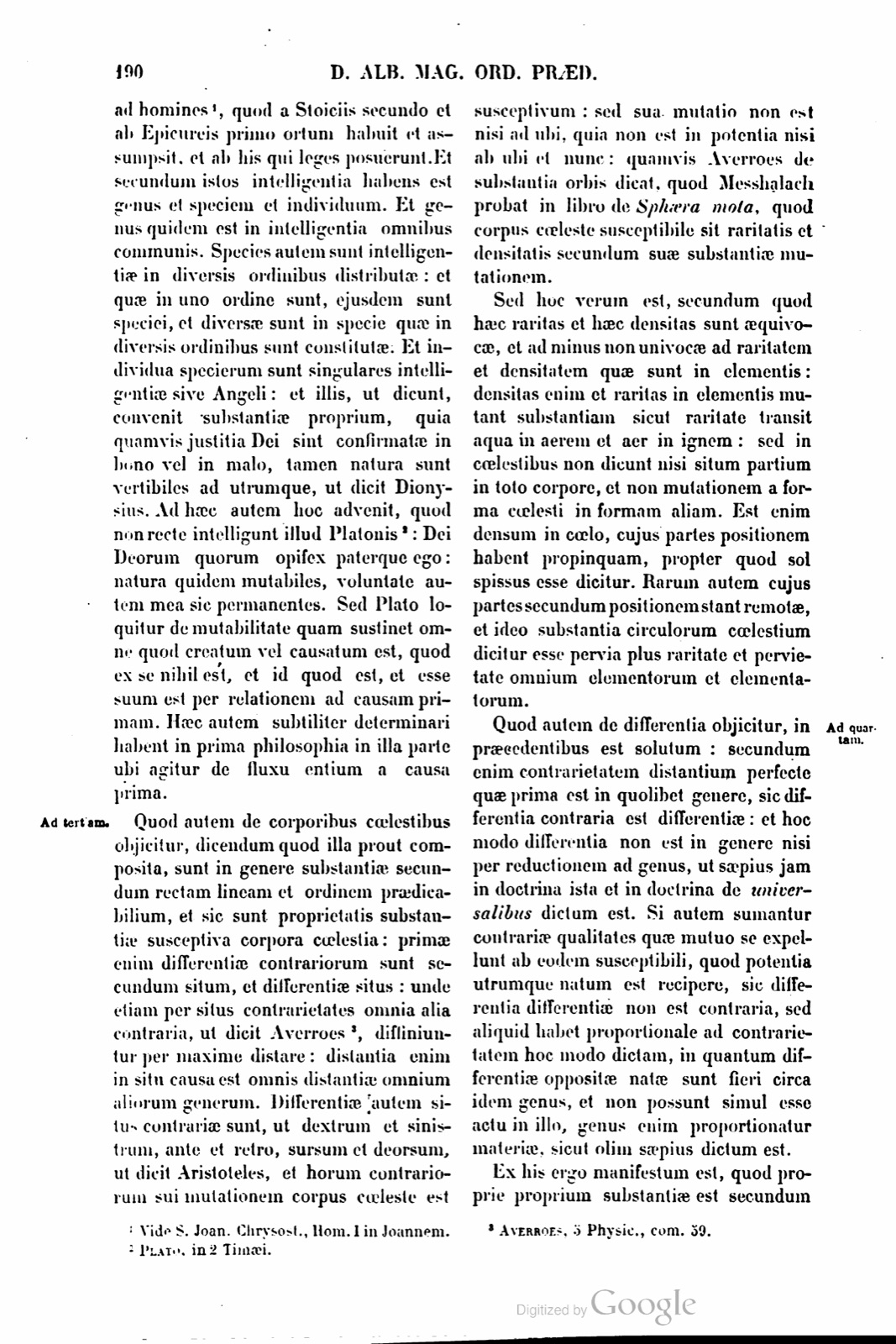
ad homines 1, quod a Stoicis secundo et ab Epicureis primo ortum habuit et assumpsit, et ab his qui leges posuerunt. Et secundum istos intelligentia habet genus et speciem et individuum. Et genus quidem est in intelligentia omnibus communis. Species autem sunt intelligentiæ in diversis ordinibus distributæ: et quæ in uno ordine sunt, ejusdem sunt speciei, et diversæ sunt in specie quæ in diversis ordinibus sunt constitutæ. Et individua specierum sunt singulares intelligentiæ sive Angeli: et illis, ut dicunt, convenit substantiæ proprium, quia quamvis justitia Dei sint confirmatæ in bono vel in malo, tamen natura sunt vertibiles ad utrumque, ut dicit Dionysius. Ad hæc autem hoc advenit, quod non recte intelligunt illud Platonis 2: Dei Deorum quorum opifex paterque ego: natura quidem mutabiles, voluntate autem mea sic permanentes. Sed Plato loquitur de mutabilitate quam sustinet omne quod creatum vel causatum est, quod ex se nihil est, et id quod est, et esse suum est per relationem ad causam primam. Hæc autem subtiliter determinari habent in prima philosophia in illa parte ubi agitur de fluxu entium a causa prima.
Quod autem de corporibus cælestibus objicitur, dicendum quod illa prout composita, sunt in genere substantiæ secundum rectam lineam et ordinem prædicabilium, et sic sunt proprietatis substantiæ susceptiva corpora cælestia: primæ enim differentiæ contrariorum sunt secundum situm, et differentiæ situs: unde etiam per situs contrarietates omnia alia contraria, ut dicit Averroes 3, diffiniuntur per maxime distare: distantia enim in situ causa est omnis distantiæ omnium aliorum generum. Differentiæ autem situs contrariæ sunt, ut dextrum et sinistrum, ante et retro, sursum et deorsum, ut dicit Aristoteles, et horum contrariorum sui mutationem corpus cæleste est susceptivum: sed sua mutatio non est nisi ad ubi, quia non est in potentia nisi ab ubi et nunc: quamvis Averroes de substantia orbis dicat, quod Messhalach probat in libro de Sphæra mota, quod corpus cæleste susceptibile sit raritatis et densitatis secundum suæ substantiæ mutationem.
Sed hoc verum est, secundum quod hæc raritas et hæc densitas sunt æquivocæ, et ad minus non univocæ ad raritatem et densitatem quæ sunt in elementis: densitas enim et raritas in elementis mutant substantiam sicut raritate transit aqua in aerem et aer in ignem: sed in cælestibus non dicunt nisi situm partium in toto corpore, et non mutationem a forma cælesti in formam aliam. Est enim densum in cælo, cujus partes positionem habent propinquam, propter quod sol spissus esse dicitur. Rarum autem cujus partes secundum positionem stant remotæ, et ideo substantia circulorum cælestium dicitur esse pervia plus raritate et pervietate omnium elementorum et elementatorum.
Quod autem de differentia objicitur, in præcedentibus est solutum: secundum enim contrarietatem distantium perfecte quæ prima est in quolibet genere, sic differentia contraria est differentiæ: et hoc modo differentia non est in genere nisi per reductionem ad genus, ut sæpius jam in doctrina ista et in doctrina de universalibus dictum est. Si autem sumantur contrariæ qualitates quæ mutuo se expellunt ab eodem susceptibili, quod potentia utrumque natum est recipere, sic differentia differentiæ non est contraria, sed aliquid habet proportionale ad contrarietatem hoc modo dictam, in quantum differentiæ oppositæ natæ sunt fieri circa idem genus, et non possunt simul esse actu in illo, genus enim proportionatur materiæ, sicut olim sæpius dictum est.
Ex his ergo manifestum est, quod proprie proprium substantiæ est secundum
to men 1, which had and assumed its rise secondly from the Stoics and firstly from the Epicureans, and from those who established laws. And according to those men, intelligence has genus and species and individual. And genus indeed is common to all in intelligence. But species are intelligences distributed in diverse orders; and those which are in one order are of the same species, and diverse in species are those which are constituted in diverse orders. And the individuals of the species are singular intelligences or Angels; and to them, as they say, the property of substance belongs, because although by the justice of God they have been confirmed in good or in evil, nevertheless by nature they are turnable to each, as Dionysius says. But to these things this is added, that they do not rightly understand that saying of Plato 2: Gods of gods, of whom I am maker and father: by nature indeed mutable, but by my will thus remaining. But Plato speaks of the mutability which everything created or caused sustains, because from itself it is nothing, and that which it is, and its being, is through relation to the first cause. But these things have to be determined subtly in first philosophy in that part where the flux of beings from the first cause is treated.
But as to what is objected concerning celestial bodies, one must say that those, insofar as they are composites, are in the genus of substance according to the straight line and order of predicables, and thus celestial bodies are receptive of the property of substance. For the first differences of contraries are according to position, and are differences of position; hence also through contrarieties of position all other contraries, as Averroes says 3, are defined through being maximally distant: for distance in position is the cause of every distance of all other genera. But differences of position are contrary, as right and left, before and behind, above and below, as Aristotle says; and the celestial body is susceptible, according to its own change, of these contraries. But its change is only to where, because it is not in potency except from where and now; although Averroes says concerning the substance of the orb that Messhalach proves in the book On the Moved Sphere that a celestial body is susceptible of rarity and density according to the change of its substance.
But this is true according as this rarity and this density are equivocal, and at least not univocal with the rarity and density which are in the elements; for density and rarity in the elements change substance, as by rarity water passes into air and air into fire; but in the heavenly bodies they say only the position of parts in the whole body, and not a change from a celestial form into another form. For there is dense in heaven whose parts have near position, on account of which the sun is said to be dense. But rare is that whose parts stand remote according to position, and therefore the substance of the heavenly circles is said to be pervious by more rarity and perviousness than all elements and things composed of elements.
But what is objected concerning difference has been solved in the preceding things: for according to the contrariety of things perfectly distant, which is first in any genus, thus difference is contrary to difference; and in this mode difference is not in a genus except through reduction to a genus, as has already been said more often in this doctrine and in the doctrine On the Universals. But if contrary qualities are taken which mutually expel one another from the same susceptible subject, which by potency is naturally fitted to receive each, then in this way difference is not contrary to difference, but has something proportional to contrariety said in this mode, insofar as opposed differences are naturally fitted to come to be around the same genus, and cannot be in act in it at the same time; for genus is proportioned to matter, as was formerly said rather often.
From these things therefore it is manifest that what is properly proper to substance is according to
If a page does not appear, its photograph has not been uploaded yet.