Volume 1 · pp. 183–185
Chapter X. On the property of substance, which is not to receive more and less
A marker with ≈ is an approximate page boundary, placed by measure of the text; the page photographs remain the authority. In the paired views, clicking a page marker brings that page into view.
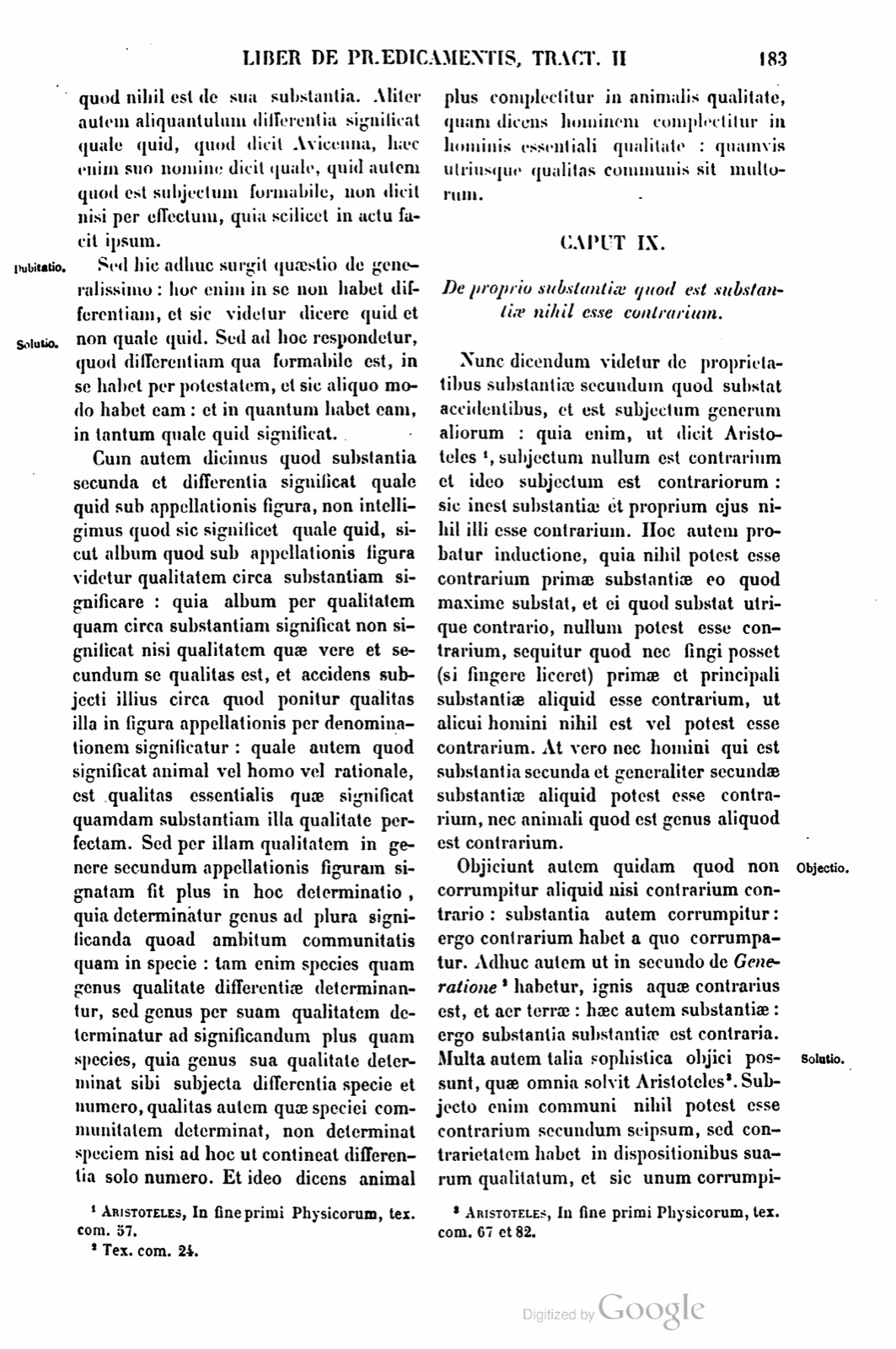
corrumpitur ab alio, et contrarium agit in contrarium, ut grossum in subtile, et grave in leve, et calidum in frigidum, et sic de aliis. Hæc autem contrarietas non est substantiæ quæ subjectum est, quia si esset alicui contrarium, non posset utrique contrariorum esse subjectum.
Et attende, quod multipliciter dicitur contrarietas: primo perfecta distantia oppositarum differentiarum in eodem genere, cujus subjectum est primum genus, ad quod illa contraria sicut ad unum genus reducuntur, et sicut ad unum subjectum, in quo illa contraria sunt potestate et non actu, sicut videtur Aristoteles 1 dicere, quod in omni genere primo est una contrarietas prima. Et secundum hanc contrarietatem proprium est substantiæ, secundum quod substat et subjectum est, non habere contrarium. Secundum autem quod substantia dicitur essentialis forma quæ est differentia, sic habet contrarium: quia una differentia est alii contraria. Sed hoc modo de substantia non loquimur hic, quia non ponimus differentiam esse in genere substantiæ, secundum quod de substantiis loquimur ut de substare et de subjecto. Primam autem Philosophus hoc modo dictam contrarietatem considerat, qui ad unum genus reducit ea quæ sunt ejusdem rationis substantiæ aliquo modo. Dicitur etiam contrarietas habitus et privatio, sive contrariæ formæ circa eamdem materiam quæ substat utrique: et est substantia a substando dicta, et illi iterum convenit neutri esse contraria, ut probatur in fine primi Physicorum 2. Dicitur etiam contrarietas distantia completa passionum et qualitatum circa idem subjectum, quod manens unum et idem, receptibile est utriusque contrariorum, ut albi et nigri, et calidi et frigidi, et hujusmodi: et iterum ei quod utrique contrariorum substat, convenit nulli esse contrarium: et iste est verus intellectus Aristotelis qui hæc omnia dicit et probat rationibus quæ inductæ sunt.
is corrupted by another, and contrary acts on contrary, as the dense acts on the subtle, and the heavy on the light, and the hot on the cold, and so concerning others. But this contrariety does not belong to substance which is a subject, because if something were contrary to it, it could not be the subject of each contrary.
And attend that contrariety is said in many ways: first, the perfect distance of opposed differences in the same genus, whose subject is the first genus, to which those contraries are reduced as to one genus, and as to one subject, in which those contraries are in potency and not in act, as Aristotle seems to say 1, that in every first genus there is one first contrariety. And according to this contrariety it is proper to substance, according as it underlies and is subject, not to have a contrary. But according as substance is called the essential form which is difference, in this way it has a contrary, because one difference is contrary to another. But we are not speaking here of substance in this way, because we do not posit difference to be in the genus of substance, according as we speak of substances as concerning underlying and concerning subject. But the Philosopher considers the first contrariety, called in this way, who reduces to one genus those things which are of the same account of substance in some mode. Contrariety is also called habit and privation, or contrary forms concerning the same matter which underlies each; and it is substance called from underlying, and to that again it belongs to be contrary to neither, as is proved at the end of the first book of the Physics 2. Contrariety is also called the complete distance of passions and qualities concerning the same subject, which, remaining one and the same, is receptive of each contrary, as of white and black, and of hot and cold, and things of this sort; and again to that which underlies each of the contraries it belongs to be contrary to none; and this is the true understanding of Aristotle, who says and proves all these things by the reasons which have been brought in.
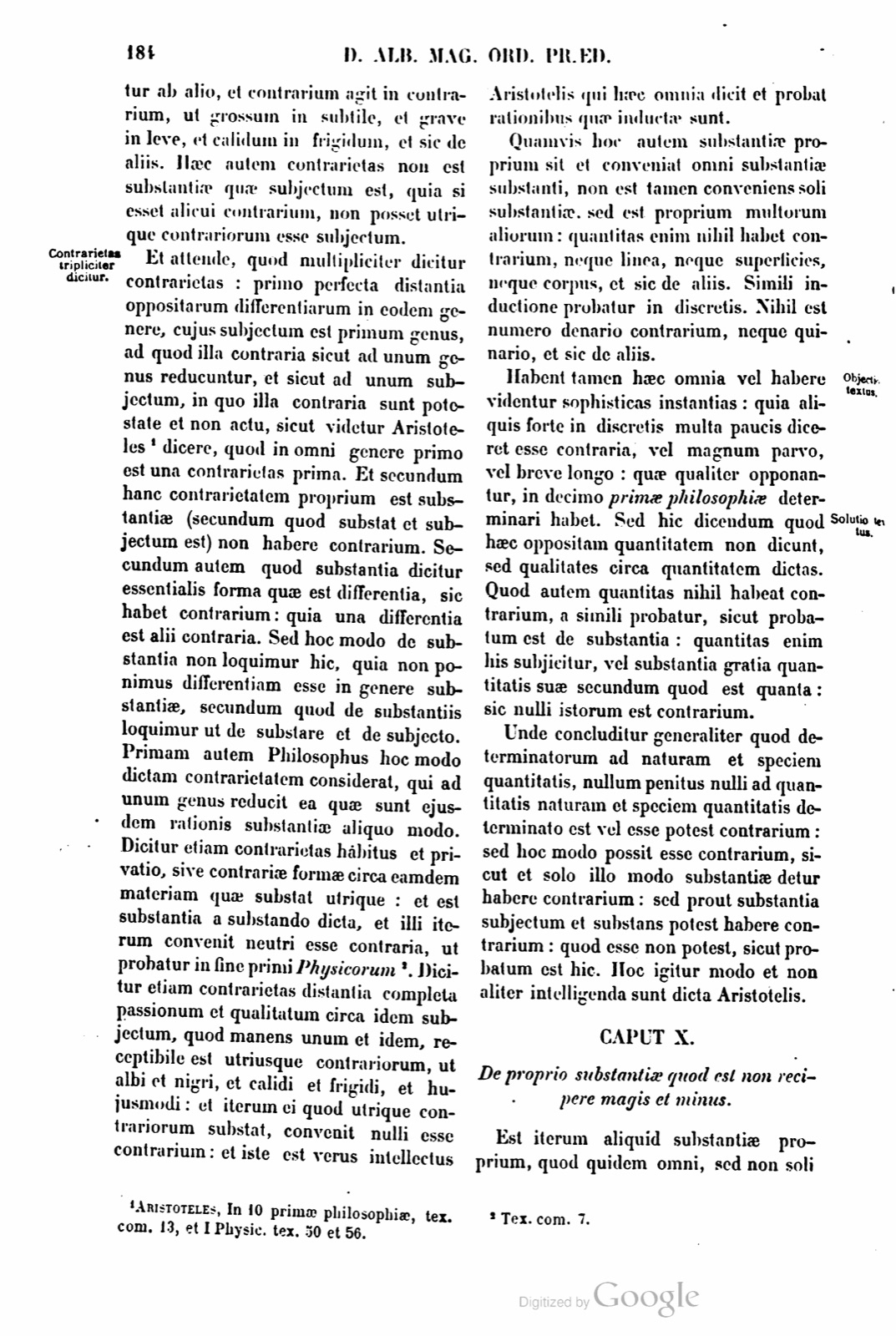
Quamvis hoc autem substantiæ proprium sit et conveniat omni substantiæ substanti, non est tamen conveniens soli substantiæ, sed est proprium multorum aliorum: quantitas enim nihil habet contrarium, neque linea, neque superficies, neque corpus, et sic de aliis. Simili inductione probatur in discretis. Nihil est numero denario contrarium, neque quinario, et sic de aliis.
Habent tamen hæc omnia vel habere videntur sophisticas instantias: quia aliquis forte in discretis multa paucis diceret esse contraria, vel magnum parvo, vel breve longo: quæ qualiter opponantur, in decimo primæ philosophiæ determinari habet. Sed hic dicendum quod hæc oppositam quantitatem non dicunt, sed qualitates circa quantitatem dictas. Quod autem quantitas nihil habeat contrarium, a simili probatur, sicut probatum est de substantia: quantitas enim his subjicitur, vel substantia gratia quantitatis suæ secundum quod est quanta: sic nulli istorum est contrarium.
Unde concluditur generaliter quod determinatorum ad naturam et speciem quantitatis, nullum penitus nulli ad quantitatis naturam et speciem quantitatis determinato est vel esse potest contrarium: sed hoc modo possit esse contrarium, sicut et solo illo modo substantiæ detur habere contrarium: sed prout substantia subjectum et substans potest habere contrarium: quod esse non potest, sicut probatum est hic. Hoc igitur modo et non aliter intelligenda sunt dicta Aristotelis.
CAPUT X. De proprio substantiæ quod est non recipere magis et minus.
Est iterum aliquid substantiæ proprium, quod quidem omni, sed non soli
But although this is a property of substance and belongs to every underlying substance, nevertheless it does not belong to substance alone, but is a property of many other things; for quantity has nothing contrary, nor does line, nor surface, nor body, and so concerning others. By a similar induction this is proved in discrete things. Nothing is contrary to the number ten, nor to five, and so concerning others.
Yet all these have, or seem to have, sophistical objections: because perhaps someone would say that among discrete things many are contrary to few, or great to small, or short to long; how these are opposed must be determined in the tenth book of the first philosophy. But here it must be said that these do not say opposed quantity, but qualities said concerning quantity. But that quantity has nothing contrary is proved from a likeness, as was proved concerning substance: for quantity is subjected to these, or substance by reason of its quantity according as it is quantified; thus nothing of these is contrary.
Hence it is concluded generally that, of things determined to the nature and species of quantity, absolutely none is or can be contrary to any thing determined to the nature of quantity and the species of quantity; but in this mode it could be contrary, just as also only in that mode may substance be granted to have a contrary; but insofar as substance is a subject and underlying, it can have a contrary, which cannot be, as has been proved here. Therefore the sayings of Aristotle are to be understood in this mode and not otherwise.
CHAPTER X. On the property of substance, which is not to receive more and less.
There is again something proper to substance, which indeed belongs to every substance, but not to it alone
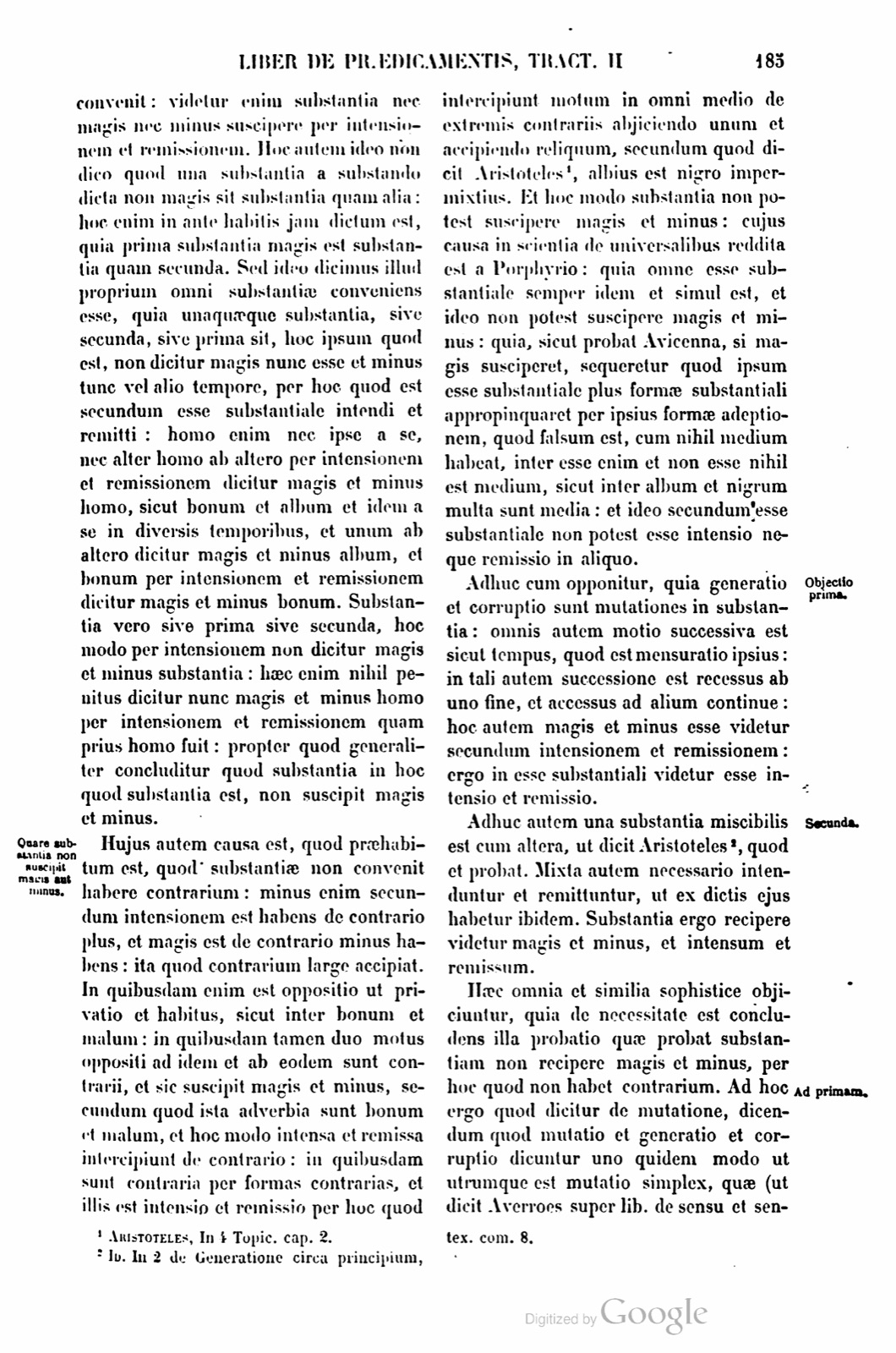
convenit: videtur enim substantia nec magis nec minus suscipere per intensionem et remissionem. Hoc autem ideo non dico quod una substantia a substando dicta non magis sit substantia quam alia: hoc enim in ante habitis jam dictum est, quia prima substantia magis est substantia quam secunda. Sed ideo dicimus illud proprium omni substantiæ conveniens esse, quia unaquæque substantia, sive secunda, sive prima sit, hoc ipsum quod est, non dicitur magis nunc esse et minus tunc vel alio tempore, per hoc quod est secundum esse substantiale intendi et remitti: homo enim nec ipse a se, nec alter homo ab altero per intensionem et remissionem dicitur magis et minus homo, sicut bonum et album et idem a se in diversis temporibus, et unum ab altero dicitur magis et minus album, et bonum per intensionem et remissionem dicitur magis et minus bonum. Substantia vero sive prima sive secunda, hoc modo per intensionem non dicitur magis et minus substantia: hæc enim nihil penitus dicitur nunc magis et minus homo per intensionem et remissionem quam prius homo fuit: propter quod generaliter concluditur quod substantia in hoc quod substantia est, non suscipit magis et minus.
Hujus autem causa est, quod præhabitum est, quod substantiæ non convenit habere contrarium: minus enim secundum intensionem est habens de contrario plus, et magis est de contrario minus habens: ita quod contrarium large accipiat. In quibusdam enim est oppositio ut privatio et habitus, sicut inter bonum et malum: in quibusdam tamen duo motus oppositi ad idem et ab eodem sunt contrarii, et sic suscipit magis et minus, secundum quod ista adverbia sunt bonum et malum, et hoc modo intensa et remissa intercipiunt de contrario: in quibusdam sunt contraria per formas contrarias, et illis est intensio et remissio per hoc quod intercipiunt motum in omni medio de extremis contrariis abjiciendo unum et accipiendo reliquum, secundum quod dicit Aristoteles 3, albius est nigro impermixtius. Et hoc modo substantia non potest suscipere magis et minus: cujus causa in scientia de Universalibus reddita est a Porphyrio: quia omne esse substantiale semper idem et simul est, et ideo non potest suscipere magis et minus: quia, sicut probat Avicenna, si magis susciperet, sequeretur quod ipsum esse substantiale plus formæ substantiali appropinquaret per ipsius formæ adeptionem, quod falsum est, cum nihil medium habeat, inter esse enim et non esse nihil est medium, sicut inter album et nigrum multa sunt media: et ideo secundum esse substantiale non potest esse intensio neque remissio in aliquo.
Adhuc cum opponitur, quia generatio et corruptio sunt mutationes in substantia: omnis autem motio successiva est sicut tempus, quod est mensuratio ipsius: in tali autem successione est recessus ab uno fine, et accessus ad alium continue: hoc autem magis et minus esse videtur secundum intensionem et remissionem: ergo in esse substantiali videtur esse intensio et remissio.
Adhuc autem una substantia miscibilis est cum altera, ut dicit Aristoteles 4, quod et probat. Mixta autem necessario intenduntur et remittuntur, ut ex dictis ejus habetur ibidem. Substantia ergo recipere videtur magis et minus, et intensum et remissum.
Hæc omnia et similia sophistice objiciuntur, quia de necessitate est concludens illa probatio quæ probat substantiam non recipere magis et minus, per hoc quod non habet contrarium. Ad hoc ergo quod dicitur de mutatione, dicendum quod mutatio et generatio et corruptio dicuntur uno quidem modo ut utrumque est mutatio simplex, quæ, ut dicit Averroes super lib. de sensu et
belongs: for substance seems to receive neither more nor less by intension and remission. But I do not say this in the sense that one substance, called from underlying, is not more substance than another; for this has already been said in the things held before, because first substance is substance more than second. Rather, for this reason we say that that property belongs to every substance, because each substance, whether it is second or first, is not said to be now more this very thing which it is and then less, or at another time less, through being intensified and remitted according to substantial being. For a man, neither he himself from himself nor one man from another, is said through intension and remission to be more and less man, as good and white, both the same thing from itself at different times and one thing from another, are said to be more and less white, and good is said through intension and remission to be more and less good. But substance, whether first or second, is not in this mode through intension said to be more and less substance; for this is in no way at all said now to be more and less man through intension and remission than before it was man. On account of this it is generally concluded that substance, in that it is substance, does not receive more and less.
But the cause of this is what has been held before, that it does not belong to substance to have a contrary: for the less according to intension has more of the contrary, and the more has less of the contrary, so that it would take contrary broadly. For in some things there is opposition as privation and habit, as between good and evil; yet in some things two motions opposed toward the same thing and from the same thing are contrary, and thus it receives more and less, according as these adverbs are good and evil, and in this mode the intensified and remitted things take in something from the contrary. In some things there are contraries through contrary forms, and in them there is intension and remission through this, that they intercept motion in every middle from the extreme contraries by casting off one and receiving the remaining one, according as Aristotle says 3, the whiter is more unmixed with black. And in this mode substance cannot receive more and less; the cause of this was given by Porphyry in the science On the Universals: because every substantial being is always the same and simultaneous, and therefore it cannot receive more and less; because, as Avicenna proves, if it received more, it would follow that substantial being itself would approach nearer to substantial form through the acquiring of that form, which is false, since it has no middle; for between being and non-being there is no middle, as there are many middles between white and black. And therefore according to substantial being there cannot be intension or remission in anything.
Moreover, when it is objected that generation and corruption are changes in substance, and every successive motion is like time, which is the measurement of it; but in such succession there is departure from one end and approach to another continuously; and this seems to be more and less being according to intension and remission; therefore in substantial being there seems to be intension and remission.
Moreover one substance is miscible with another, as Aristotle says 4 and also proves. But mixed things are necessarily intensified and remitted, as is held there from his sayings. Therefore substance seems to receive more and less, and the intensified and remitted.
All these and similar things are objected sophistically, because that proof which proves that substance does not receive more and less through the fact that it does not have a contrary is concluding from necessity. Therefore to this, what is said concerning change, one must say that change and generation and corruption are said in one mode as each is simple change, which, as Averroes says on the book On Sense and
Notes
- Aristotle, In book 10 of the First Philosophy, text, commentary 13, and book 1 of the Physics, texts 50 and 56. (Aristoteles, In 10 primæ philosophiæ, tex. com. 13, et I Physic. tex. 50 et 56.) ↩
- Text, commentary 7. (Tex. com. 7.) ↩
- Aristotle, In book 4 of the Topics, chapter 2. (Aristoteles, In 4 Topic. cap. 2.) ↩
- The same, in book 2 On Generation, around the beginning, text, commentary 8. (Id. In 2 de Generatione circa principium, tex. com. 8.) ↩
If a page does not appear, its photograph has not been uploaded yet.