Volume 1 · pp. 178–180
Chapter VII. On the property of substance and difference, which is to be predicated univocally
A marker with ≈ is an approximate page boundary, placed by measure of the text; the page photographs remain the authority. In the paired views, clicking a page marker brings that page into view.
solvunt objectionem, quia objectio sic procedit dicens, quod quæcumque ut endelechia sunt in corpore, etc., motivum autem in moto est sicut endelechia: anima autem in secundo de Anima 1 dicitur esse endelechia corporis organici, potentia vitam habentis. Et hoc dictum est de anima, non secundum quod est anima, sed secundum quod est corporis animati forma: et ideo dicit Aristoteles quod sic diffinita anima est in habitu, et sicut somnus, et sicut figura elementalis: et est diffinitio ad demonstrationem se habens sicut conclusio: et ideo in sequentibus corrigit eam Aristoteles dicens, quod anima secundum substantiam secundum quod anima substantia est, diffinitur sic: Anima est principium et causa vitæ, supple, talis qualis ipsa anima est: vegetabilis enim est causa et principium vitæ vegetabilis, et sensibilis principium et causa vitæ est sensibilis: quæ vitæ non sunt sine corpore: et ideo illæ animæ non sunt principia et causæ talis vitæ, nisi in corpore: anima autem intellectualis principium et causa talis vitæ est sine corpore: intelligentia enim perficitur sine aliquo corpore, et est ab omni corporali subjecto separata: si igitur principium et causa talis vitæ est, et secundum seipsam talis vitæ erit principium et causa: separata igitur a corpore talis vitæ est causa et principium.
Ad objectum autem dicendum quod anima intellectualis non est endelechia corporis, nisi per suum actum, qui est infusio sensus et motus in corpus, et isti sunt actus ipsius secundum id quod est pars et potentia ipsius, sicut vegetabile et sensibile: actus autem et operatio ipsius secundum id quod est in substantia, est secundum id quod intellectualis est: et hic actus et hæc operatio est sine corpore. Hæc autem quamvis ad propositum non sint, tamen propter objectionem removendam posita sunt, ut perfectior sit doctrina.
solve the objection, because the objection proceeds in this way, saying that whatever things are in a body as endelechy, and so on, are so as the mover is in the moved, as endelechy is; but the soul in the second book of On the Soul 1 is said to be the endelechy of an organic body having life in potency. And this was said of soul, not according as it is soul, but according as it is the form of an animated body; and therefore Aristotle says that soul defined in this way is in habit, and as sleep, and as an elemental figure; and it is a definition related to demonstration as a conclusion. And therefore in what follows Aristotle corrects it, saying that soul according to substance, according as soul is substance, is defined thus: Soul is the principle and cause of life, understand, of such life as the soul itself is. For the vegetative soul is the cause and principle of vegetative life, and the sensitive soul is the principle and cause of sensitive life. These lives are not without a body, and therefore those souls are not principles and causes of such life except in a body. But the intellectual soul is the principle and cause of such life without a body; for understanding is perfected without any body, and is separated from every bodily subject. Therefore, if it is the principle and cause of such life, also according to itself it will be the principle and cause of such life; therefore, separated from the body, it is the cause and principle of such life.
But to the objected argument one must say that the intellectual soul is not the endelechy of the body except through its act, which is the infusion of sense and motion into the body, and those are its acts according to that which is its part and potency, as the vegetative and the sensitive are. But its act and operation according to that which it is in substance is according to that by which it is intellectual; and this act and this operation is without a body. But these things, although they are not to the proposal, nevertheless have been set down for removing the objection, so that the doctrine may be more perfect.
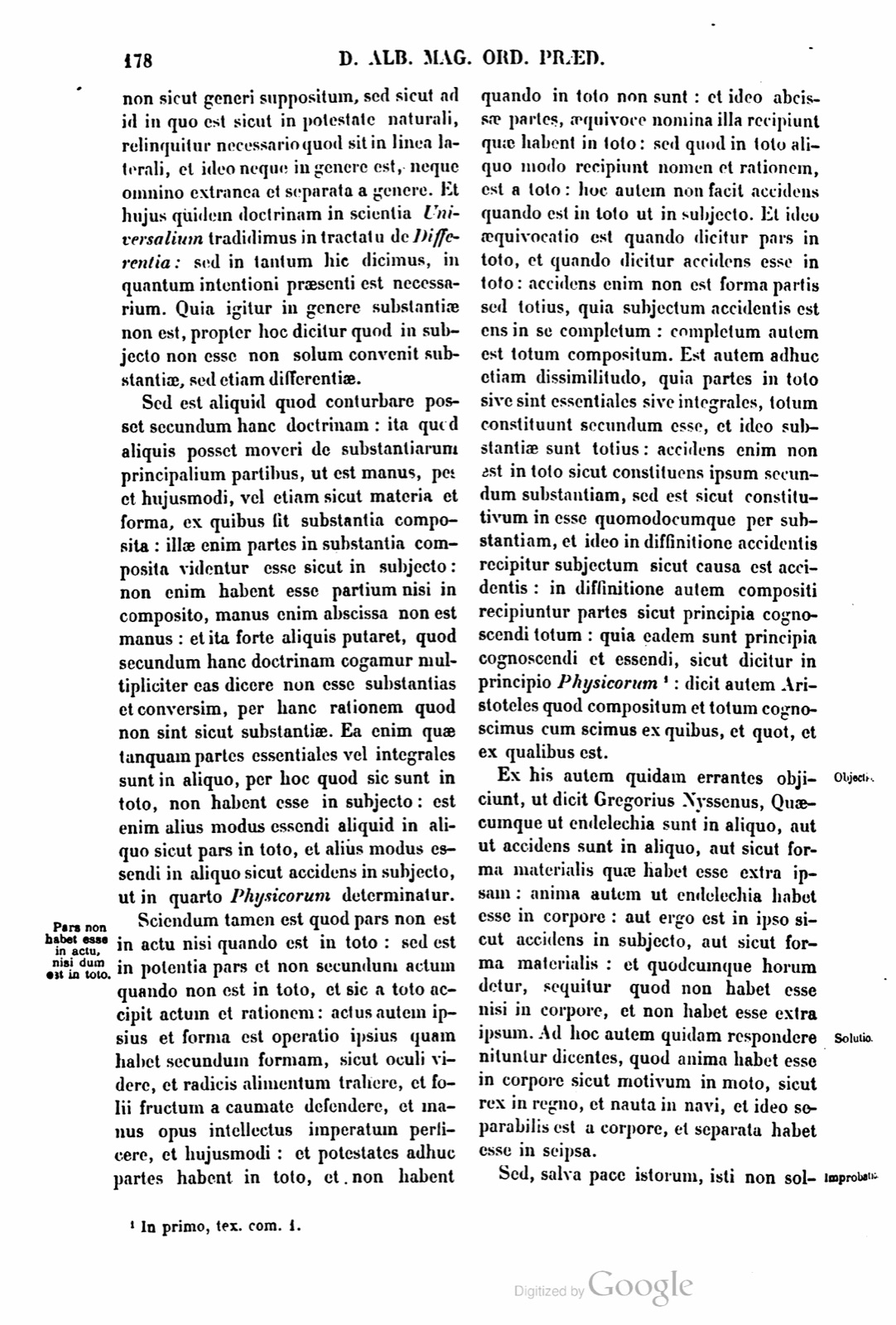
CAPUT VII. De proprio substantiæ et differentiæ quod est univoce prædicari.
Adhuc autem est proprium quod convenit semper, sed non soli, neque omni: soli quidem non convenit, quia convenit substantiæ et differentiæ: non autem omni convenit, quia non convenit principali substantiæ. Hoc autem proprium quod inest quidem ut proprium substantiis quæ a substando et superstando substantiæ dicuntur, et inest differentiis quæ a substando directe in genere esse non dicuntur, est quod omnia prædicata quæ sunt ex ipsis et de numero eorum sunt, univoce prædicantur de his de quibus prædicantur: omnia enim prædicata quæ sunt ab his, hoc est, substantia et differentiis sumpta, aut prædicantur de individuis aut de speciebus, generaliter dicta specie ad subalternam et specialissimam. Hoc autem proprium non omni convenit substantiæ, quia non convenit principali substantiæ quæ est substantia individua. A principali namque substantia nulla est prædicatio, quia individuum de nullo prædicatur: et si nulla est prædicatio sumpta de principali substantia, tunc non prædicatur univoce de aliquo, eo quod de nullo ut sibi subjecto prædicatur ipsa: est enim omnium novissimum subjectum, et ideo habere non potest aliquid quod sibi sit subjectum, prout subjectum dicitur secundum naturam substans suppositum, nec potest dici de subjecto: omne autem quod univoce prædicatur de aliquo, de ipso dicitur ut de subjecto: prima igitur substantia de nullo univoce prædicatur. Et sic habentur duæ conditiones, scilicet quod non prædicatur, et quod non prædicatur univoce.
Huic autem videtur contrarium esse quod in libro de quinque universalibus dicit Porphyrius quod scilicet individuum
CHAPTER VII. On the property of substance and difference, which is to be predicated univocally.
Moreover, there is a property which belongs always, but not to it alone, nor to every one: indeed it does not belong to it alone, because it belongs to substance and difference; but it does not belong to every one, because it does not belong to principal substance. Now this property, which indeed is in substances as a property, substances which are called substances from underlying and standing-over, and is in differences which are not said to be in the genus directly from underlying, is that all predicates which are from these very things and are of their number are predicated univocally of those things of which they are predicated. For all predicates which are from these, that is, taken from substance and differences, are predicated either of individuals or of species, species being said generally for the subalternate and the most special. But this property does not belong to every substance, because it does not belong to principal substance, which is individual substance. For from principal substance there is no predication, because an individual is predicated of nothing; and if no predication is taken from principal substance, then it is not predicated univocally of anything, because it itself is predicated of nothing as of a subject to itself. For it is the last subject of all, and therefore it cannot have anything which is a subject to it, insofar as subject is called according to nature an underlying supposit, nor can it be said of a subject. But everything that is predicated univocally of something is said of it as of a subject; therefore first substance is predicated univocally of nothing. And thus two conditions are had, namely that it is not predicated, and that it is not predicated univocally.
But contrary to this seems to be what Porphyry says in the book On the Five Universals, namely that the individual
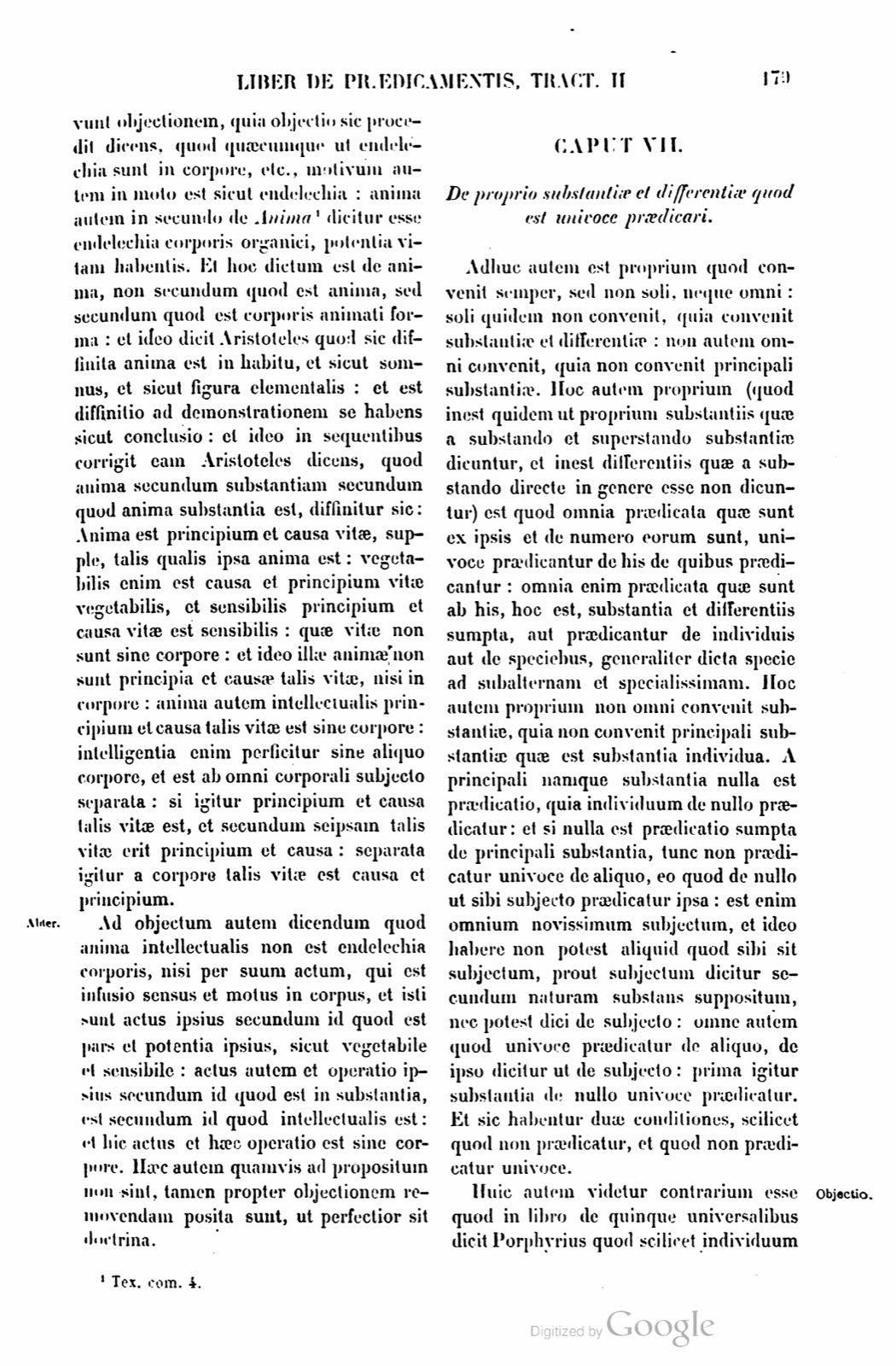
de uno solo, hoc est, de seipso prædicatur. Sed hoc in scientia quam de Universalibus scripsimus solutum est. Ibidem enim diximus quod aliquid prædicari de seipso naturali prædicatione non contingit, sive essentiali prædicatione. Quia in tali prædicatione prædicatum debet esse de ratione subjecti et principium constituendi et cognoscendi ipsum. Hoc autem non potest esse quando idem de seipso prædicatur. Eodem modo quando subjectum est de ratione prædicati, tunc subjectum est principium cognoscendi prædicatum: et hoc iterum esse non potest quando idem de se prædicatur: non enim potest esse nisi prædicatio per accidens si prædicatio est: non enim ibi prædicatur proprius effectus de causa. Sed per accidens non est prædicatio, quia nec prædicatum est accidens subjecti, nec subjectum est accidens prædicati. Et sic nec est prædicatio per se, nec per accidens: ergo nulla. Et hoc quidem verum est, quia quando individuum de se prædicatur, significatur idem sibi inesse: quod nullo modo potest intelligi: quia nihil inest sibiipsi, ut dicit Aristoteles 2. Sed quod dicit Porphyrius, intelligendum est de inordinata prædicatione, quæ non est universalis alicujus prædicatio: et tunc illa prædicatio reducitur ad artem, ut idem secundum id quo est intelligatur prædicari, et hoc est cum dicitur, hic homo est hic homo, vel Socrates est Socrates, ut sensus sit, quia hic homo secundum id quod est res naturæ est hic homo quo habet esse hominis, vel Socrates secundum quod est hic Socrates, est Socrates quo habet esse Socratis, hoc est, secundum quod est sub individuantibus significantibus ipsum esse Socratem. De talibus prædicationibus hic non loquimur.
Hoc autem modo loquendo, ut dicit Boetius, nullæ sunt propositiones veriores his, in quibus idem de seipso prædicatur: quia in talibus idem secundum id quo est de eo quod est prædicatur, esse enim quo est id quod est, ab eo quod est, inseparabile est per intellectum: et ideo semper est vera, et ut quidam dicunt, a nullo nisi a seipsa talis propositio suam habet veritatem: semper enim verum est hoc, homo est homo, domus est domus, quia esse in eo quod est, semper accipitur per intellectum, et ideo æterna est talium veritas propositionum, ut dicunt quidam.
Patet igitur qualiter est et qualiter non est a prima et principali substantia prædicatio. Quod autem univoce non prædicatur, facile probatur per hoc quod non habet aliquid sub se suppositum, in quo sit ut genus, vel differentia, quod causa est univocæ prædicationis. Cum autem aliquo modo de se prædicatur, non tamen prædicatur ut ens de ratione suiipsius, et sic univoce de se non potest prædicari.
Quod autem omnis prædicatio quæ sumitur de secundis substantiis et differentiis sit univoca, probatur per inductionem: quia quæcumque sunt de numero secundarum substantiarum, sunt species vel genera: et species quidem essentialiter prædicatur de pluribus differentibus numero solo, et hæc sunt individua: genera autem prædicantur et de speciebus et de individuis substantiali prædicatione, quia genus prædicatur de pluribus differentibus specie. Similiter etiam differentiæ prædicantur de speciebus et individuis specierum quas constituunt, sicut essentiæ formales quæ insunt speciebus et individuis: et quando species de primis substantiis prædicantur, tunc primæ substantiæ suscipiunt rationem specierum, quia species individuo dat nomen suum et rationem: et similiter quando genera de speciebus prædicantur et individuis, species suscipiunt rationes generum propter eamdem causam, quia per hoc quod genus essentialiter est in specie et actu et intellectu, genus speciei dat nomen suum et suam rationem per illam quæ præmissa est dignitatem, scilicet quod quando
is predicated of one alone, that is, of itself. But this was solved in the science which we wrote On the Universals. For there we said that for something to be predicated of itself does not happen by natural predication, or by essential predication. For in such predication the predicate must be of the account of the subject and the principle of constituting and knowing it. But this cannot be when the same thing is predicated of itself. In the same way, when the subject is of the account of the predicate, then the subject is the principle of knowing the predicate; and this again cannot be when the same thing is predicated of itself. For if there is predication, it can be only predication per accidens; for there the proper effect is not predicated of the cause. But there is not predication per accidens, because neither is the predicate an accident of the subject, nor is the subject an accident of the predicate. And thus there is neither predication per se nor per accidens; therefore there is none. And this indeed is true, because when an individual is predicated of itself, the same thing is signified to be in itself, which can in no way be understood, because nothing is in itself, as Aristotle says 2. But what Porphyry says must be understood of inordinate predication, which is not some universal predication; and then that predication is reduced to art, so that the same thing is understood to be predicated according to that by which it is. And this is when it is said, this man is this man, or Socrates is Socrates, so that the sense is that this man according to that which is a thing of nature is this man by which he has the being of man; or Socrates, according as he is this Socrates, is Socrates by which he has the being of Socrates, that is, according as he is under the individuating things signifying him to be Socrates. We are not speaking here of such predications.
But speaking in this mode, as Boethius says, no propositions are truer than these in which the same thing is predicated of itself, because in such propositions the same thing is predicated according to that by which it is of that which it is. For the being by which that which is is, is inseparable by the intellect from that which is; and therefore it is always true, and, as certain persons say, such a proposition has its truth from nothing except from itself. For this is always true, man is man, house is house, because being in that which is is always received by the intellect, and therefore the truth of such propositions is eternal, as certain persons say.
Therefore it is clear in what way there is predication from first and principal substance and in what way there is not. But that it is not predicated univocally is easily proved through this, that it does not have something supposed under itself, in which it would be as genus or difference, which is the cause of univocal predication. But when it is predicated of itself in some mode, nevertheless it is not predicated as a being of the account of itself, and thus it cannot be predicated univocally of itself.
But that every predication which is taken from second substances and differences is univocal is proved by induction: because whatever things are of the number of second substances are species or genera; and species indeed is predicated essentially of many things differing only in number, and these are individuals. But genera are predicated both of species and of individuals by substantial predication, because genus is predicated of many things differing in species. Similarly also differences are predicated of species and of the individuals of the species which they constitute, as formal essences which are in species and individuals; and when species are predicated of first substances, then first substances receive the account of species, because species gives its name and account to the individual. And similarly when genera are predicated of species and individuals, species receive the accounts of genera for the same reason, because through the fact that genus is essentially in the species both in act and in understanding, the genus gives its name and its account to the species through that dignity which was set down before, namely that when
If a page does not appear, its photograph has not been uploaded yet.