Volume 1 · pp. 176–178
Chapter VI. On this common feature of substance, that it is not in a subject
quia de speciebus et generibus omnia reliqua accidentalia prædicata, prædicantur per modum qui supra determinatus est: aliquem enim hominem dices esse grammaticum, ergo et hominem et animal grammaticum dicis, sicut nuper ante probatum est: similiter etiam est in aliis accidentalibus prædicatis. Secundum igitur locum in substando species habent et genera: ideo secundæ dicuntur substantiæ, et omnes dicuntur substantiæ, et nullæ tertiæ vel quartæ.
CAPUT VI. De hoc communi substantiæ quod est in subjecto non esse.
His determinatis de principalibus et secundis substantiis, jam nunc proprietates sive passiones genus substantiæ consequentes relinquitur determinare. Tangemus igitur prius proprietates quæcumque substantiæ conveniunt in quantum est in prædicabilibus, quia illæ sunt huic nostræ intentioni magis propriæ. Quia vero proprium est conveniens omni et semper, ideo ea quæ proprie dicuntur esse toti generi et toti coordinationi substantiæ, sunt speciebus et generibus communia.
Dicamus igitur quod commune est omni substantiæ in subjecto non esse eo modo quo accidens est in subjecto. Jam enim ante distinximus quod subjectum dicitur secundum nomen, idem quod subtus jactum sive suppositum, et sic natura communis in suo inferiori est sicut in subjecto, sicut genus in specie, et species in individuo, et universaliter secunda substantia in inferiori et particulari. Dicitur autem subjectum ens in se completum, quod est accidentis vel alterius causa existendi in eo: et hoc modo non nisi accidens est in subjecto: et sic omni substantiæ tam secundæ quam primæ commune est in subjecto non esse.
Hoc autem patet inductione. Principalis substantia quæ est particulare substantiæ, neque de subjecto dicitur, quia nihil sibi substat ut suppositum, neque est in subjecto sicut accidens esse est in subjecto esse, quia est per se existens. Secundarum vero substantiarum similiter manifestum est quod nulla est in subjecto sic dicto subjecto quod est ens completum, quod alii dat esse in seipso, quod esse non habet nisi insit ei: homo enim qui est substantia secunda dicitur quidem de subjecto, prout suppositum dicitur subjectum quando de aliquo homine prædicatur, ut cum dicitur, aliquis homo est homo. Sed non est in aliquo homine ut in subjecto, prout subjectum dicit ens completum, alii dans esse per hoc quod est in ipso et non haberet esse nisi in ipso esset. Cujus probatio est: quia sicut homo quod est secunda substantia non est in aliquo homine, ita quod accipiat ab aliquo homine esse, quod non haberet nisi in ipso esset: homo enim prout substantia secunda et species est esse individuorum et esse alicujus hominis, dans esse particularibus, et ideo impossibile est quod esse accipiat propter hoc quod insit eis. Similiter autem et animal quod est substantia secunda ut genus, de subjecto quidem dicitur de aliquo homine vel aliquo animali, sed non inest alicui animali vel homini ut accidens in subjecto.
Et secundum hoc patet quod si fiat talis argumentatio, scilicet, substantia secunda est in prima, et prima substantia est subjectum secundæ: ergo est in ea sicut in subjecto: peccat secundum fallaciam æquivocationis, quia substantia in prima stat pro supposito, in conclusione autem stat pro subjecto in se completo quod est subjectum accidentis.
Amplius, sicut ante habitum est, eorum quidem quæ in subjecto sunt ut accidens est in subjecto, nomen quidem nil prohibet aliquando prædicari de subjecto in quo sunt, rationem vero eorum prædicari de subjecto, ita quod prædicetur ut ratio subjecti, est impossibile, sicut ante ostensum est. Secundarum vero substantiarum prædicatur de subjecto quod est suppositum, et nomen et ratio diffinitiva: quod patet, quia nomen hominis quod est
because concerning species and genera all the remaining accidental predicates are predicated in the mode that was determined above: for you will say that some man is grammatical; therefore you say that both man and animal are grammatical, as was proved a little before; similarly also it is so in other accidental predicates. Therefore species and genera have the second place in underlying; for this reason they are called second substances, and all are called substances, and none are third or fourth.
CHAPTER VI. On this common feature of substance, that it is not in a subject.
These things having been determined concerning principal and second substances, now at this point it remains to determine the properties or passions consequent upon the genus of substance. Therefore first we shall touch on whatever properties belong to substance insofar as it is among the predicables, because those are more proper to this intention of ours. But because a property is what belongs to every instance and always, therefore the things which are properly said to belong to the whole genus and to the whole coordination of substance are common to species and genera.
Therefore let us say that it is common to every substance not to be in a subject in that mode in which an accident is in a subject. For before we distinguished that subject is said according to the name, the same as what is cast beneath or a supposit, and in this way a common nature is in its inferior as in a subject, as genus is in species, and species in an individual, and universally second substance in an inferior and particular. But subject is said of a being complete in itself, which is the cause for an accident, or for another thing, of existing in it; and in this mode nothing except an accident is in a subject, and thus it is common to every substance, both second and first, not to be in a subject.
But this is clear by induction. Principal substance, which is a particular of substance, is neither said of a subject, because nothing underlies it as a supposit, nor is it in a subject as the being of an accident is to be in a subject, because it is existing through itself. But concerning second substances it is similarly manifest that none is in a subject, with subject so called, which is a complete being that gives being to another in itself, which does not have being unless it is in it: for man, which is a second substance, is indeed said of a subject, insofar as the supposit is called the subject when it is predicated of some man, as when it is said, some man is man. But it is not in some man as in a subject, insofar as subject means a complete being giving being to another through this, that it is in it and would not have being unless it were in it. The proof of this is that, just as man, which is a second substance, is not in some man in such a way that it receives being from some man, which it would not have unless it were in him, for man, insofar as it is a second substance and species, is the being of individuals and the being of some man, giving being to particulars, and therefore it is impossible that it receive being on account of the fact that it is in them. Likewise also animal, which is a second substance as genus, is indeed said of a subject, of some man or some animal, but it is not in some animal or man as an accident in a subject.
And according to this it is clear that if such an argumentation is made, namely, second substance is in first substance, and first substance is the subject of second substance; therefore it is in it as in a subject, it sins according to the fallacy of equivocation, because substance in the first premise stands for the supposit, but in the conclusion it stands for a subject complete in itself, which is the subject of an accident.
Further, as was held before, concerning those things which are in a subject as an accident is in a subject, the name indeed sometimes does not prevent being predicated of the subject in which they are, but for their definition to be predicated of the subject, so that it is predicated as the definition of the subject, is impossible, as was shown before. But of second substances, there is predicated of the subject which is the supposit both the name and the definitive account; this is clear, because the name of man, which is
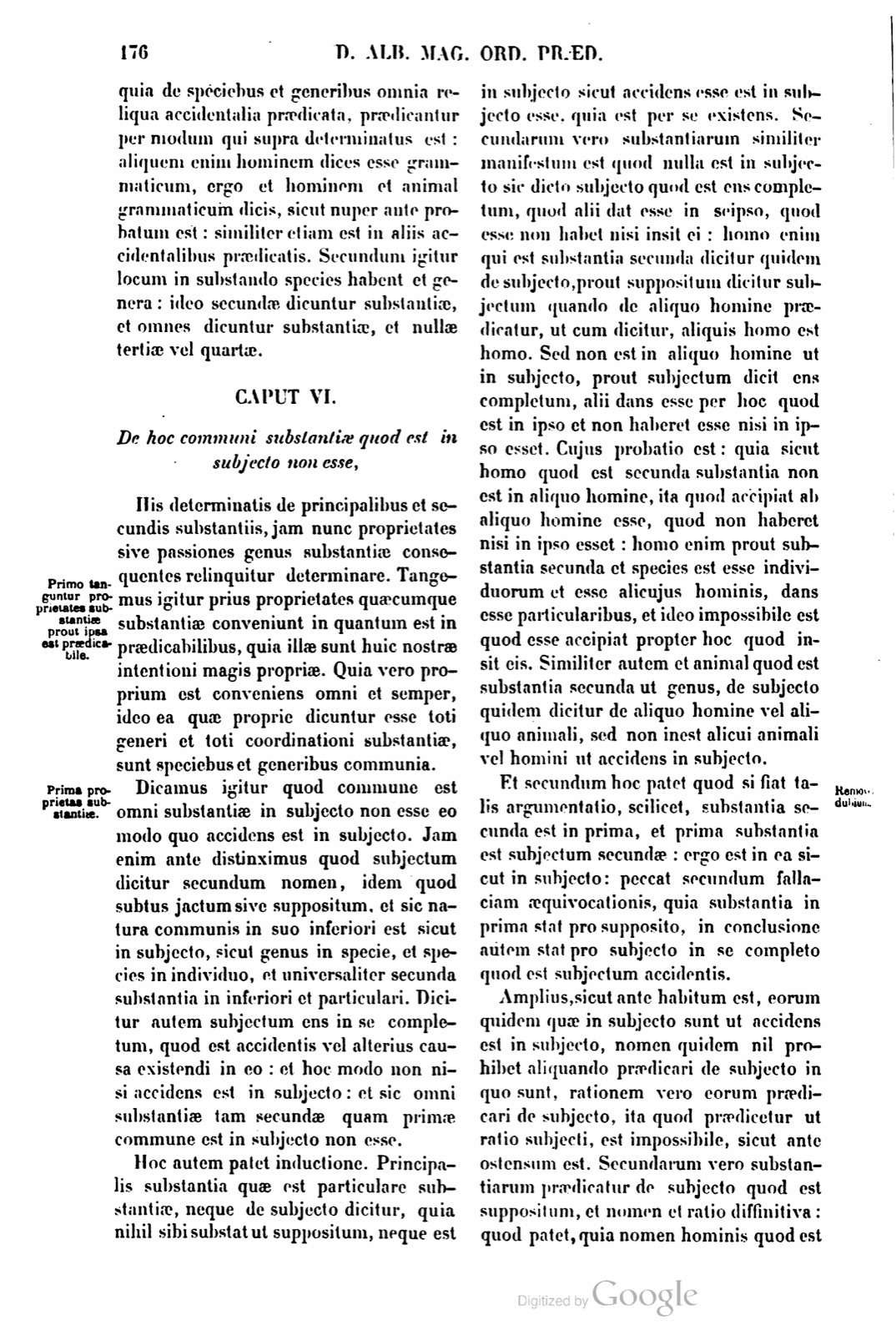
substantia secunda prædicatur de aliquo homine, aliquis enim homo est homo: et ratio similiter, quia aliquis homo est animal rationale et mortale: igitur secunda substantia non est de numero eorum quæ in subjecto sunt sicut accidens est in subjecto.
Hoc autem quod est in subjecto non esse, est quidem proprium quod convenit omni substantiæ et semper, sed non convenit soli: convenit enim etiam differentiæ quæ in prædicamento substantiæ secundum rectam lineam prædicabilium in superstando et substando non est: differentia enim in subjecto non est: bipes enim et gressibile, quæ sunt differentiæ animalis mobilis divisivæ, et speciei hominis differentiæ constitutivæ, dicuntur et prædicantur de subjecto in quo sunt quod est subjectum, ut suppositum de homine: in subjecto autem nullo sunt, prout subjectum in se completum dat esse accidenti quod est in potentia: differentia enim in specie dat esse actu speciei: quia, sicut in scientia Universalium determinatum est, differentia est quod ad esse conducit et quod ejus quod est esse rei pars est: igitur nec bipes nec gressibile in homine est, ita quod per inesse accipiat quod sit: confert enim speciei esse differentia, et non accipit ab ipsa: si enim acciperet esse a subjecta sibi specie, oporteret quod species acciperetur in diffinitione differentiæ sicut subjectum recipitur in diffinitione accidentis: hoc autem non fit: sed potius differentia recipitur in diffinitione speciei: patet igitur quod non inest speciei ut accidens. Adhuc autem de quocumque prædicatur differentia ut de subjecto nomine, de eodem prædicatur ratio sive diffinitio differentiæ, sicut patet exemplo: quia si gressibile de homine dicitur sive prædicatur, tunc etiam ratio diffinitiva gressibilis de homine prædicatur, quæ est pedibus esse mobile voluntate sive appetitu secundum processivum motum: est enim homo gressibilis, homo mobilis voluntate motu processivo.
Potest autem hic oriri dubium, utrum differentia sit substantia? Videtur enim ipsam non esse substantiam propter hoc quod dicitur, hoc quod est in subjecto non esse, non soli substantiæ convenit sed etiam differentiæ: per hoc enim videtur differentiam substantiam non esse.
Sed hoc jam in scientia Universalium sufficienter determinatum est. Est enim differentia illa quæ magis proprie differentia est, secundum id quod est et secundum suam naturam substantia, quæ est forma substantialis, quæ dat esse actu substantiæ toti, et hoc modo totius esse: quod autem est notio designans totum esse in actu, differentia est, et ideo de toto prædicatur. Si tamen differentia prout relata ad genus consideratur, cujus qualitas est in ipsius potestate consistens, sic se habet ad genus ut perfectum esse generis consequens, et ideo in hac comparatione comparatur ad genus ut qualitas accidentis inseparabilis: quæ tamen qualitas secundum naturam qualitatis qualitas non est, sed est qualitas essentialis propter hoc quod generis potentia est potentia imperfecti, cujus imperfectio ad actum perficitur determinata potentia generis per conjunctam sibi differentiam: et hoc modo substantialis forma est habens modum qualitatis. Comparata autem ad speciem quam in suo esse constituit, qualitas est etiam essentialis et substantia, quia nihil constituit in esse nisi substantia: et quia sic habet modum qualitatis et effectum substantiæ, ideo non secundum suam totam rationem substantia est. Et quia est simplex et non composita, ideo in directa linea coordinationis prædicabilium substantiæ cadere non potest secundum ordinem superstandi et substandi: quia non respicit ad genus substantiæ, sicut ad sui esse principium, ideo per se genus esse non potest: prima enim genera sunt prima rerum principia. Respiciens autem ad aliud ut ad sui principium in quo est, primum principium esse non potest, et sic non potest esse genus. Cum ergo respiciat ad genus
second substance is predicated of some man, for some man is man; and the account similarly, because some man is a rational and mortal animal. Therefore second substance is not of the number of those things which are in a subject as an accident is in a subject.
But this, not to be in a subject, is indeed a property which belongs to every substance and always, but it does not belong to it alone: for it also belongs to difference, which is not in the predicament of substance according to the straight line of the predicables in standing-over and underlying. For difference is not in a subject: for biped and capable of walking, which are divisive differences of mobile animal and constitutive differences of the species man, are said and predicated of the subject in which they are, which is subject as a supposit, namely of man; but they are in no subject insofar as a subject complete in itself gives being to an accident which is in potency. For difference gives to the species being in act in the species: because, as was determined in the science of the Universals, difference is that which leads to being and which is part of the being of the thing that is. Therefore neither biped nor capable of walking is in man in such a way that through being-in it receives that it is; for difference confers being on the species, and does not receive being from it. For if it received being from the species subjected to it, the species would have to be received in the definition of difference as subject is received in the definition of an accident; but this does not happen; rather difference is received in the definition of the species. Therefore it is clear that it is not in the species as an accident. Moreover, of whatever thing difference is predicated as of a subject by name, of the same thing the account or definition of the difference is predicated, as is clear by example: because if capable of walking is said or predicated of man, then also the definitive account of capable of walking is predicated of man, which is to be movable by feet through will or appetite according to progressive motion; for man is capable of walking, man is movable by will with progressive motion.
But here a doubt can arise, whether difference is substance. For it seems that it is not substance on account of what is said: this, not to be in a subject, belongs not to substance alone but also to difference; for through this it seems that difference is not substance.
But this has already been sufficiently determined in the science of the Universals. For that difference which is more properly difference is, according to that which it is and according to its own nature, substance, which is substantial form, which gives being in act to the whole substance, and in this mode gives the being of the whole; but that which is a notion designating the whole being in act is difference, and therefore it is predicated of the whole. Yet if difference is considered insofar as it is related to genus, whose quality consists in its potency, in this way it is related to genus as the perfected being consequent upon the genus, and therefore in this comparison it is compared to genus as the quality of an inseparable accident. Yet this quality is not a quality according to the nature of quality, but is an essential quality, because the potency of the genus is the potency of an imperfect thing, whose imperfection is perfected to act once the potency of the genus has been determined through the difference joined to it; and in this mode substantial form has the mode of quality. But compared to the species which it constitutes in its own being, it is also an essential quality and substance, because nothing constitutes in being except substance; and because thus it has the mode of quality and the effect of substance, therefore it is not substance according to its whole account. And because it is simple and not composed, therefore it cannot fall in the direct line of the coordination of the predicables of substance according to the order of standing-over and underlying, because it does not look to the genus of substance as to the principle of its being; therefore it cannot through itself be a genus. For the first genera are the first principles of things. But looking to another as to its own principle in which it is, it cannot be a first principle, and thus it cannot be a genus. Therefore, since it looks to genus
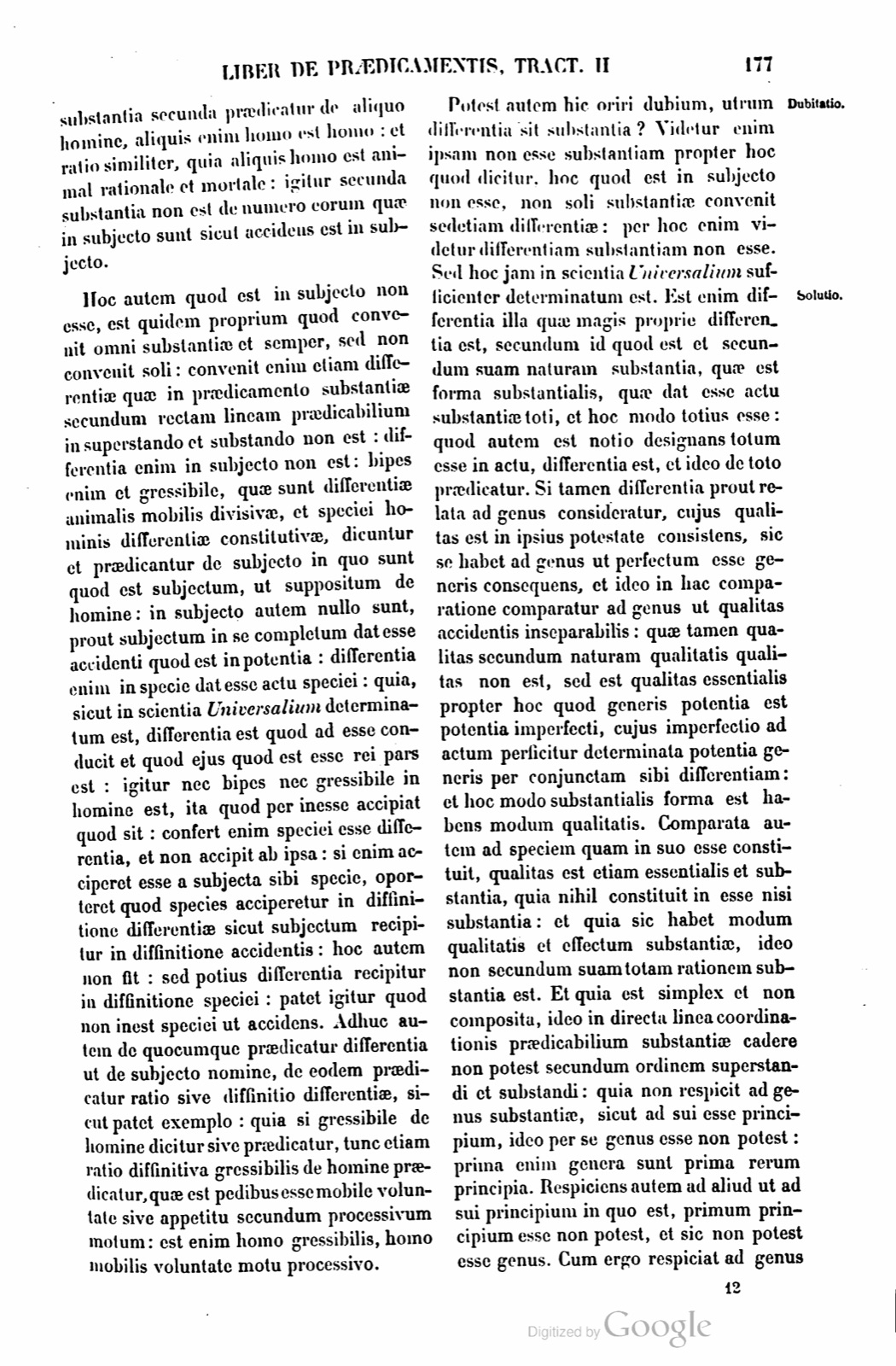
non sicut generi suppositum, sed sicut ad id in quo est sicut in potestate naturali, relinquitur necessario quod sit in linea laterali, et ideo neque in genere est, neque omnino extranea et separata a genere. Et hujus quidem doctrinam in scientia Universalium tradidimus in tractatu de Differentia: sed in tantum hic dicimus, in quantum intentioni præsenti est necessarium. Quia igitur in genere substantiæ non est, propter hoc dicitur quod in subjecto non esse non solum convenit substantiæ, sed etiam differentiæ.
Sed est aliquid quod conturbare posset secundum hanc doctrinam: ita quod aliquis posset moveri de substantiarum principalium partibus, ut est manus, pes et hujusmodi, vel etiam sicut materia et forma, ex quibus fit substantia composita: illæ enim partes in substantia composita videntur esse sicut in subjecto: non enim habent esse partium nisi in composito, manus enim abscissa non est manus: et ita forte aliquis putaret, quod secundum hanc doctrinam cogamur multipliciter eas dicere non esse substantias et conversim, per hanc rationem quod non sint sicut substantiæ. Ea enim quæ tanquam partes essentiales vel integrales sunt in aliquo, per hoc quod sic sunt in toto, non habent esse in subjecto: est enim alius modus essendi aliquid in aliquo sicut pars in toto, et alius modus essendi in aliquo sicut accidens in subjecto, ut in quarto Physicorum determinatur.
Sciendum tamen est quod pars non est in actu nisi quando est in toto: sed est in potentia pars et non secundum actum quando non est in toto, et sic a toto accipit actum et rationem: actus autem ipsius et forma est operatio ipsius quam habet secundum formam, sicut oculi videre, et radicis alimentum trahere, et folii fructum a caumate defendere, et manus opus intellectus imperatum perficere, et hujusmodi: et potestates adhuc partes habent in toto, et non habent quando in toto non sunt: et ideo abscissæ partes, æquivoce nomina illa recipiunt quæ habent in toto: sed quod in toto aliquo modo recipiunt nomen et rationem, est a toto: hoc autem non facit accidens quando est in toto ut in subjecto. Et ideo æquivocatio est quando dicitur pars in toto, et quando dicitur accidens esse in toto: accidens enim non est forma partis sed totius, quia subjectum accidentis est ens in se completum: completum autem est totum compositum. Est autem adhuc etiam dissimilitudo, quia partes in toto sive sint essentiales sive integrales, totum constituunt secundum esse, et ideo substantiæ sunt totius: accidens enim non est in toto sicut constituens ipsum secundum substantiam, sed est sicut constitutivum in esse quomodocumque per substantiam, et ideo in diffinitione accidentis recipitur subjectum sicut causa est accidentis: in diffinitione autem compositi recipiuntur partes sicut principia cognoscendi totum: quia eadem sunt principia cognoscendi et essendi, sicut dicitur in principio Physicorum 1: dicit autem Aristoteles quod compositum et totum cognoscimus cum scimus ex quibus, et quot, et ex qualibus est.
Ex his autem quidam errantes objiciunt, ut dicit Gregorius Nyssenus, Quæcumque ut endelechia sunt in aliquo, aut ut accidens sunt in aliquo, aut sicut forma materialis quæ habet esse extra ipsam: anima autem ut endelechia habet esse in corpore: aut ergo est in ipso sicut accidens in subjecto, aut sicut forma materialis: et quodcumque horum detur, sequitur quod non habet esse nisi in corpore, et non habet esse extra ipsum. Ad hoc autem quidam respondere nituntur dicentes, quod anima habet esse in corpore sicut motivum in moto, sicut rex in regno, et nauta in navi, et ideo separabilis est a corpore, et separata habet esse in seipsa.
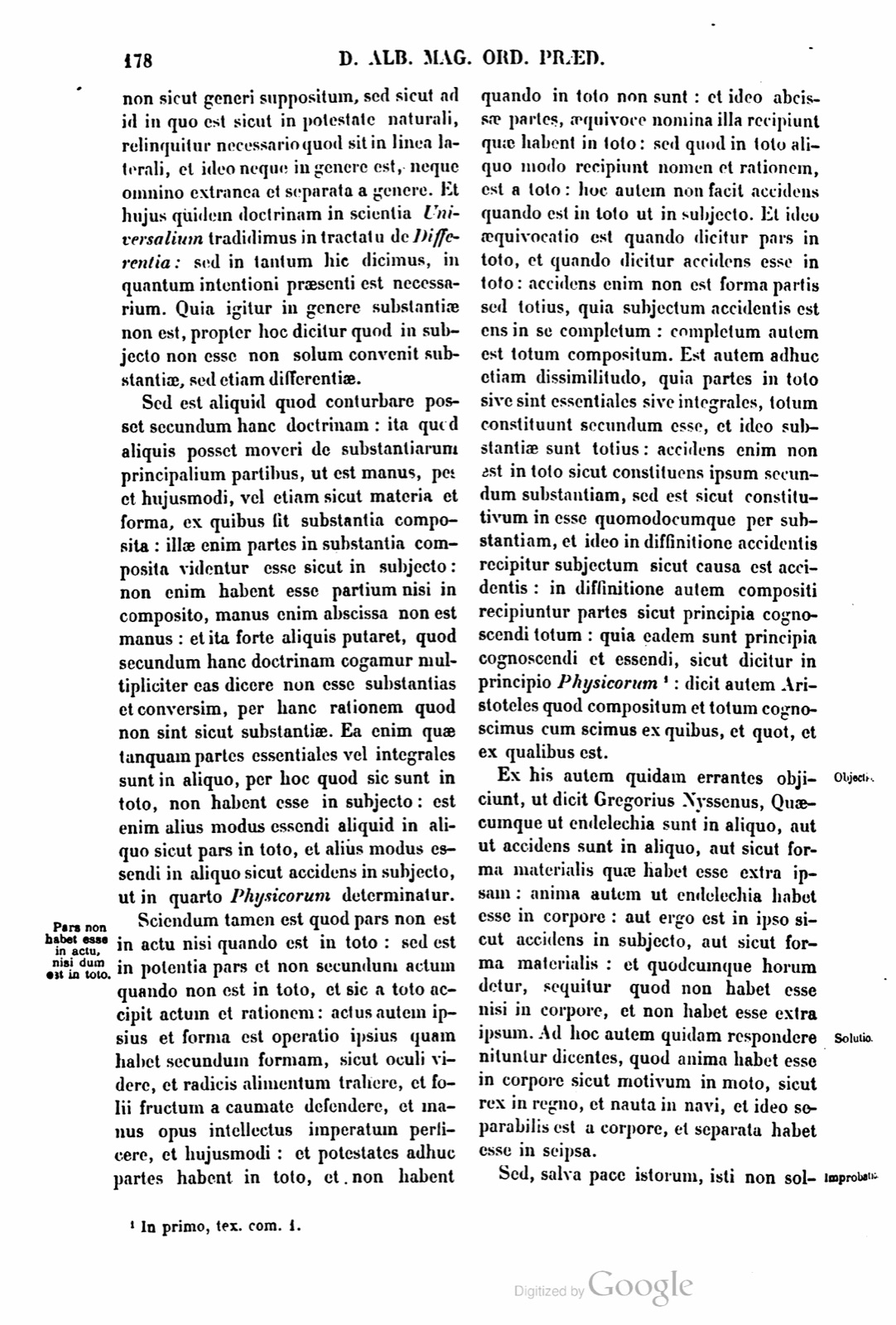
Sed, salva pace istorum, isti non
not as something supposed under a genus, but as to that in which it is as in a natural potency, it follows necessarily that it is in a lateral line, and therefore it is neither in the genus nor wholly extraneous and separated from the genus. And we have handed down the doctrine of this in the science of the Universals in the treatise On Difference; but we speak here only so far as is necessary for the present intention. Therefore because it is not in the genus of substance, on account of this it is said that not to be in a subject belongs not only to substance but also to difference.
But there is something that could disturb one according to this doctrine: so that someone could be moved concerning the parts of principal substances, such as hand, foot, and things of this sort, or even concerning matter and form, from which composite substance comes to be. For those parts in composite substance seem to be as in a subject; for they do not have the being of parts except in the composite, for a hand cut off is not a hand. And thus perhaps someone would think that, according to this doctrine, we are compelled in many ways to say that they are not substances, and conversely, through this reason, that they are not as substances. For those things which are in something as essential or integral parts, through the fact that they are thus in the whole, do not have being in a subject: for there is one mode for something to be in something as a part in a whole, and another mode for being in something as an accident in a subject, as is determined in the fourth book of the Physics.
Nevertheless one must know that a part is not in act except when it is in the whole; but it is a part in potency and not according to act when it is not in the whole, and thus it receives act and account from the whole. But its act and form is its operation which it has according to form, as seeing belongs to the eye, drawing nourishment to the root, defending the fruit from burning heat to the leaf, and carrying out the work commanded by intellect to the hand, and things of this sort. And besides, parts have powers in the whole, and do not have them when they are not in the whole; and therefore cut-off parts receive equivocally those names which they have in the whole. But that in the whole they receive the name and account in some way is from the whole; however an accident does not do this when it is in the whole as in a subject. And therefore there is equivocation when a part is said to be in a whole, and when an accident is said to be in a whole; for an accident is not the form of the part but of the whole, because the subject of an accident is a being complete in itself; but the complete is the whole composite. There is, moreover, also this dissimilarity: because parts in the whole, whether they are essential or integral, constitute the whole according to being, and therefore they are substances of the whole; for an accident is not in the whole as constituting it according to substance, but is as something constitutive in being in whatever way through substance, and therefore in the definition of an accident the subject is received as the cause of the accident; but in the definition of a composite the parts are received as principles of knowing the whole, because the principles of knowing and of being are the same, as is said at the beginning of the Physics 1. But Aristotle says that we know the composite and whole when we know from what things, and how many, and from what qualities it is.
But from these things certain erring persons object, as Gregory of Nyssa says: Whatever things are in something as endelechy are either in something as an accident, or as a material form which has being outside itself. But the soul as endelechy has being in a body; therefore either it is in it as an accident in a subject, or as a material form; and whichever of these is granted, it follows that it does not have being except in the body, and does not have being outside it. But to this certain persons try to respond, saying that the soul has being in the body as the mover in the moved, as a king in a kingdom and a sailor in a ship, and therefore it is separable from the body and, when separated, has being in itself.
But, with peace granted to those men, those men do not
Notes
- In the first book, text, commentary 1. (In primo, tex. com. 1.) ↩
If a page does not appear, its photograph has not been uploaded yet.