Volume 1 · pp. 174–175
Chapter V. That species are substances more than genera, but not so a most special species with respect to another most special species
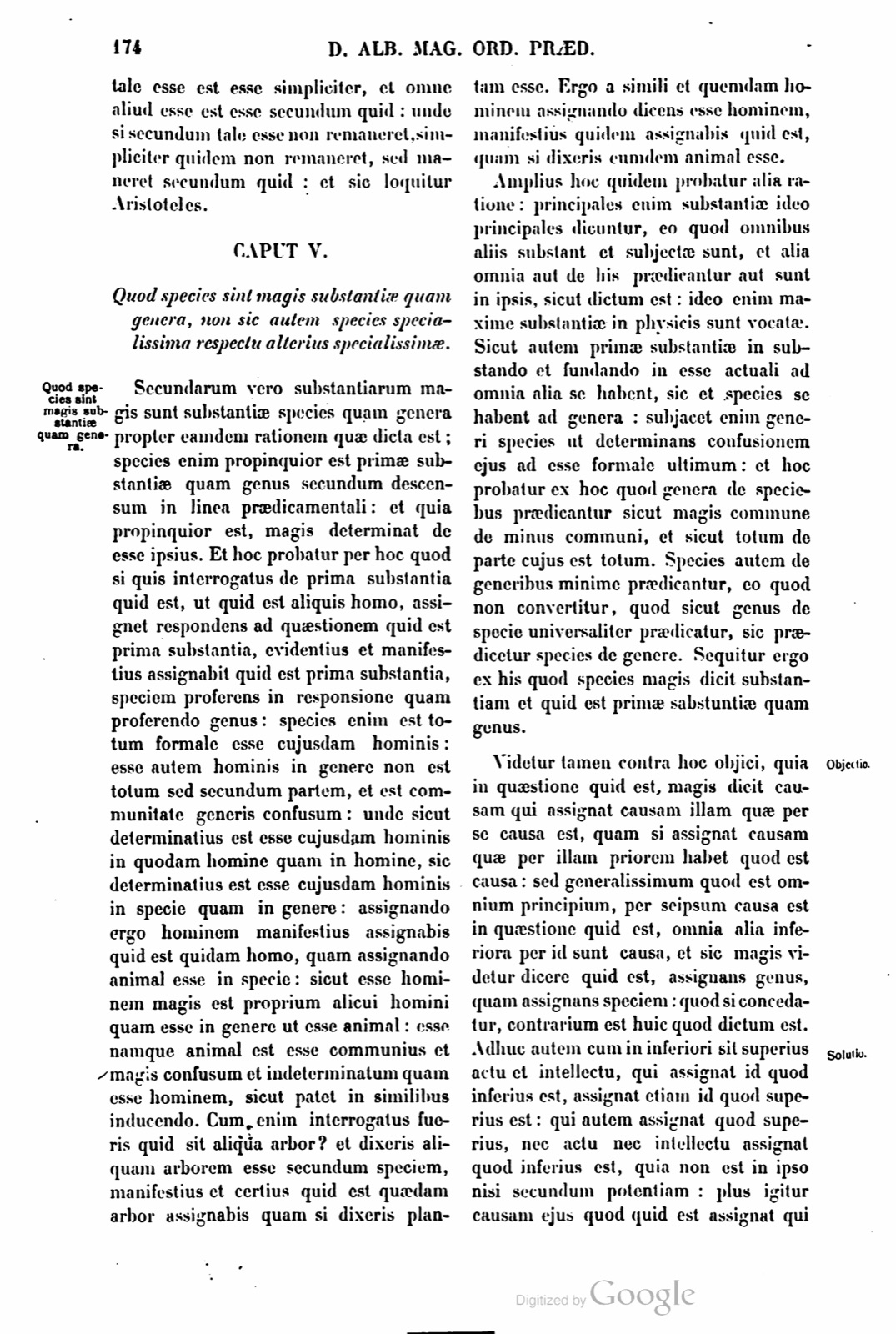
tale esse est esse simpliciter, et omne aliud esse est esse secundum quid: unde si secundum tale esse non remaneret, simpliciter quidem non remaneret, sed maneret secundum quid: et sic loquitur Aristoteles.
CAPUT V. Quod species sint magis substantiæ quam genera, non sic autem species specialissima respectu alterius specialissimæ.
Secundarum vero substantiarum magis sunt substantiæ species quam genera propter eamdem rationem quæ dicta est; species enim propinquior est primæ substantiæ quam genus secundum descensum in linea prædicamentali: et quia propinquior est, magis determinat de esse ipsius. Et hoc probatur per hoc quod si quis interrogatus de prima substantia quid est, ut quid est aliquis homo, assignet respondens ad quæstionem quid est prima substantia, evidentius et manifestius assignabit quid est prima substantia, speciem proferens in responsione quam proferendo genus: species enim est totum formale esse cujusdam hominis: esse autem hominis in genere non est totum sed secundum partem, et est communitate generis confusum: unde sicut determinatius est esse cujusdam hominis in quodam homine quam in homine, sic determinatius est esse cujusdam hominis in specie quam in genere: assignando ergo hominem manifestius assignabis quid est quidam homo, quam assignando animal esse in specie: sicut esse hominem magis est proprium alicui homini quam esse in genere ut esse animal: esse namque animal est esse communius et magis confusum et indeterminatum quam esse hominem, sicut patet in similibus inducendo. Cum enim interrogatus fueris quid sit aliqua arbor? et dixeris aliquam arborem esse secundum speciem, manifestius et certius quid est quædam arbor assignabis quam si dixeris plantam esse. Ergo a simili et quemdam hominem assignando dicens esse hominem, manifestius quidem assignabis quid est, quam si dixeris eumdem animal esse.
Amplius hoc quidem probatur alia ratione: principales enim substantiæ ideo principales dicuntur, eo quod omnibus aliis substant et subjectæ sunt, et alia omnia aut de his prædicantur aut sunt in ipsis, sicut dictum est: ideo enim maxime substantiæ in physicis sunt vocatæ. Sicut autem primæ substantiæ in substando et fundando in esse actuali ad omnia alia se habent, sic et species se habent ad genera: subjacet enim generi species ut determinans confusionem ejus ad esse formale ultimum: et hoc probatur ex hoc quod genera de speciebus prædicantur sicut magis commune de minus communi, et sicut totum de parte cujus est totum. Species autem de generibus minime prædicantur, eo quod non convertitur, quod sicut genus de specie universaliter prædicatur, sic prædicetur species de genere. Sequitur ergo ex his quod species magis dicit substantiam et quid est primæ substantiæ quam genus.
Videtur tamen contra hoc objici, quia in quæstione quid est, magis dicit causam qui assignat causam illam quæ per se causa est, quam si assignat causam quæ per illam priorem habet quod est causa: sed generalissimum quod est omnium principium, per seipsum causa est in quæstione quid est, omnia alia inferiora per id sunt causa, et sic magis videtur dicere quid est, assignans genus, quam assignans speciem: quod si concedatur, contrarium est huic quod dictum est.
Adhuc autem cum in inferiori sit superius actu et intellectu, qui assignat id quod inferius est, assignat etiam id quod superius est: qui autem assignat quod superius, nec actu nec intellectu assignat quod inferius est, quia non est in ipso nisi secundum potentiam: plus igitur causam ejus quod quid est assignat qui
such being is being simply, and every other being is being in a certain respect. Hence if it did not remain according to such being, it would not indeed remain simply, but it would remain in a certain respect; and Aristotle speaks in this way.
CHAPTER V. That species are substances more than genera, but not so a most special species with respect to another most special species.
Now among second substances, species are substances more than genera, on account of the same reason that has been stated; for species is nearer to first substance than genus is according to the descent in the categorial line, and because it is nearer, it determines more concerning its being. This is proved through this: if someone, when asked what first substance is, as what some man is, answers the question what is first substance, he will assign what first substance is more evidently and more manifestly by putting forward the species in his response than by putting forward the genus. For species is the whole formal being of some man, whereas the being of man in the genus is not the whole but according to part, and is confused by the commonness of the genus. Hence, just as the being of some man in some man is more determinate than in man, so the being of some man in the species is more determinate than in the genus. Therefore by assigning man you will more manifestly assign what some man is than by assigning animal to be in the species; just as being man is more proper to some man than being in the genus as being animal. For being animal is a more common, more confused, and more indeterminate being than being man, as is clear by induction in similar cases. For when you have been asked what some tree is, and you have said that some tree is according to its species, you will assign more manifestly and certainly what some tree is than if you said that it is a plant. Therefore by likeness, by assigning some man and saying that he is man, you will indeed assign more manifestly what he is than if you said that the same one is animal.
Moreover this is proved by another reason: principal substances are called principal because they underlie all other things and are subjected, and all other things are either predicated of these or are in them, as has been said; for because of this they have been called substances most of all by the natural philosophers. But just as first substances are related to all other things in underlying and founding in actual being, so species are related to genera: for the species underlies the genus as determining its confusion to ultimate formal being. And this is proved from the fact that genera are predicated of species as the more common of the less common, and as the whole of the part of which it is the whole. But species are least of all predicated of genera, because it is not converted, that just as genus is predicated universally of species, so species would be predicated of genus. Therefore from these things it follows that species says substance and what first substance is more than genus does.
Yet there seems to be an objection against this, because in the question what is it, the one who assigns the cause which is a cause through itself says the cause more than if he assigns a cause which has from that prior cause that it is a cause. But the most general thing, which is the principle of all, is through itself the cause in the question what is it; all other lower things are a cause through it, and so the one assigning the genus seems more to say what it is than the one assigning the species. If this is conceded, it is contrary to what has been said here.
Moreover, since the superior is in the inferior in act and in understanding, the one who assigns that which is lower also assigns that which is higher; but the one who assigns what is higher assigns neither in act nor in understanding that which is lower, because it is in it only according to potency. Therefore the one who
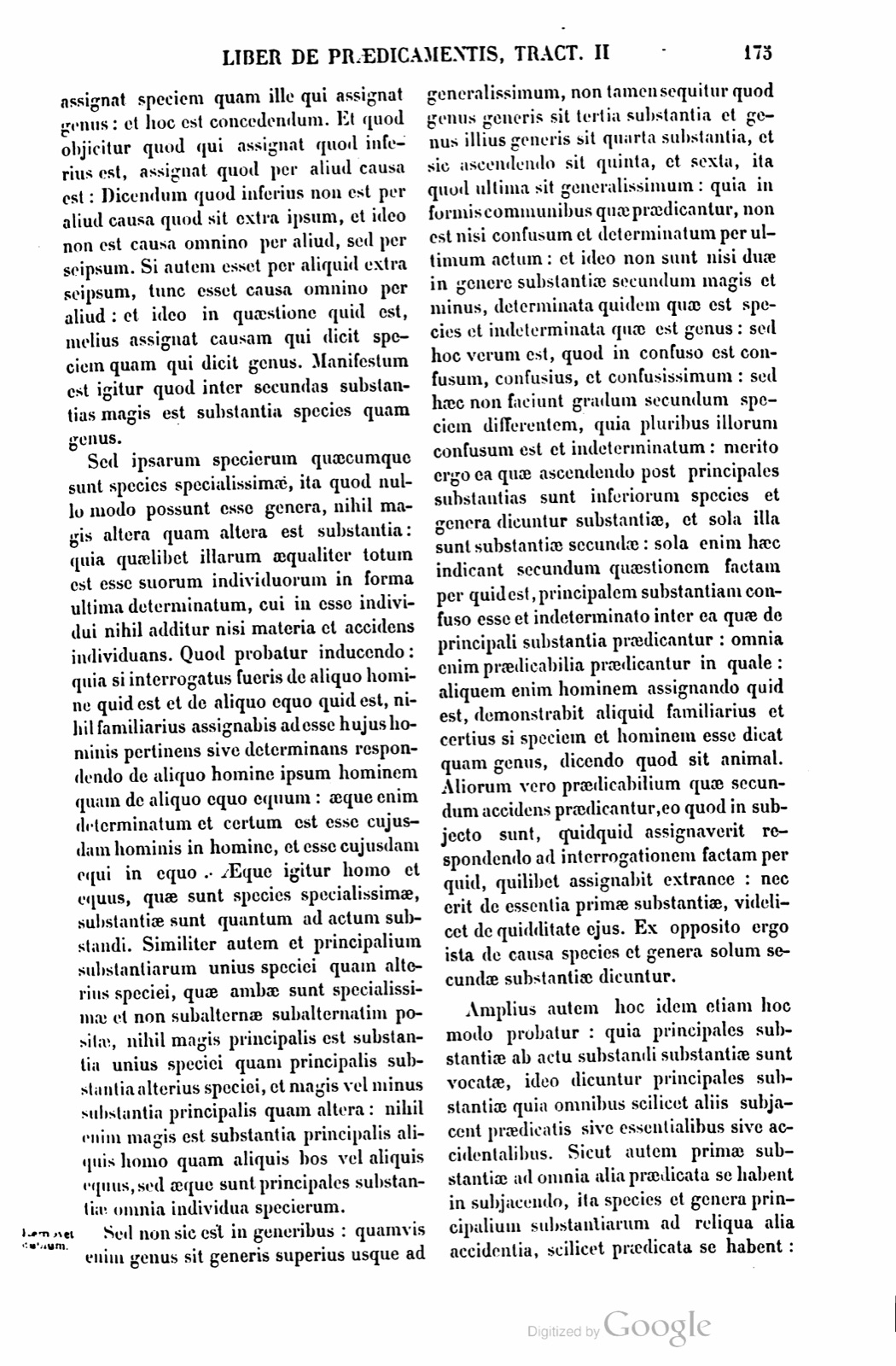
assignat speciem quam ille qui assignat genus: et hoc est concedendum. Et quod objicitur quod qui assignat quod inferius est, assignat quod per aliud causa est: dicendum quod inferius non est per aliud causa quod sit extra ipsum, et ideo non est causa omnino per aliud, sed per seipsum. Si autem esset per aliquid extra seipsum, tunc esset causa omnino per aliud: et ideo in quæstione quid est, melius assignat causam qui dicit speciem quam qui dicit genus. Manifestum est igitur quod inter secundas substantias magis est substantia species quam genus.
Sed ipsarum specierum quæcumque sunt species specialissimæ, ita quod nullo modo possunt esse genera, nihil magis altera quam altera est substantia: quia quælibet illarum æqualiter totum est esse suorum individuorum in forma ultima determinatum, cui in esse individui nihil additur nisi materia et accidens individuans. Quod probatur inducendo: quia si interrogatus fueris de aliquo homine quid est et de aliquo equo quid est, nihil familiarius assignabis ad esse hujus hominis pertinens sive determinans respondendo de aliquo homine ipsum hominem quam de aliquo equo equum: æque enim determinatum et certum est esse cujusdam hominis in homine, et esse cujusdam equi in equo. Æque igitur homo et equus, quæ sunt species specialissimæ, substantiæ sunt quantum ad actum substandi. Similiter autem et principalium substantiarum unius speciei quam alterius speciei, quæ ambæ sunt specialissimæ et non subalternæ subalternatim positæ, nihil magis principalis est substantia unius speciei quam principalis substantia alterius speciei, et magis vel minus substantia principalis quam altera: nihil enim magis est substantia principalis aliquis homo quam aliquis bos vel aliquis equus, sed æque sunt principales substantiæ omnia individua specierum.
Sed non sic est in generibus: quamvis enim genus sit generis superius usque ad generalissimum, non tamen sequitur quod genus generis sit tertia substantia et genus illius generis sit quarta substantia, et sic ascendendo sit quinta, et sexta, ita quod ultima sit generalissimum: quia in formis communibus quæ prædicantur, non est nisi confusum et determinatum per ultimum actum: et ideo non sunt nisi duæ in genere substantiæ secundum magis et minus, determinata quidem quæ est species et indeterminata quæ est genus: sed hoc verum est, quod in confuso est confusum, confusius, et confusissimum: sed hæc non faciunt gradum secundum speciem differentem, quia pluribus illorum confusum est et indeterminatum: merito ergo ea quæ ascendendo post principales substantias sunt inferiorum species et genera dicuntur substantiæ, et sola illa sunt substantiæ secundæ: sola enim hæc indicant secundum quæstionem factam per quid est, principalem substantiam confuso esse et indeterminato inter ea quæ de principali substantia prædicantur: omnia enim prædicabilia prædicantur in quale: aliquem enim hominem assignando quid est, demonstrabit aliquid familiarius et certius si speciem et hominem esse dicat quam genus, dicendo quod sit animal. Aliorum vero prædicabilium quæ secundum accidens prædicantur, eo quod in subjecto sunt, quidquid assignaverit respondendo ad interrogationem factam per quid, quilibet assignabit extranee: nec erit de essentia primæ substantiæ, videlicet de quidditate ejus. Ex opposito ergo ista de causa species et genera solum secundæ substantiæ dicuntur.
Amplius autem hoc idem etiam hoc modo probatur: quia principales substantiæ ab actu substandi substantiæ sunt vocatæ, ideo dicuntur principales substantiæ quia omnibus scilicet aliis subjacent prædicatis sive essentialibus sive accidentalibus. Sicut autem primæ substantiæ ad omnia alia prædicata se habent in subjacendo, ita species et genera principalium substantiarum ad reliqua alia accidentia, scilicet prædicata se habent:
assigns the species than the one who assigns the genus; and this must be conceded. And as to what is objected, that the one who assigns what is lower assigns what is a cause through another, one must say that the lower is not a cause through another that is outside it, and therefore it is not a cause wholly through another, but through itself. But if it were through something outside itself, then it would be a cause wholly through another. Therefore in the question what is it, the one who says the species assigns the cause better than the one who says the genus. Therefore it is manifest that among second substances the species is substance more than the genus.
But of the species themselves, whatever are most special species, so that in no way can they be genera, one is not substance more than another: because each of them equally is the whole being of its individuals, determined in ultimate form, to which nothing is added in the being of the individual except matter and an individuating accident. This is proved by induction: because if you are asked what some man is and what some horse is, you will assign nothing more familiar as pertaining to the being of this man, or as determining it, by answering concerning some man that he is man, than by answering concerning some horse that he is horse. For the being of some man in man, and the being of some horse in horse, are equally determinate and certain. Therefore man and horse, which are most special species, are equally substances with respect to the act of underlying. Similarly also among principal substances of one species and of another species, both of which are most special and not subalternate things placed subalternately, the principal substance of one species is not more principal than the principal substance of another species, nor more or less a principal substance than another: for some man is not more a principal substance than some ox or some horse, but all individuals of species are equally principal substances.
But it is not so in genera. For although there is a genus higher than a genus all the way up to the most general, nevertheless it does not follow that the genus of a genus is a third substance and the genus of that genus a fourth substance, and so, by ascending, a fifth and a sixth, so that the last is the most general. For in the common forms which are predicated, there is only the confused and what is determined by ultimate act; and therefore there are only two things in the genus of substance according to more and less: the determinate, which is species, and the indeterminate, which is genus. But this is true, that in the confused there is confused, more confused, and most confused; yet these do not make a grade differing according to species, because the confused and indeterminate belongs to many of them. Therefore deservedly those things which, ascending after principal substances, are species and genera of lower things are called substances, and those alone are second substances. For these alone indicate, according to the question made through what is it, the principal substance with confused and indeterminate being among the things which are predicated of principal substance. For all predicables are predicated in quale: for by assigning some man as what he is, someone will show something more familiar and certain if he says the species and that he is man than if he says the genus, saying that he is animal. But of the other predicables which are predicated accidentally, because they are in a subject, whatever anyone assigns by responding to the question made through what, he will assign extraneously; nor will it belong to the essence of first substance, that is, to its quiddity. Therefore, from the opposite, for this reason species and genera alone are called second substances.
Moreover, this same thing is also proved in this way: because principal substances are called substances from the act of underlying; therefore they are called principal substances because, namely, they underlie all other predicates, whether essential or accidental. But just as first substances are related to all other predicates in underlying, so species and genera of principal substances are related to the remaining other accidents, namely predicates:
If a page does not appear, its photograph has not been uploaded yet.