Volume 1 · pp. 169–172
Chapter III. What second substances are, and how they alone are predicated of first substances in name and account
A marker with ≈ is an approximate page boundary, placed by measure of the text; the page photographs remain the authority. In the paired views, clicking a page marker brings that page into view.
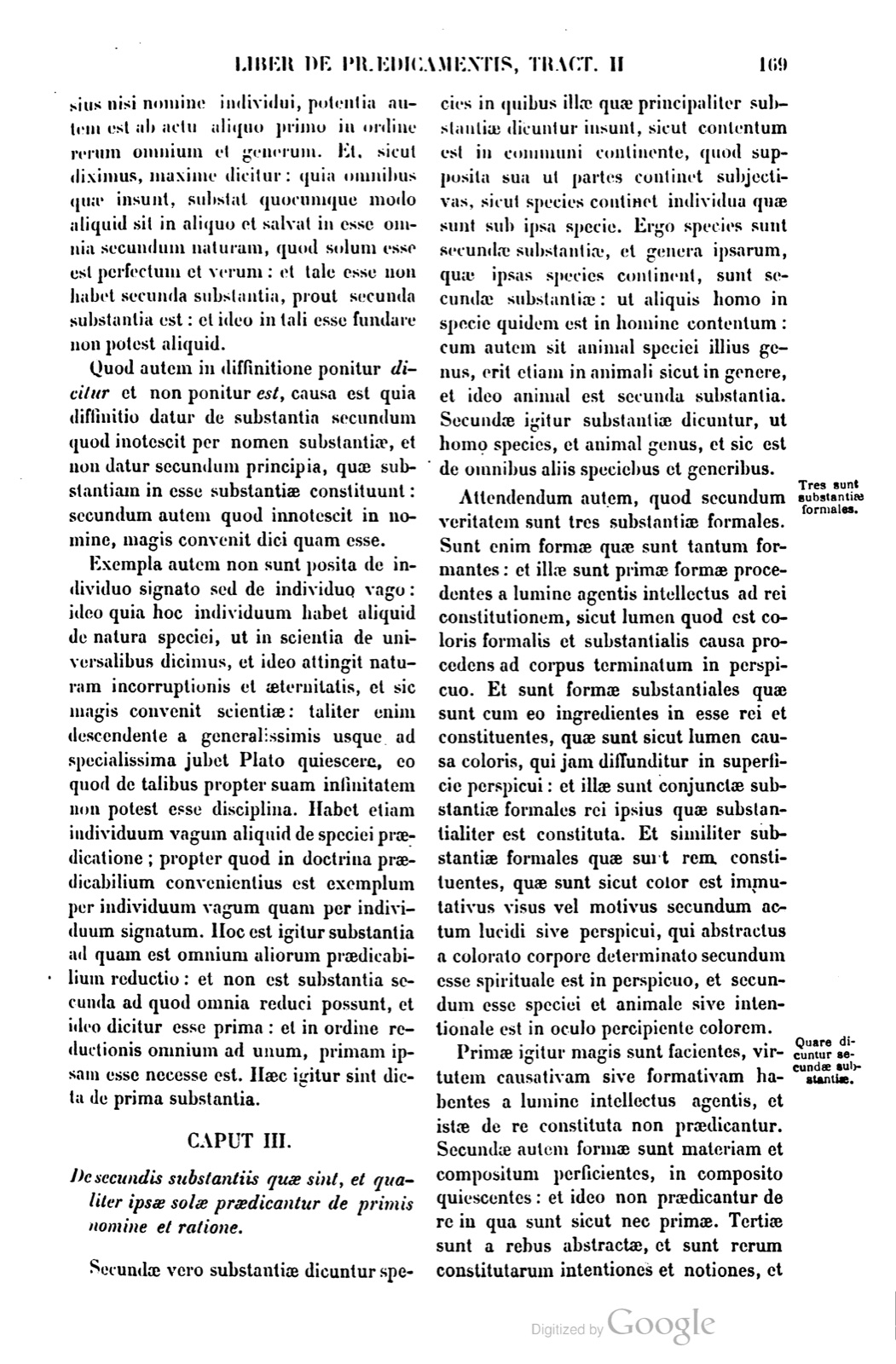
CAPUT III. De secundis substantiis quæ sint, et qualiter ipsæ solæ prædicantur de primis nomine et ratione.
Secundæ vero substantiæ dicuntur species in quibus illæ quæ principaliter substantiæ dicuntur insunt, sicut contentum in communi continente, quod supposita sua ut partes continet subjectivas, sicut species continet individua quæ sunt sub ipsa specie. Ergo species sunt secundæ substantiæ, et genera ipsarum, quæ ipsas species continent, sunt secundæ substantiæ: ut aliquis homo in specie quidem est in homine contentum: cum autem sit animal speciei illius genus, erit etiam in animali sicut in genere, et ideo animal est secunda substantia. Secundæ igitur substantiæ dicuntur, ut homo species, et animal genus, et sic est de omnibus aliis speciebus et generibus.
Attendendum autem, quod secundum veritatem sunt tres substantiæ formales. Sunt enim formæ quæ sunt tantum formantes: et illæ sunt primæ formæ procedentes a lumine agentis intellectus ad rei constitutionem, sicut lumen quod est coloris formalis et substantialis causa procedens ad corpus terminatum in perspicuo. Et sunt formæ substantiales quæ sunt cum eo ingredientes in esse rei et constituentes, quæ sunt sicut lumen causa coloris, qui jam diffunditur in superficie perspicui: et illæ sunt conjunctæ substantiæ formales rei ipsius quæ substantialiter est constituta. Et similiter substantiæ formales quæ sunt rem constituentes, quæ sunt sicut color est immutativus visus vel motivus secundum actum lucidi sive perspicui, qui abstractus a colorato corpore determinato secundum esse spirituale est in perspicuo, et secundum esse speciei et animale sive intentionale est in oculo percipiente colorem.
Primæ igitur magis sunt facientes, virtutem causativam sive formativam habentes a lumine intellectus agentis, et istæ de re constituta non prædicantur. Secundæ autem formæ sunt materiam et compositum perficientes, in composito quiescentes: et ideo non prædicantur de re in qua sunt sicut nec primæ. Tertiæ a rebus abstractæ, et sunt rerum constitutarum intentiones et notiones, et ideo prædicantur de ipsis nomine, et ratione: propter quod etiam secundæ substantiæ dicuntur, non quia simpliciter substantiæ sint sicut primæ, sed quia sunt secundæ, hoc est, hoc secundo loco substantiæ, sicut primæ substantiæ dicuntur primæ, quæ primo loco vel ordine dicuntur substantiæ, perfectam participantes substantiæ rationem.
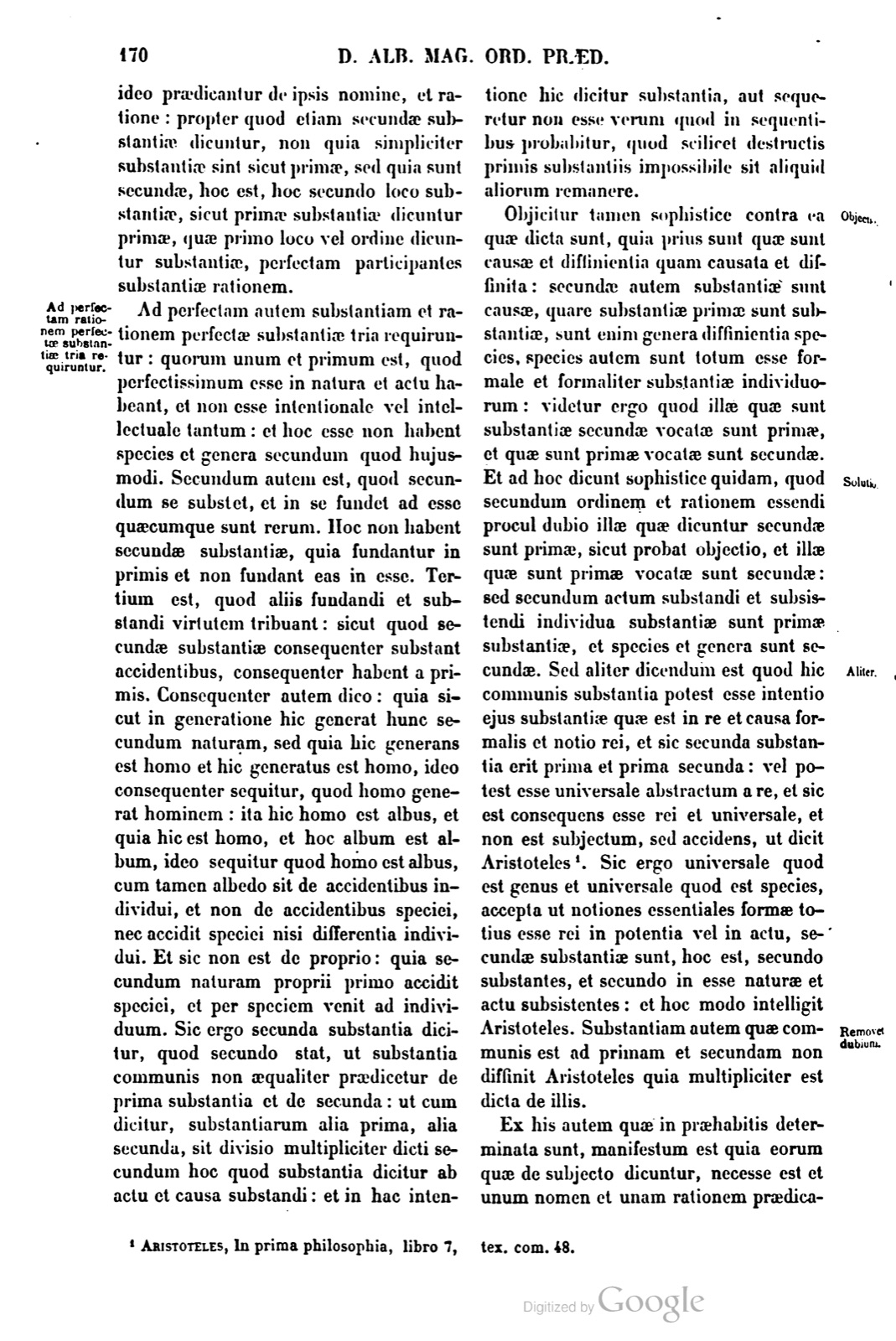
Ad perfectam autem substantiam et rationem perfectæ substantiæ tria requiruntur: quorum unum et primum est, quod perfectissimum esse in natura et actu habeant, et non esse intentionale vel intellectuale tantum: et hoc esse non habent species et genera secundum quod hujusmodi. Secundum autem est, quod secundum se substet, et in se fundet ad esse quæcumque sunt rerum. Hoc non habent secundæ substantiæ, quia fundantur in primis et non fundant eas in esse. Tertium est, quod aliis fundandi et substandi virtutem tribuant: sicut quod secundæ substantiæ consequenter substant accidentibus, consequenter habent a primis. Consequenter autem dico: quia sicut in generatione hic generat hunc secundum naturam, sed quia hic generans est homo et hic generatus est homo, ideo consequenter sequitur, quod homo generat hominem: ita hic homo est albus, et quia hic est homo, et hoc album est album, ideo sequitur quod homo est albus, cum tamen albedo sit de accidentibus individui, et non de accidentibus speciei, nec accidit speciei nisi differentia individui. Et sic non est de proprio: quia secundum naturam proprii primo accidit speciei, et per speciem venit ad individuum. Sic ergo secunda substantia dicitur, quod secundo stat, ut substantia communis non æqualiter prædicetur de prima substantia et de secunda: ut cum dicitur, substantiarum alia prima, alia secunda, sit divisio multipliciter dicti secundum hoc quod substantia dicitur ab actu et causa substandi: et in hac intentione hic dicitur substantia, aut videretur non esse verum quod in sequentibus probabitur, quod scilicet destructis primis substantiis impossibile sit aliquid aliorum remanere.
CHAPTER III. What second substances are, and how they alone are predicated of first substances in name and account.
But those species in which those things which are principally called substances are in, as a contained thing is in a common container, which contains its supposits as subjective parts, just as a species contains the individuals which are under that species, are called second substances. Therefore species are second substances, and their genera, which contain those species themselves, are second substances: as some man is indeed in the species, contained in man; but since animal is the genus of that species, he will also be in animal as in a genus, and therefore animal is a second substance. Therefore second substances are called such as man the species, and animal the genus, and so it is concerning all other species and genera.
It must be attended, however, that according to the truth there are three formal substances. For there are forms which are only forming; and those are the first forms proceeding from the light of the agent intellect to the constitution of the thing, just as light, which is the formal and substantial cause of color, proceeds to a body terminated in the transparent. And there are substantial forms which, together with it, enter into the being of the thing and constitute it, which are like light as the cause of color, which now is diffused in the surface of the transparent; and those are the joined formal substances of the thing itself which is substantially constituted. And similarly there are formal substances which constitute the thing, which are as color is immutative of sight or motive according to the act of the luminous or transparent, which, abstracted from a determinate colored body according to spiritual being, is in the transparent, and according to the being of species and animal or intentional being is in the eye perceiving color.
The first, therefore, are more making, having causative or formative power from the light of the agent intellect, and these are not predicated of the constituted thing. The second forms, however, are perfecting matter and the composite, resting in the composite; and therefore they are not predicated of the thing in which they are, just as neither are the first. The third are abstracted from things, and are the intentions and notions of constituted things, and therefore they are predicated of them by name and by account: on account of which they are also called second substances, not because they are substances simply, as the first are, but because they are second, that is, substances in this second place, just as first substances are called first, which are called substances in the first place or order, participating in the perfect account of substance.
But for perfect substance and for the account of perfect substance three things are required. One of these, and the first, is that they have most perfect being in nature and in act, and not intentional or intellectual being only; and species and genera, according as they are such, do not have this being. The second, however, is that it underlie according to itself, and in itself found toward being whatsoever things are of things. Second substances do not have this, because they are founded in first substances and do not found them in being. The third is that they bestow on others the power of founding and of underlying: just as the fact that second substances consequently underlie accidents, they consequently have from first substances. But I say consequently because, just as in generation this man generates this man according to nature, but because this generating one is man and this generated one is man, therefore it consequently follows that man generates man; so this man is white, and because this is man, and this white thing is white, therefore it follows that man is white, although nevertheless whiteness is among the accidents of the individual, and not among the accidents of the species, nor does it belong to the species except by the difference of the individual. And thus it is not concerning a property, because according to the nature of a property it first belongs to the species, and through the species comes to the individual. Therefore second substance is so called, because it stands secondly, so that common substance is not predicated equally of first substance and of second substance: as, when it is said that of substances one is first, another second, the division is of a thing said in many ways according to this, that substance is said from the act and cause of underlying. And in this intention substance is said here; otherwise it would seem not to be true which will be proved in what follows, namely that when first substances have been destroyed, it is impossible for any of the other things to remain.
Objicitur tamen sophistice contra ea quæ dicta sunt, quia prius sunt quæ sunt causæ et diffinientia quam causata et diffinita: secundæ autem substantiæ sunt causæ, quare substantiæ primæ sunt substantiæ, sunt enim genera diffinientia species, species autem sunt totum esse formale et formaliter substantiæ individuorum: videtur ergo quod illæ quæ substantiæ secundæ vocatæ sunt primæ, et quæ sunt primæ vocatæ sunt secundæ. Et ad hoc dicunt sophistice quidam, quod secundum ordinem et rationem esse procul dubio illæ quæ dicuntur secundæ sunt primæ, sicut probat objectio, et illæ quæ sunt primæ vocatæ sunt secundæ: sed secundum actum substandi et subtendi individua substantiæ sunt primæ substantiæ, et species et genera sunt secundæ. Sed aliter dicendum est quod communis substantia potest esse intentio ejus substantiæ quæ est in re et causa formalis et notio rei, et sic secunda substantia erit prima et prima secunda: vel potest esse universale abstractum a re, et sic est consequens esse rei et universale, et non est subjectum, sed accidens, ut dicit Aristoteles1. Sic ergo universale quod est genus et universale quod est species, accepta ut notiones essentiales formæ totius esse rei in potentia vel in actu, secundæ substantiæ sunt, hoc est, secundo substantes, et secundo in esse naturæ et actu subsistentes: et hoc modo intelligit Aristoteles. Substantiam autem quæ communis est ad primam et secundam non diffinit Aristoteles quia multipliciter est dicta de illis.
Nevertheless it is objected sophistically against those things which have been said, because those things which are causes and defining things are prior to caused and defined things; but second substances are causes why first substances are substances, for they are genera defining species, and species are the whole formal being and formally the substances of individuals. Therefore it seems that those which have been called second substances are first, and those which are first have been called second. And to this some say sophistically that, according to the order and account of being, without doubt those which are called second are first, as the objection proves, and those which are first have been called second; but according to the act of underlying and of being stretched beneath, individual substances are first substances, and species and genera are second. But it must be said otherwise: common substance can be the intention of that substance which is in the thing, and the formal cause and notion of the thing, and thus second substance will be first and first second; or it can be the universal abstracted from the thing, and thus it is consequent upon the being of the thing and universal, and is not a subject, but an accident, as Aristotle says1. Thus, therefore, the universal which is genus and the universal which is species, taken as essential notions of the form of the whole being of the thing in potency or in act, are second substances, that is, secondly underlying, and secondly subsisting in the being of nature and act; and in this way Aristotle understands it. But Aristotle does not define substance which is common to first and second, because it is said of them in many ways.
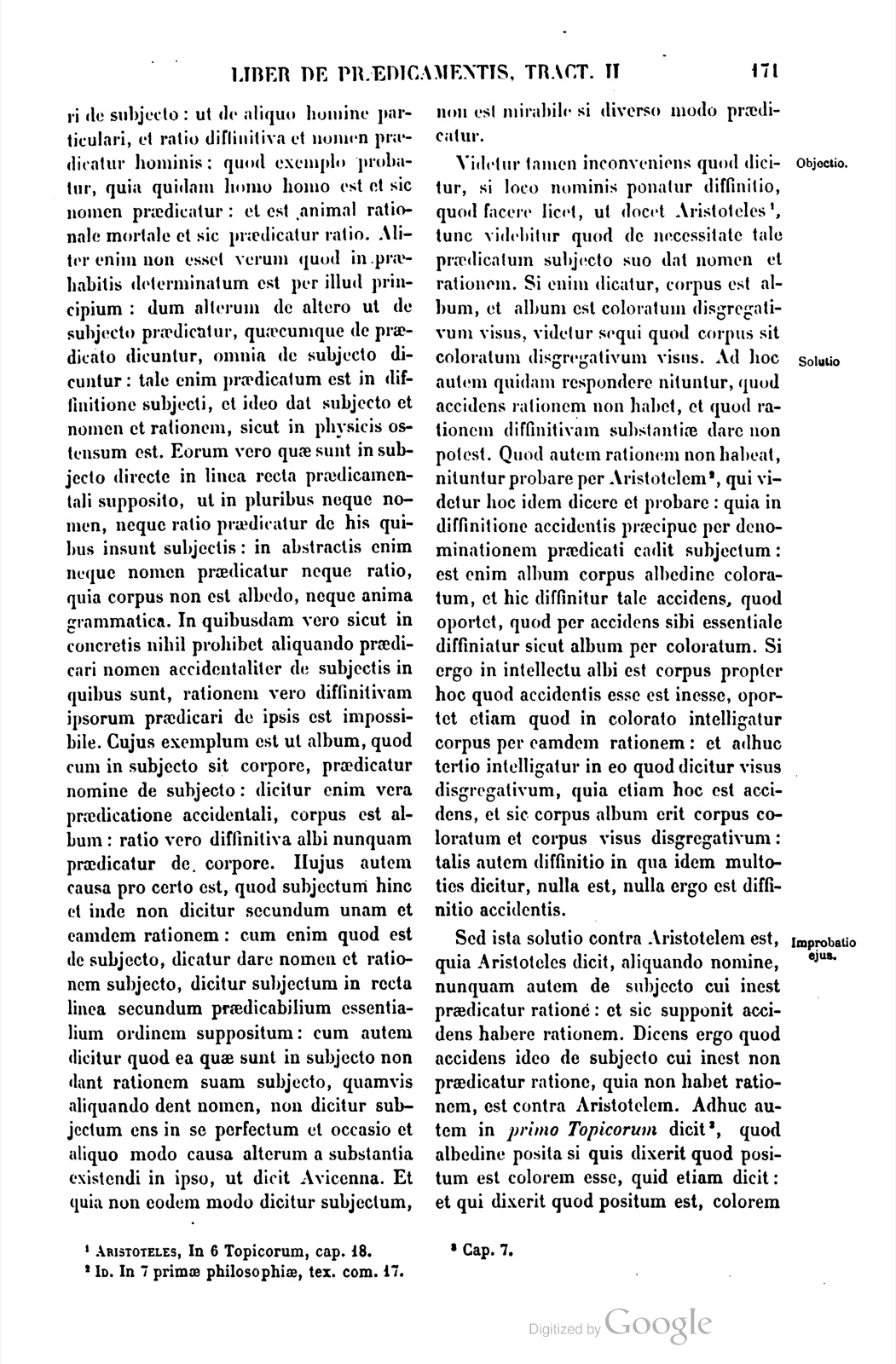
Ex his autem quæ in præhabitis determinata sunt, manifestum est quia eorum quæ de subjecto dicuntur, necesse est unum nomen et unam rationem prædicari de subjecto: ut de aliquo homine particulari, et ratio diffinitiva et nomen prædicatur hominis: quod exemplo probatur, quia quidam homo homo est et sic nomen prædicatur: et est animal rationale mortale et sic prædicatur ratio. Aliter enim non esset verum quod in præhabitis determinatum est per illud principium: dum alterum de altero ut de subjecto prædicatur, quæcumque de prædicato dicuntur, omnia de subjecto dicuntur: tale enim prædicatum est in diffinitione subjecti, et ideo dat subjecto et nomen et rationem, sicut in physicis ostensum est.
Eorum vero quæ sunt in subjecto directe in linea recta prædicamentali supposito, ut in pluribus neque nomen, neque ratio prædicatur de his quibus insunt subjectis: in abstractis enim neque nomen prædicatur neque ratio, quia corpus non est albedo, neque anima grammatica. In quibusdam vero sicut in concretis nihil prohibet aliquando prædicari nomen accidentaliter de subjectis in quibus sunt, rationem vero diffinitivam ipsorum prædicari de ipsis est impossibile. Cujus exemplum est ut album, quod cum in subjecto sit corpore, prædicatur nomine de subjecto: dicitur enim vera prædicatione accidentali, corpus est album: ratio vero diffinitiva albi nunquam prædicatur de corpore. Hujus autem causa pro certo est, quod subjectum hinc et inde non dicitur secundum unam et eamdem rationem: cum enim quod est de subjecto, dicatur dare nomen et rationem subjecto, dicitur subjectum in recta linea secundum prædicabilium essentialium ordinem suppositum: cum autem dicitur quod ea quæ sunt in subjecto non dant rationem suam subjecto, quamvis aliquando dent nomen, non dicitur subjectum nisi ens in se perfectum et occasio et aliquo modo causa alterum a substantia existendi in ipso, ut dicit Avicenna. Et quia non eodem modo dicitur subjectum, non est mirabile si diverso modo prædicatur.
Videtur tamen inconveniens quod dicitur, si loco nominis ponatur diffinitio, quod facere licet, ut docet Aristoteles2, tunc videbitur quod de necessitate tale prædicatum subjecto suo dat nomen et rationem. Si enim dicatur, corpus est album, et album est coloratum disgregativum visus, videtur sequi quod corpus sit coloratum disgregativum visus. Ad hoc autem quidam respondere nituntur, quod accidens rationem non habet, et quod rationem diffinitivam substantiæ dare non potest. Quod autem rationem non habeat, nituntur probare per Aristotelem3, qui videtur hoc idem dicere et probare: quia in diffinitione accidentis præcipue per denominationem prædicati cadit subjectum: est enim album corpus albedine coloratum, et hic diffinitur tale accidens, quod oportet, quod per accidens sibi essentiale diffiniatur sicut album per coloratum. Si ergo in intellectu albi est corpus propter hoc quod accidentis esse est inesse, oportet etiam quod in colorato intelligatur corpus per eamdem rationem: et adhuc tertio intelligatur in eo quod dicitur visus disgregativum, quia etiam hoc est accidens, et sic corpus album erit corpus coloratum et corpus visus disgregativum: talis autem diffinitio in qua idem multoties dicitur, nulla est, nulla ergo est diffinitio accidentis.
From these things, however, which have been determined in the foregoing, it is manifest that of those things which are said of a subject, it is necessary that one name and one account be predicated of the subject: as, of some particular man, both the definitive account and the name of man are predicated. This is proved by example, because some man is man, and thus the name is predicated; and he is a rational mortal animal, and thus the account is predicated. For otherwise what was determined in the foregoing through that principle would not be true: when one thing is predicated of another as of a subject, whatsoever things are said of the predicate, all are said of the subject. For such a predicate is in the definition of the subject, and therefore gives to the subject both name and account, as was shown in the physical writings.
But of those things which are in a subject directly in the straight predicamental line, when the subject has been supposed, for the most part neither the name nor the account is predicated of those subjects in which they are. For in abstracts neither name nor account is predicated, because body is not whiteness, nor soul grammar. In some things, however, as in concretes, nothing prevents the name sometimes from being predicated accidentally of the subjects in which they are; but for the definitive account of those things to be predicated of them is impossible. An example of this is as white, which, since it is in body as in a subject, is predicated by name of the subject; for it is said by true accidental predication: body is white. But the definitive account of white is never predicated of body. The cause of this, however, for certain, is that subject on this side and on that is not said according to one and the same account. For when what is of a subject is said to give name and account to the subject, subject is said as something supposed in the straight line according to the order of essential predicables. But when it is said that those things which are in a subject do not give their account to the subject, although sometimes they give the name, subject is not said except as a being perfect in itself and as the occasion and in some way the cause of another thing distinct from substance existing in it, as Avicenna says. And because subject is not said in the same way, it is not wondrous if it is predicated in a diverse way.
Nevertheless what is said seems unfitting: if in place of the name the definition is put, which it is permitted to do, as Aristotle teaches2, then it will seem that of necessity such a predicate gives to its subject both name and account. For if it is said, body is white, and white is colored and dispersive of sight, it seems to follow that body is colored and dispersive of sight. To this, however, some try to respond that an accident does not have an account, and that it cannot give the definitive account of substance. But that it does not have an account they try to prove through Aristotle3, who seems to say and prove this same thing: because in the definition of an accident, the subject falls in chiefly through denomination of the predicate; for white is a body colored by whiteness, and here such an accident is defined, which must be defined through an accident essential to itself, just as white is defined through colored. Therefore, if in the understanding of white there is body on account of this, that the being of an accident is to be in, it is fitting that body also be understood in colored by the same account; and still, thirdly, that it be understood in that which is called dispersive of sight, because this also is an accident. And thus white body will be colored body and body dispersive of sight. But such a definition, in which the same thing is said many times, is no definition; therefore there is no definition of accident.
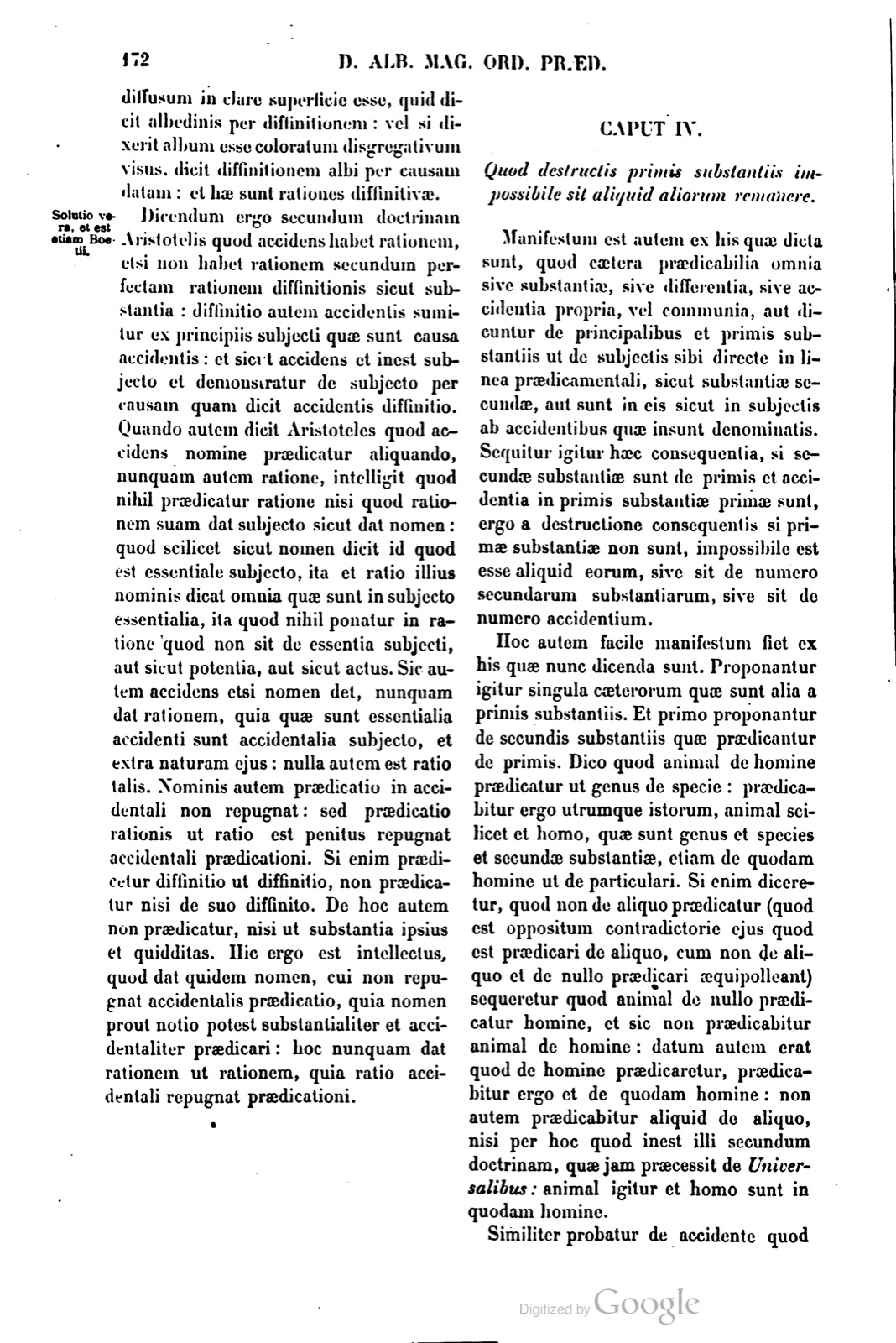
Sed ista solutio contra Aristotelem est, quia Aristoteles dicit, aliquando nomine, nunquam autem de subjecto cui inest prædicatur ratione: et sic supponit accidens habere rationem. Dicens ergo quod accidens ideo de subjecto cui inest non prædicatur ratione, quia non habet rationem, est contra Aristotelem. Adhuc autem in primo Topicorum dicit4, quod albedine posita si quis dixerit quod positum est colorem esse, quid etiam dicit: et qui dixerit quod positum est, colorem diffusum in clara superficie esse, quid dicit albedinis per diffinitionem: vel si dixerit album esse coloratum disgregativum visus, dicit diffinitionem albi per causam datam: et hæ sunt rationes diffinitivæ.
Dicendum ergo secundum doctrinam Aristotelis quod accidens habet rationem, etsi non habet rationem secundum perfectam rationem diffinitionis sicut substantia: diffinitio autem accidentis sumitur ex principiis subjecti quæ sunt causa accidentis: et sicut accidens et inest subjecto et demonstratur de subjecto per causam quam dicit accidentis diffinitio. Quando autem dicit Aristoteles quod accidens nomine prædicatur aliquando, nunquam autem ratione, intelligit quod nihil prædicatur ratione nisi quod rationem suam dat subjecto sicut dat nomen: quod scilicet sicut nomen dicit id quod est essentiale subjecto, ita et ratio illius nominis dicat omnia quæ sunt in subjecto essentialia, ita quod nihil ponatur in ratione quod non sit de essentia subjecti, aut sicut potentia, aut sicut actus. Sic autem accidens etsi nomen det, nunquam dat rationem, quia quæ sunt essentialia accidenti sunt accidentalia subjecto, et extra naturam ejus: nulla autem est ratio talis. Nominis autem prædicatio in accidentali non repugnat: sed prædicatio rationis ut ratio est penitus repugnat accidentali prædicationi. Si enim prædicetur diffinitio ut diffinitio, non prædicatur nisi de suo diffinito. De hoc autem non prædicatur, nisi ut substantia ipsius et quidditas. Hic ergo est intellectus, quod dat quidem nomen, cui non repugnat accidentalis prædicatio, quia nomen prout notio potest substantialiter et accidentaliter prædicari: hoc nunquam dat rationem ut rationem, quia ratio accidentali repugnat prædicationi.
But that solution is against Aristotle, because Aristotle says: sometimes by name, but never by account, is it predicated of the subject in which it is; and thus he supposes that accident has an account. Therefore one saying that an accident is for this reason not predicated by account of the subject in which it is, because it has no account, is against Aristotle. Moreover, in the first book of the Topics he says4 that, once whiteness has been posited, if someone says that what has been posited is color, he also says what it is; and he who has said that what has been posited is color diffused in a clear surface says what whiteness is through definition; or if he says that white is colored and dispersive of sight, he says the definition of white through the cause given; and these are definitive accounts.
Therefore it must be said according to the doctrine of Aristotle that accident has an account, even if it does not have an account according to the perfect account of definition as substance does. But the definition of an accident is taken from the principles of the subject which are the cause of the accident; and, just as the accident is in the subject, so also it is demonstrated of the subject through the cause which the definition of the accident says. But when Aristotle says that accident is sometimes predicated by name, but never by account, he understands that nothing is predicated by account except that which gives its own account to the subject just as it gives its name: namely, that just as the name says that which is essential to the subject, so also the account of that name says all things which are essential in the subject, so that nothing is placed in the account which is not of the essence of the subject, either as potency or as act. In this way, however, although accident gives the name, it never gives the account, because those things which are essential to accident are accidental to the subject and outside its nature; but there is no such account. The predication of a name, however, in an accidental matter is not repugnant; but the predication of an account as account is utterly repugnant to accidental predication. For if a definition is predicated as definition, it is predicated only of its own defined thing. But of this it is not predicated except as its substance and quiddity. Therefore this is the understanding: that it indeed gives the name, to which accidental predication is not repugnant, because a name, insofar as it is a notion, can be predicated substantially and accidentally; but this never gives the account as account, because account is repugnant to accidental predication.
Notes
- Aristotle, in First Philosophy, book 7, text/commentary 48. (ARISTOTELES, In prima philosophia, libro 7, tex. com. 48.) ↩
- Aristotle, in Topics VI, chapter 18. (ARISTOTELES, In 6 Topicorum, cap. 18.) ↩
- The same, in First Philosophy VII, text/commentary 17. (ID. In 7 primæ philosophiæ, tex. com. 17.) ↩
- Chapter 7. (Cap. 7.) ↩
If a page does not appear, its photograph has not been uploaded yet.