Volume 1 · pp. 163–165
Chapter VII. On the enumeration of the genera into which predicables are reduced
A marker with ≈ is an approximate page boundary, placed by measure of the text; the page photographs remain the authority. In the paired views, clicking a page marker brings that page into view.
CAPUT VII. De enumeratione generum in quæ prædicabilia reducuntur.
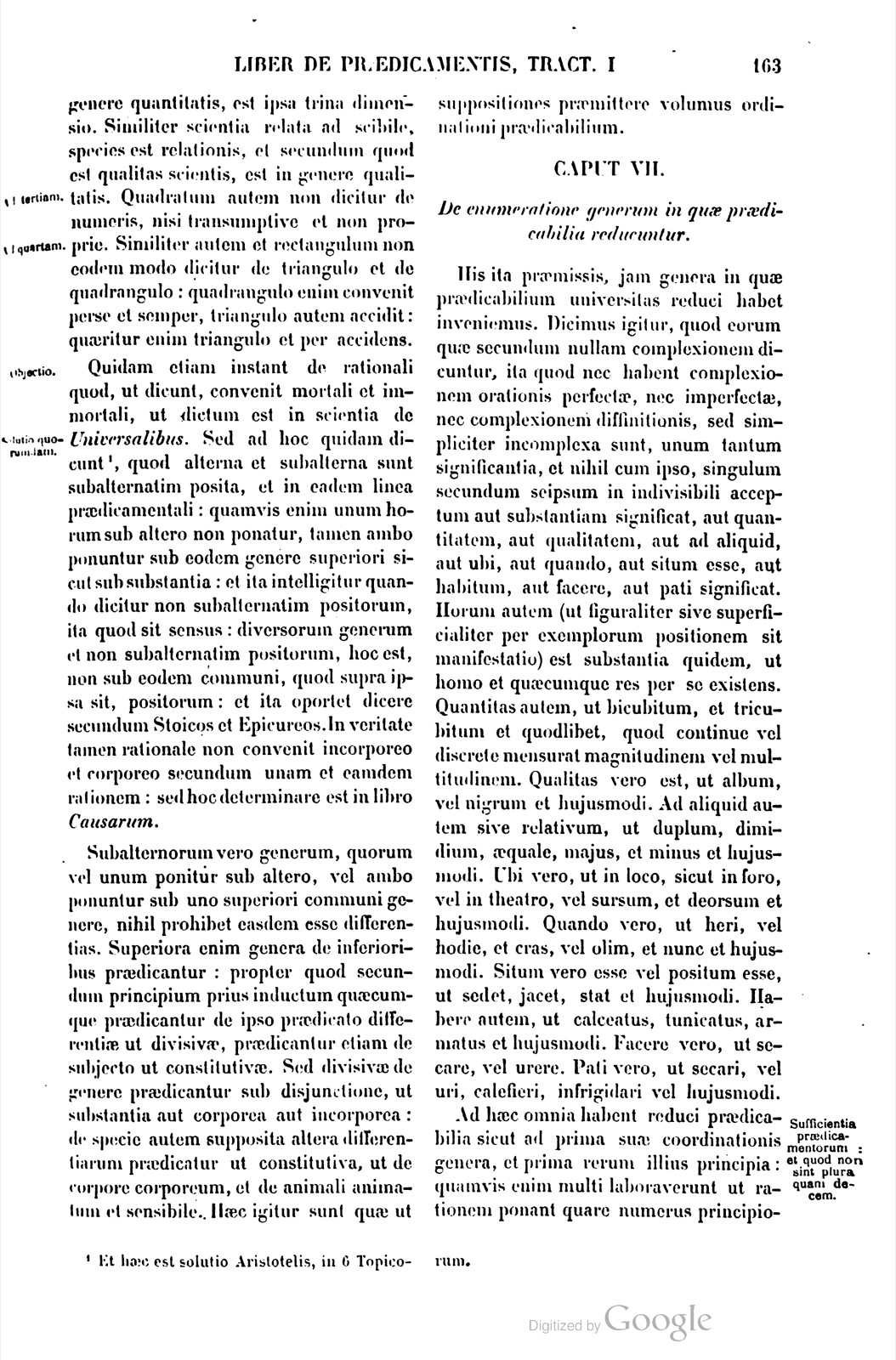
His ita præmissis, jam genera in quæ prædicabilium universitas reduci habet inveniemus. Dicimus igitur, quod eorum quæ secundum nullam complexionem dicuntur, ita quod nec habent complexionem orationis perfectæ, nec imperfectæ, nec complexionem diffinitionis, sed simpliciter incomplexa sunt, unum tantum significantia, et nihil cum ipso, singulum secundum seipsum in indivisibili acceptum aut substantiam significat, aut quantitatem, aut qualitatem, aut ad aliquid, aut ubi, aut quando, aut situm esse, aut habitum, aut facere, aut pati significat. Horum autem, ut figuraliter sive superficialiter per exemplorum positionem sit manifestatio, est substantia quidem, ut homo et quæcumque res per se existens. Quantitas autem, ut bicubitum, et tricubitum et quodlibet, quod continue vel discrete mensurat magnitudinem vel multitudinem. Qualitas vero est, ut album, vel nigrum et hujusmodi. Ad aliquid autem sive relativum, ut duplum, dimidium, æquale, majus, et minus et hujusmodi. Ubi vero, ut in loco, sicut in foro, vel in theatro, vel sursum, et deorsum et hujusmodi. Quando vero, ut heri, vel hodie, et cras, vel olim, et nunc et hujusmodi. Situm vero esse vel positum esse, ut sedet, jacet, stat et hujusmodi. Habere autem, ut calceatus, tunicatus, armatus et hujusmodi. Facere vero, ut secare, vel urere. Pati vero, ut secari, vel uri, calefieri, infrigidari vel hujusmodi.
Ad hæc omnia habent reduci prædicabilia sicut ad prima suæ coordinationis genera, et prima rerum illius principia: quamvis enim multi laboraverunt ut rationem ponant quare numerus principiorum omnium rerum stat in decem, nos, quantum possumus, studebimus ex propriis horum generum modis prædicandi ostendere hujus numeri rationem. Notandum igitur est quod iste numerus non est nisi prædicabilium, quæ ut universalia de subjectis prædicantur. Propter quod si aliquid est quod de nullo prædicatur ut universale, nec de ipso potest aliquid prædicari ut de subjecto et particulari vel specie, illud non est in aliquo istorum generum, sed ante hæc, et causa omnium istorum, sicut causa prima, Deus scilicet excedens omnia, qui nec est universale, nec particulare, nec species, nec genus, nec differentia, nec potentia, nec actus alicujus: et vere non est aliquid ut substantia, vel ut accidens alicujus, sed est omnium efficiens, et tale principium per suam scientiam activam et per intellectum universaliter agentem. Hæc autem in libro de Causis habent probari. Si quæ etiam sunt formæ separatæ res formantes, et a rebus separatæ nullo modo miscibiles, ad quas ipsæ res sicut ad sigilla quædam formantur, et rebus non insunt, sicut dixit Plato, illæ de rebus non prædicantur, eo quod nihil sunt rerum. Et non potest aliquid de aliquo prædicari, quod nihil ipsius est. Illæ etiam non sunt in genere, nec ad aliquod genus reducibiles. Et si dicuntur substantiæ, erit æquivocum nomen substantiæ ad istas substantias. Hoc autem in prima philosophia habet determinari. Omnia autem quæ universalia sunt, vel universalium subjecta quæcumque aliquo modo sunt in quibusdam, et in quibus ut in subjectis sunt, quocumque modo, illa reducuntur ad ista decem genera quæ sunt numerata, et exeunt ab eis sicut a primis suis essentialibus principiis.
CHAPTER VII. On the enumeration of the genera into which predicables are reduced.
These things having thus been premised, we shall now find the genera into which the universality of predicables has to be reduced. Therefore we say that, of those things which are said according to no complex composition, so that they have neither the complex composition of a perfect speech nor of an imperfect one, nor the complex composition of a definition, but are simply incomplex, signifying one thing only and nothing together with it, each single thing, taken according to itself in an indivisible way, signifies either substance, or quantity, or quality, or relation-to-something, or where, or when, or being-situated, or having, or doing, or undergoing. Of these, however, so that there may be a figurative or superficial manifestation through the placing of examples, substance indeed is as man and whatever thing exists through itself. Quantity, however, is as two-cubits, and three-cubits, and anything whatever that continuously or discretely measures magnitude or multitude. Quality, however, is as white, or black, and the like. To-something, however, or the relative, is as double, half, equal, greater, and less, and the like. Where, however, is as in a place, as in the marketplace, or in the theater, or above, and below, and the like. When, however, is as yesterday, or today, and tomorrow, or formerly, and now, and the like. Being situated, however, or being positioned, is as he sits, lies, stands, and the like. Having, however, is as shod, tunicked, armed, and the like. Doing, however, is as to cut, or to burn. Undergoing, however, is as to be cut, or to be burned, to be heated, to be chilled, or the like.
To all these, predicables have to be reduced as to the first genera of their own coordination, and to the first principles of the things of that coordination. For although many have labored to set down a reason why the number of the principles of all things stands at ten, we, as far as we can, shall be eager to show the reason of this number from the proper modes of predicating of these genera. Therefore it must be noted that this number belongs only to predicables, which are predicated of subjects as universals. On account of this, if there is something which is predicated of nothing as a universal, and of which nothing can be predicated as of a subject and particular or species, that thing is not in any one of these genera, but is before these and the cause of all these, as the first cause, namely God exceeding all things, who is neither universal, nor particular, nor species, nor genus, nor difference, nor the potency, nor the act of anything. And truly he is not something as a substance, or as an accident of anything, but he is the efficient cause of all things, and such a principle through his active knowledge and through his intellect universally acting. These things, however, have to be proved in the book On Causes. And if there are also any separated forms forming things, and separated from things and in no way mixable with them, to which the things themselves are formed as to certain seals, and which are not in things, as Plato said, those forms are not predicated of things, because they are nothing of the things. And nothing can be predicated of something which is nothing of it. Those forms also are not in a genus, nor reducible to any genus. And if they are called substances, the name of substance will be equivocal with respect to those substances. This, however, has to be determined in first philosophy. But all things which are universals, or whatever subjects of universals are in some way in certain things, and in which, as in subjects, they are in whatever way, are reduced to these ten genera which have been enumerated, and proceed from them as from their first essential principles.
Sunt iterum quædam non ad unum genus reducibilia, sed sunt in omnibus, sicut ens, et unum, et res, et aliquid, quæ dicuntur non genera, sed ut principia quædam per prius et posterius de generibus illis dicta. Et ista genera primæ partes dicuntur illorum, et illa non æqualiter prædicantur de istis, sed secundum prius et posterius dicta: ita quod sunt in uno recte et vere, et non sunt in aliis nisi per analogiam et proportionem habitudinis quia se habent ad unum principium. Aliqua etiam sunt in pluribus generibus, sed in quocumque sunt vere illius generis, sicut motus qui in loco est ubi fluens, in qualitate quale fluens, in quantitate quantum fluens. Et ipsa mutatio in substantia est aliquo modo substantia fluens.
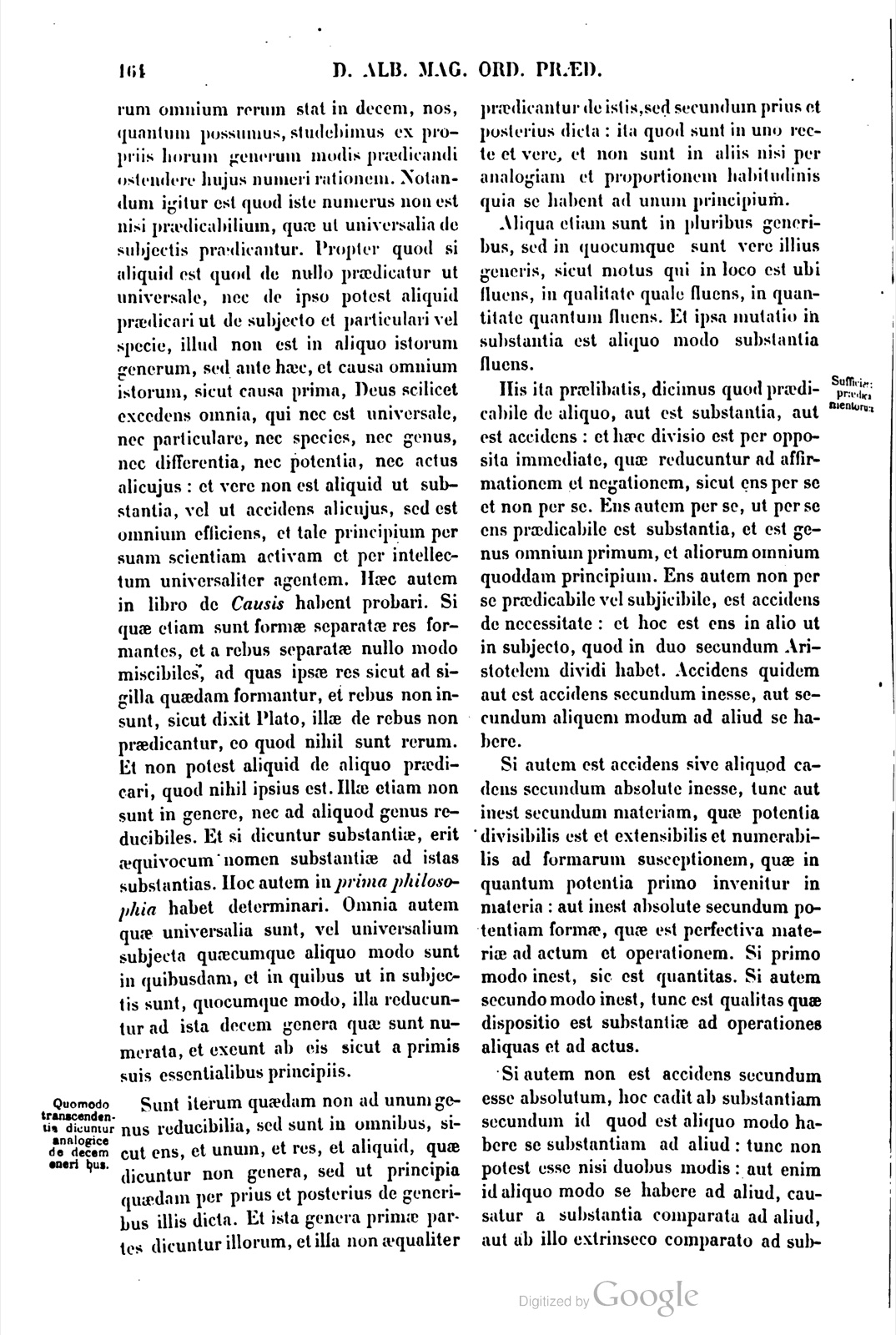
His ita prælibatis, dicimus quod prædicabile de aliquo, aut est substantia, aut est accidens: et hæc divisio est per opposita immediate, quæ reducuntur ad affirmationem et negationem, sicut ens per se et non per se. Ens autem per se, ut per se ens prædicabile est substantia, et est genus omnium primum, et aliorum omnium quoddam principium. Ens autem non per se prædicabile vel subjicibile, est accidens de necessitate: et hoc est ens in alio ut in subjecto, quod in duo secundum Aristotelem dividi habet. Accidens quidem aut est accidens secundum inesse, aut secundum aliquem modum ad aliud se habere.
Si autem est accidens sive aliquod cadens secundum absolute inesse, tunc aut inest secundum materiam, quæ potentia divisibilis est et extensibilis et numerabilis ad formarum susceptionem, quæ in quantum potentia primo invenitur in materia: aut inest absolute secundum potentiam formæ, quæ est perfectiva materiæ ad actum et operationem. Si primo modo inest, sic est quantitas. Si autem secundo modo inest, tunc est qualitas quæ dispositio est substantiæ ad operationes aliquas et ad actus.
Si autem non est accidens secundum esse absolutum, hoc cadit ad substantiam secundum id quod est aliquo modo habere se substantiam ad aliud: tunc non potest esse nisi duobus modis: aut enim id aliquo modo se habere ad aliud, causatur a substantia comparata ad aliud, aut ab illo extrinseco comparato ad substantiam de qua prædicatur. Si primo modo, tunc iterum non est nisi duobus modis: aut enim est in comparatione simplici ad aliud, aut secundum comparationem partium ad totum in seipso consideratum. Et si est secundo modo, est situs vel positio. Si autem est primo: aut secundum comparationem ortam a forma, aut secundum comparationem ortam a toto simul. Et si est prædicabile secundum comparationem ortam a forma, est actio: unde dicit Averroes1, quod actio nihil aliud est, nisi comparatio agentis ad patiens. Si autem comparatio illa est orta a materia, tunc est pati: propter quod idem Averroes dicit quod passio est comparatio patientis ad agens secundum quod agens est. Si autem oritur a toto, non potest oriri, nisi per aliquem actum totius, quo innascitur comparatio illa, et tunc est ad aliquid sive relatio. Si autem oritur comparatio ab aliquo extrinseco comparato ad subjectum, de quo fit prædicatio, illud extrinsecum, aut est adjacens tantum, aut adjacens et applicatum. Si autem est adjacens tantum, et ex adjacentia simplici comparatum, aut est adjacens ei quod est esse quod est cum motu et esse distenso. Si primo quidem est ortum ab adjacentia extrinseca, tunc est ubi. Si autem comparatio est orta ab adjacentia extrinseci secundo modo, tunc est prædicamentum quando. Si autem oritur ab adjacente extrinseco et applicato, tunc est prædicamentum habitus. Nec possunt plura prædicari secundum adjacentiam extrinsecam.
Again, there are certain things not reducible to one genus, but they are in all, such as being, and one, and thing, and something, which are not called genera, but are called as certain principles said of those genera according to prior and posterior. And these genera are called the first parts of those things, and those things are not predicated equally of these, but are said according to prior and posterior: so that they are in one rightly and truly, and are not in the others except through analogy and proportion of relation, because they are related to one principle. There are also some things in several genera, but in whatever genus they are, they are truly of that genus, as motion, which in place is a flowing where, in quality a flowing quale, in quantity a flowing quantum. And change itself in substance is in some way a flowing substance.
These things having thus been set out beforehand, we say that what is predicable of something is either substance or accident; and this division is through immediate opposites, which are reduced to affirmation and negation, as being through itself and being not through itself. But being through itself, as predicable being-through-itself, is substance, and is the first genus of all, and a certain principle of all the others. But being not through itself, predicable or subjectible, is of necessity accident; and this is being in another as in a subject, which, according to Aristotle, has to be divided into two. Accident indeed is either accident according to being-in, or according to some mode of having itself to another.
But if it is an accident, or something falling according to absolute being-in, then either it is in according to matter, which is a potency divisible and extensible and numerable for the reception of forms, which, insofar as it is potency, is first found in matter; or it is in absolutely according to the potency of form, which is perfective of matter toward act and operation. If it is in in the first mode, thus it is quantity. But if it is in in the second mode, then it is quality, which is a disposition of substance toward certain operations and toward acts.
But if it is not an accident according to absolute being, this falls to substance according to that which is substance's having itself in some way to another: then it can be only in two modes. For either this having itself in some way to another is caused by substance compared to another, or by that extrinsic thing compared to the substance of which the predication is made. If in the first mode, then again it is only in two modes: for either it is in a simple comparison to another, or according to the comparison of parts to the whole considered in itself. And if it is in the second mode, it is site or position. But if it is in the first, it is either according to a comparison arisen from form, or according to a comparison arisen from the whole at once. And if it is predicable according to a comparison arisen from form, it is action: whence Averroes says1 that action is nothing other than the comparison of agent to patient. But if that comparison is arisen from matter, then it is undergoing: on account of which the same Averroes says that passion is the comparison of patient to agent according as it is agent. But if it arises from the whole, it cannot arise except through some act of the whole, by which that comparison is born in, and then it is to-something or relation. But if the comparison arises from some extrinsic thing compared to the subject concerning which the predication is made, that extrinsic thing is either merely adjacent, or adjacent and applied. But if it is merely adjacent, and compared from simple adjacency, then it is adjacent either to that which is being which is with motion, or to distended being. If indeed it is arisen in the first way from extrinsic adjacency, then it is where. But if the comparison is arisen from the adjacency of the extrinsic thing in the second mode, then it is the category when. But if it arises from the extrinsic adjacent thing and one applied, then it is the category of habit. Nor can more things be predicated according to extrinsic adjacency.
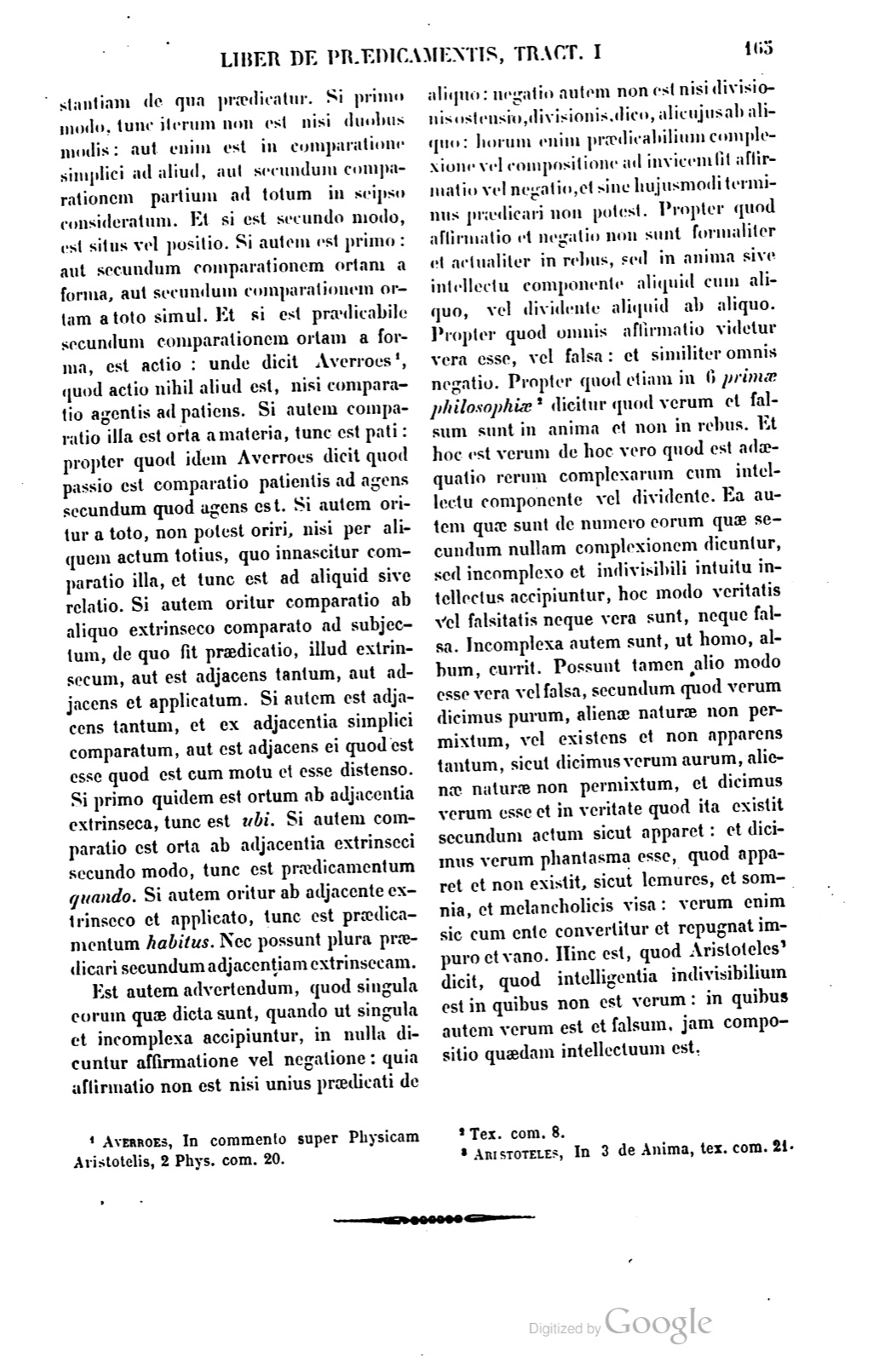
Est autem advertendum, quod singula eorum quæ dicta sunt, quando ut singula et incomplexa accipiuntur, in nulla dicuntur affirmatione vel negatione: quia affirmatio non est nisi unius prædicati de aliquo: negatio autem non est nisi divisionis ostensio, divisionis, dico, alicujus ab aliquo: horum enim prædicabilium complexione vel compositione ad invicem fit affirmatio vel negatio, et sine hujusmodi terminis prædicari non potest. Propter quod affirmatio et negatio non sunt formaliter et actualiter in rebus, sed in anima sive intellectu componente aliquid cum aliquo, vel dividente aliquid ab aliquo. Propter quod omnis affirmatio videtur vera esse, vel falsa: et similiter omnis negatio. Propter quod etiam in 6 primæ philosophiæ2 dicitur quod verum et falsum sunt in anima et non in rebus. Et hoc est verum de hoc vero quod est adæquatio rerum complexarum cum intellectu componente vel dividente. Ea autem quæ sunt de numero eorum quæ secundum nullam complexionem dicuntur, sed incomplexo et indivisibili intuitu intellectus accipiuntur, hoc modo veritatis vel falsitatis neque vera sunt, neque falsa. Incomplexa autem sunt, ut homo, album, currit. Possunt tamen alio modo esse vera vel falsa, secundum quod verum dicimus purum, alienæ naturæ non permixtum, vel existens et non apparens tantum, sicut dicimus verum aurum, alienæ naturæ non permixtum, et dicimus verum esse et in veritate quod ita existit secundum actum sicut apparet: et dicimus verum phantasma esse, quod apparet et non existit, sicut lemures, et somnia, et melancholicis visa: verum enim sic cum ente convertitur et repugnat impuro et vano. Hinc est, quod Aristoteles3 dicit, quod intelligentia indivisibilium est in quibus non est verum: in quibus autem verum est et falsum, jam compositio quædam intellectuum est.
It must, however, be adverted that each one of the things which have been said, when they are taken as single and incomplex, are said in no affirmation or negation: because affirmation is only of one predicate concerning something; but negation is only the showing of division, of division, I say, of something from something. For from the complexing or composition of these predicables with one another there is made affirmation or negation, and without terms of this sort predication cannot occur. On account of this, affirmation and negation are not formally and actually in things, but in the soul or intellect composing something with something, or dividing something from something. On account of this, every affirmation seems to be true or false, and similarly every negation. On account of this also, in the sixth book of first philosophy2 it is said that the true and the false are in the soul and not in things. And this is true concerning that true which is the adequation of complex things with the intellect composing or dividing. But those things which are of the number of those things which are said according to no complex composition, but are received by an incomplex and indivisible intuition of the intellect, in this mode of truth or falsity are neither true nor false. But incomplex things are, as man, white, runs. Nevertheless they can in another mode be true or false, according as we call true what is pure, not mixed with an alien nature, or existing and not only appearing, as we call true gold that which is not mixed with an alien nature, and we say that it truly is and is in truth when it so exists according to act as it appears; and we say that a true phantasm is that which appears and does not exist, as apparitions, and dreams, and things seen by melancholics. For the true in this way is converted with being and is opposed to the impure and the vain. Hence it is that Aristotle says3 that the understanding of indivisibles is in those things in which there is no true; but in those things in which there is true and false, there is already a certain composition of understandings.
If a page does not appear, its photograph has not been uploaded yet.