Volume 1 · pp. 161–163
Chapter VI. On the principles or suppositions which ought to be premised to the order of predicables
A marker with ≈ is an approximate page boundary, placed by measure of the text; the page photographs remain the authority. In the paired views, clicking a page marker brings that page into view.
CAPUT VI. De principiis vel suppositionibus quæ debent præmitti ordini prædicabilium.
Suppositiones autem sunt duæ quæ pro principiis præmittendæ sunt ordini prædicabilium. Quarum una quidem est, quod quando alterum de altero prædicatur ut de proprio sibi in recta linea subjecto, et directe et substantialiter substante secundum omnium quinque universalium respectum ad ea quæ directe sub ipsis sunt, quæcumque de eo quod prædicatur dicuntur recto ordine et substantiali, omnia etiam dici de subjecto necesse est. Hæc quidem in scientia de universalibus secundum omnem modum prædicandi quinque universalium dedimus exempla, ut homo ut species prædicatur de quodam homine: animal autem in eodem ordine de homine prædicatur ut genus et substantia de animali, necesse est quod animal et substantia de quodam homine ut differentia: sensibile autem et vitale et animatum de rationali ut genera et differentiæ, necesse est quod et hæc de quodam homine prædicentur. Similiter risibile de quodam homine prædicatur ut proprium: de risibili autem admirativum ut genus, et de hoc suspensivum ad apprehensa, et ad hoc secundum naturam desiderationis, necesse est quod et hæc de quodam homine prædicentur. Similiter album de quodam homine ut accidens prædicatur: de albo autem coloratum, de colorato autem quale: oportet igitur quod et hæc de quodam homine prædicentur. Et generaliter loquendo quæcumque secundum rectam lineam ordine individui ad speciem et speciei ad genus de prædicato quocumque dici possunt.
Et sicut Avicenna et Algazel dicunt, in negatione est similiter, dummodo negentur ea de prædicato quæcumque sunt secundum formam speciei aut generis prædicato opposita: ut si quidam homo non est lapis, lapis autem est inanimatum, necesse est quod quidam homo non sit inanimatum. Similiter est in ordine differentiarum et propriorum et accidentium: sicut si homo est rationale, rationale autem non est insensibile, et sic de aliis: sequitur quod homo non sit insensibile. Et hoc est facile videre in omnibus: sicut si homo est risibile, risibile autem non potest esse non admirativum, sequitur quod quidam homo non possit esse non admirativum. Et si homo est album: album autem non est non coloratum, sequitur quod homo non est non coloratum: et sic est in omnibus. Et hoc principio utimur ad ponendam rectam lineam prædicamentalem, et ad sciendum quæ extra lineam sunt prædicamentalem.
CHAPTER VI. On the principles or suppositions which ought to be premised to the order of predicables.
Now the suppositions are two which must be premised as principles to the order of predicables. Of these, one indeed is that, when one thing is predicated of another as of its own proper subject in a straight line, and as of something directly and substantially underlying according to the relation of all the five universals to those things which are directly under them, whatsoever things are said of that which is predicated, in a right and substantial order, all these also must necessarily be said of the subject. In the science concerning universals, indeed, we gave examples according to every mode of predicating the five universals: as man, as a species, is predicated of some man; but animal, in the same order, is predicated of man as genus, and substance of animal, and therefore it is necessary that animal and substance also be predicated of some man. Likewise, as to difference: sensible, however, and living, and animate are predicated of rational as genera and differences, and it is necessary that these also be predicated of some man. Similarly risible is predicated of some man as a property; but of risible, wonder-capable is predicated as genus, and of this, suspense-capable toward things apprehended, and toward this according to the nature of desire; and it is necessary that these also be predicated of some man. Similarly white is predicated of some man as an accident; but of white, colored, and of colored, quale: therefore it is fitting that these also be predicated of some man. And, speaking generally, this holds for whatsoever things, according to the straight line in the order of individual to species and of species to genus, can be said of any predicate whatsoever.
And, as Avicenna and Algazel say, it is similar in negation, provided that those things are denied of the predicate which, according to the form of the species or genus, are opposed to the predicate: as, if some man is not stone, but stone is inanimate, it is necessary that some man not be inanimate. It is similar also in the order of differences and properties and accidents: just as, if man is rational, but rational is not insensible, and so concerning the others, it follows that man is not insensible. And this is easy to see in all cases: as, if man is risible, but risible cannot be non-wonder-capable, it follows that some man cannot be non-wonder-capable. And if man is white, but white is not non-colored, it follows that man is not non-colored; and so it is in all cases. And we use this principle for positing the straight predicamental line, and for knowing those things which are outside the predicamental line.
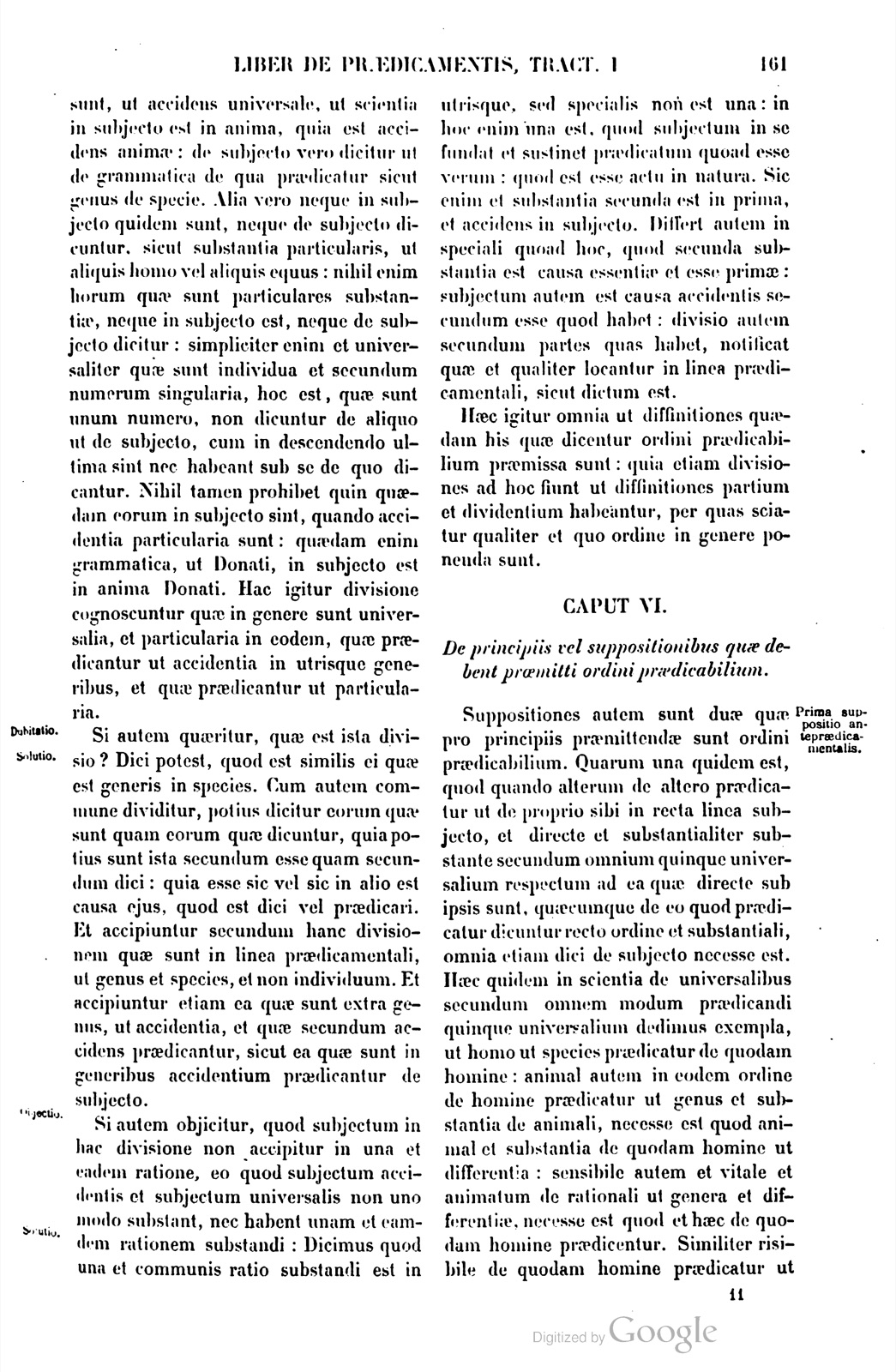
Ex his autem facile patet quod non sequitur, quidam homo est homo: homo est species: ergo quidam homo est species. Et homo est animal, et animal est genus: ergo homo est genus. Non enim species prædicatur de homine ut subjecto secundum rectum ordinem prædicamentalem, sed prædicatur de ipso ut accidens extraneum ab hoc ordine: et ideo in tali argumento est fallacia accidentis. Et per hoc etiam principium prima figura invenietur in syllogismis, sicut patebit in doctrina priorum Analyticorum.
Alterum autem principium est, quod diversorum generum, et non subalternatim positorum, diversæ sunt species et differentiæ: sicut enim diversa sunt genera, animal et scientia, secundum diversa prædicamenta: unum enim est genus in prædicamento substantiæ, et alterum est genus in prædicamento qualitatis, et non sunt in eadem prædicamenti linea subalternatim posita, ita quod unum sub altero directe contineatur: et ideo habent diversas differentias non ad se invicem ut inferius et superius ordinatas. Animalis enim species sunt homo et equus: differentiæ autem ut gressibile, quadrupes, et volatile. Scientiæ vero nulla harum specierum vel differentiarum est. Hæ species scientiæ sunt grammatica, logica, et physica: differentiæ vero demonstrativum, opinabile, probabile, et hujusmodi. Scientia enim una non differt ab alia in eo quod una bipes sit, et alia non, sed demonstrativum: et similiter est de omnibus generibus non subalternatim positis, quæ non in eadem linea continentur prædicamentali.
Ad hæc tamen quæ dicta sunt, instantiæ feruntur, sed sophisticæ sunt. Quarum prima est de corpore quod ponitur species substantiæ, et species quantitatis, quæ sunt diversa genera, et non subalternatim posita. Secunda est de scientia quæ ponitur et species qualitatis et relationis. Tertia est de quadrato quod est differentia figuræ, ut in secundo Euclidis dicitur, et est differentia numeri, ut secundo arithmeticæ. Quarta est de rectangulo quod ponitur differentia trianguli, ut patet in primo Euclidis, et ponitur differentia quadranguli, ut patet in Euclidis secundo.
From these things, however, it is easily clear that it does not follow: some man is man; man is a species; therefore some man is a species. And: man is animal, and animal is a genus; therefore man is a genus. For species is not predicated of man as of a subject according to the right predicamental order, but is predicated of him as an accident foreign to this order; and therefore in such an argument there is the fallacy of accident. And through this principle also the first figure will be found in syllogisms, as will be clear in the doctrine of the Prior Analytics.
The other principle, however, is that of diverse genera, and of genera not placed subalternately, the species and differences are diverse. For just as animal and science are diverse genera according to diverse predicaments, since one is a genus in the predicament of substance, and the other is a genus in the predicament of quality, and they are not placed subalternately in the same predicamental line, so that one is contained directly under the other, so also, for this reason, they have diverse differences, not ordered to one another as lower and higher. For the species of animal are man and horse; but the differences are walking, quadruped, and flying. Of science, however, none of these is a species or a difference. These are the species of science: grammar, logic, and physics; but its differences are demonstrative, opinable, probable, and the like. For one science does not differ from another in this, that one is two-footed and another not, but in that one is demonstrative; and it is similar concerning all genera not placed subalternately, which are not contained in the same predicamental line.
Against these things, nevertheless, which have been said, instances are brought forward, but they are sophistical. The first of them is about body, which is posited as a species of substance and as a species of quantity, which are diverse genera and not placed subalternately. The second is about science, which is posited both as a species of quality and of relation. The third is about square, which is a difference of figure, as is said in the second book of Euclid, and is a difference of number, as in the second book of Arithmetic. The fourth is about rectangle, which is posited as a difference of triangle, as is clear in the first book of Euclid, and is posited as a difference of quadrangle, as is clear in the second book of Euclid.
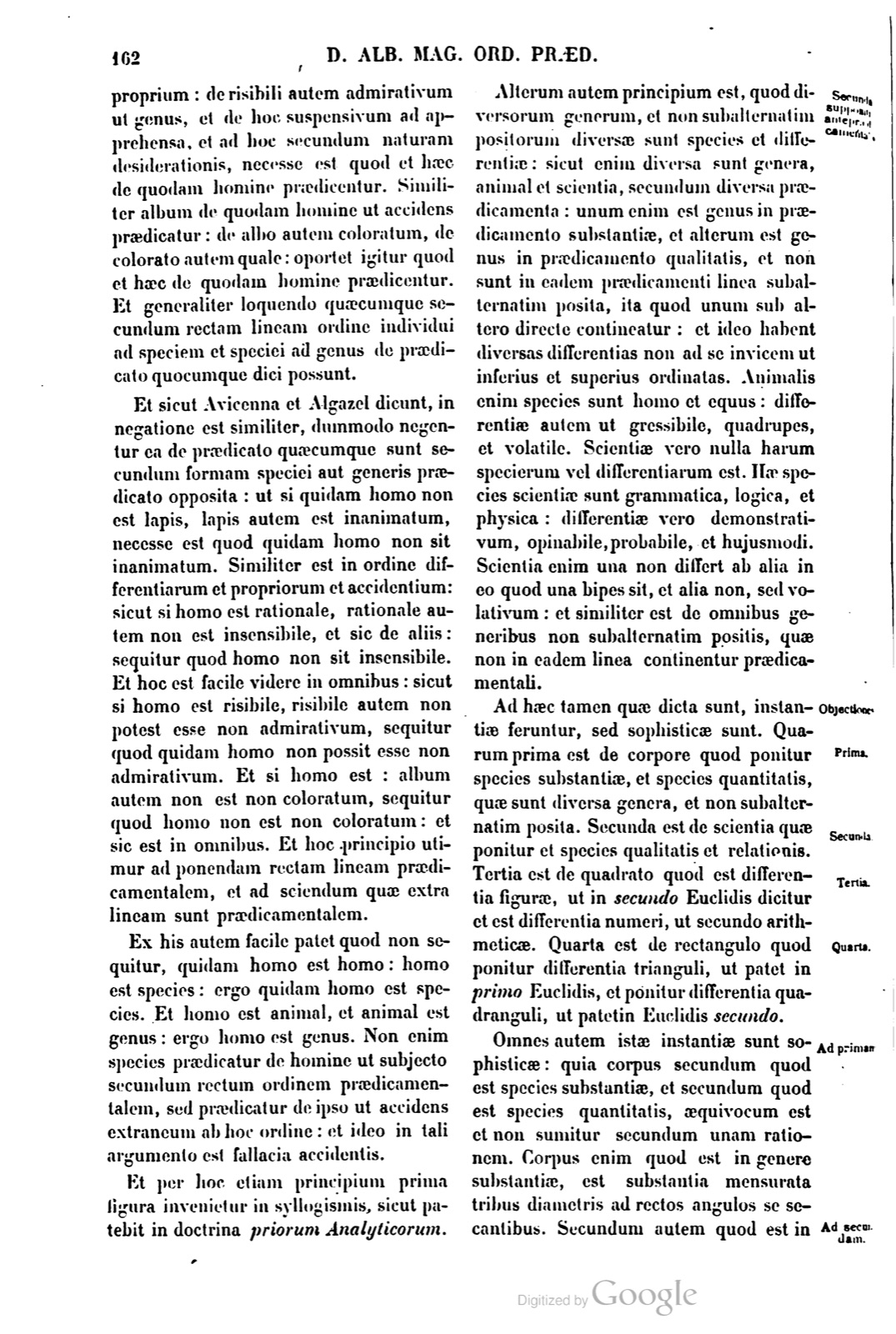
Omnes autem istæ instantiæ sunt sophisticæ: quia corpus secundum quod est species substantiæ, et secundum quod est species quantitatis, æquivocum est et non sumitur secundum unam rationem. Corpus enim quod est in genere substantiæ, est substantia mensurata tribus diametris ad rectos angulos se secantibus. Secundum autem quod est in genere quantitatis, est ipsa trina dimensio. Similiter scientia relata ad scibile, species est relationis, et secundum quod est qualitas scientis, est in genere qualitatis. Quadratum autem non dicitur de numeris, nisi transumptive et non proprie. Similiter autem et rectangulum non eodem modo dicitur de triangulo et de quadrangulo: quadrangulo enim convenit per se et semper, triangulo autem accidit: quæritur enim triangulo et per accidens.
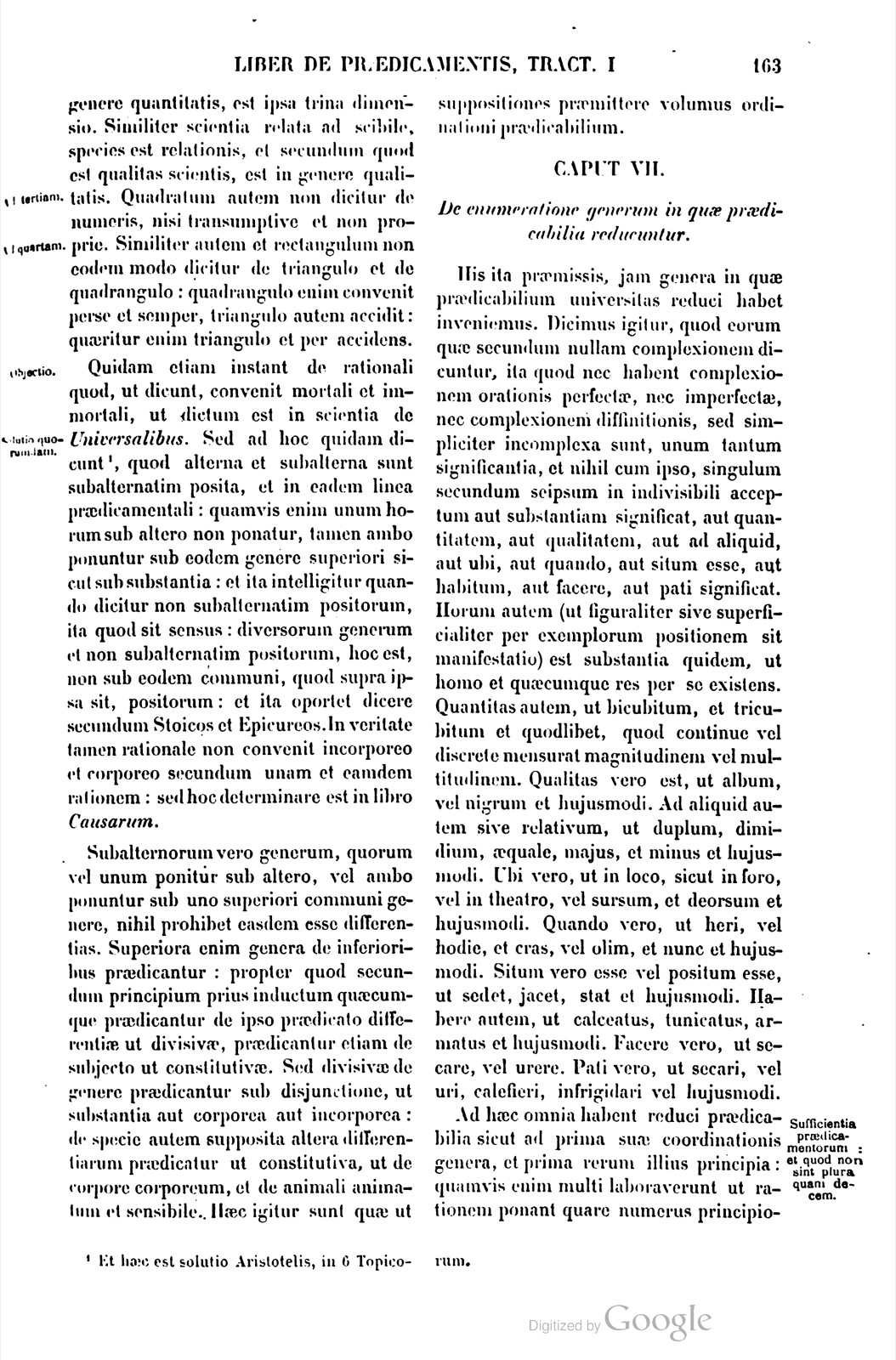
Quidam etiam instant de rationali quod, ut dicunt, convenit mortali et immortali, ut dictum est in scientia de Universalibus. Sed ad hoc quidam dicunt1, quod alterna et subalterna sunt subalternatim posita, et in eadem linea prædicamentali: quamvis enim unum horum sub altero non ponatur, tamen ambo ponuntur sub eodem genere superiori sicut sub substantia: et ita intelligitur quando dicitur non subalternatim positorum, ita quod sit sensus: diversorum generum et non subalternatim positorum, hoc est, non sub eodem communi, quod supra ipsa sit, positorum: et ita oportet dicere secundum Stoicos et Epicureos. In veritate tamen rationale non convenit incorporeo et corporeo secundum unam et eamdem rationem: sed hoc determinare est in libro Causarum.
Subalternorum vero generum, quorum vel unum ponitur sub altero, vel ambo ponuntur sub uno superiori communi genere, nihil prohibet easdem esse differentias. Superiora enim genera de inferioribus prædicantur: propter quod secundum principium prius inductum quæcumque prædicantur de ipso prædicato differentiæ ut divisivæ, prædicantur etiam de subjecto ut constitutivæ. Sed divisivæ de genere prædicantur sub disjunctione, ut substantia aut corporea aut incorporea: de specie autem supposita altera differentiarum prædicatur ut constitutiva, ut de corpore corporeum, et de animali animatum et sensibile. Hæc igitur sunt quæ ut suppositiones præmittere volumus ordinationi prædicabilium.
All those instances, however, are sophistical: because body, according as it is a species of substance, and according as it is a species of quantity, is equivocal and is not taken according to one account. For body which is in the genus of substance is substance measured by three diameters cutting one another at right angles. But according as it is in the genus of quantity, it is the threefold dimension itself. Similarly science, related to the knowable, is a species of relation; and according as it is a quality of the knower, it is in the genus of quality. Square, however, is not said of numbers except transumptively and not properly. Likewise, too, rectangle is not said in the same mode of triangle and of quadrangle: for it belongs to quadrangle through itself and always, but to triangle it belongs accidentally; for it is sought for triangle and by accident.
Some also make an instance concerning rational, which, as they say, belongs to mortal and immortal, as was said in the science concerning Universals. But to this some say1 that alternate and subalternate things are placed subalternately and in the same predicamental line: for although one of these is not placed under the other, nevertheless both are placed under the same higher genus, as under substance. And thus it is understood when things are said to be not placed subalternately, so that the sense is: of diverse genera and not placed subalternately, that is, not placed under the same common thing which is above them; and thus it is necessary to speak according to the Stoics and Epicureans. In truth, nevertheless, rational does not belong to incorporeal and corporeal according to one and the same account; but to determine this belongs in the book On Causes.
But of subalternate genera, of which either one is placed under the other, or both are placed under one higher common genus, nothing prevents the same differences from existing. For the higher genera are predicated of the lower; on account of which, according to the principle previously introduced, whatsoever things are predicated of the predicate itself of the difference as divisive, are predicated also of the subject as constitutive. But divisive differences are predicated of the genus under disjunction, as substance is either corporeal or incorporeal; but of the species, when one of the differences has been supposed, it is predicated as constitutive, as corporeal of body, and animate and sensible of animal. These, therefore, are the things which we wish to premise as suppositions to the ordering of predicables.
Notes
- And this is the solution of Aristotle, in Topics VI. (Et hæc est solutio Aristotelis, in 6 Topicorum.) ↩
If a page does not appear, its photograph has not been uploaded yet.