Volume 1 · pp. 159–161
Chapter V. On the division of things orderable and not orderable in a category
A marker with ≈ is an approximate page boundary, placed by measure of the text; the page photographs remain the authority. In the paired views, clicking a page marker brings that page into view.
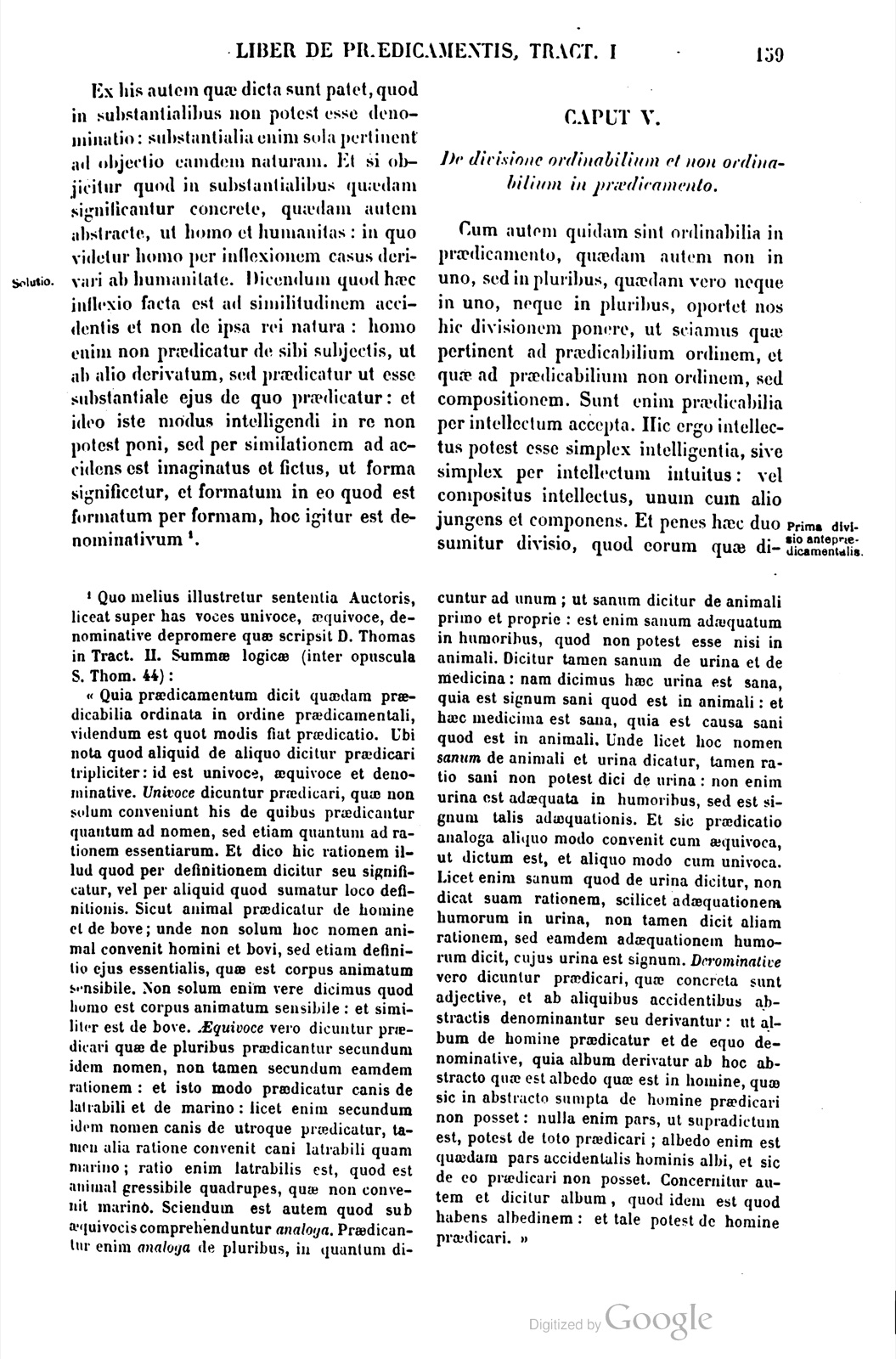
CAPUT V. De divisione ordinabilium et non ordinabilium in prædicamento.
Cum autem quidam sint ordinabilia in prædicamento, quædam autem non in uno, sed in pluribus, quædam vero neque in uno, neque in pluribus, oportet nos hic divisionem ponere, ut sciamus quæ pertinent ad prædicabilium ordinem, et quæ ad prædicabilium non ordinem, sed compositionem. Sunt enim prædicabilia per intellectum accepta. Hic ergo intellectus potest esse simplex intelligentia, sive simplex per intellectum intuitus: vel compositus intellectus, unum cum alio jungens et componens. Et penes hæc duo sumitur prima divisio, quod eorum quæ dicuntur alia quidem sine complexione dicuntur, alia vero dicuntur cum complexione. Quamvis enim res omnes incomplexæ sint, tamen compositionem formæ cum materia vel prædicati cum subjecto non potest significare intellectus, nisi per notam complexionem. Complexio autem est designatio unius cum altero vel in altero: sicut cum dicitur, homo currit vel homo vincit: in his enim vocibus notatur cursus inesse homini et victoria, ut actus inest agenti. Et hanc complexionem componens facit intellectus: et non est in re per modum compositionis, quæ media sit inter hominem agentem et actum ejusdem. Ea vero quæ sine complexione sunt, exemplariter sunt, sicut cum per se dicimus homo, et per se vincit, per se currit, ut in tractatu de antecedentibus ad logicam satis dictum est, ubi diffinitum est complexum et incomplexum.1 Incomplexum autem sub voce conceptum, est ordinabile in prædicamento aliquo. Complexum autem pertinet ad intellectum componentem secundum naturam compositionis.
Aliam autem præmittemus divisionem secundum rationem illam dictam, secundum quam aliud ponitur in eodem vel diverso prædicamento. Et hanc dabimus quadrimembrem super duas divisiones bimembres fundatam. Est enim prædicabilium quæ in prædicamento vel ad subjectum unum ordinantur aliud substantia, aliud accidens, aliud universale, aliud particulare. Et est accidens universale, et accidens particulare: et est substantia universale, et est substantia quæ est particulare per conjunctionem membrorum dividentium in duabus divisionibus inductis. Et ideo egreditur quadrimembris divisio, quod eorum quæ sunt in natura et quidditate sua, alia de subjecto quodam dicuntur, et non sunt in subjecto aliquo, sicut substantia universalis, sicut homo universale vel species de subjecto dicitur, quando homo dicitur de aliquo homine, sicut cum dicitur per individuum vagum, aliquis homo est homo: vel per individuum significatum, sicut cum dicitur, Socrates est homo. In subjecto vero nullo est, sicut accidens in subjecto est quod sui esse causam habet subjectum: quando enim homo prædicatur de aliquo homine, prædicatum est causa et essentiæ subjecti, et non accipit sui esse causam a subjecto. Alia autem per oppositionem ad ista in subjecto quidem sunt, sed de nullo dicuntur ut de subjecto, ordinata prædicatione: sed si dicuntur de aliquo, est sicut individuum quod prædicatur de seipso.
CHAPTER V. On the division of things orderable and not orderable in a category.
But since some things are orderable in a category, some however not in one category but in many, and some truly neither in one nor in many, it is necessary for us here to set down a division, so that we may know which things belong to the order of predicables, and which things belong not to the order of predicables but to composition. For predicables are received through the intellect. This intellect, therefore, can be a simple understanding, or a simple intuition through the intellect; or a composite understanding, joining and composing one thing with another. And according to these two there is taken the first division, that of those things which are said, some are said without complexity, while others are said with complexity. For although all things are incomplex, nevertheless the intellect cannot signify the composition of form with matter or of predicate with subject except through a mark of complexity. But complexity is the designation of one thing with another or in another, as when it is said, man runs or man conquers; for in these words running is marked as being in man, and victory, as act is in the agent. And the composing intellect makes this complexity; and it is not in the thing by way of a composition which would be a middle thing between the acting man and his act. But those things which are without complexity are by way of example, as when we say by itself man, and by itself conquers, by itself runs, as has been sufficiently said in the treatise on the things preceding logic, where the complex and the incomplex have been defined.1 But the incomplex conceived under a word is orderable in some category. The complex, however, belongs to the intellect composing according to the nature of composition.
But we shall preface another division according to that stated account, according to which one thing is placed in the same or in a diverse category. And we shall give this as a four-membered division founded upon two two-membered divisions. For of predicables which are ordered in a category or to one subject, one is substance, another accident, another universal, another particular. And there is universal accident and particular accident; and there is universal substance, and there is substance which is particular through the conjunction of the members of division in the two divisions introduced. And therefore a four-membered division comes forth: that of the things which exist in their own nature and quiddity, some are said of a certain subject and are not in any subject, as universal substance, as man universal or species is said of a subject when man is said of some man, as when it is said through a vague individual, some man is man; or through a signified individual, as when it is said, Socrates is man. But it is in no subject, as an accident is in a subject when the subject has the cause of its being; for when man is predicated of some man, the predicate is a cause also of the essence of the subject, and does not receive the cause of its being from the subject. But other things, by opposition to these, are indeed in a subject, but are said of nothing as of a subject by ordered predication; but if they are said of something, it is as an individual which is predicated of itself.
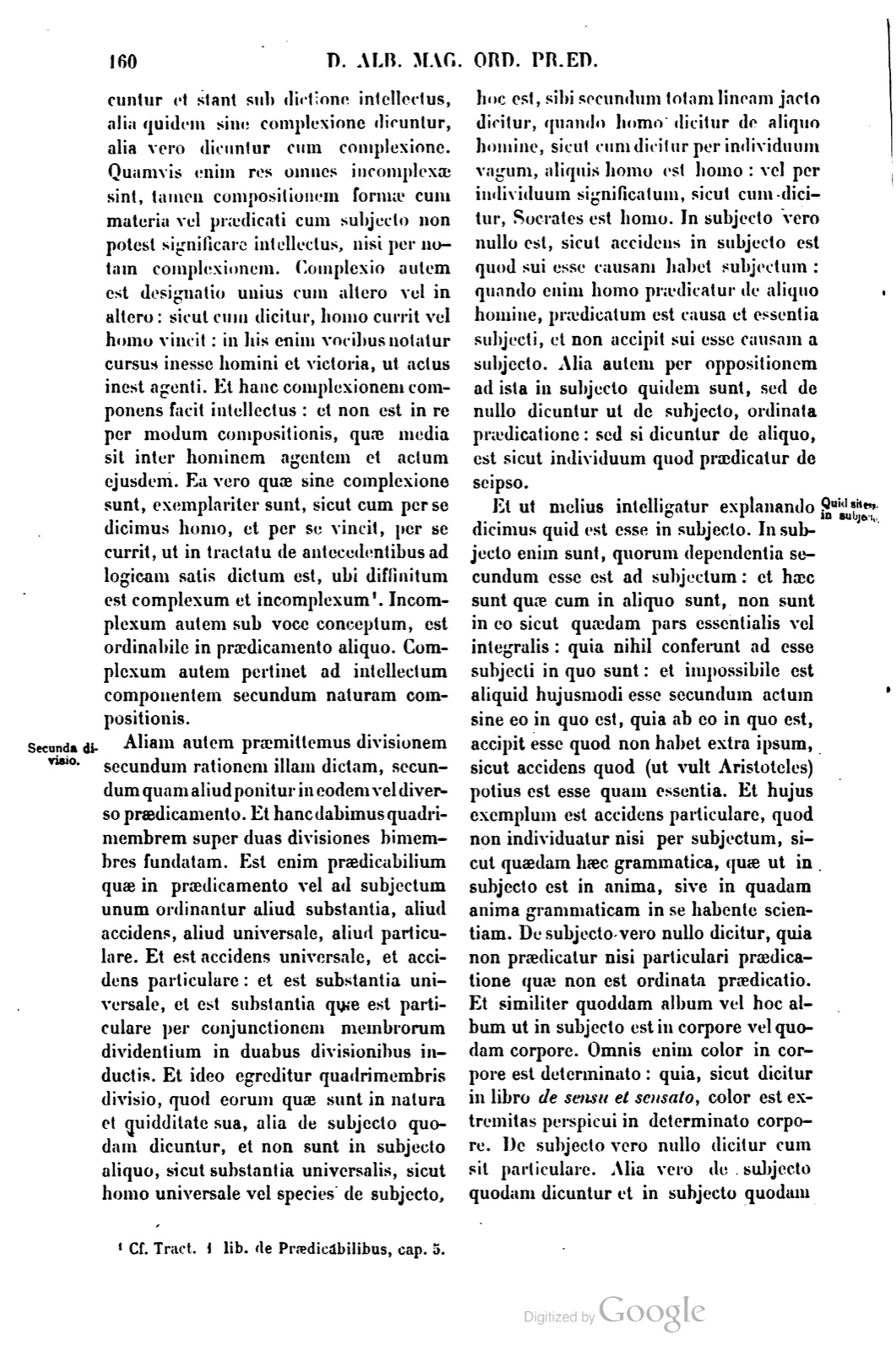
Et ut melius intelligatur explanando dicimus quid est esse in subjecto. In subjecto enim sunt, quorum dependentia secundum esse est ad subjectum: et hæc sunt quæ cum in aliquo sunt, non sunt in eo sicut quædam pars essentialis vel integralis: quia nihil conferunt ad esse subjecti in quo sunt: et impossibile est aliquid hujusmodi esse secundum actum sine eo in quo est, quia ab eo in quo est, accipit esse quod non habet extra ipsum, sicut accidens quod, ut vult Aristoteles, potius est esse quam essentia. Et hujus exemplum est accidens particulare, quod non individuatur nisi per subjectum, sicut quædam hæc grammatica, quæ ut in subjecto est in anima, sive in quadam anima grammaticam in se habente scientiam. De subjecto vero nullo dicitur, quia non prædicatur nisi particulari prædicatione quæ non est ordinata prædicatio. Et similiter quoddam album vel hoc album ut in subjecto est in corpore vel quodam corpore. Omnis enim color in corpore est determinato: quia, sicut dicitur in libro de sensu et sensato, color est extremitas perspicui in determinato corpore. De subjecto vero nullo dicitur cum sit particulare. Alia vero de subjecto quodam dicuntur et in subjecto quodam
And in order that it may be understood better, explaining it we say what it is to be in a subject. For those things are in a subject whose dependence according to being is upon a subject; and these are things which, when they are in something, are not in it as a certain essential or integral part, because they contribute nothing to the being of the subject in which they are; and it is impossible for something of this sort to be in act without that in which it is, because from that in which it is it receives the being which it does not have outside it, as an accident, which, as Aristotle wills, is rather being than essence. And an example of this is a particular accident, which is not individuated except through a subject, as this certain grammar, which as in a subject is in the soul, or in a certain soul having grammatical science in itself. But it is said of no subject, because it is predicated only by a particular predication, which is not an ordered predication. And similarly a certain white thing or this white thing, as in a subject, is in a body or a certain body. For every color is in a determined body, because, as is said in the book On Sense and Sensible, color is the extremity of the transparent in a determined body. But it is said of no subject since it is particular. But other things are said of a certain subject and in a certain subject
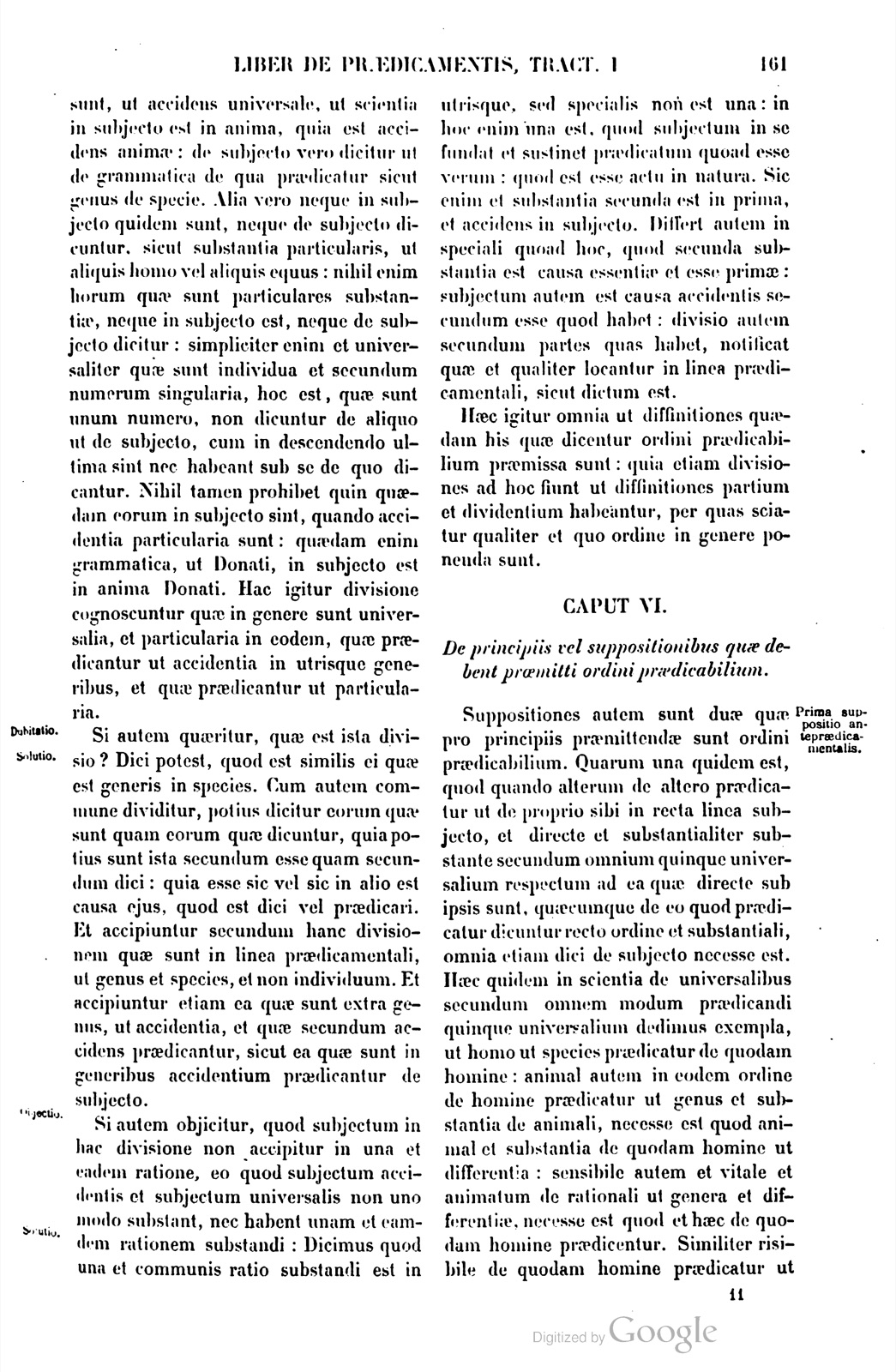
sunt, ut accidens universale, ut scientia in subjecto est in anima, quia est accidens animæ: de subjecto vero dicitur ut de grammatica de qua prædicatur sicut genus de specie. Alia vero neque in subjecto quidem sunt, neque de subjecto dicuntur, sicut substantia particularis, ut aliquis homo vel aliquis equus: nihil enim horum quæ sunt particulares substantiæ, neque in subjecto est, neque de subjecto dicitur: simpliciter enim et universaliter quæ sunt individua et secundum numerum singularia, hoc est, quæ sunt unum numero, non dicuntur de aliquo ut de subjecto, cum in descendendo ultima sint nec habeant sub se de quo dicantur. Nihil tamen prohibet quin quædam eorum in subjecto sint, quando accidentia particularia sunt: quædam enim grammatica, ut Donati, in subjecto est in anima Donati. Hac igitur divisione cognoscuntur quæ in genere sunt universalia, et particularia in eodem, quæ prædicantur ut accidentia in utrisque generibus, et quæ prædicantur ut particularia.
Si autem quæritur, quæ est ista divisio? Dici potest, quod est similis ei quæ est generis in species. Cum autem commune dividitur, potius dicitur eorum quæ sunt quam eorum quæ dicuntur, quia potius sunt ista secundum esse quam secundum dici: quia esse sic vel sic in alio est causa ejus, quod est dici vel prædicari. Et accipiuntur secundum hanc divisionem quæ sunt in linea prædicamentali, ut genus et species, et non individuum. Et accipiuntur etiam ea quæ sunt extra genus, ut accidentia, et quæ secundum accidens prædicantur, sicut ea quæ sunt in generibus accidentium prædicantur de subjecto.
Si autem objicitur, quod subjectum in hac divisione non accipitur in una et eadem ratione, eo quod subjectum accidentis et subjectum universalis non uno modo substant, nec habent unam et eamdem rationem substandi: dicimus quod una et communis ratio substandi est in utrisque, sed specialis non est una: in hoc enim una est, quod subjectum in se fundat et sustinet prædicatum quoad esse verum: quod est esse actu in natura. Sic enim et substantia secunda est in prima, et accidens in subjecto. Differt autem in speciali quoad hoc, quod secunda substantia est causa essentiæ et esse primæ: subjectum autem est causa accidentis secundum esse quod habet: divisio autem secundum partes quas habet, notificat quæ et qualiter locantur in linea prædicamentali, sicut dictum est.
Hæc igitur omnia ut diffinitiones quædam his quæ dicentur ordini prædicabilium præmissa sunt: quia etiam divisiones ad hoc fiunt ut diffinitiones partium et dividentium habeantur, per quas sciatur qualiter et quo ordine in genere ponenda sunt.
are, as a universal accident is, as science is in a subject, namely in the soul, because it is an accident of the soul; but it is said of a subject as grammar is said of that of which it is predicated, as a genus is said of a species. But other things neither are in a subject nor are said of a subject, such as a particular substance, as some man or some horse: for none of those things which are particular substances either is in a subject or is said of a subject. For simply and universally those things which are individuals and singular according to number, that is, which are one in number, are not said of anything as of a subject, since in descending they are last and do not have beneath themselves something of which they may be said. Yet nothing prevents some of them from being in a subject, when they are particular accidents: for some particular grammar, as that of Donatus, is in a subject, in the soul of Donatus. Therefore by this division there are known the universals which are in a genus, and the particulars in the same genus, the things which are predicated as accidents in both genera, and the things which are predicated as particulars.
But if it is asked what sort of division this is, it can be said that it is similar to that which is of a genus into species. But when a common thing is divided, it is more properly said to be a division of the things which are than of the things which are said, because these things are more properly such according to being than according to being-said: for to be in another in this or that way is the cause of its being said or predicated. And according to this division there are taken the things which are in the categorial line, such as genus and species, and not the individual. And there are also taken the things which are outside the genus, as accidents, and the things which are predicated accidentally, just as the things which are in the genera of accidents are predicated of a subject.
But if it is objected that subject in this division is not taken according to one and the same account, because the subject of an accident and the subject of a universal do not underlie in one way, nor do they have one and the same account of underlying, we say that one common account of underlying is in both, but one special account is not. For it is one in this respect, that the subject grounds in itself and sustains the predicate with respect to true being, which is being in act in nature. For thus both second substance is in first substance, and an accident is in a subject. But it differs specifically in this respect, that second substance is the cause of the essence and being of first substance; but the subject is the cause of the accident according to the being which it has. And the division, according to the parts which it has, makes known which things are located in the categorial line and in what way, as has been said.
Therefore all these things, as certain definitions, have been set before the things which are to be said concerning the order of predicables, because divisions also are made for this purpose, that definitions of the parts and of the things divided may be had, through which it may be known how and in what order they must be placed in a genus.
Notes
- Compare tractate 1 of the book On Predicables, chapter 5. (Cf. Tract. 1 lib. de Prædicabilibus, cap. 5.) ↩
If a page does not appear, its photograph has not been uploaded yet.