Volume 1 · pp. 157–159
Chapter IV. On denominative things
A marker with ≈ is an approximate page boundary, placed by measure of the text; the page photographs remain the authority. In the paired views, clicking a page marker brings that page into view.
CAPUT IV. De denominativis.
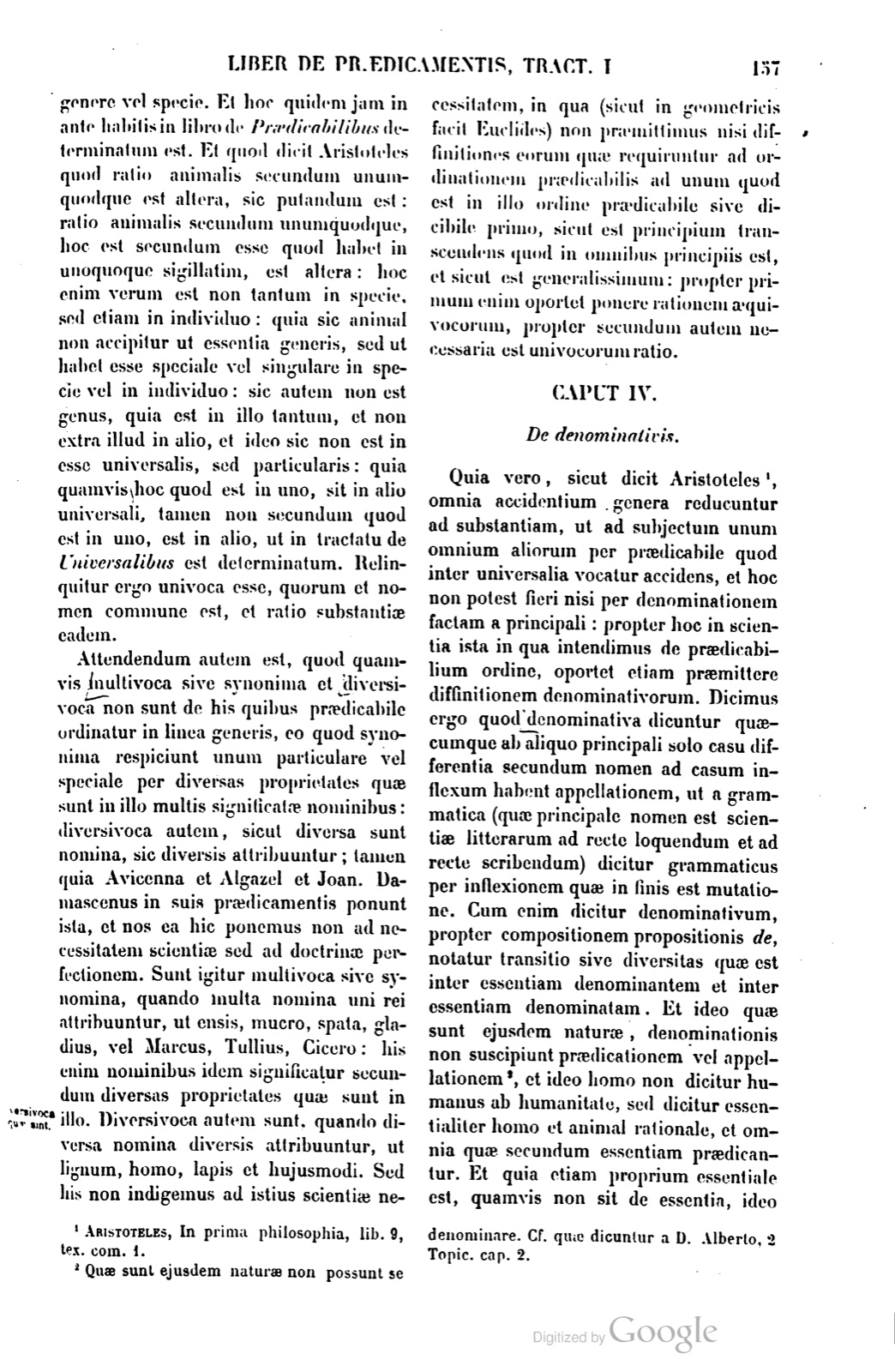
Quia vero, sicut dicit Aristoteles,1 omnia accidentium genera reducuntur ad substantiam, ut ad subjectum unum omnium aliorum per prædicabile quod inter universalia vocatur accidens, et hoc non potest fieri nisi per denominationem factam a principali: propter hoc in scientia ista in qua intendimus de prædicabilium ordine, oportet etiam præmittere diffinitionem denominativorum. Dicimus ergo quod denominativa dicuntur quæcumque ab aliquo principali solo casu differentia secundum nomen ad casum inflexum habent appellationem, ut a grammatica, quæ principale nomen est scientiæ litterarum ad recte loquendum et ad recte scribendum, dicitur grammaticus per inflexionem quæ in finis est mutatione. Cum enim dicitur denominativum, propter compositionem propositionis de, notatur transitio sive diversitas quæ est inter essentiam denominantem et inter essentiam denominatam. Et ideo quæ sunt ejusdem naturæ, denominationis non suscipiunt prædicationem vel appellationem,2 et ideo homo non dicitur humanus ab humanitate, sed dicitur essentialiter homo et animal rationale, et omnia quæ secundum essentiam prædicantur. Et quia etiam proprium essentiale est, quamvis non sit de essentia, ideo non congrue dicitur homo risibilitatus.
In accidentibus etiam secundum quod ordinata sunt in generibus suis et speciebus, non recipiunt denominationis rationem: albedo enim nec dicitur alba, nec dicitur colorata, sed dicitur color, et sic de omnibus aliis. Sed quando natura aliena quæ est post esse alterius, intelligitur et significatur quasi circumposita, scilicet composita per unius naturæ ad alienam congregationem, tunc fit denominatio, ut dicitur homo albus, vel alba quod est res alba. Hæc igitur sicut univoca et æquivoca, quia multitudinem essentiarum significantur, competentius diffiniuntur in plurali, ut dicantur denominativa, quam singulari ut dicatur denominativum.
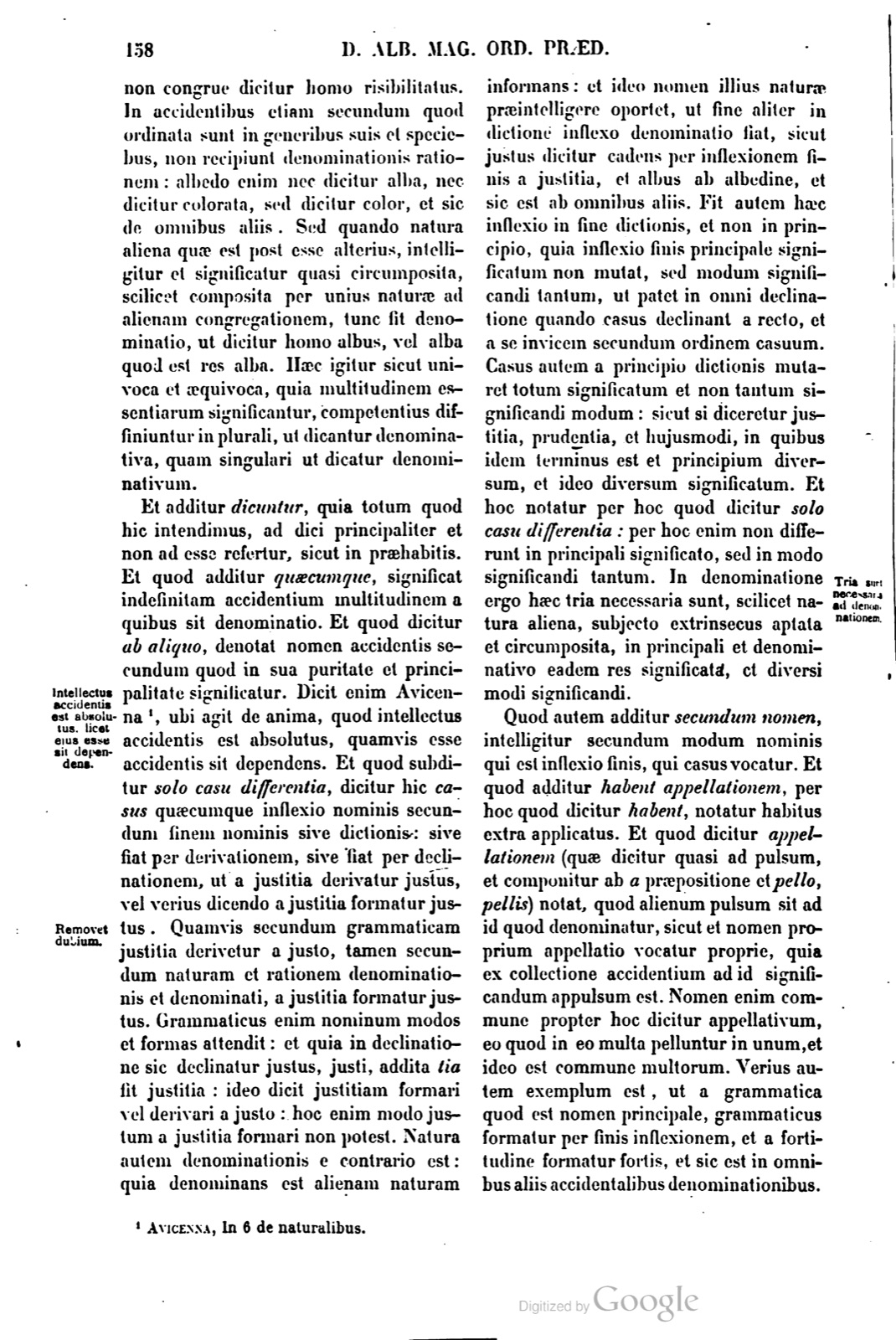
Et additur dicuntur, quia totum quod hic intendimus, ad dici principaliter et non ad esse refertur, sicut in præhabitis. Et quod additur quæcumque, significat indefinitam accidentium multitudinem a quibus sit denominatio. Et quod dicitur ab aliquo, denotat nomen accidentis secundum quod in sua puritate et principalitate significatur. Dicit enim Avicenna,3 ubi agit de anima, quod intellectus accidentis est absolutus, quamvis esse accidentis sit dependens. Et quod subditur solo casu differentia, dicitur hic casus quæcumque inflexio nominis secundum finem nominis sive dictionis: sive fiat per derivationem, sive fiat per declinationem, ut a justitia derivatur justus, vel verius dicendo a justitia formatur justus. Quamvis secundum grammaticam justitia derivetur a justo, tamen secundum naturam et rationem denominationis et denominati, a justitia formatur justus. Grammaticus enim nominum modos et formas attendit: et quia in declinatione sic declinatur justus, justi, addita tia fit justitia: ideo dicit justitiam formari vel derivari a justo: hoc enim modo justum a justitia formari non potest. Natura autem denominationis e contrario est: quia denominans est alienam naturam informans: et ideo nomen illius naturæ præintelligere oportet, ut fine aliter in dictione inflexo denominatio fiat, sicut justus dicitur cadens per inflexionem finis a justitia, et albus ab albedine, et sic est ab omnibus aliis.
CHAPTER IV. On denominative things.
But because, as Aristotle says,1 all genera of accidents are reduced to substance as to one subject of all the others through the predicable which among universals is called accident, and this cannot happen except through denomination made from a principal thing, on this account in this science, in which we intend the order of predicables, it is also necessary to preface the definition of denominative things. Therefore we say that denominative things are called all those things which, differing from some principal thing by case alone according to the name, have an appellation toward an inflected case, as from grammar, which is the principal name of the science of letters for speaking rightly and writing rightly, grammatical is said through an inflection which is in a change of ending. For when denominative is said, on account of the composition of the proposition de, a transition or diversity is marked which is between the denominating essence and the denominated essence. And therefore things which are of the same nature do not receive the predication or appellation of denomination,2 and therefore man is not called humaned from humanity, but is called essentially man and rational animal, and all things which are predicated according to essence. And because even a property is essential, although it is not of the essence, therefore man is not fittingly called risibilitated.
Also in accidents, according as they are ordered in their genera and species, they do not receive the account of denomination: for whiteness is neither called white nor called colored, but is called color; and so with all other things. But when an alien nature which is after the being of another is understood and signified as though placed around, namely composed through the gathering of one nature to an alien nature, then denomination occurs, as man is called white, or white, which is a white thing. Therefore these, just as univocal and equivocal things, because they signify a multitude of essences, are more suitably defined in the plural, so that they are called denominative things, than in the singular, so that it is called a denominative thing.
And it is added that they are called, because the whole that we intend here is principally referred to being-said and not to being, as in the preceding matters. And what is added, whatsoever, signifies the indefinite multitude of accidents from which denomination may occur. And what is said, from something, denotes the name of an accident according as it is signified in its purity and principality. For Avicenna says,3 where he treats the soul, that the understanding of an accident is absolute, although the being of an accident is dependent. And what is added, differing by case alone, here case is called any inflection whatever of a name according to the end of the name or diction, whether it happens through derivation or through declension, as just is derived from justice, or, to speak more truly, just is formed from justice. Although according to grammar justice is derived from just, nevertheless according to the nature and account of denomination and of the denominated, just is formed from justice. For the grammarian attends to the modes and forms of names; and because in declension just is declined thus, justus, justi, with tia added justice comes to be; therefore he says that justice is formed or derived from just. For in this mode just cannot be formed from justice. But the nature of denomination is the contrary, because the denominating nature is an alien nature informing; and therefore it is necessary to pre-understand the name of that nature, so that denomination may occur with the ending inflected otherwise in diction, just as just is said as falling by inflection of the ending from justice, and white from whiteness, and so it is from all other things.
Fit autem hæc inflexio in fine dictionis, et non in principio, quia inflexio finis principale significatum non mutat, sed modum significandi tantum, ut patet in omni declinatione quando casus declinant a recto, et a se invicem secundum ordinem casuum. Casus autem a principio dictionis mutaret totum significatum et non tantum significandi modum: sicut si diceretur justitia, prudentia, et hujusmodi, in quibus idem terminus est et principium diversum, et ideo diversum significatum. Et hoc notatur per hoc quod dicitur solo casu differentia: per hoc enim non differunt in principali significato, sed in modo significandi tantum. In denominatione ergo hæc tria necessaria sunt, scilicet natura aliena, subjecto extrinsecus aptata et circumposita, in principali et denominativo eadem res significata, et diversi modi significandi.
But this inflection occurs at the end of the diction and not at the beginning, because inflection of the ending does not change the principal signified, but only the mode of signifying, as is clear in every declension when cases decline from the nominative and from one another according to the order of cases. But a case from the beginning of diction would change the whole signified and not only the mode of signifying, as if justice, prudence, and things of this kind were said, in which the same ending exists and the beginning is diverse, and therefore the signified is diverse. And this is marked by what is said, differing by case alone; for through this they do not differ in the principal signified, but only in the mode of signifying. Therefore in denomination these three things are necessary: namely an alien nature, fitted extrinsically and placed around a subject, the same thing signified in the principal and in the denominative, and diverse modes of signifying.
Quod autem additur secundum nomen, intelligitur secundum modum nominis qui est inflexio finis, qui casus vocatur. Et quod additur habent appellationem, per hoc quod dicitur habent, notatur habitus extra applicatus. Et quod dicitur appellationem, quæ dicitur quasi ad pulsum, et componitur ab a præpositione et pello, pellis, notat quod alienum pulsum sit ad id quod denominatur, sicut et nomen proprium appellatio vocatur proprie, quia ex collectione accidentium ad id significandum appulsum est. Nomen enim commune propter hoc dicitur appellativum, eo quod in eo multa pelluntur in unum, et ideo est commune multorum. Verius autem exemplum est, ut a grammatica quod est nomen principale, grammaticus formatur per finis inflexionem, et a fortitudine formatur fortis, et sic est in omnibus aliis accidentalibus denominationibus.
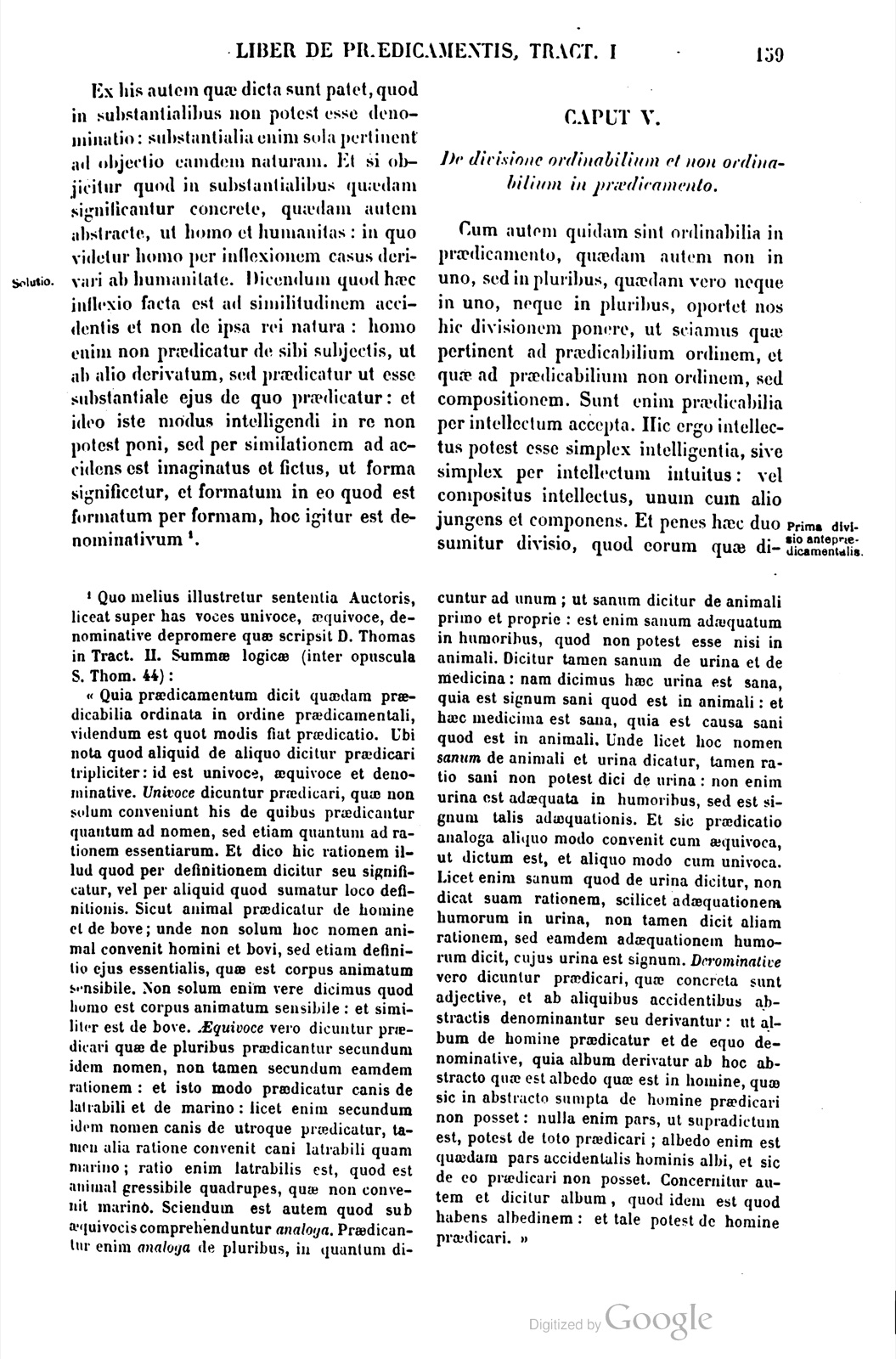
Ex his autem quæ dicta sunt patet, quod in substantialibus non potest esse denominatio: substantialia enim sola pertinent ad objectio eamdem naturam. Et si objicitur quod in substantialibus quædam significantur concrete, quædam autem abstracte, ut homo et humanitas: in quo videtur homo per inflexionem casus derivari ab humanitate. Dicendum quod hæc inflexio facta est ad similitudinem accidentis et non de ipsa rei natura: homo enim non prædicatur de sibi subjectis, ut ab alio derivatum, sed prædicatur ut esse substantiale ejus de quo prædicatur: et ideo iste modus intelligendi in re non potest poni, sed per similationem ad accidens est imaginatus et fictus, ut forma significetur, et formatum in eo quod est formatum per formam, hoc igitur est denominativum.4
But what is added, according to the name, is understood according to the mode of the name which is inflection of the ending, which is called case. And what is added, have appellation, through the fact that have is said, an externally applied having is marked. And what is said, appellation, which is said as though ad pulsum, and is composed from the preposition a and pello, pellis, marks that an alien striking is toward that which is denominated, just as a proper name is properly called an appellation because it has been applied from a collection of accidents to signify that thing. For a common name is for this reason called appellative, because in it many things are driven together into one, and therefore it is common to many. But a truer example is that from grammar, which is the principal name, grammatical is formed through inflection of the ending, and from fortitude, brave is formed; and so it is in all other accidental denominations.
From these things which have been said, it is clear that in substantial things there cannot be denomination; for substantial things alone belong to the same nature as object. And if it is objected that in substantial things certain things are signified concretely and certain things abstractly, as man and humanity, in which man seems to be derived from humanity by inflection of case, it must be said that this inflection has been made according to the likeness of an accident and not from the very nature of the thing. For man is not predicated of the things subject to it as derived from another, but is predicated as the substantial being of that of which it is predicated; and therefore this mode of understanding cannot be placed in the thing, but has been imagined and fashioned by assimilation to an accident, so that the form is signified, and what is formed in that in which it has been formed by the form. This, therefore, is denominative.4
Notes
- Aristotle, in the First Philosophy, book 9, text/commentary 1. (Aristoteles, In prima philosophia, lib. 9, tex. com. 1.) ↩
- Things which are of the same nature cannot denominate themselves. Compare what is said by D. Albert, Topics 2, chapter 2. (Quæ sunt ejusdem naturæ non possunt se denominare. Cf. quæ dicuntur a D. Alberto, 2 Topic. cap. 2.) ↩
- Avicenna, in book 6 On Natural Things. (Avicenna, In 6 de naturalibus.) ↩
- In order that the Author's meaning may be illustrated better, it is permitted to draw forth, concerning these words univocally, equivocally, denominatively, the things which D. Thomas wrote in Tractate II of the Summa of Logic, among the opuscula of St. Thomas, 44: Because a category expresses certain predicables ordered in categorial order, it must be seen in how many modes predication occurs. Note there that something is said to be predicated of something in three ways, that is, univocally, equivocally, and denominatively. Those things are said to be predicated univocally which agree with the things of which they are predicated not only with respect to the name, but also with respect to the account of the essences. And here I call account that which is said or signified through definition, or through something which is taken in place of definition. Thus animal is predicated of man and of ox; hence not only does this name animal belong to man and ox, but also its essential definition, which is sensible animate body. For we not only truly say that man is sensible animate body; and similarly this is so of ox. But those things are said to be predicated equivocally which are predicated of many according to the same name, but not according to the same account; and in this mode dog is predicated of a barking dog and of a sea-dog. For although according to the same name dog is predicated of each, nevertheless by one account it belongs to the barking dog and by another to the sea-dog; for the account of the barking dog is that it is a walking quadruped animal, which does not belong to the sea-dog. It must be known, however, that analogues are included under equivocal things. For analogues are predicated of many insofar as they are said toward one thing; as healthy is said of an animal first and properly, for healthy is what is proportioned in humors, which cannot exist except in an animal. Nevertheless healthy is said of urine and of medicine; for we say this urine is healthy because it is a sign of the healthy thing which is in the animal, and this medicine is healthy because it is a cause of the healthy thing which is in the animal. Hence, although this name healthy is said of animal and urine, nevertheless the account of healthy cannot be said of urine; for urine is not proportioned in humors, but is a sign of such proportion. And thus analogous predication agrees in some way with equivocal predication, as has been said, and in some way with univocal predication. For although healthy, which is said of urine, does not express its own account, namely the proportion of humors in urine, nevertheless it does not express another account, but expresses the same proportion of humors of which urine is a sign. But those things are said to be predicated denominatively which are concrete adjectivally, and are denominated or derived from certain abstract accidents; as white is predicated of man and of horse denominatively, because white is derived from this abstract which is whiteness, which is in man, and which, taken thus in the abstract, could not be predicated of man; for no part, as was said above, can be predicated of the whole, and whiteness is a certain accidental part of a white man, and so could not be predicated of him. But it is connoted and is called white, which is the same as having whiteness; and such a thing can be predicated of man. (Quo melius illustretur sententia Auctoris, liceat super has voces univoce, æquivoce, denominative depromere quæ scripsit D. Thomas in Tract. II. Summæ logicæ (inter opuscula S. Thom. 44): « Quia prædicamentum dicit quædam prædicabilia ordinata in ordine prædicamentali, videndum est quot modis fiat prædicatio. Ubi nota quod aliquid de aliquo dicitur prædicari tripliciter: id est univoce, æquivoce et denominative. Univoce dicuntur prædicari, quæ non solum conveniunt his de quibus prædicantur quantum ad nomen, sed etiam quantum ad rationem essentiarum. Et dico hic rationem illud quod per definitionem dicitur seu significatur, vel per aliquid quod sumatur loco definitionis. Sicut animal prædicatur de homine et de bove; unde non solum hoc nomen animal convenit homini et bovi, sed etiam definitio ejus essentialis, quæ est corpus animatum sensibile. Non solum enim vere dicimus quod homo est corpus animatum sensibile: et similiter est de bove. Æquivoce vero dicuntur prædicari quæ de pluribus prædicantur secundum idem nomen, non tamen secundum eamdem rationem: et isto modo prædicatur canis de latrabili et de marino: licet enim secundum idem nomen canis de utroque prædicatur, tamen alia ratione convenit cani latrabili quam marino; ratio enim latrabilis est, quod est animal gressibile quadrupes, quæ non convenit marino. Sciendum est autem quod sub æquivocis comprehenduntur analoga. Prædicantur enim analoga de pluribus, in quantum dicuntur ad unum; ut sanum dicitur de animali primo et proprie: est enim sanum adæquatum in humoribus, quod non potest esse nisi in animali. Dicitur tamen sanum de urina et de medicina: nam dicimus hæc urina est sana, quia est signum sani quod est in animali: et hæc medicina est sana, quia est causa sani quod est in animali. Unde licet hoc nomen sanum de animali et urina dicatur, tamen ratio sani non potest dici de urina: non enim urina est adæquata in humoribus, sed est signum talis adæquationis. Et sic prædicatio analoga aliquo modo convenit cum æquivoca, ut dictum est, et aliquo modo cum univoca. Licet enim sanum quod de urina dicitur, non dicat suam rationem, scilicet adæquationem humorum in urina, non tamen dicit aliam rationem, sed eamdem adæquationem humorum dicit, cujus urina est signum. Denominative vero dicuntur prædicari, quæ concreta sunt adjective, et ab aliquibus accidentibus abstractis denominantur seu derivantur: ut album de homine prædicatur et de equo denominative, quia album derivatur ab hoc abstracto quæ est albedo quæ est in homine, quæ sic in abstracto sumpta de homine prædicari non posset: nulla enim pars, ut supradictum est, potest de toto prædicari; albedo enim est quædam pars accidentalis hominis albi, et sic de eo prædicari non posset. Concernitur autem et dicitur album, quod idem est quod habens albedinem: et tale potest de homine prædicari. ») ↩
If a page does not appear, its photograph has not been uploaded yet.