Volume 1 · pp. 155–157
Chapter III. On univocal things
A marker with ≈ is an approximate page boundary, placed by measure of the text; the page photographs remain the authority. In the paired views, clicking a page marker brings that page into view.
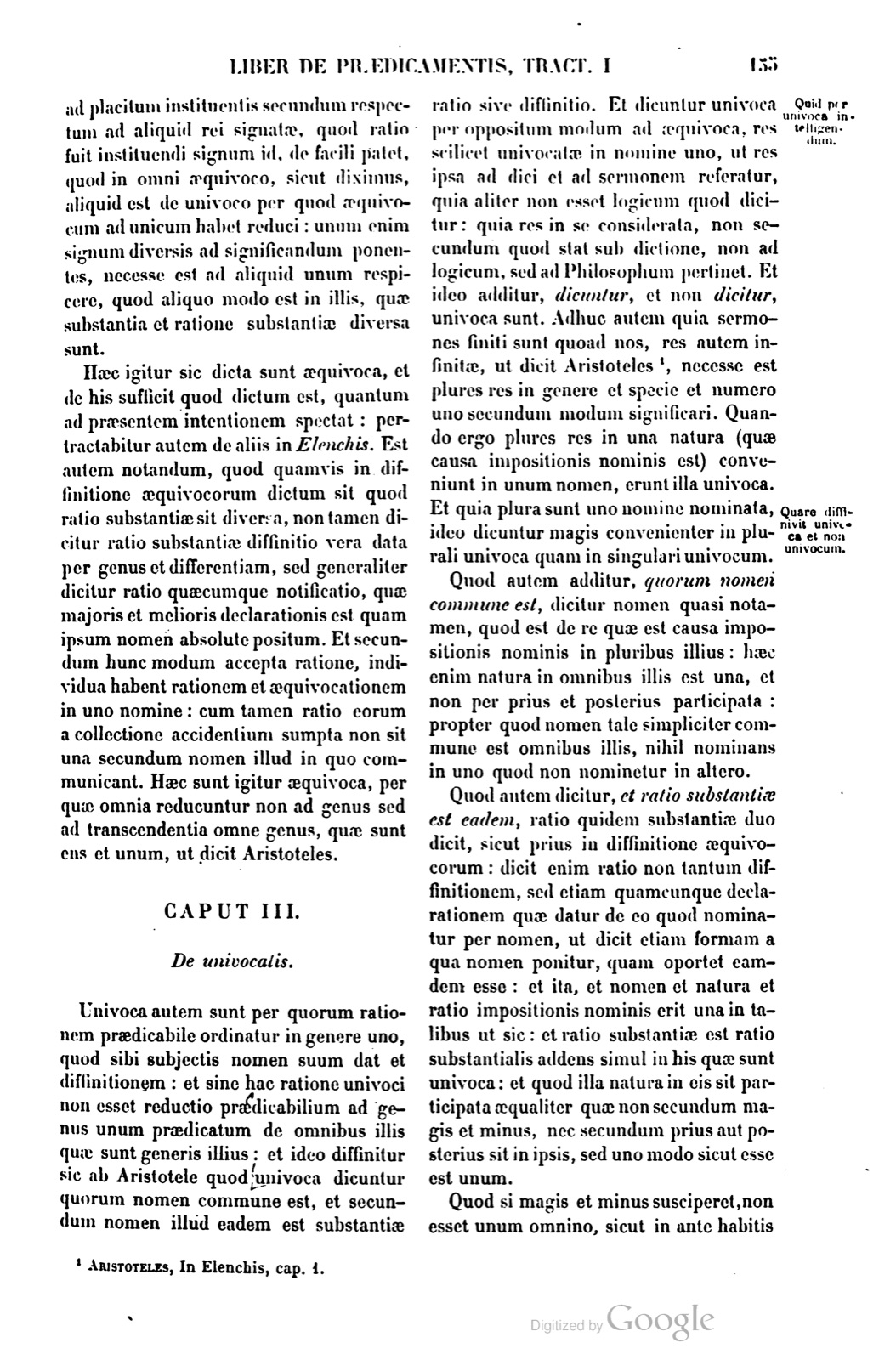
CAPUT III. De univocatis.
Univoca autem sunt per quorum rationem prædicabile ordinatur in genere uno, quod sibi subjectis nomen suum dat et diffinitionem: et sine hac ratione univoci non esset reductio prædicabilium ad genus unum prædicatum de omnibus illis quæ sunt generis illius: et ideo diffinitur sic ab Aristotele quod univoca dicuntur quorum nomen commune est, et secundum nomen illud eadem est substantiæ ratio sive diffinitio. Et dicuntur univoca per oppositum modum ad æquivoca, res scilicet univocatæ in nomine uno, ut res ipsa ad dici et ad sermonem referatur, quia aliter non esset logicum quod dicitur: quia res in se considerata, non secundum quod stat sub dictione, non ad logicum, sed ad Philosophum pertinet. Et ideo additur, dicuntur, et non dicitur, univoca sunt. Adhuc autem quia sermones finiti sunt quoad nos, res autem infinitæ, ut dicit Aristoteles, necesse est plures res in genere et specie et numero uno secundum modum significari. Quando ergo plures res in una natura, quæ causa impositionis nominis est, conveniunt in unum nomen, erunt illa univoca. Et quia plura sunt uno nomine nominata, ideo dicuntur magis convenienter in plurali univoca quam in singulari univocum.
Quod autem additur, quorum nomen commune est, dicitur nomen quasi notamen, quod est de re quæ est causa impositionis nominis in pluribus illis: hæc enim natura in omnibus illis est una, et non per prius et posterius participata: propter quod nomen tale simpliciter commune est omnibus illis, nihil nominans in uno quod non nominetur in altero.
Quod autem dicitur, et ratio substantiæ est eadem, ratio quidem substantiæ duo dicit, sicut prius in diffinitione æquivocorum: dicit enim ratio non tantum diffinitionem, sed etiam quamcumque declarationem quæ datur de eo quod nominatur per nomen, ut dicit etiam formam a qua nomen ponitur, quam oportet eamdem esse: et ita, et nomen et natura et ratio impositionis nominis erit una in talibus ut sic: et ratio substantiæ est ratio substantialis addens simul in his quæ sunt univoca: et quod illa natura in eis sit participata æqualiter quæ non secundum magis et minus, nec secundum prius aut posterius sit in ipsis, sed uno modo sicut esse est unum.
Quod si magis et minus susciperet, non esset unum omnino, sicut in ante habitis determinatum est in libro de universalibus. Quamvis enim nulla comparentur, nisi per aliquod unum quod est in illis, tamen illud unum quod est in eis, secundum magis et minus non potest esse de esse ipsorum. Et ideo ratio ipsius non est ratio substantiæ ipsorum. Substantia enim eorum consistit in participatione generis et participatione differentiæ, quæ sunt actus et potentia constituentia substantiam, eo quod termini esse substantialis sunt esse omnium eorum quæ sunt, sicut homo dicitur animal et bos dicitur animal: ita quod animal nomen unius naturæ notam facit quæ æqualiter est in homine et bove, quæ quidem natura est substantia animata sensibilis: et ideo si explicetur natura sive substantia quæ dicitur per nomen sicut nomen commune, sic explicans nomen ratio sive diffinitio erit communis æqualiter utrique: unde si quis assignet utriusque rationem, hominis scilicet et bovis, secundum hoc quod sunt animalia, hoc est, secundum naturam de qua notam facit nomen commune quod est animal, eamdem de necessitate assignabit hominis scilicet et bovis rationem diffinitivam. Et similiter est de Socrate, et Platone in hoc nomine homo. Et hoc est in omnibus quæ ut genus vel species sunt, vel ut differentia, vel ut proprium, vel ut accidens sub eodem nomine prædicantur, ut dicunt Avicenna et Algazel: si enim dicatur, Socrates est albus et Cicero est albus, si ratio sumatur secundum nomen commune, prædicatum de Socrate et Platone erit una et eadem ratio. Idem si dico Socratem esse risibilem, et idem erit si dicam Socratem esse rationalem: et ut generaliter dicatur, omne quod ut universale de multis et de sibi subjectis prædicatur, univoce dicitur.
CHAPTER III. On univocal things.
Univocal things are those through whose account the predicable is ordered in one genus, which gives its name and definition to the things subject to it; and without this account of the univocal there would be no reduction of predicables to one genus predicated of all those things which belong to that genus. And therefore Aristotle defines it thus, that those things are called univocal whose name is common, and according to that name the account or definition of substance is the same. And they are called univocal by a mode opposite to equivocal things, namely things univocated in one name, so that the thing itself is referred to being-said and to speech, because otherwise what is said would not be logical: for the thing considered in itself, not according as it stands under diction, does not belong to the logician but to the philosopher. And therefore it is added, they are called, and it is not said, they are univocal. Moreover, because speeches are finite with respect to us, but things are infinite, as Aristotle says, it is necessary that many things in genus and species and number be signified by one according to a mode. Therefore when many things agree in one nature, which is the cause of the imposition of the name, in one name, those things will be univocal. And because many things are named by one name, therefore they are more fittingly called univocal things in the plural than a univocal thing in the singular.
But as for what is added, whose name is common, name is said as though it were a mark, which is from the thing which is the cause of the imposition of the name in those many things; for this nature is one in all those things, and is not participated according to prior and posterior; for this reason such a name is simply common to all those things, naming nothing in one which is not named in another.
But as for what is said, and the account of substance is the same, the account of substance indeed says two things, as earlier in the definition of equivocal things; for account says not only definition, but also any declaration whatever which is given concerning that which is named through the name, as it also says the form from which the name is posited, which must be the same. And thus both the name and the nature and the account of the imposition of the name will be one in such things as such; and the account of substance is the substantial account adding together in those things which are univocal, and that that nature is participated equally in them, not according to more and less, nor according to prior or posterior in them, but in one mode as being is one.
But if it received more and less, it would not be wholly one, as has been determined in the preceding matters in the book On Universals. For although things are not compared except through some one thing which is in them, nevertheless that one thing which is in them according to more and less cannot belong to their being. And therefore its account is not the account of their substance. For their substance consists in participation of genus and participation of difference, which are act and potency constituting substance, because the terms of substantial being are the being of all things which are, just as man is called animal and ox is called animal. Thus the name animal makes the mark of one nature which is equally in man and ox, and that nature indeed is animate sensible substance; and therefore if the nature or substance which is expressed through the name is unfolded, just as the name is common, so the account or definition unfolding the name will be common equally to each. Hence if someone assigns the account of each, namely of man and of ox, according to this, that they are animals, that is, according to the nature concerning which the common name animal makes a mark, he will of necessity assign the same definitive account of man and of ox. And it is similar concerning Socrates and Plato in this name man. And this is so in all things which are as genus or species, or as difference, or as property, or as accident, predicated under the same name, as Avicenna and Algazel say: for if it is said, Socrates is white and Cicero is white, if the account is taken according to the common name, the predicate of Socrates and Plato will be one and the same account. It is the same if I say that Socrates is risible, and it will be the same if I say that Socrates is rational. And, to speak generally, everything that is predicated as a universal of many and of the things subject to it is said univocally.
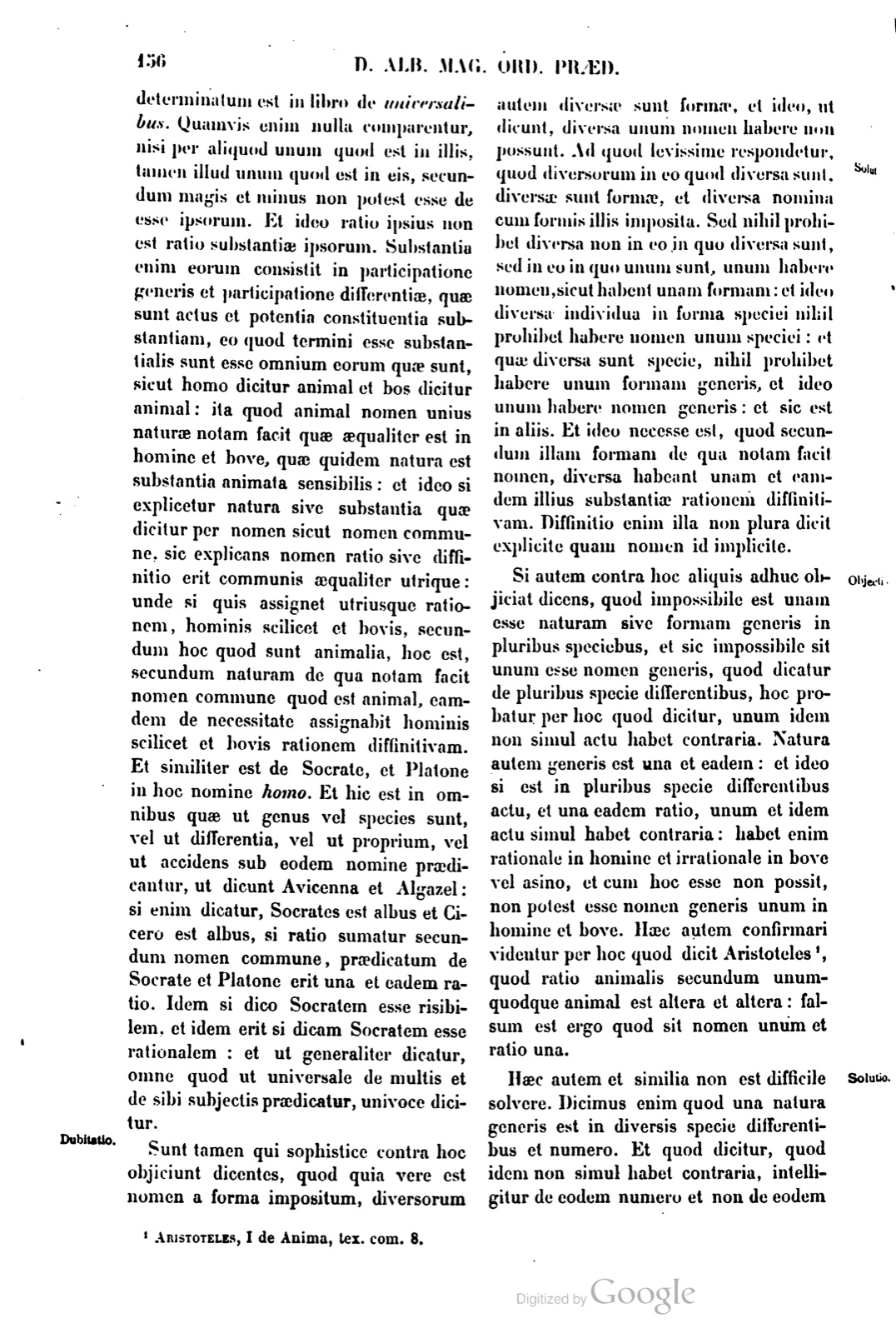
Sunt tamen qui sophistice contra hoc objiciunt dicentes, quod quia vere est nomen a forma impositum, diversorum autem diversæ sunt formæ, et ideo, ut dicunt, diversa unum nomen habere non possunt. Ad quod levissime respondetur, quod diversorum in eo quod diversa sunt, diversæ sunt formæ, et diversa nomina cum formis illis imposita. Sed nihil prohibet diversa non in eo in quo diversa sunt, sed in eo in quo unum sunt, unum habere nomen, sicut habent unam formam: et ideo diversa individua in forma speciei nihil prohibet habere nomen unum speciei; et quæ diversa sunt specie, nihil prohibet habere unam formam generis, et ideo unum habere nomen generis: et sic est in aliis. Et ideo necesse est, quod secundum illam formam de qua notam facit nomen, diversa habeant unam et eamdem illius substantiæ rationem diffinitivam. Diffinitio enim illa non plura dicit explicite quam nomen id implicite.
Si autem contra hoc aliquis adhuc objiciat dicens, quod impossibile est unam esse naturam sive formam generis in pluribus speciebus, et sic impossibile sit unum esse nomen generis, quod dicatur de pluribus specie differentibus, hoc probatur per hoc quod dicitur, unum idem non simul actu habet contraria. Natura autem generis est una et eadem: et ideo si est in pluribus specie differentibus actu, et una eadem ratio, unum et idem actu simul habet contraria: habet enim rationale in homine et irrationale in bove vel asino, et cum hoc esse non possit, non potest esse nomen generis unum in homine et bove. Hæc autem confirmari videntur per hoc quod dicit Aristoteles,1 quod ratio animalis secundum unumquodque animal est altera et altera: falsum est ergo quod sit nomen unum et ratio una.
Nevertheless there are those who sophistically object against this, saying that because a name is truly imposed from a form, but the forms of diverse things are diverse, therefore, as they say, diverse things cannot have one name. To this the answer is very slight: diverse things, in that in which they are diverse, have diverse forms, and have diverse names imposed with those forms. But nothing prevents diverse things from having one name not in that in which they are diverse, but in that in which they are one, just as they have one form; and therefore nothing prevents diverse individuals in the form of a species from having one name of the species; and nothing prevents things diverse in species from having one form of genus, and therefore one name of the genus; and so it is in other cases. And therefore it is necessary that, according to that form of which the name makes a mark, diverse things have one and the same definitive account of that substance. For that definition does not say explicitly more things than the name says implicitly.
But if someone still objects against this, saying that it is impossible for one nature or form of genus to be in many species, and so it is impossible that there be one name of a genus which is said of many things differing in species, this is proved through what is said, that one and the same thing does not have contraries at once in act. But the nature of the genus is one and the same; and therefore if it is in many things differing in species in act, and there is one and the same account, one and the same thing has contraries at once in act: for it has rational in man and irrational in ox or ass; and since this cannot be, there cannot be one name of a genus in man and ox. These things seem to be confirmed by what Aristotle says,1 that the account of animal according to each animal is one and another; therefore it is false that there is one name and one account.
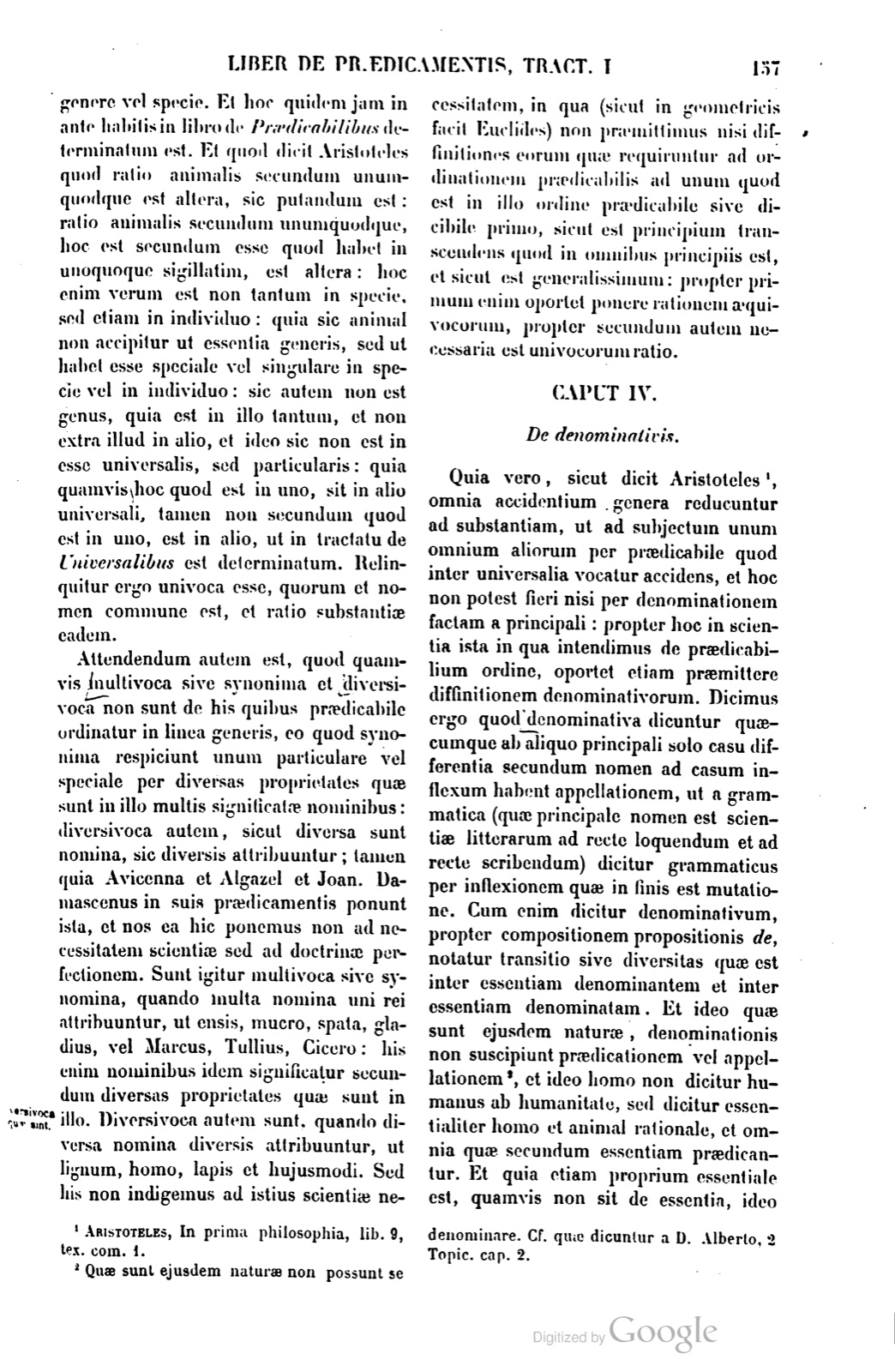
Hæc autem et similia non est difficile solvere. Dicimus enim quod una natura generis est in diversis specie differentibus et numero. Et quod dicitur, quod idem non simul habet contraria, intelligitur de eodem numero et non de eodem genere vel specie. Et hoc quidem jam in ante habitis in libro de Prædicabilibus determinatum est. Et quod dicit Aristoteles quod ratio animalis secundum unumquodque est altera, sic putandum est: ratio animalis secundum unumquodque, hoc est secundum esse quod habet in unoquoque sigillatim, est altera: hoc enim verum est non tantum in specie, sed etiam in individuo: quia sic animal non accipitur ut essentia generis, sed ut habet esse speciale vel singulare in specie vel in individuo: sic autem non est genus, quia est in illo tantum, et non extra illud in alio, et ideo sic non est in esse universalis, sed particularis: quia quamvis hoc quod est in uno, sit in alio universali, tamen non secundum quod est in uno, est in alio, ut in tractatu de Universalibus est determinatum. Relinquitur ergo univoca esse, quorum et nomen commune est, et ratio substantiæ eadem.
Attendendum autem est, quod quamvis multivoca sive synonima et diversivoca non sunt de his quibus prædicabile ordinatur in linea generis, eo quod synonima respiciunt unum particulare vel speciale per diversas proprietates quæ sunt in illo multis significatæ nominibus: diversivoca autem, sicut diversa sunt nomina, sic diversis attribuuntur; tamen quia Avicenna et Algazel et Joan. Damascenus in suis prædicamentis ponunt ista, et nos ea hic ponemus non ad necessitatem scientiæ sed ad doctrinæ perfectionem. Sunt igitur multivoca sive synonima, quando multa nomina uni rei attribuuntur, ut ensis, mucro, spata, gladius, vel Marcus, Tullius, Cicero: his enim nominibus idem significatur secundum diversas proprietates quæ sunt in illo. Diversivoca autem sunt, quando diversa nomina diversis attribuuntur, ut lignum, homo, lapis et hujusmodi. Sed his non indigemus ad istius scientiæ necessitatem, in qua, sicut in geometricis facit Euclides, non præmittimus nisi diffinitiones eorum quæ requiruntur ad ordinationem prædicabilis ad unum quod est in illo ordine prædicabile sive dicibile primo, sicut est principium transcendens quod in omnibus principiis est, sicut est generalissimum: propter primum enim oportet ponere rationem æquivocorum, propter secundum autem necessaria est univocorum ratio.
But these and similar things are not difficult to solve. For we say that one nature of genus is in diverse things differing in species and number. And what is said, that the same thing does not have contraries at once, is understood of the same thing in number and not of the same thing in genus or species. And this indeed has already been determined in the preceding matters in the book On Predicables. And what Aristotle says, that the account of animal according to each is one and another, must be understood thus: the account of animal according to each thing, that is, according to the being which it has in each one singly, is one and another. For this is true not only in species but also in the individual, because in this way animal is not taken as the essence of the genus, but as having special or singular being in the species or in the individual. But in this way it is not a genus, because it is in that thing alone and not outside that thing in another; and therefore in this way it is not in the being of a universal but of a particular. For although that which is in one thing is in another universal, nevertheless not according as it is in one is it in another, as has been determined in the treatise On Universals. Therefore it remains that univocal things are those whose name is common and whose account of substance is the same.
It must be understood, however, that although multivocal or synonymous things and diversivocal things are not among those things by which the predicable is ordered in the line of genus, because synonyms regard one particular or special thing through diverse properties which are signified in it by many names, while diversivocal things, just as the names are diverse, are attributed to diverse things; nevertheless, because Avicenna and Algazel and John Damascene put these things in their Categories, we too will put them here, not for the necessity of the science but for the perfection of the doctrine. Therefore multivocal or synonymous things are when many names are attributed to one thing, as sword, blade, broadsword, gladius, or Marcus, Tullius, Cicero; for by these names the same thing is signified according to diverse properties which are in it. But diversivocal things are when diverse names are attributed to diverse things, as wood, man, stone, and things of this kind. But we do not need these for the necessity of this science, in which, as Euclid does in geometrical matters, we preface only the definitions of those things which are required for the ordering of the predicable to one thing which in that order is first predicable or sayable, just as it is the transcendent principle which is in all principles, as the most general is. For on account of the first it is necessary to posit the account of equivocal things; but on account of the second the account of univocal things is necessary.
Notes
- Aristotle, On the Soul I, text/commentary 8. (Aristoteles, I de Anima, tex. com. 8.) ↩
If a page does not appear, its photograph has not been uploaded yet.