Volume 1 · pp. 151–155
Chapter II. How there is prefaced a treatment of equivocal, univocal, and denominative things, and what equivocal things are
A marker with ≈ is an approximate page boundary, placed by measure of the text; the page photographs remain the authority. In the paired views, clicking a page marker brings that page into view.
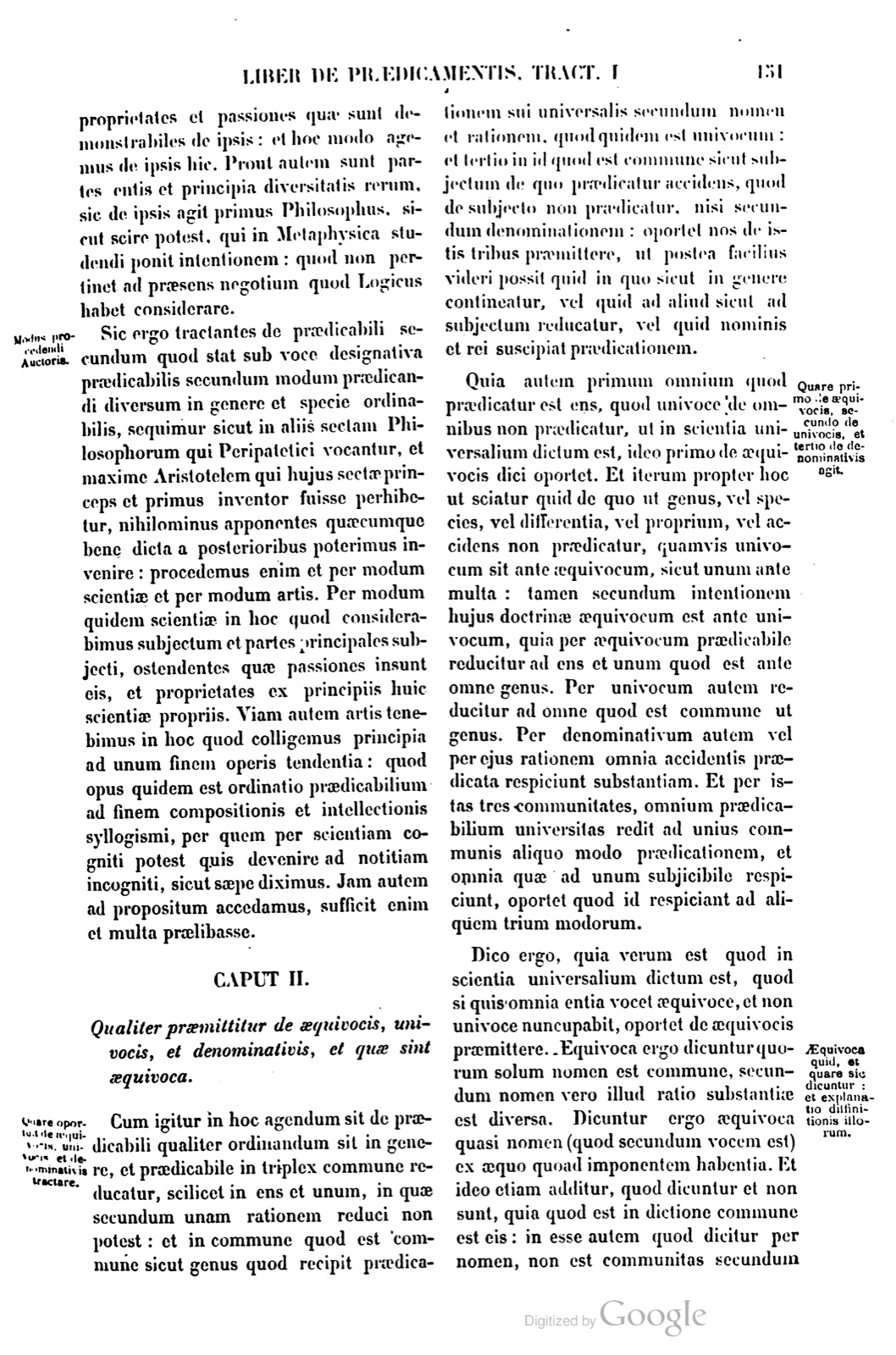
CAPUT II. Qualiter præmittitur de æquivocis, univocis, et denominativis, et quæ sint æquivoca.
Cum igitur in hoc agendum sit de prædicabili qualiter ordinandum sit in genere, et prædicabile in triplex commune reducatur, scilicet in ens et unum, in quæ secundum unam rationem reduci non potest; et in commune quod est commune sicut genus quod recipit prædicationem sui universalis secundum nomen et rationem, quod quidem est univocum; et tertio in id quod est commune sicut subjectum de quo prædicatur accidens, quod de subjecto non prædicatur, nisi secundum denominationem: oportet nos de istis tribus præmittere, ut postea facilius videri possit quid in quo sicut in genere contineatur, vel quid ad aliud sicut ad subjectum reducatur, vel quid nominis et rei suscipiat prædicationem.
Quia autem primum omnium quod prædicatur est ens, quod univoce de omnibus non prædicatur, ut in scientia universalium dictum est, ideo primo de æquivocis dici oportet. Et iterum propter hoc ut sciatur quid de quo ut genus, vel species, vel differentia, vel proprium, vel accidens non prædicatur, quamvis univocum sit ante æquivocum, sicut unum ante multa: tamen secundum intentionem hujus doctrinæ æquivocum est ante univocum, quia per æquivocum prædicabile reducitur ad ens et unum quod est ante omne genus. Per univocum autem reducitur ad omne quod est commune ut genus. Per denominativum autem vel per ejus rationem omnia accidentis prædicata respiciunt substantiam. Et per istas tres communitates, omnium prædicabilium universitas redit ad unius communis aliquo modo prædicationem, et omnia quæ ad unum subjicibile respiciunt, oportet quod id respiciant ad aliquem trium modorum.
Dico ergo, quia verum est quod in scientia universalium dictum est, quod si quis omnia entia vocet æquivoce, et non univoce nuncupabit, oportet de æquivocis præmittere. Æquivoca ergo dicuntur quorum solum nomen est commune, secundum nomen vero illud ratio substantiæ est diversa. Dicuntur ergo æquivoca quasi nomen, quod secundum vocem est, ex æquo quoad imponentem habentia. Et ideo etiam additur, quod dicuntur et non sunt, quia quod est in dictione commune est eis: in esse autem quod dicitur per nomen, non est communitas secundum æquam participationem; quamvis enim æquivocum actuali multiplicitate multa dicat, tamen nihil omnium illorum æqua participatione participatur ab his quæ in nomine significantur: propter quod æquivoca dicuntur, quia æqualiter nomen habentia, esse nominis non æqua suscipiunt participatione.
Propter quod etiam additur, quorum solum nomen est commune: nomen enim quamvis dicatur quasi notamen, eo quod aliquam notam rei facit quantum ad actum significantis et imponentis nomen, eo quod imponens nomen secundum aliquid proprietatis rei affectus est quando nomen imponitur, quia etiam significatio rei quæ intenditur per nomen formam dat nomini. Tamen hæc non sunt de intrinsecis ipsi nomini secundum quod nomen est solum, sed potius intrinseca sunt nomini litteratio talis sive compositio nominis ex littera et syllaba et accentu, quæ sunt intrinseca nomini ut nomen est. Quibus jam perfectis quantum ad substantiam nominis tunc primum refert nomen ad id quo affectus est ille, sive quod concepit ille qui nomen imposuit: et ideo in æquivocis solum nomen secundum quod consistit in sono litterarum et syllabarum et accentu est commune, et absque æqua participatione alicujus rei quæ importatur in nomine: et ideo dicitur æquivocum.
CHAPTER II. How there is prefaced a treatment of equivocal, univocal, and denominative things, and what equivocal things are.
Since, therefore, in this place one must deal with the predicable, how it must be ordered in a genus, and the predicable is reduced to a threefold common, namely to being and one, into which it cannot be reduced according to one account; and to the common which is common as a genus, which receives the predication of its universal according to name and account, and this indeed is the univocal; and third, to that which is common as the subject of which an accident is predicated, which is not predicated of the subject except according to denomination: we must preface a treatment of these three, so that afterward it may be seen more easily what is contained in what as in a genus, or what is reduced to another as to a subject, or what receives predication of name and thing.
But because the first of all things that is predicated is being, which is not predicated univocally of all things, as has been said in the science of universals, therefore first it is necessary to speak of equivocal things. And again this is so that it may be known what is not predicated of what as genus, or species, or difference, or property, or accident. Although the univocal is prior to the equivocal, as one is prior to many, nevertheless according to the intention of this doctrine the equivocal is prior to the univocal, because through the equivocal the predicable is reduced to being and one, which is before every genus. But through the univocal it is reduced to everything that is common as a genus. Through the denominative, however, or through its account, all predications of accident regard substance. And through those three communities the totality of all predicables returns to the predication of one common in some way, and all things which regard one subjectible must regard it according to one of the three modes.
I say, therefore, because it is true that in the science of universals it has been said that if anyone calls all beings equivocal, and will not name them univocal, it is necessary to preface a treatment of equivocal things. Therefore those things are called equivocal whose name alone is common, but according to that name the account of substance is diverse. Therefore they are called equivocal as things having a name, which is according to word, equally with respect to the one imposing it. And therefore it is also added that they are called and are not, because what is common to them is in diction; but in the being which is expressed through the name there is no community according to equal participation. For although the equivocal says many things by an actual multiplicity, nevertheless nothing of all those things is participated with equal participation by the things which are signified in the name; for this reason they are called equivocal, because, though they have the name equally, they do not receive the being of the name by equal participation.
For this reason it is also added, whose name alone is common: for although name is said as though it were a mark, because it makes some mark of the thing with respect to the act of the one signifying and imposing the name, since the one imposing the name is affected according to something of the thing's property when the name is imposed, because even the signification of the thing which is intended through the name gives form to the name. Nevertheless these are not among the things intrinsic to the name itself insofar as it is only a name; rather intrinsic to the name are such lettering, or the composition of the name from letter and syllable and accent, which are intrinsic to the name as name. When these have already been completed with respect to the substance of the name, then first the name refers to that by which he was affected, or to what he conceived who imposed the name; and therefore in equivocal things the name alone, according as it consists in the sound of letters and syllables and accent, is common, and without equal participation of any thing which is carried in the name; and therefore it is called equivocal.
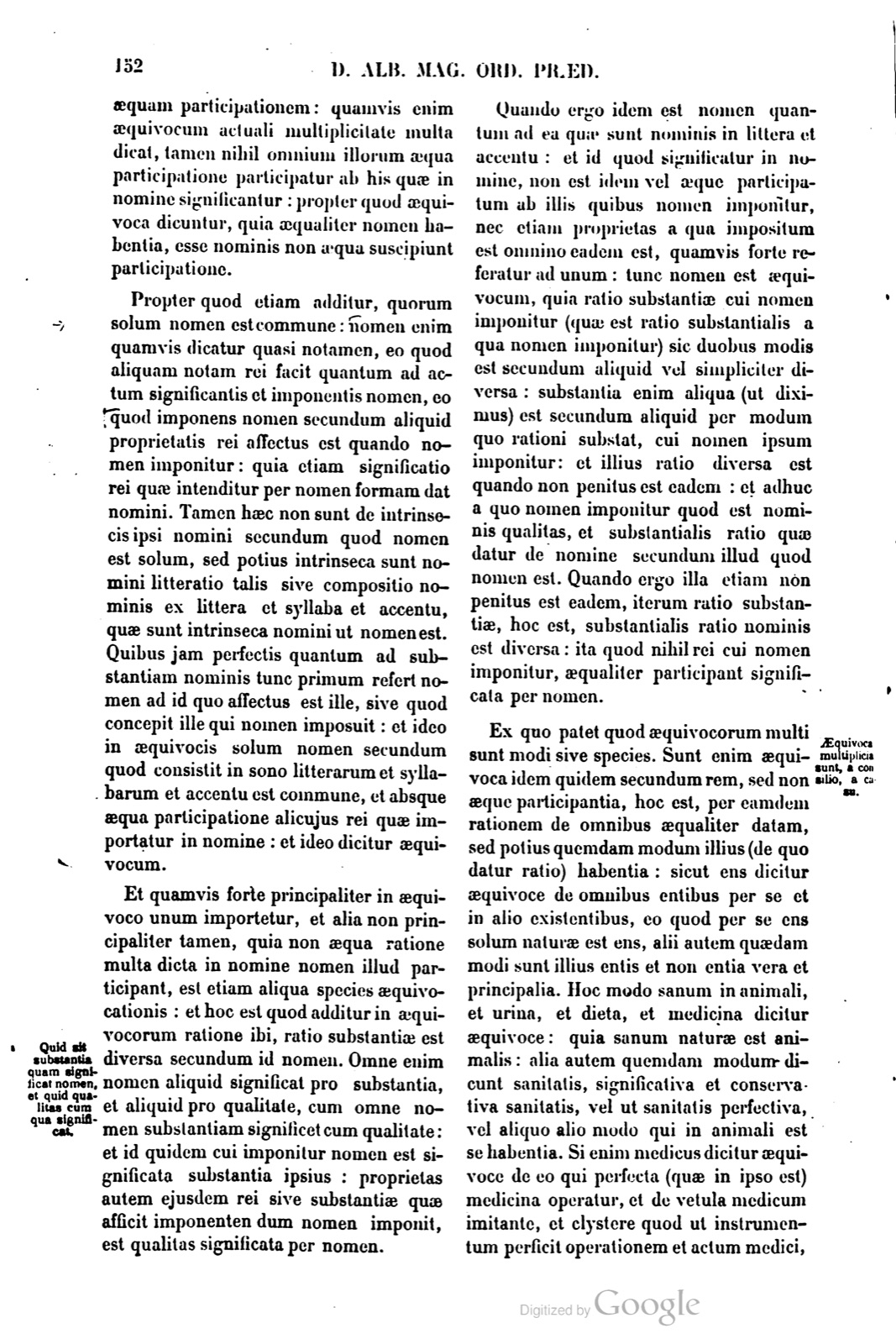
Et quamvis forte principaliter in æquivoco unum importetur, et alia non principaliter tamen, quia non æqua ratione multa dicta in nomine nomen illud participant, est etiam aliqua species æquivocationis: et hoc est quod additur in æquivocorum ratione ibi, ratio substantiæ est diversa secundum id nomen. Omne enim nomen aliquid significat pro substantia, et aliquid pro qualitate, cum omne nomen substantiam significet cum qualitate: et id quidem cui imponitur nomen est significata substantia ipsius; proprietas autem ejusdem rei sive substantiæ quæ afficit imponentem dum nomen imponit, est qualitas significata per nomen.
Quando ergo idem est nomen quantum ad ea quæ sunt nominis in littera et accentu; et id quod significatur in nomine, non est idem vel æque participatum ab illis quibus nomen imponitur; nec etiam proprietas a qua impositum est omnino eadem est, quamvis forte referatur ad unum: tunc nomen est æquivocum, quia ratio substantiæ cui nomen imponitur, quæ est ratio substantialis a qua nomen imponitur, sic duobus modis est secundum aliquid vel simpliciter diversa: substantia enim aliqua, ut diximus, est secundum aliquid per modum quo rationi substat, cui nomen ipsum imponitur: et illius ratio diversa est quando non penitus est eadem: et adhuc a quo nomen imponitur quod est nominis qualitas, et substantialis ratio quæ datur de nomine secundum illud quod nomen est. Quando ergo illa etiam non penitus est eadem, iterum ratio substantiæ, hoc est, substantialis ratio nominis est diversa: ita quod nihil rei cui nomen imponitur, æqualiter participant significata per nomen.
Ex quo patet quod æquivocorum multi sunt modi sive species. Sunt enim æquivoca idem quidem secundum rem, sed non æque participantia, hoc est, per eamdem rationem de omnibus æqualiter datam, sed potius quemdam modum illius de quo datur ratio habentia: sicut ens dicitur æquivoce de omnibus entibus per se et in alio existentibus, eo quod per se ens solum naturæ est ens, alii autem quædam modi sunt illius entis et non entia vera et principalia. Hoc modo sanum in animali, et urina, et dieta, et medicina dicitur æquivoce: quia sanum naturæ est animalis; alia autem quemdam modum dicunt sanitatis, significativa et conservativa sanitatis, vel ut sanitatis perfectiva, vel aliquo alio modo qui in animali est se habentia. Si enim medicus dicitur æquivoce de eo qui perfecta quæ in ipso est medicina operatur, et de vetula medicum imitante, et clystere quod ut instrumentum perficit operationem et actum medici, et de quibusdam aliis modis aliquem modum participantibus: sic etiam ens et unum dicuntur æquivoce, eo quod ens et unum primo est id quod per se est ens et unum; alia autem dicuntur ens et unum, quia ad id sicut ad subjectum aliquo modo entitatis referuntur, vel sicut mensura illius, vel sicut dispositio, vel sicut respectus, vel aliquo alio modo, quæ sunt in illo sicut in subjecto. Et hic quidem modus vocatur multiplex dictum secundum analogiam, sive proportionem ad unum quod principaliter in nomine significatur.
And although perhaps one thing is principally imported in the equivocal and the others not principally, nevertheless, because many things spoken in the name do not participate that name by an equal account, there is also a certain species of equivocation; and this is what is added in the account of equivocal things there: the account of substance is diverse according to that name. For every name signifies something as substance and something as quality, since every name signifies substance with quality; and that to which the name is imposed is the signified substance of it, but the property of the same thing or substance which affects the imposer while he imposes the name is the quality signified through the name.
Therefore when the name is the same with respect to those things which belong to the name in letter and accent, and that which is signified in the name is not the same or equally participated by those to which the name is imposed, nor even is the property from which it has been imposed wholly the same, although perhaps it is referred to one thing: then the name is equivocal, because the account of the substance to which the name is imposed, which is the substantial account from which the name is imposed, is thus in two ways, according to something or simply, diverse. For some substance, as we have said, is according to something through the mode by which it stands beneath the account to which the name itself is imposed; and its account is diverse when it is not entirely the same. And further there is that from which the name is imposed, which is the quality of the name, and the substantial account which is given concerning the name according to that which the name is. Therefore when that also is not entirely the same, again the account of substance, that is, the substantial account of the name, is diverse, so that they participate equally in nothing of the thing to which the name is imposed, signified through the name.
From this it is clear that there are many modes or species of equivocal things. For some equivocal things are indeed the same according to the thing, but not equally participating, that is, not having an account given of all equally through the same account, but rather having a certain mode of that concerning which the account is given; as being is said equivocally of all beings existing through themselves and in another, because being through itself alone is being of nature, while the others are certain modes of that being and are not true and principal beings. In this way healthy is said equivocally in an animal, urine, diet, and medicine, because healthy by nature belongs to an animal; but the other things express a certain mode of health, as signifying and preserving health, or as perfecting health, or as related in some other mode to that which is in the animal. For if physician is said equivocally of the one who performs the perfected medicine which is in him, and of an old woman imitating a physician, and of a clyster which as an instrument completes the operation and act of the physician, and of certain other things participating some mode, then in this way being and one are also said equivocally, because being and one first is that which through itself is being and one; but other things are called being and one because they are referred to it, as to a subject, by some mode of entity, or as its measure, or as disposition, or as relation, or in some other mode, which are in it as in a subject. And this mode indeed is called the manifold said according to analogy, or proportion to the one thing which is principally signified in the name.
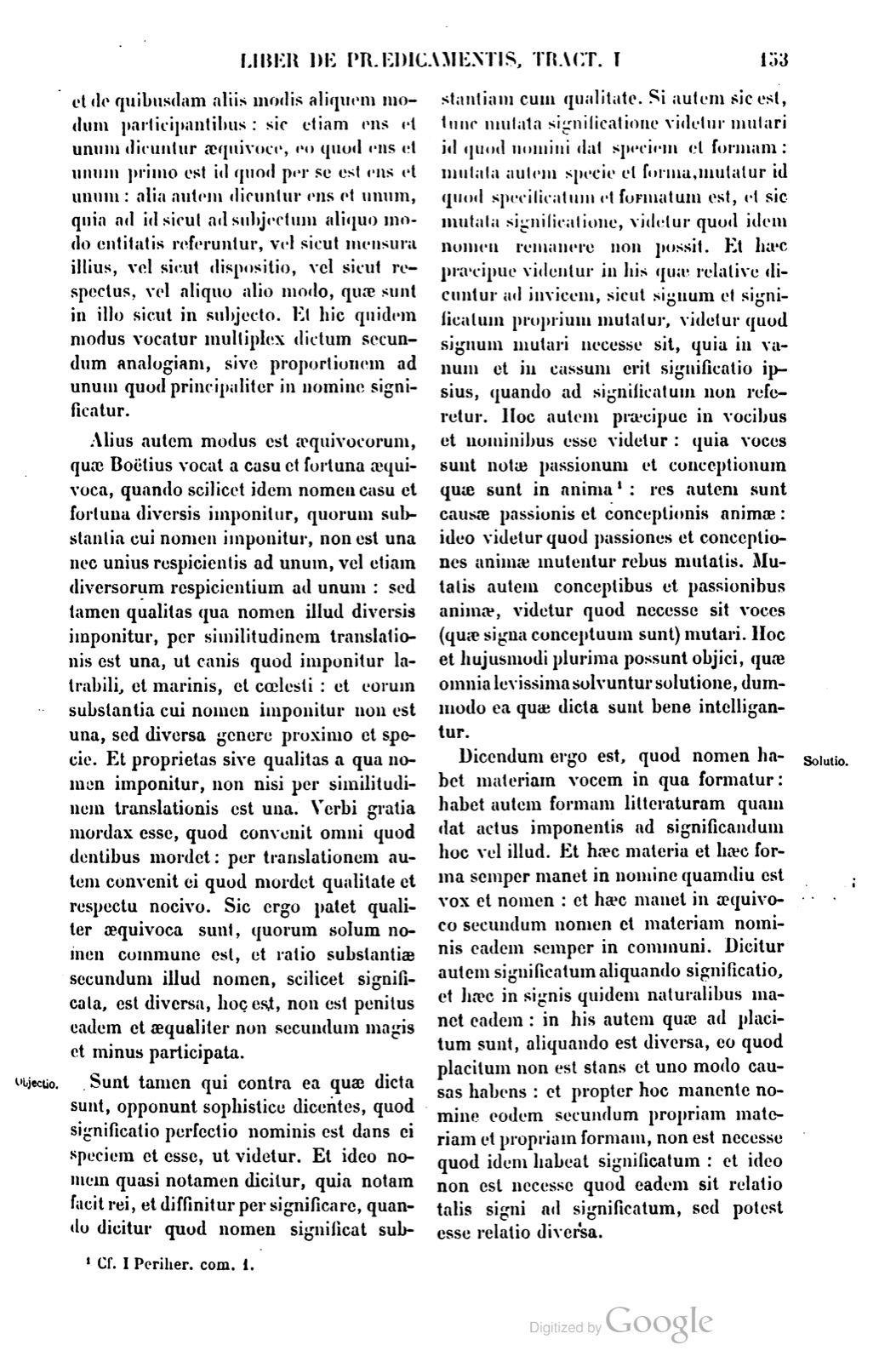
Alius autem modus est æquivocorum, quæ Boëtius vocat a casu et fortuna æquivoca, quando scilicet idem nomen casu et fortuna diversis imponitur, quorum substantia cui nomen imponitur, non est una nec unius respicientis ad unum, vel etiam diversorum respicientium ad unum: sed tamen qualitas qua nomen illud diversis imponitur, per similitudinem translationis est una, ut canis quod imponitur latrabili, et marinis, et cœlesti: et eorum substantia cui nomen imponitur non est una, sed diversa genere proximo et specie. Et proprietas sive qualitas a qua nomen imponitur, non nisi per similitudinem translationis est una. Verbi gratia mordax esse, quod convenit omni quod dentibus mordet: per translationem autem convenit ei quod mordet qualitate et respectu nocivo. Sic ergo patet qualiter æquivoca sunt, quorum solum nomen commune est, et ratio substantiæ secundum illud nomen, scilicet significata, est diversa, hoc est, non est penitus eadem et æqualiter non secundum magis et minus participata.
Sunt tamen qui contra ea quæ dicta sunt, opponunt sophistice dicentes, quod significatio perfectio nominis est dans ei speciem et esse, ut videtur. Et ideo nomen quasi notamen dicitur, quia notam facit rei, et diffinitur per significare, quando dicitur quod nomen significat substantiam cum qualitate.1 Si autem sic est, tunc mutata significatione videtur mutari id quod nomini dat speciem et formam; mutata autem specie et forma, mutatur id quod specificatum et formatum est, et sic mutata significatione, videtur quod idem nomen remanere non possit. Et hæc præcipue videntur in his quæ relative dicuntur ad invicem, sicut signum et significatum proprium mutatur, videtur quod signum mutari necesse sit, quia in vanum et in cassum erit significatio ipsius, quando ad significatum non refertur. Hoc autem præcipue in vocibus et nominibus esse videtur: quia voces sunt notæ passionum et conceptionum quæ sunt in anima: res autem sunt causæ passionis et conceptionis animæ: ideo videtur quod passiones et conceptiones animæ mutentur rebus mutatis. Mutatis autem conceptibus et passionibus animæ, videtur quod necesse sit voces, quæ signa conceptuum sunt, mutari. Hoc et hujusmodi plurima possunt objici, quæ omnia levissima solvuntur solutione, dummodo ea quæ dicta sunt bene intelligantur.
But another mode of equivocal things is those which Boethius calls equivocal by chance and fortune, namely when the same name by chance and fortune is imposed upon diverse things, whose substance to which the name is imposed is not one, nor of one thing looking to one, nor even of diverse things looking to one; but nevertheless the quality by which that name is imposed on diverse things is one through the likeness of transference, as dog, which is imposed on the barking dog, and on sea-dogs, and on the heavenly dog; and the substance of these to which the name is imposed is not one, but diverse in proximate genus and species. And the property or quality from which the name is imposed is one only through likeness of transference. For example, being biting, which belongs to everything that bites with teeth; but by transference it belongs to that which bites by a harmful quality and relation. Thus, therefore, it is clear what sort of things equivocal things are, whose name alone is common, and whose account of substance according to that name, namely the signified account, is diverse, that is, is not entirely the same and not participated equally according to more and less.
Nevertheless there are those who sophistically object against what has been said, saying that signification, as it seems, is the perfection of the name, giving it species and being. And therefore name is said as though it were a mark, because it makes a mark of the thing, and it is defined through signifying when it is said that a name signifies substance with quality.1 But if this is so, then, when the signification is changed, that which gives species and form to the name seems to be changed; and when species and form are changed, that which is specified and formed is changed; and thus, when signification is changed, it seems that the same name cannot remain. And these things seem especially in those things which are said relatively to one another; as, when the proper sign and signified are changed, it seems necessary that the sign be changed, because its signification will be in vain and useless when it is not referred to the signified. But this seems especially to be the case in words and names, because words are signs of passions and conceptions which are in the soul; but things are causes of passion and conception of the soul; therefore it seems that passions and conceptions of the soul are changed when things are changed. But when the concepts and passions of the soul are changed, it seems necessary that words, which are signs of concepts, be changed. These and very many things of this kind can be objected, all of which are solved by a very slight solution, provided that the things which have been said are well understood.
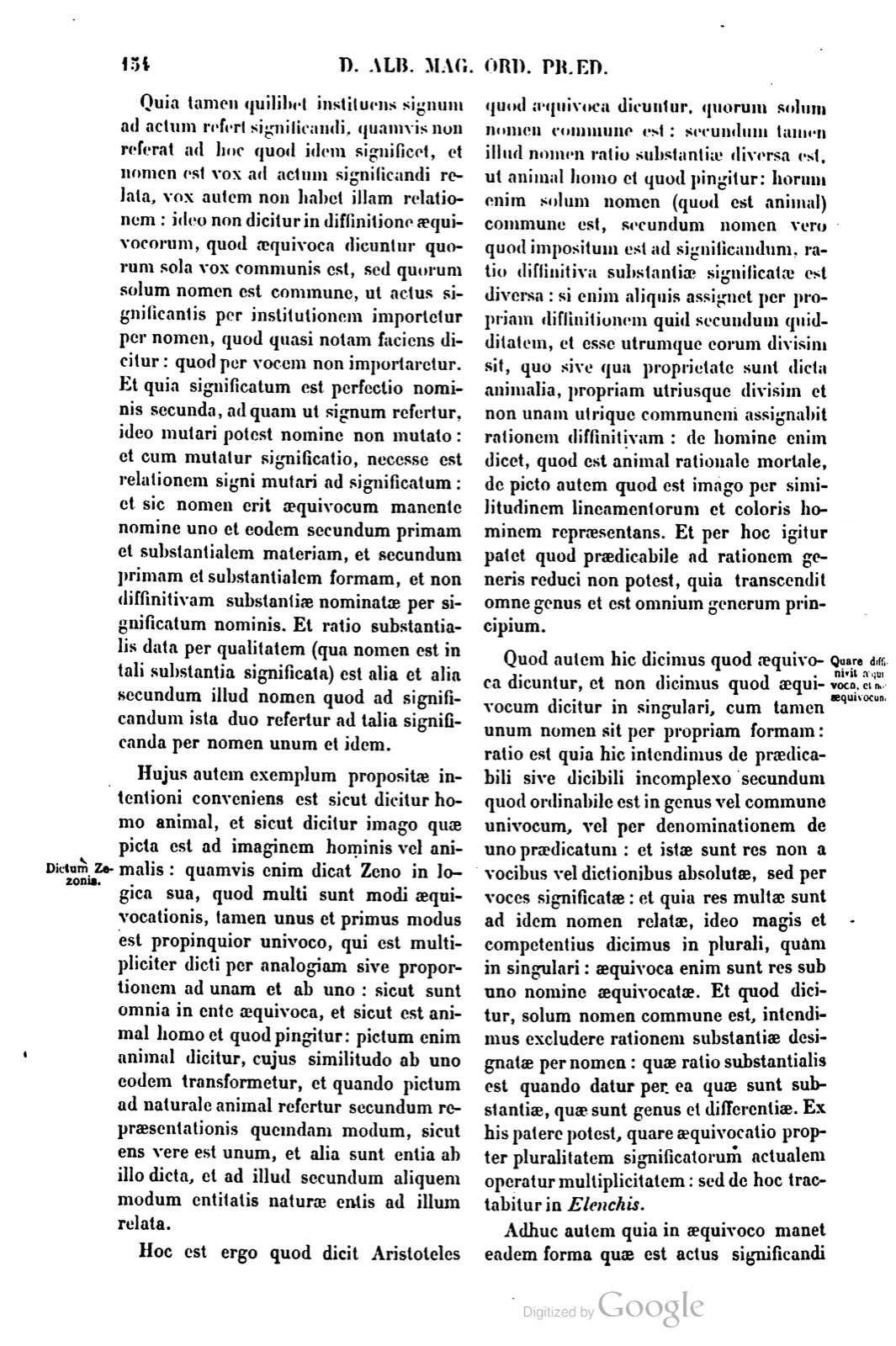
Dicendum ergo est, quod nomen habet materiam vocem in qua formatur; habet autem formam litteraturam quam dat actus imponentis ad significandum hoc vel illud. Et hæc materia et hæc forma semper manet in nomine quamdiu est vox et nomen: et hæc manet in æquivoco secundum nomen et materiam nominis eadem semper in communi. Dicitur autem significatum aliquando significatio, et hæc in signis quidem naturalibus manet eadem: in his autem quæ ad placitum sunt, aliquando est diversa, eo quod placitum non est stans et uno modo causas habens: et propter hoc manente nomine eodem secundum propriam materiam et propriam formam, non est necesse quod idem habeat significatum: et ideo non est necesse quod eadem sit relatio talis signi ad significatum, sed potest esse relatio diversa.
Quia tamen quilibet instituens signum ad actum refert significandi, quamvis non referat ad hoc quod idem significet, et nomen est vox ad actum significandi relata, vox autem non habet illam relationem: ideo non dicitur in diffinitione æquivocorum, quod æquivoca dicuntur quorum sola vox communis est, sed quorum solum nomen est commune, ut actus significantis per institutionem importetur per nomen, quod quasi notam faciens dicitur: quod per vocem non importaretur. Et quia significatum est perfectio nominis secunda, ad quam ut signum refertur, ideo mutari potest nomine non mutato: et cum mutatur significatio, necesse est relationem signi mutari ad significatum: et sic nomen erit æquivocum manente nomine uno et eodem secundum primam et substantialem materiam, et secundum primam et substantialem formam, et non diffinitivam substantiæ nominatæ per significatum nominis. Et ratio substantialis data per qualitatem, qua nomen est in tali substantia significata, est alia et alia secundum illud nomen quod ad significandum ista duo refertur ad talia significanda per nomen unum et idem.
Hujus autem exemplum propositæ intentioni conveniens est sicut dicitur homo animal, et sicut dicitur imago quæ picta est ad imaginem hominis vel animalis: quamvis enim dicat Zeno in logica sua, quod multi sunt modi æquivocationis, tamen unus et primus modus est propinquior univoco, qui est multipliciter dicti per analogiam sive proportionem ad unam et ab uno: sicut sunt omnia in ente æquivoca, et sicut est animal homo et quod pingitur: pictum enim animal dicitur, cujus similitudo ab uno eodem transformetur, et quando pictum ad naturale animal refertur secundum repræsentationis quemdam modum, sicut ens vere est unum, et alia sunt entia ab illo dicta, et ad illud secundum aliquem modum entitatis naturæ entis ad illum relata.
Hoc est ergo quod dicit Aristoteles quod æquivoca dicuntur, quorum solum nomen commune est: secundum tamen illud nomen ratio substantiæ diversa est, ut animal homo et quod pingitur: horum enim solum nomen, quod est animal, commune est; secundum nomen vero quod impositum est ad significandum, ratio diffinitiva substantiæ significatæ est diversa: si enim aliquis assignet per propriam diffinitionem quid secundum quidditatem et esse utrumque eorum divisim sit, quo sive qua proprietate sunt dicta animalia, propriam utriusque divisim et non unam utrique communem assignabit rationem diffinitivam: de homine enim dicet, quod est animal rationale mortale; de picto autem quod est imago per similitudinem lineamentorum et coloris hominem repræsentans. Et per hoc igitur patet quod prædicabile ad rationem generis reduci non potest, quia transcendit omne genus et est omnium generum principium.
Therefore it must be said that a name has as matter the word in which it is formed; but it has as form the lettering which the act of the one imposing gives for signifying this or that. And this matter and this form always remain in the name as long as it is a word and a name; and this remains in the equivocal according to the name and the matter of the name, always the same in common. But the signified is sometimes called the signification, and in natural signs this indeed remains the same; but in those signs which are by convention it is sometimes diverse, because convention is not standing and having causes in one mode; and on account of this, with the same name remaining according to its proper matter and proper form, it is not necessary that it have the same signified; and therefore it is not necessary that the same relation of such a sign to the signified remain, but the relation can be diverse.
Yet because everyone instituting a sign refers it to the act of signifying, although he does not refer it to this, that it signify the same thing, and because a name is a word referred to the act of signifying, while a word does not have that relation, therefore it is not said in the definition of equivocal things that equivocal things are those whose word alone is common, but those whose name alone is common, so that the act of the one signifying by institution may be imported through the name, which is so called as making a mark; and this would not be imported through the word. And because the signified is the second perfection of the name, to which it is referred as a sign, therefore it can be changed while the name is not changed; and when the signification is changed, it is necessary that the relation of the sign be changed toward the signified; and thus the name will be equivocal while one and the same name remains according to first and substantial matter, and according to first and substantial form, and not according to the definition of the substance named through the signified of the name. And the substantial account given through the quality by which the name is in such a signified substance is one and another according to that name which is referred to signify these two things, to such things to be signified through one and the same name.
But an example of this, fitting the proposed intention, is as man is called animal, and as an image which has been painted after the image of a man or animal is called animal. For although Zeno says in his Logic that there are many modes of equivocation, nevertheless one and the first mode is nearer to the univocal, namely that of what is said manifoldly through analogy or proportion to one thing and from one thing; as all things in being are equivocal, and as man and what is painted are animal. For the painted thing is called an animal whose likeness is transformed from one and the same thing, and when the painted thing is referred to the natural animal according to a certain mode of representation, just as being is truly one, and other things are beings said from it and related to it according to some mode of the entity belonging to the nature of being.
This, therefore, is what Aristotle says: that equivocal things are called those whose name alone is common, yet according to that name the account of substance is diverse, as man and what is painted are animal. For of these the name alone, which is animal, is common; but according to the name which has been imposed for signifying, the definitive account of the signified substance is diverse. For if someone assigns, through a proper definition, what each of them is separately according to quiddity and being, by which or by what property they are called animals, he will assign to each separately its own definitive account, and not one common to both: for concerning man he will say that he is a rational mortal animal; but concerning the painted thing, that it is an image representing a man through likeness of lines and color. And through this, therefore, it is clear that the predicable cannot be reduced to the account of genus, because it transcends every genus and is the principle of all genera.
Quod autem hic dicimus quod æquivoca dicuntur, et non dicimus quod æquivocum dicitur in singulari, cum tamen unum nomen sit per propriam formam: ratio est quia hic intendimus de prædicabili sive dicibili incomplexo secundum quod ordinabile est in genus vel commune univocum, vel per denominationem de uno prædicatum: et istæ sunt res non a vocibus vel dictionibus absolutæ, sed per voces significatæ: et quia res multæ sunt ad idem nomen relatæ, ideo magis et competentius dicimus in plurali, quam in singulari: æquivoca enim sunt res sub uno nomine æquivocatæ. Et quod dicitur, solum nomen commune est, intendimus excludere rationem substantiæ designatæ per nomen: quæ ratio substantialis est quando datur per ea quæ sunt substantiæ, quæ sunt genus et differentiæ. Ex his patere potest, quare æquivocatio propter pluralitatem significatorum actualem operatur multiplicitatem: sed de hoc tractabitur in Elenchis.
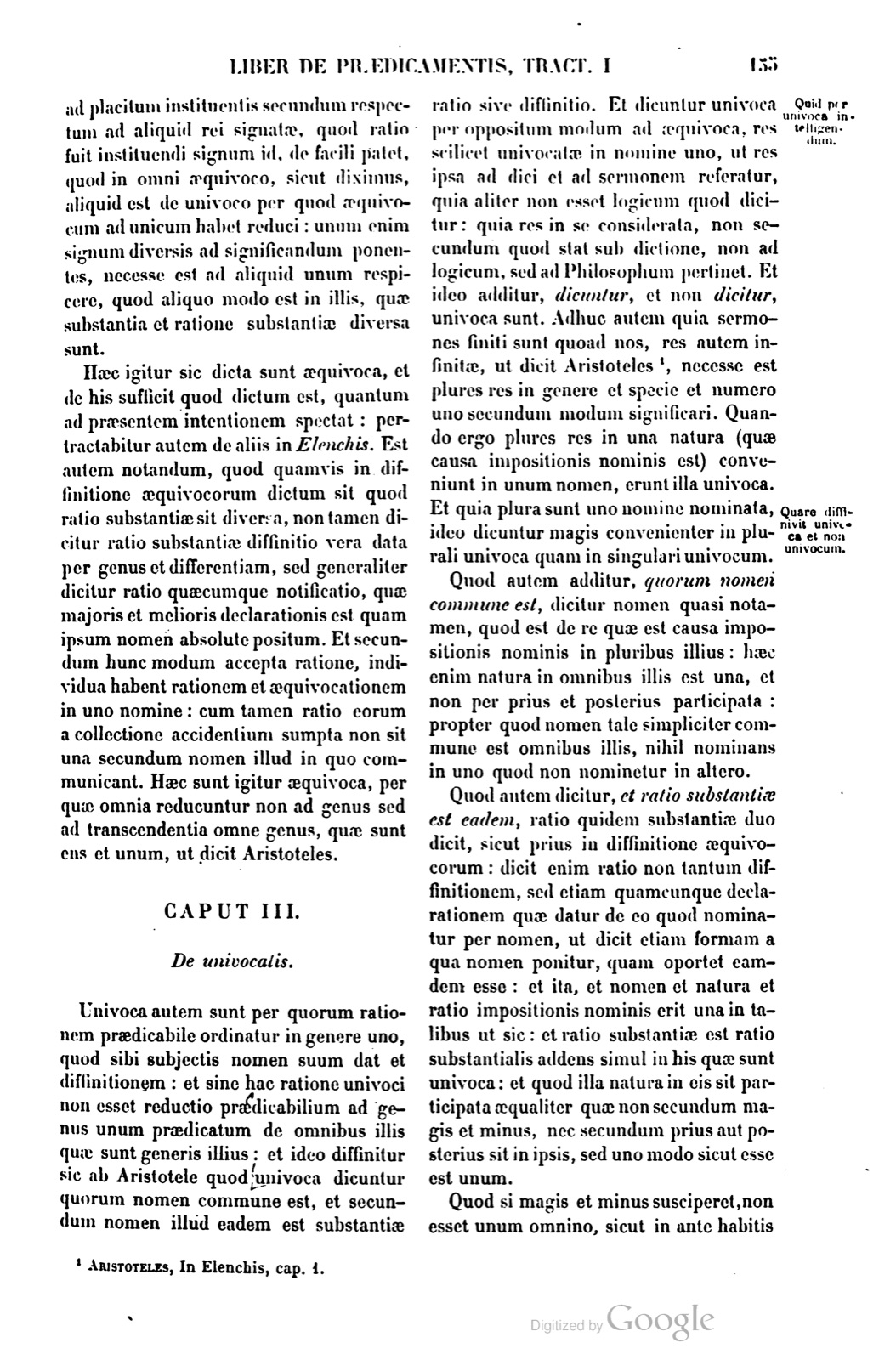
Adhuc autem quia in æquivoco manet eadem forma quæ est actus significandi ad placitum instituentis secundum respectum ad aliquid rei signatæ, quod ratio fuit instituendi signum id, de facili patet quod in omni æquivoco, sicut diximus, aliquid est de univoco per quod æquivocum ad unicum habet reduci: unum enim signum diversis ad significandum ponentes, necesse est ad aliquid unum respicere, quod aliquo modo est in illis, quæ substantia et ratione substantiæ diversa sunt.
Hæc igitur sic dicta sunt æquivoca, et de his sufficit quod dictum est, quantum ad præsentem intentionem spectat: pertractabitur autem de aliis in Elenchis. Est autem notandum, quod quamvis in diffinitione æquivocorum dictum sit quod ratio substantiæ sit diversa, non tamen dicitur ratio substantiæ diffinitio vera data per genus et differentiam, sed generaliter dicitur ratio quæcumque notificatio, quæ majoris et melioris declarationis est quam ipsum nomen absolute positum. Et secundum hunc modum accepta ratione, individua habent rationem et æquivocationem in uno nomine: cum tamen ratio eorum a collectione accidentium sumpta non sit una secundum nomen illud in quo communicant. Hæc sunt igitur æquivoca, per quæ omnia reducuntur non ad genus sed ad transcendentia omne genus, quæ sunt ens et unum, ut dicit Aristoteles.2
But as for the fact that here we say that equivocal things are called, and do not say that the equivocal is called in the singular, although nevertheless there is one name through its proper form: the reason is that here we intend the predicable or incomplex sayable according as it is orderable into a genus or a univocal common, or as predicated denominatively from one thing; and these are things not absolute from words or dictions, but signified through words. And because many things are related to the same name, therefore we speak more fittingly and more suitably in the plural than in the singular: for equivocal things are things equivocated under one name. And when it is said that the name alone is common, we intend to exclude the account of substance designated through the name; and that account is substantial when it is given through those things which belong to substance, namely genus and differences. From these things it can be clear why equivocation, on account of the plurality of actual signifieds, produces multiplicity; but this will be treated in the Elenchi.
Moreover, because in the equivocal there remains the same form which is the act of signifying of the institutor by convention according to relation to something of the signified thing, which was the reason for instituting that sign, it is easily clear that in every equivocal, as we have said, there is something of the univocal through which the equivocal has to be reduced to one thing; for when they posit one sign for diverse things to be signified, it is necessary to look to some one thing which in some mode is in those things which are diverse in substance and in the account of substance.
Therefore equivocal things have been spoken of in this way, and concerning them what has been said is sufficient insofar as it belongs to the present intention; but the other matters will be fully treated in the Elenchi. It must be noted, however, that although in the definition of equivocal things it was said that the account of substance is diverse, nevertheless the account of substance is not called a true definition given through genus and difference; rather, generally, any notification whatever is called an account, one that is of greater and better declaration than the name itself posited absolutely. And according to an account taken in this way, individuals have an account and equivocation in one name, although nevertheless their account, taken from a collection of accidents, is not one according to that name in which they communicate. These, therefore, are equivocal things, through which all things are reduced not to a genus but to things transcending every genus, which are being and one, as Aristotle says.2
If a page does not appear, its photograph has not been uploaded yet.