Volume 1 · pp. 149–151
Book II on the Categories, Tractate I, Chapter I
A marker with ≈ is an approximate page boundary, placed by measure of the text; the page photographs remain the authority. In the paired views, clicking a page marker brings that page into view.
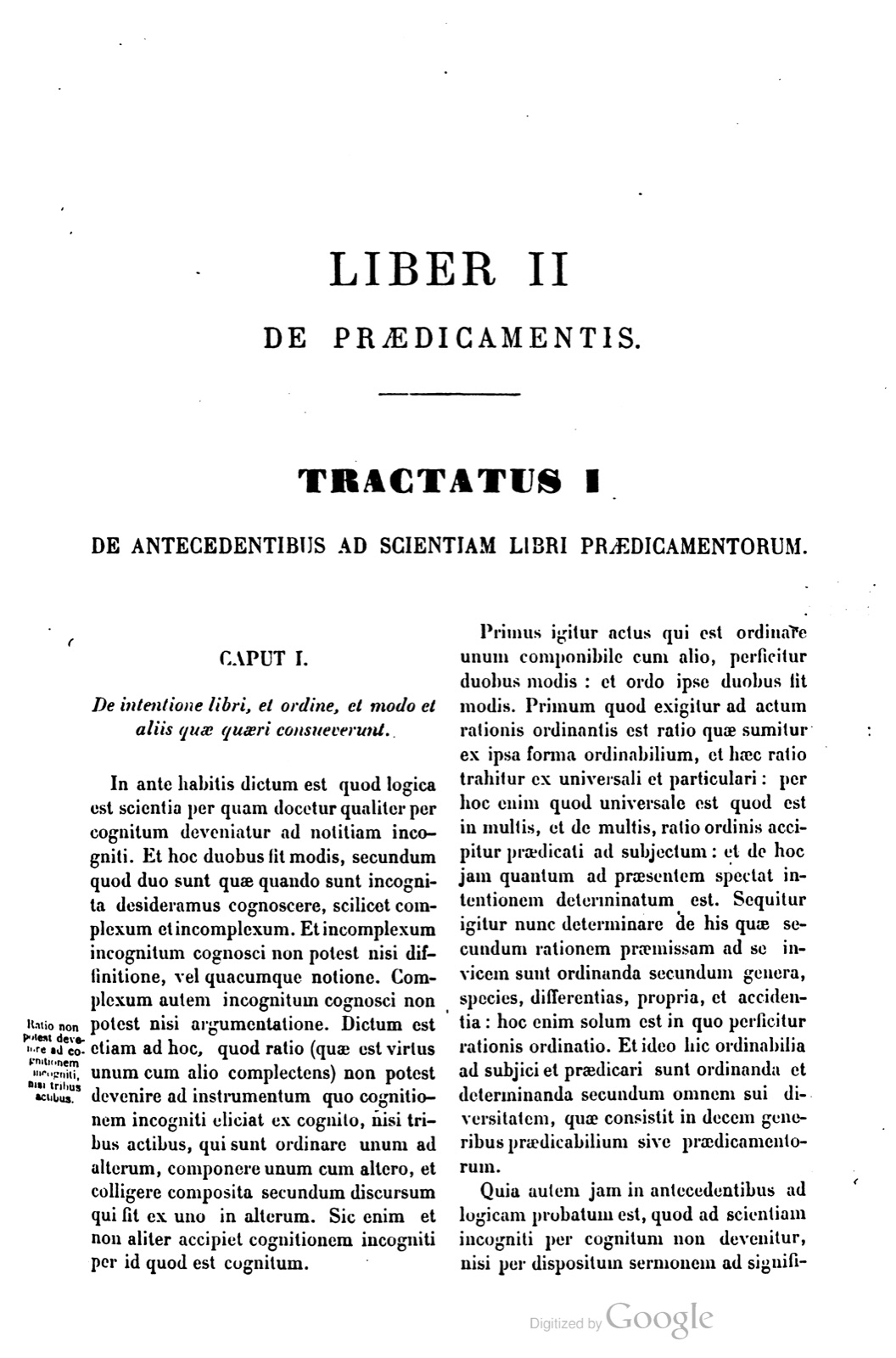
LIBER II DE PRÆDICAMENTIS.
TRACTATUS I. DE ANTECEDENTIBUS AD SCIENTIAM LIBRI PRÆDICAMENTORUM.
CAPUT I. De intentione libri, et ordine, et modo et aliis quæ quæri consueverunt.
In ante habitis dictum est quod logica est scientia per quam docetur qualiter per cognitum deveniatur ad notitiam incogniti. Et hoc duobus fit modis, secundum quod duo sunt quæ quando sunt incognita desideramus cognoscere, scilicet complexum et incomplexum. Et incomplexum incognitum cognosci non potest nisi diffinitione, vel quacumque notione. Complexum autem incognitum cognosci non potest nisi argumentatione. Dictum est etiam ad hoc, quod ratio (quæ est virtus unum cum alio complectens) non potest devenire ad instrumentum quo cognitionem incogniti eliciat ex cognito, nisi tribus actibus, qui sunt ordinare unum ad alterum, componere unum cum altero, et colligere composita secundum discursum qui fit ex uno in alterum. Sic enim et non aliter accipiet cognitionem incogniti per id quod est cognitum.
Primus igitur actus qui est ordinare unum componibile cum alio, perficitur duobus modis: et ordo ipse duobus fit modis. Primum quod exigitur ad actum rationis ordinantis est ratio quæ sumitur ex ipsa forma ordinabilium, et hæc ratio trahitur ex universali et particulari: per hoc enim quod universale est quod est in multis, et de multis, ratio ordinis accipitur prædicati ad subjectum: et de hoc jam quantum ad præsentem spectat intentionem determinatum est. Sequitur igitur nunc determinare de his quæ secundum rationem præmissam ad se invicem sunt ordinanda secundum genera, species, differentias, propria, et accidentia: hoc enim solum est in quo perficitur rationis ordinatio. Et ideo hic ordinabilia ad subjici et prædicari sunt ordinanda et determinanda secundum omnem sui diversitatem, quæ consistit in decem generibus prædicabilium sive prædicamentorum.
Quia autem jam in antecedentibus ad logicam probatum est, quod ad scientiam incogniti per cognitum non devenitur, nisi per dispositum sermonem ad significandum, sive homo inquirat apud seipsum per interius dispositum sermonem, sive inquirat apud alium per sermonem exterius prolatum, sequitur de necessitate, quod ordo prædicabilium non potest determinari, nisi secundum quod sub voce habet prædicabile designari. Rebus enim inquisitive incognitis uti non possumus, eo quod nec finitæ sunt nobis, nec præsentes: et ideo signis et vocibus uti oportet. Propter quod prædicabilia oportet considerare secundum quod vocibus significantur: propter quod dicit Boëtius quod hæc scientia, scilicet libri prædicamentorum, est de decem primis vocibus prima genera rerum significantibus: ordo enim non est in rebus ipsis, sed oportet quod ratio ponat ordinem, sicut et facit complexionem et collectionem compositorum.
BOOK II ON THE CATEGORIES.
TRACTATE I. ON THE THINGS PRECEDING THE KNOWLEDGE OF THE BOOK OF THE CATEGORIES.
CHAPTER I. On the intention of the book, and the order, and the mode, and other things which are customarily asked.
In what has been treated before, it has been said that logic is the science through which one is taught how, through what is known, one may come to knowledge of the unknown. And this happens in two ways, according as there are two things which, when they are unknown, we desire to know, namely the complex and the incomplex. And the unknown incomplex cannot be known except by definition, or by some notion whatever. But the unknown complex cannot be known except by argumentation. It has also been said for this purpose that reason, which is the power embracing one thing with another, cannot come to an instrument by which it may draw out knowledge of the unknown from the known, except by three acts, which are to order one thing to another, to compose one thing with another, and to gather composed things according to the discourse which takes place from one thing into another. For thus, and not otherwise, it will receive knowledge of the unknown through that which is known.
Therefore the first act, which is to order one composable thing with another, is completed in two ways; and order itself occurs in two ways. The first thing required for the act of ordering reason is the account which is taken from the very form of orderable things, and this account is drawn from the universal and the particular; for through this, that the universal is that which is in many and said of many, the account of the order of predicate to subject is received; and concerning this, insofar as it belongs to the present intention, determination has already been made. Therefore it follows now to determine concerning those things which, according to the account previously stated, must be ordered to one another according to genera, species, differences, properties, and accidents. For this alone is that in which the ordering of reason is completed. And therefore here the things orderable to being subjected and being predicated must be ordered and determined according to all their diversity, which consists in the ten genera of predicables or categories.
But because it has already been proved among the things preceding logic that one does not come to the science of the unknown through the known except through speech disposed for signifying, whether a man inquires with himself through interiorly disposed speech, or inquires with another through speech outwardly uttered, it follows of necessity that the order of predicables cannot be determined except according as the predicable has to be designated under a word. For we cannot use the things themselves, investigatively unknown, because they are neither finite for us nor present; and therefore it is necessary to use signs and words. For this reason it is necessary to consider predicables according as they are signified by words; for which reason Boethius says that this science, namely that of the book of the Categories, is about the ten first words signifying the first genera of things. For order is not in the things themselves, but reason must posit order, just as it also makes the complexing and gathering of composed things.
Et ex his planum est quid sit hujus libri subjectum: est enim subjectum ordinabile in ratione prædicabilis vel subjicibilis, secundum quod stat sub voce talem ordinem signante. Et sic patet qualiter ista scientia est una ab uno subjecto.
Partes autem hujus subjecti sunt ordinabilia secundum diversum modum prædicandi in substantia, et accidente, et in accidentibus secundum omnia novem genera accidentium. Et sic multitudo infinita restringitur in decem genera, ut dicit Boëtius: decem autem in duo prædicabilia, substantiam scilicet et accidens: et duo in unum prædicabile, scilicet ordinatum ad compositionem secundum rationem prædicabilis, vel determinatum ex universali et particulari, vel subjicibili et prædicabili. Ex hoc etiam patet quæ sit causa suscepti operis: non enim est componibile prædicabile cum subjicibili, nisi per ordinem unius ad alterum, et ideo de ipsis ordinabilibus in genere et specie oportuit determinare.
Patet etiam quis finis ultimus et quis est finis propinquus. Ultimus enim est ut ex ordinatis ratio accipiatur compositionis ad enuntiationem, quæ sola inter orationes verum significat: et ulterior adhuc finis est, ut ex compositis eliciatur collectio consequentiæ unius ex altero, per quam accipiatur scientia complexi quod ignotum est. Finis autem propinquus est, qui est terminus operis, ut scientia habeatur ordinabilium secundum omne genus, secundum quod potest esse diversus modus prædicandi, vel diversus ordo prædicabilis ad subjectum de quo prædicatur: quæ scientia libri Prædicamentorum est proprius finis.
Modus autem istius scientiæ oportet quod ex fine sumatur: est enim ille modus eligendus, quo in materia proposita potest devenire quis ad finem intentionis. Est igitur, cum sit de incomplexis, diffinitivus quidem secundum quod ex prioribus secundum naturam procedit: divisivus autem secundum quod notificat quod est prius per sua posteriora quæ sunt in ipso. Et primus quidem, scilicet diffinitivus, notificat rei substantiam et esse. Secundus autem, scilicet divisivus, notificat rei posse: quia non perfecte cognoscitur res, nisi cognoscatur secundum esse et secundum posse. Tertius autem modus, non propter scibile, sed propter eum qui scire quærit, apponetur a nobis, et appositus est ab antecessoribus ut facilior sit doctrina, et ille est exemplorum positivus.
And from these things it is plain what the subject of this book is: for the subject is the orderable thing in the account of what can be predicated or subjected, according as it stands under a word signifying such an order. And thus it is clear how this science is one from one subject.
But the parts of this subject are orderable things according to the diverse mode of predicating in substance and in accident, and in accidents according to all the nine genera of accidents. And so an infinite multitude is narrowed to ten genera, as Boethius says; but the ten are narrowed to two predicables, namely substance and accident; and the two to one predicable, namely that which is ordered to composition according to the account of predicable, or determined from universal and particular, or from subjectible and predicable. From this it is also clear what the cause of the undertaken work is: for a predicable is not composable with a subjectible except through the order of one to the other; and therefore it was necessary to determine concerning those orderable things themselves in genus and species.
It is also clear what the ultimate end is and what the proximate end is. The ultimate end is that, from things ordered, reason may receive the composition belonging to enunciation, which alone among utterances signifies the true; and a still further end is that from composed things there may be drawn a gathering of the consequence of one thing from another, through which the science of the complex, which is unknown, is received. But the proximate end, which is the term of the work, is that there may be had science of orderable things according to every genus, according as there can be a diverse mode of predicating, or a diverse order of the predicable to the subject of which it is predicated; and that science is the proper end of the book of the Categories.
But the mode of this science must be taken from the end; for that mode must be chosen by which, in the proposed matter, one can come to the intended end. Therefore, since it concerns incomplex things, it is indeed definitive insofar as it proceeds from things prior according to nature; but it is divisive insofar as it makes known what is prior through its posterior things which are in it. And the first, namely the definitive mode, makes known the substance and being of the thing. But the second, namely the divisive mode, makes known the power of the thing; for a thing is not perfectly known unless it is known according to being and according to power. But the third mode will be added by us not on account of the knowable thing, but on account of the one who seeks to know, and it has been added by predecessors so that the doctrine may be easier; and that is the mode which sets down examples.
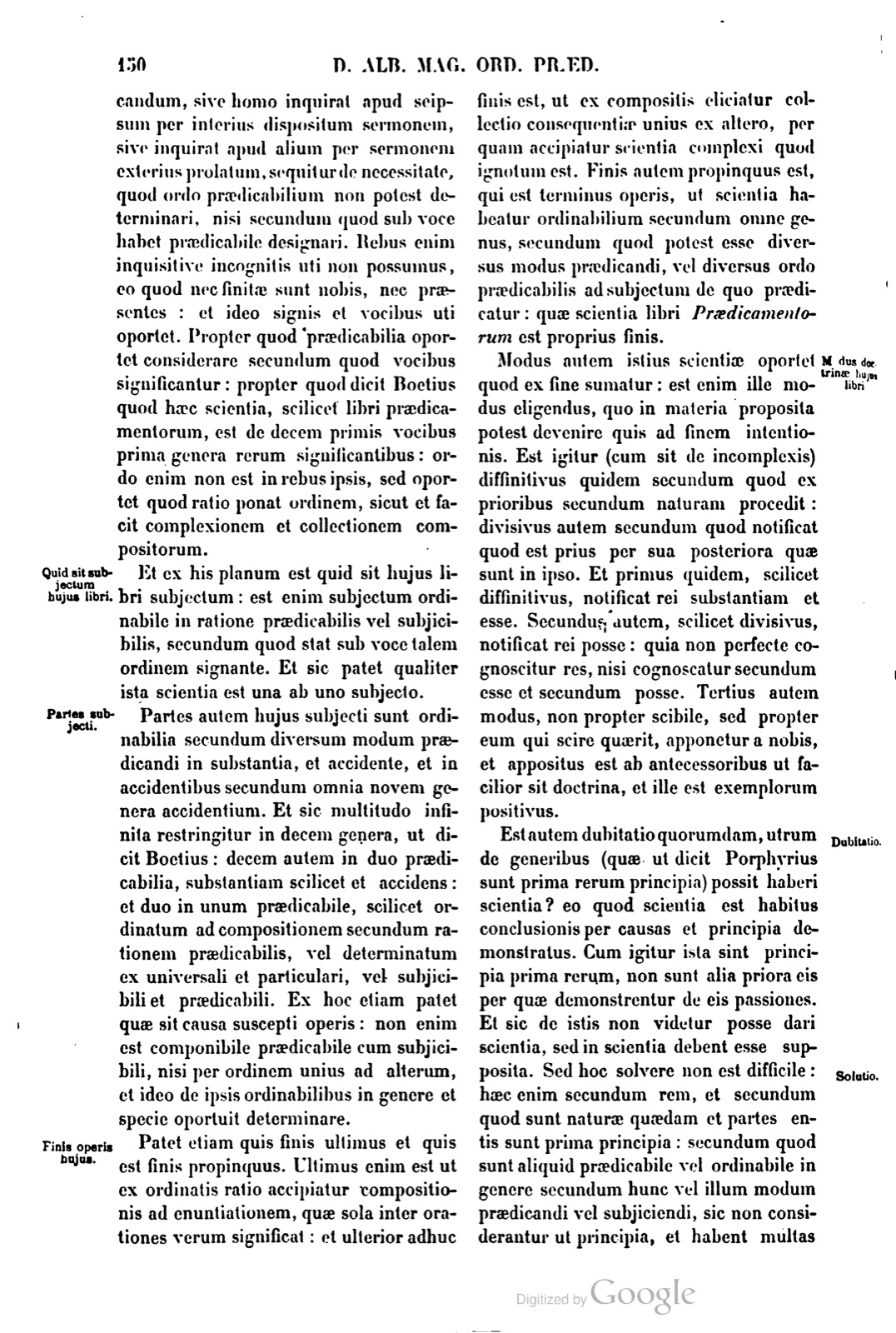
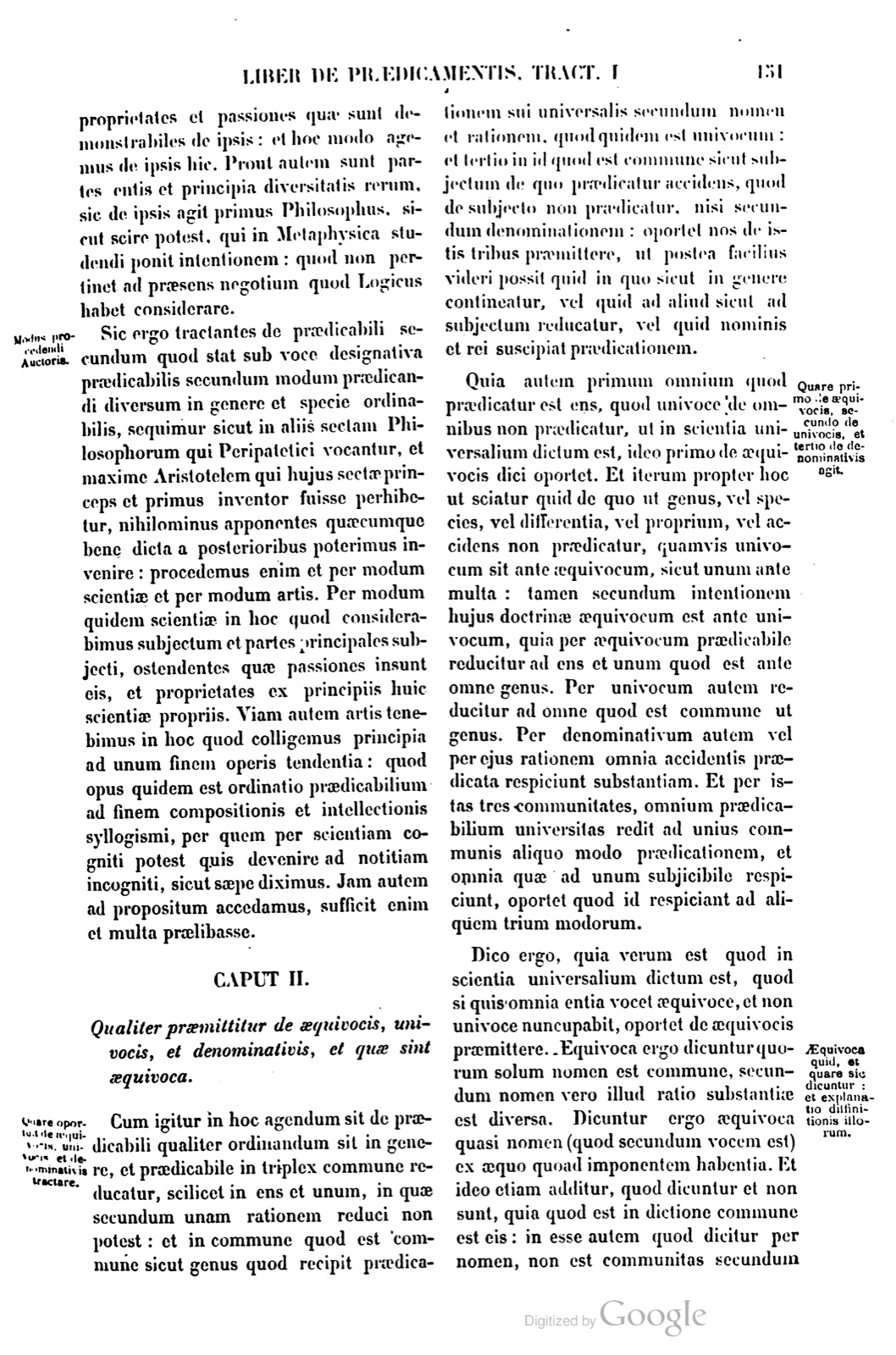
Est autem dubitatio quorumdam, utrum de generibus, quæ ut dicit Porphyrius sunt prima rerum principia, possit haberi scientia? eo quod scientia est habitus conclusionis per causas et principia demonstratus. Cum igitur ista sint principia prima rerum, non sunt alia priora eis per quæ demonstrentur de eis passiones. Et sic de istis non videtur posse dari scientia, sed in scientia debent esse supposita. Sed hoc solvere non est difficile: hæc enim secundum rem, et secundum quod sunt naturæ quædam et partes entis sunt prima principia: secundum quod sunt aliquid prædicabile vel ordinabile in genere secundum hunc vel illum modum prædicandi vel subjiciendi, sic non considerantur ut principia, et habent multas proprietates et passiones quæ sunt demonstrabiles de ipsis: et hoc modo agemus de ipsis hic. Prout autem sunt partes entis et principia diversitatis rerum, sic de ipsis agit primus Philosophus, sicut scire potest, qui in Metaphysica studendi ponit intentionem: quod non pertinet ad præsens negotium quod Logicus habet considerare.
Sic ergo tractantes de prædicabili secundum quod stat sub voce designativa prædicabilis secundum modum prædicandi diversum in genere et specie ordinabilis, sequimur sicut in aliis sectam Philosophorum qui Peripatetici vocantur, et maxime Aristotelem qui hujus sectæ princeps et primus inventor fuisse perhibetur, nihilominus apponentes quæcumque bene dicta a posterioribus poterimus invenire: procedemus enim et per modum scientiæ et per modum artis. Per modum quidem scientiæ in hoc quod considerabimus subjectum et partes principales subjecti, ostendentes quæ passiones insunt eis, et proprietates ex principiis huic scientiæ propriis. Viam autem artis tenebimus in hoc quod colligemus principia ad unum finem operis tendentia: quod opus quidem est ordinatio prædicabilium ad finem compositionis et intellectionis syllogismi, per quem per scientiam cogniti potest quis devenire ad notitiam incogniti, sicut sæpe diximus. Jam autem ad propositum accedamus, sufficit enim et multa prælibasse.
There is, however, a doubt on the part of some, whether science can be had concerning genera, which, as Porphyry says, are the first principles of things, because science is a habit of a conclusion demonstrated through causes and principles. Therefore, since these are first principles of things, there are no other things prior to them through which the properties concerning them may be demonstrated. And thus science seems not able to be given concerning these things, but they ought to be presupposed in science. But this is not difficult to solve: for these, according to the thing and according as they are certain natures and parts of being, are first principles; but according as they are something predicable or orderable in a genus according to this or that mode of predicating or being subjected, they are not considered as principles, and they have many properties and passions which are demonstrable concerning them; and in this mode we treat them here. But insofar as they are parts of being and principles of the diversity of things, the first Philosopher treats them, as one can know who sets his intention to study in the Metaphysics; and that does not belong to the present business which the Logician has to consider.
Thus, therefore, treating the predicable according as it stands under a word designative of the predicable according to a diverse mode of predicating, orderable in genus and species, we follow, as in other matters, the sect of the Philosophers who are called Peripatetics, and especially Aristotle, who is reported to have been the prince and first inventor of this sect, nevertheless adding whatever things well said by later men we shall be able to find. For we shall proceed both by the mode of science and by the mode of art: by the mode of science in this, that we shall consider the subject and the principal parts of the subject, showing what passions are in them and what properties from the principles proper to this science. But we shall hold the way of art in this, that we gather principles tending to one end of the work; and that work indeed is the ordering of predicables toward the end of the composition and understanding of the syllogism, through which, by the science of the known, someone can come to knowledge of the unknown, as we have often said. Now let us come to the proposed matter; for it is enough to have prefaced many things.
If a page does not appear, its photograph has not been uploaded yet.