Volume 1 · p. 144
Tractate IX. On the comparison of all these universals to one another from Avicenna's logic on the comparison of these five among themselves. Chapter I. How all these coincide in one.
TRACTATUS IX.
DE COMPARATIONE OMNIUM ISTORUM UNIVERSALIUM AD INVICEM EX LOGICA AVICENNAE DE COMPARATIONE ISTORUM QUINQUE INTER SE.
CAPUT I.
Qualiter haec omnia in unum coincidunt.
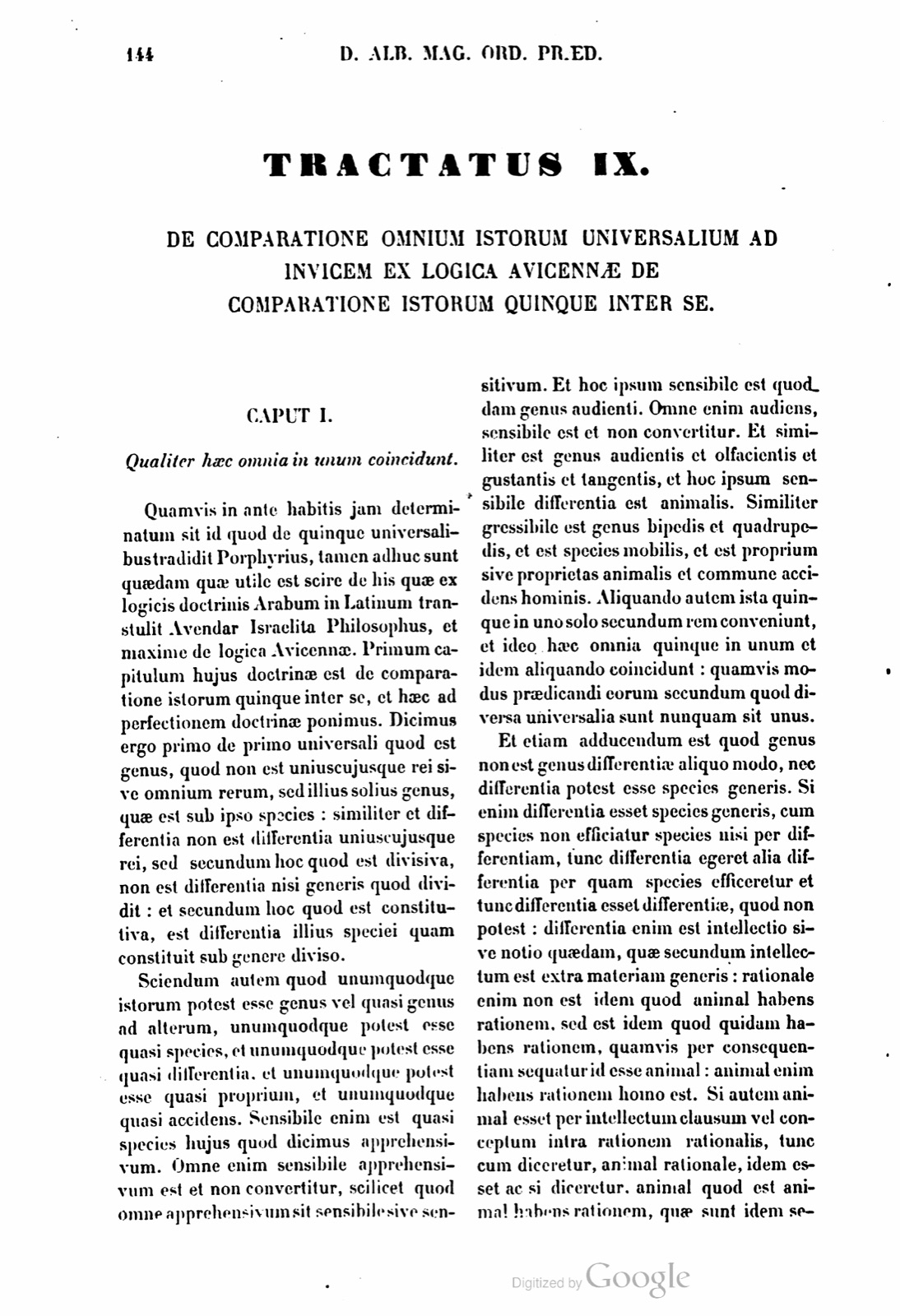
Quamvis in ante habitis jam determinatum sit id quod de quinque universalibus tradidit Porphyrius, tamen adhuc sunt quaedam quae utile est scire de his quae ex logicis doctrinis Arabum in Latinum transtulit Avendar Israelita Philosophus, et maxime de logica Avicennae. Primum capitulum hujus doctrinae est de comparatione istorum quinque inter se, et haec ad perfectionem doctrinae ponimus. Dicimus ergo primo de primo universali quod est genus, quod non est uniuscujusque rei sive omnium rerum, sed illius solius genus, quae est sub ipso species: similiter et differentia non est differentia uniuscujusque rei, sed secundum hoc quod est divisiva, non est differentia nisi generis quod dividit: et secundum hoc quod est constitutiva, est differentia illius speciei quam constituit sub genere diviso.
Sciendum autem quod unumquodque istorum potest esse genus vel quasi genus ad alterum, unumquodque potest esse quasi species, et unumquodque potest esse quasi differentia, et unumquodque potest esse quasi proprium, et unumquodque quasi accidens. Sensibile enim est quasi species hujus quod dicimus apprehensivum. Omne enim sensibile apprehensivum est et non convertitur, scilicet quod omne apprehensivum sit sensibile sive sensitivum. Et hoc ipsum sensibile est quoddam genus audienti. Omne enim audiens, sensibile est et non convertitur. Et similiter est genus audientis et olfacientis et gustantis et tangentis, et hoc ipsum sensibile differentia est animalis. Similiter gressibile est genus bipedis et quadrupedis, et est species mobilis, et est proprium sive proprietas animalis et commune accidens hominis. Aliquando autem ista quinque in uno solo secundum rem conveniunt, et ideo haec omnia quinque in unum et idem aliquando coincidunt: quamvis modus praedicandi eorum secundum quod diversa universalia sunt nunquam sit unus.
Et etiam adducendum est quod genus non est genus differentiae aliquo modo, nec differentia potest esse species generis. Si enim differentia esset species generis, cum species non efficiatur species nisi per differentiam, tunc differentia egeret alia differentia per quam species efficeretur et tunc differentia esset differentiae, quod non potest: differentia enim est intellectio sive notio quaedam, quae secundum intellectum est extra materiam generis: rationale enim non est idem quod animal habens rationem, sed est idem quod quidam habens rationem, quamvis per consequentiam sequatur id esse animal: animal enim habens rationem homo est. Si autem animal esset per intellectum clausum vel conceptum intra rationem rationalis, tunc cum diceretur, animal rationale, idem esset ac si diceretur, animal quod est animal habens rationem, quae sunt idem secundum
TRACTATE IX.
ON THE COMPARISON OF ALL THESE UNIVERSALS TO ONE ANOTHER FROM AVICENNA'S LOGIC ON THE COMPARISON OF THESE FIVE AMONG THEMSELVES.
CHAPTER I.
How all these coincide in one.
Although in the preceding matters what Porphyry handed down about the five universals has already been determined, nevertheless there are still certain things which it is useful to know from those things which Avendar the Israelite philosopher translated into Latin from the logical teachings of the Arabs, and especially from the logic of Avicenna. The first chapter of this doctrine concerns the comparison of these five among themselves, and we set these things down for the perfection of the doctrine. Therefore first we say about the first universal, which is genus, that it is not the genus of each and every thing or of all things, but only of that thing which is a species under it. Similarly difference is not the difference of each and every thing, but according as it is divisive, it is only the difference of the genus which it divides; and according as it is constitutive, it is the difference of that species which it constitutes under the divided genus.
But one must know that each of these can be genus or quasi-genus toward another; each can be quasi-species, each can be quasi-difference, each can be quasi-proper, and each quasi-accident. For sensible is as species of this which we call apprehensive. For every sensible thing is apprehensive, and it is not converted, namely that every apprehensive thing would be sensible or sensitive. And this very sensible is a certain genus of hearing. For every hearing thing is sensible, and it is not converted. And similarly it is the genus of hearing, smelling, tasting, and touching, and this very sensible is the difference of animal. Similarly walkable is the genus of two-footed and four-footed, and is the species of movable, and is the proper or property of animal and a common accident of man. But sometimes these five agree according to the thing in one thing alone, and therefore all these five sometimes coincide in one and the same, although their mode of predicating according as they are diverse universals is never one.
And it must also be added that genus is not in any way the genus of difference, nor can difference be the species of genus. For if difference were a species of genus, since species is not made species except through difference, then difference would need another difference through which it would be made species, and then there would be difference of difference, which cannot be. For difference is a certain understanding or notion which according to understanding is outside the matter of genus. For rational is not the same as animal having reason, but is the same as a certain thing having reason, although by consequence it follows that it is animal; for animal having reason is man. But if animal were enclosed by understanding or conceived within the account of rational, then when animal rational were said, it would be the same as if animal which is animal having reason were said, which are the same according to
If a page does not appear, its photograph has not been uploaded yet.