Volume 1 · p. 143
Chapter XIII. On the common features of proper and inseparable accident, and their differences.
CAPUT XIII.
De communibus proprii et inseparabilis accidentis, ac eorum differentiis.
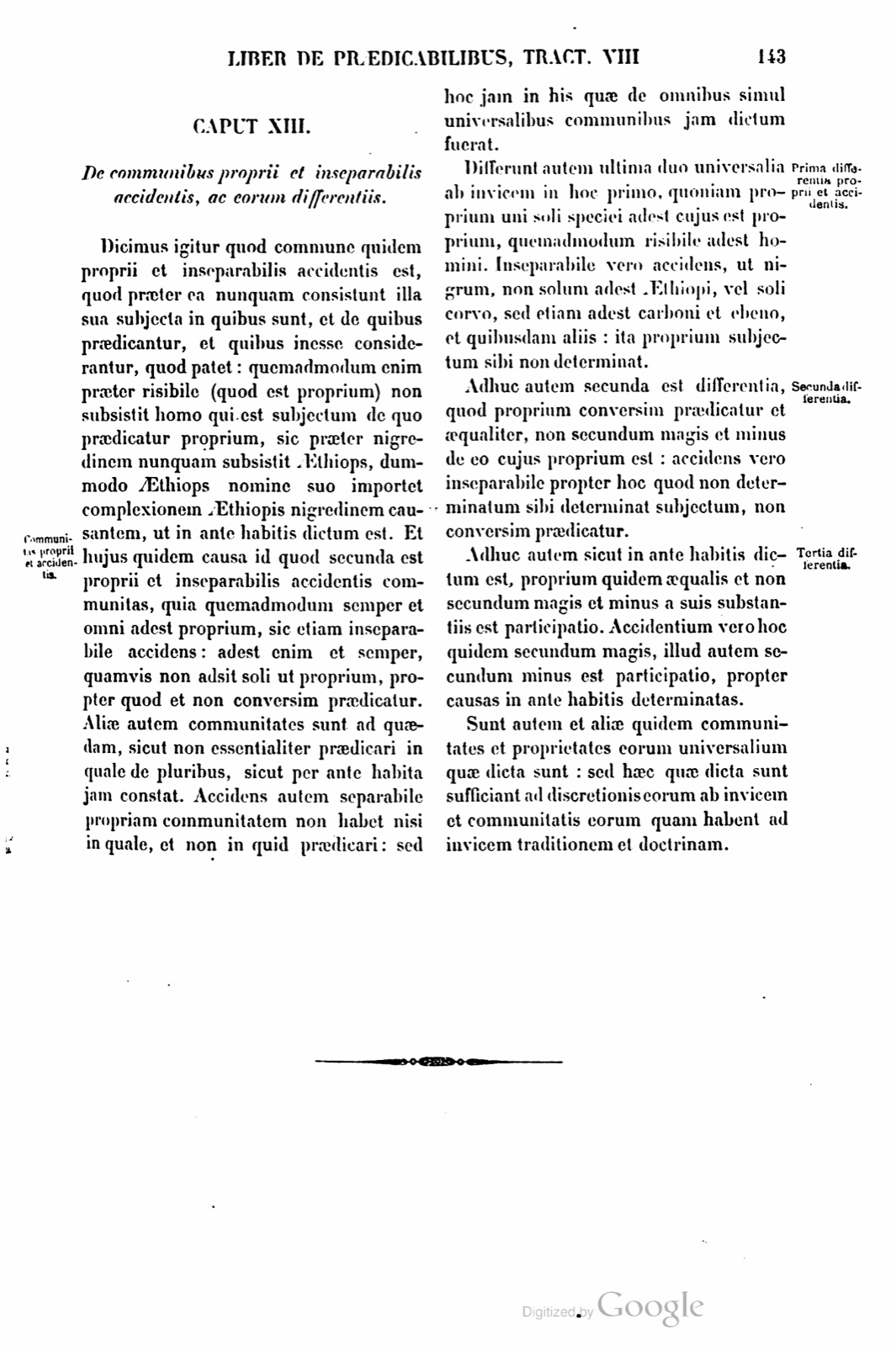
Dicimus igitur quod commune quidem proprii et inseparabilis accidentis est, quod praeter ea nunquam consistunt illa sua subjecta in quibus sunt, et de quibus praedicantur, et quibus inesse considerantur, quod patet: quemadmodum enim praeter risibile, quod est proprium, non subsistit homo qui est subjectum de quo praedicatur proprium, sic praeter nigredinem nunquam subsistit Ethiops, dummodo Aethiops nomine suo importet complexionem Aethiopis nigredinem causantem, ut in ante habitis dictum est. Et hujus quidem causa id quod secunda est proprii et inseparabilis accidentis communitas, quia quemadmodum semper et omni adest proprium, sic etiam inseparabile accidens: adest enim et semper, quamvis non adsit soli ut proprium, propter quod et non conversim praedicatur. Aliae autem communitates sunt ad quaedam, sicut non essentialiter praedicari in quale de pluribus, sicut per ante habita jam constat. Accidens autem separabile propriam communitatem non habet nisi hoc jam in his quae de omnibus simul universalibus communibus jam dictum fuerat.
Differunt autem ultima duo universalia ab invicem in hoc primo, quoniam proprium uni soli speciei adest cujus est proprium, quemadmodum risibile adest homini. Inseparabile vero accidens, ut nigrum, non solum adest Ethiopi, vel soli corvo, sed etiam adest carboni et ebeno, et quibusdam aliis: ita proprium subjectum sibi non determinat.
Adhuc autem secunda est differentia, quod proprium conversim praedicatur et aequaliter, non secundum magis et minus de eo cujus proprium est: accidens vero inseparabile propter hoc quod non determinatum sibi determinat subjectum, non conversim praedicatur.
Adhuc autem sicut in ante habitis dictum est, proprium quidem aequalis et non secundum magis et minus a suis substantiis est participatio. Accidentium vero hoc quidem secundum magis, illud autem secundum minus est participatio, propter causas in ante habitis determinatas.
Sunt autem et aliae quidem communitates et proprietates eorum universalium quae dicta sunt: sed haec quae dicta sunt sufficiant ad discretionis eorum ab invicem et communitatis eorum quam habent ad invicem traditionem et doctrinam.
CHAPTER XIII.
On the common features of proper and inseparable accident, and their differences.
Therefore we say that what is common to proper and inseparable accident is that without them those subjects of theirs in which they are, of which they are predicated, and in which they are considered to inhere, never stand. This is clear: for just as without risible, which is a proper, man, who is the subject of which proper is predicated, does not subsist, so without blackness an Ethiopian never subsists, provided Ethiopian by its name imports the complexion of the Ethiopian causing blackness, as was said in the preceding matters. And the cause of this is the second commonality of proper and inseparable accident, because just as proper is always and to every one present, so also inseparable accident is present. For it is present and always, although it is not present to it alone as proper is, on account of which it is not predicated conversely. But the other commonalities are toward certain things, such as being predicated non-essentially in what-sort-of of many, as is now clear through the preceding matters. But separable accident has no proper commonality except this, which had already been stated among the common features of all universals together.
But the last two universals differ from one another first in this, that proper is present to one species alone of which it is the proper, as risible is present to man. But inseparable accident, as black, is present not only to the Ethiopian or only to the raven, but also to coal and ebony and certain others; thus proper does not determine such a subject for itself.
Further, the second difference is that proper is predicated conversely and equally, not according to more and less, of that of which it is the proper. But inseparable accident, because it determines for itself no determinate subject, is not predicated conversely.
Further, as has been said in the preceding matters, proper is participated equally and not according to more and less by its substances. But of accidents the participation of this one is according to more, and of that one according to less, for the causes determined in the preceding matters.
There are indeed also other commonalities and properties of these universals that have been discussed; but these things that have been said suffice for handing down and teaching their distinction from one another and their commonality which they have toward one another.
If a page does not appear, its photograph has not been uploaded yet.