Volume 1 · p. 142
Chapter XII. On the agreements and differences of species and accident.
CAPUT XII.
De convenientiis et differentiis speciei et accidentis.
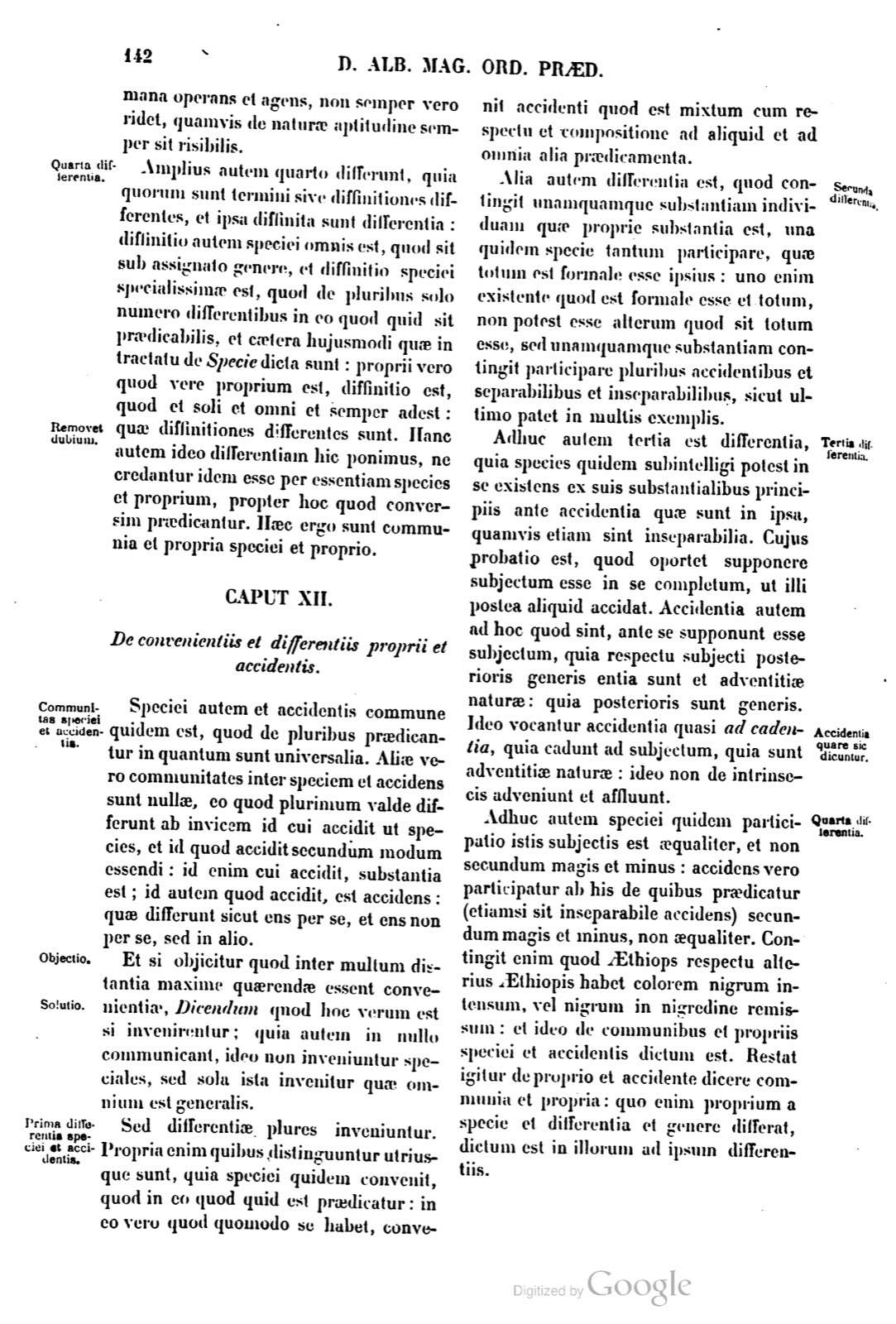
Speciei autem et accidentis commune quidem est, quod de pluribus praedicantur in quantum sunt universalia. Aliae vero communitates inter speciem et accidens sunt nullae, eo quod plurimum valde differunt ab invicem id cui accidit ut species, et id quod accidit secundum modum essendi: id enim cui accidit, substantia est; id autem quod accidit, est accidens: quae differunt sicut ens per se, et ens non per se, sed in alio.
Et si objicitur quod inter multum distantia maxime quaerendae essent convenientia, dicendum quod hoc verum est si invenirentur; quia autem in nullo communicant, ideo non inveniuntur speciales, sed sola ista invenitur quae omnium est generalis.
Sed differentiae plures inveniuntur. Propria enim quibus distinguuntur utriusque sunt, quia speciei quidem convenit, quod in eo quod quid est praedicatur: in eo vero quod quomodo se habet, convenit accidenti quod est mixtum cum respectu et compositione ad aliquid et ad omnia alia praedicamenta.
Alia autem differentia est, quod contingit unamquamque substantiam individuam quae proprie substantia est, una quidem specie tantum participare, quae totum est formale esse ipsius: uno enim existente quod est formale esse et totum, non potest esse alterum quod sit totum esse, sed unamquamque substantiam contingit participare pluribus accidentibus et separabilibus et inseparabilibus, sicut ultimo patet in multis exemplis.
Adhuc autem tertia est differentia, quia species quidem subintelligi potest in se existens ex suis substantialibus principiis ante accidentia quae sunt in ipsa, quamvis etiam sint inseparabilia. Cujus probatio est, quod oportet supponere subjectum esse in se completum, ut illi postea aliquid accidat. Accidentia autem ad hoc quod sint, ante se supponunt esse subjectum, quia respectu subjecti posterioris generis entia sunt et adventitiae naturae: quia posterioris sunt generis. Ideo vocantur accidentia quasi ad cadentia, quia cadunt ad subjectum, quia sunt adventitiae naturae: ideo non de intrinsecis adveniunt et affluunt.
Adhuc autem speciei quidem participatio istis subjectis est aequaliter, et non secundum magis et minus: accidens vero participatur ab his de quibus praedicatur, etiamsi sit inseparabile accidens, secundum magis et minus, non aequaliter. Contingit enim quod Ethiops respectu alterius Ethiopis habet colorem nigrum intensum, vel nigrum in nigredine remissum: et ideo de communibus et propriis speciei et accidentis dictum est. Restat igitur de proprio et accidente dicere communia et propria: quo enim proprium a specie et differentia et genere differat, dictum est in illorum ad ipsum differentiis.
CHAPTER XII.
On the agreements and differences of species and accident.
But it is common to species and accident that they are predicated of many insofar as they are universals. There are no other commonalities between species and accident, because that to which something happens as species and that which happens differ very greatly from each other according to the mode of being. For that to which something happens is substance; but that which happens is accident. These differ as being per se and being not per se but in another.
And if it is objected that among things very distant agreements should especially be sought, one must say that this is true if they were found; but because they communicate in nothing, special agreements are not found, but only that one is found which is general to all.
But several differences are found. For the proper features by which each is distinguished are these: that it belongs to species to be predicated in what it is; but to accident which is mixed with relation and composition toward something and toward all the other predicaments, it belongs to be predicated in how it is disposed.
But another difference is that each individual substance which is properly substance can participate only one species, which is its whole formal being. For when there is one thing which is formal being and whole, there cannot be another which is whole being. But each substance can participate several accidents, both separable and inseparable, as is finally clear in many examples.
Further, the third difference is that species can be understood beneath as existing in itself from its substantial principles before the accidents which are in it, although they are also inseparable. The proof of this is that it is necessary to suppose the subject to be completed in itself, so that something may afterward happen to it. But accidents, in order that they may be, suppose before themselves the being of a subject, because with respect to the subject they are beings of a posterior genus and of an adventitious nature, because they are of a posterior genus. Therefore they are called accidents, as though things falling to, because they fall to the subject, because they are of an adventitious nature; therefore they do not come and flow from intrinsic things.
Further, the participation of species by these subjects is equally and not according to more and less. But accident is participated by those of which it is predicated, even if it is an inseparable accident, according to more and less, not equally. For it happens that an Ethiopian with respect to another Ethiopian has an intense black color, or black remitted in blackness. And therefore the common and proper features of species and accident have been stated. It remains therefore to state the common and proper features of proper and accident; for in what proper differs from species, difference, and genus was stated in their differences toward it.
If a page does not appear, its photograph has not been uploaded yet.