Volume 1 · pp. 141–142
Chapter XI. On the agreements and differences of species and proper.
A marker with ≈ is an approximate page boundary, placed by measure of the text; the page photographs remain the authority. In the paired views, clicking a page marker brings that page into view.
CAPUT XI.
De convenientiis et differentiis speciei et proprii.
Post hoc sequitur dicere convenientias et differentias speciei et proprii: in quo enim species differat a genere et a differentia dictum est prius in capitulis in quibus diximus quomodo genus differret a caeteris universalibus, et quomodo differentia differt ab aliis. Dicimus ergo quod speciei quidem et proprio commune est de se invicem praedicari: quod patet per exemplum, quia si homo est, risibile est, et e converso si risibile est, homo est: cujus conversionis causa est, quia species principiis substantialibus ponit aptitudinem, quae proprium est, sicut causa propinqua et adaequata ponit effectum. Similiter ipsa aptitudo quae est proprium, derelinquit tale subjectum, et ponit ipsum sicut effectus proprius et causae adaequatus ponit suam causam. Hoc etiam facit proprium quod est risibile, ideo quoniam non dicitur secundum actum ridere, sed dicitur secundum aptitudinem secundum quam natum est: et haec aptitudo semper est in subjecto proprii, sicut saepe jam in ante habitis dictum est.
Secunda autem convenientia est aequaliter participari, et non secundum magis et minus ab his quae participant species: et similiter propria aequaliter participantur ab his quorum sunt propria: nec hic facimus hoc in participatione propriissime dicta: large enim dicimus participare id quod aliquid habet in seipso, et participatum esse id quod inest alii, sive per se insit sive per accidens.
His autem omnibus speciei et proprio communibus assignatis, assignanda sunt in quibus differunt ab invicem. Dicimus ergo quod species quidem in hoc differt a proprio, quia ea quae est species ad unum, ad aliud potest esse genus: sed hoc non est verum de specie specialissima: proprium autem cum sit hujus speciei proprium quae est specialissima, impossibile est proprium esse aliarum specierum: si tamen esset proprium speciei subalternae quae est genus ad aliud, non esset impossibile esse proprium illarum specierum, quae continentur sub illa, ut dicit Avicenna. Unde in hac differentia accipit Porphyrius speciem non specialissimam, quod in aliarum assignatione differentiarum non fecit. Proprium autem refert ad speciem specialissimam, cum ante posuerit subalternam: et ideo quod dicit, non satis est secundum artem dictum.
CHAPTER XI.
On the agreements and differences of species and proper.
After this it follows to state the agreements and differences of species and proper. For in what species differs from genus and from difference was said before in the chapters in which we said how genus differs from the other universals and how difference differs from the others. Therefore we say that it is common to species and proper to be predicated of one another. This is clear by example, because if man is, risible is, and conversely if risible is, man is. The cause of this conversion is that species, by substantial principles, posits the aptitude which is proper, as a proximate and adequate cause posits an effect. Similarly the aptitude itself which is proper leaves behind such a subject and posits it, just as a proper effect adequate to its cause posits its cause. The proper which is risible also does this because it is not said according to actually laughing, but according to the aptitude according to which it is naturally apt; and this aptitude is always in the subject of the proper, as has already often been said in the preceding matters.
The second agreement is to be participated equally, and not according to more and less, by those which participate species; and similarly propers are participated equally by those whose propers they are. Nor here do we take this in participation most properly so called; for broadly we say that something participates what it has in itself, and that what inheres in another is participated, whether it inheres per se or per accidens.
With all these common features of species and proper assigned, the things in which they differ from one another must be assigned. Therefore we say that species differs from proper in this, because what is species with respect to one thing can be genus with respect to another; but this is not true of the most special species. But proper, since it is the proper of this species which is most special, cannot possibly be the proper of other species. Yet if it were the proper of a subaltern species which is genus with respect to another, it would not be impossible for it to be the proper of those species which are contained under it, as Avicenna says. Hence in this difference Porphyry takes species as not most special, which he did not do in the assignment of the other differences. But he refers proper to the most special species, although before he posited the subaltern; and therefore what he says is not said sufficiently according to art.
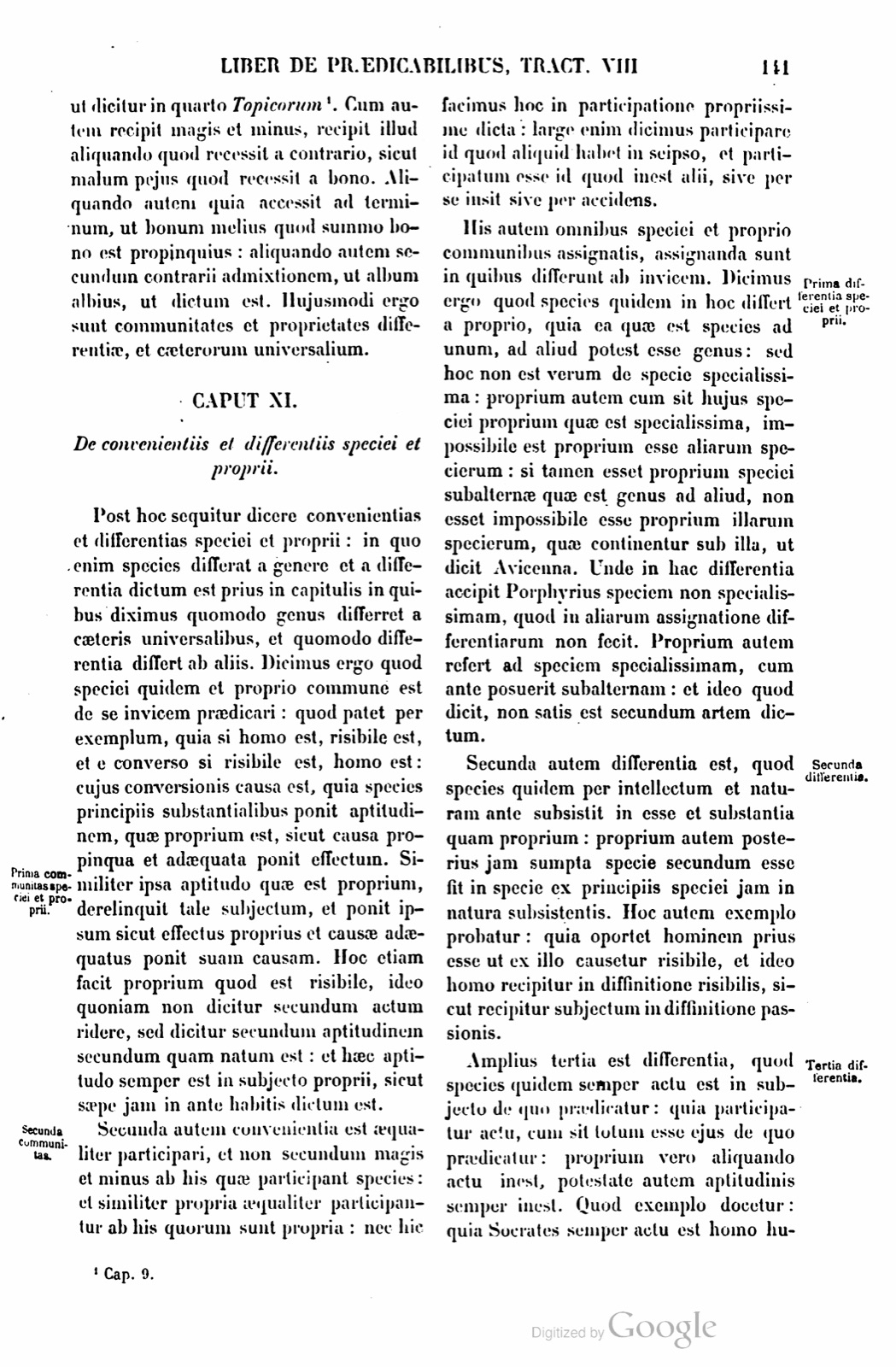
Secunda autem differentia est, quod species quidem per intellectum et naturam ante subsistit in esse et substantia quam proprium: proprium autem posterius jam sumpta specie secundum esse fit in specie ex principiis speciei jam in natura subsistentis. Hoc autem exemplo probatur: quia oportet hominem prius esse ut ex illo causetur risibile, et ideo homo recipitur in diffinitione risibilis, sicut recipitur subjectum in diffinitione passionis.
Amplius tertia est differentia, quod species quidem semper actu est in subjecto de quo praedicatur: quia participatur actu, cum sit totum esse ejus de quo praedicatur: proprium vero aliquando actu inest, potestate autem aptitudinis semper inest. Quod exemplo docetur: quia Socrates semper actu est homo humana operans et agens, non semper vero ridet, quamvis de naturae aptitudine semper sit risibilis.
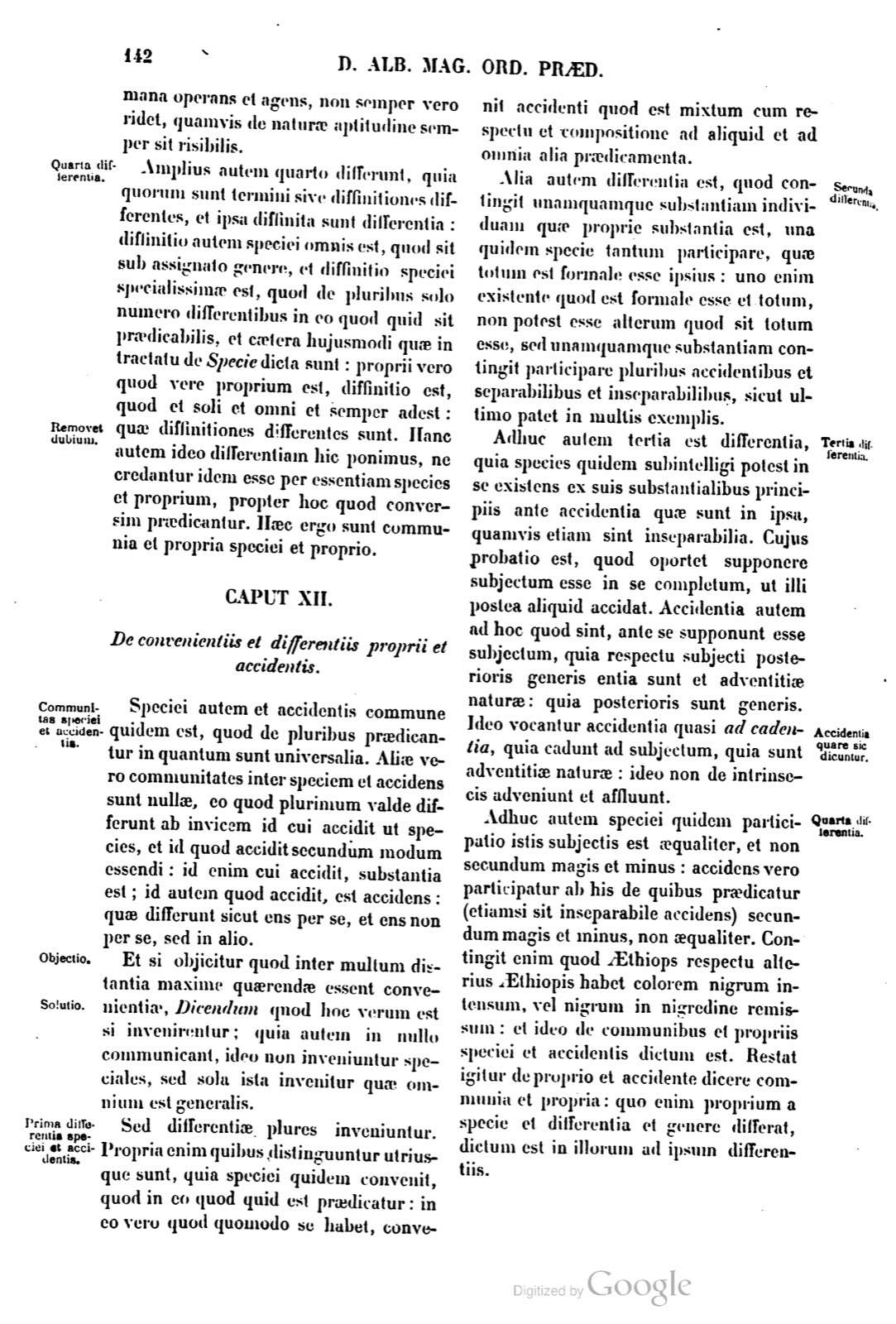
Amplius autem quarto differunt, quia quorum sunt termini sive diffinitiones differentes, et ipsa diffinita sunt differentia: diffinitio autem speciei omnis est, quod sit sub assignato genere, et diffinitio speciei specialissimae est, quod de pluribus solo numero differentibus in eo quod quid sit praedicabilis, et caetera hujusmodi quae in tractatu de Specie dicta sunt: proprii vero quod vere proprium est, diffinitio est, quod et soli et omni et semper adest: quae diffinitiones differentes sunt. Hanc autem ideo differentiam hic ponimus, ne credantur idem esse per essentiam species et proprium, propter hoc quod conversim praedicantur. Haec ergo sunt communia et propria speciei et proprio.
But the second difference is that species subsists first by understanding and nature in being and substance before proper; but proper later, once species has been taken according to being, comes to be in species from the principles of species already subsisting in nature. This is proved by example: because man must first be so that risible may be caused from him, and therefore man is received in the definition of risible, just as subject is received in the definition of passion.
Further, the third difference is that species is always actually in the subject of which it is predicated, because it is participated actually, since it is the whole being of that of which it is predicated; but proper sometimes inheres actually, while by the power of aptitude it always inheres. This is taught by example: because Socrates is always actually man, operating and acting humanly, but does not always laugh, although by aptitude of nature he is always risible.
Further, fourth, they differ because things whose terms or definitions are different are themselves defined things that are different. But the definition of every species is that it is under an assigned genus, and the definition of most special species is that it is predicable in what of many differing only in number, and the other things of this sort which were said in the tractate on Species. But the definition of proper which is truly proper is that it is present to it alone and to all and always; these definitions are different. We place this difference here so that species and proper are not believed to be the same by essence because they are predicated conversely. These therefore are the common and proper features of species and proper.
If a page does not appear, its photograph has not been uploaded yet.