Volume 1 · pp. 136–139
Chapter VIII. On the common and proper features of difference and species.
A marker with ≈ is an approximate page boundary, placed by measure of the text; the page photographs remain the authority. In the paired views, clicking a page marker brings that page into view.
CAPUT VIII.
De communibus et propriis differentiae et speciei.
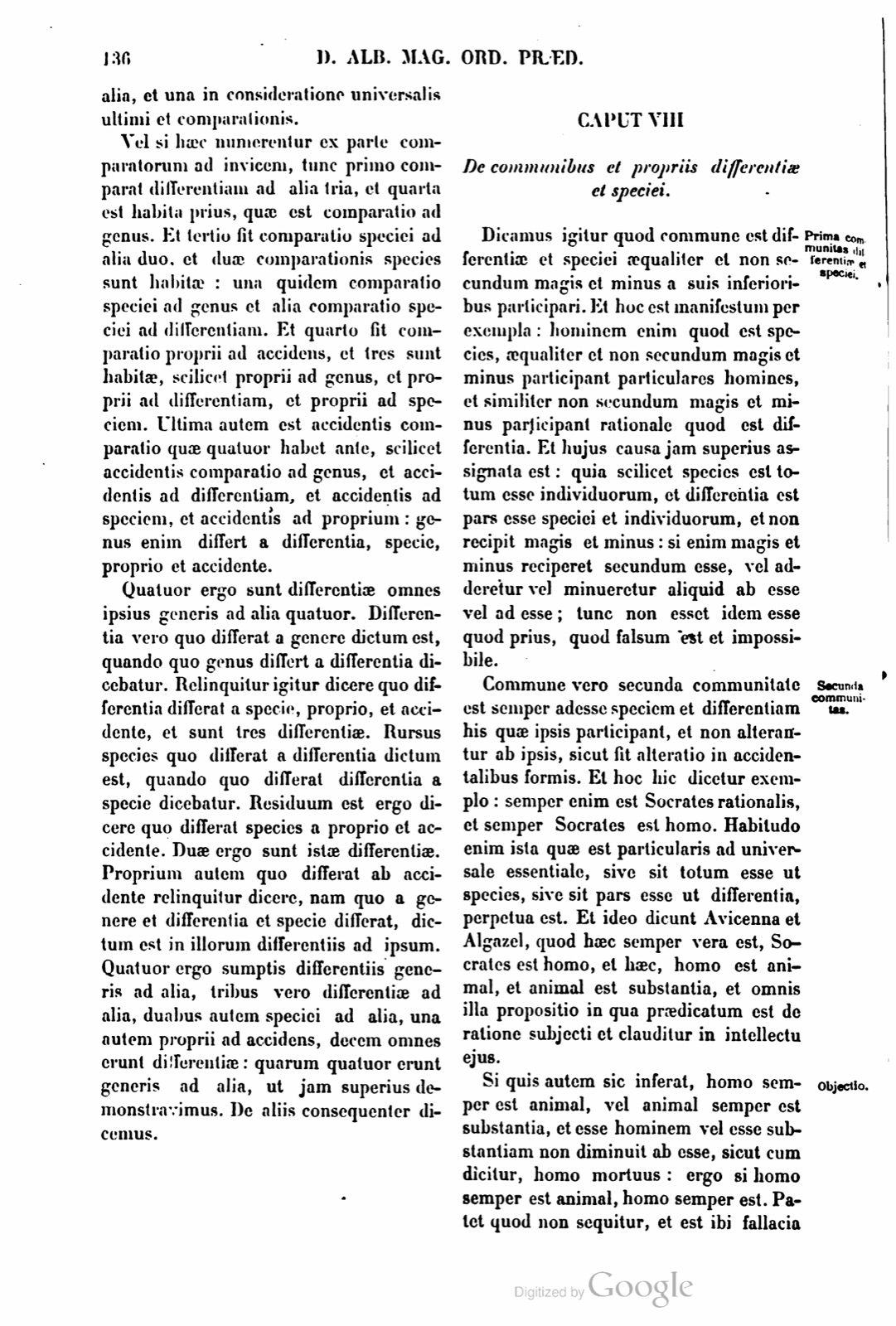
Dicamus igitur quod commune est differentiae et speciei aequaliter et non secundum magis et minus a suis inferioribus participari. Et hoc est manifestum per exempla: hominem enim quod est species, aequaliter et non secundum magis et minus participant particulares homines, et similiter non secundum magis et minus participant rationale quod est differentia. Et hujus causa jam superius assignata est: quia scilicet species est totum esse individuorum, et differentia est pars esse speciei et individuorum, et non recipit magis et minus: si enim magis et minus reciperet secundum esse, vel adderetur vel minueretur aliquid ab esse vel ad esse; tunc non esset idem esse quod prius, quod falsum est et impossibile.
Commune vero secunda communitate est semper adesse speciem et differentiam his quae ipsis participant, et non alterantur ab ipsis, sicut fit alteratio in accidentalibus formis. Et hoc hic dicetur exemplo: semper enim est Socrates rationalis, et semper Socrates est homo. Habitudo enim ista quae est particularis ad universale essentiale, sive sit totum esse ut species, sive sit pars esse ut differentia, perpetua est. Et ideo dicunt Avicenna et Algazel, quod haec semper vera est, Socrates est homo, et haec, homo est animal, et animal est substantia, et omnis illa propositio in qua praedicatum est de ratione subjecti et clauditur in intellectu ejus.
Si quis autem sic inferat, homo semper est animal, vel animal semper est substantia, et esse hominem vel esse substantiam non diminuit ab esse, sicut cum dicitur, homo mortuus: ergo si homo semper est animal, homo semper est. Patet quod non sequitur, et est ibi fallacia simpliciter et secundum quid: quia cum dicitur, homo semper est animal, quod dico semper, non dicit nisi sempiternitatem habitudinis subjecti ad praedicatum: et conclusio infertur ac si dicat sempiternitatem simpliciter. Hujus tamen consequentiae aliam dicunt causam Avicenna et Algazel: dicunt enim has esse per se, hic homo est homo, et homo est animal, et animal est substantia, et semper esse veras propter causam quae dicta est, quod scilicet praedicatum clauditur actu et intellectu in subjecto. Si autem inferatur, homo est substantia, ergo homo est: dicunt non sequi, quia illud est, est idem quod actu: et hoc accidit, accidit enim esse actu ei quod dicitur, homo est substantia, sive homo sit actu, sive non sit actu, haec semper vera est, homo est substantia.
CHAPTER VIII.
On the common and proper features of difference and species.
Therefore let us say that it is common to difference and species to be participated equally and not according to more and less by their inferiors. This is manifest through examples: particular men participate man, which is species, equally and not according to more and less, and similarly they participate rational, which is difference, not according to more and less. The cause of this has already been assigned above, namely that species is the whole being of individuals and difference is part of the being of species and individuals, and it does not receive more and less. For if it received more and less according to being, something would be added to or diminished from being or toward being; then it would not be the same being as before, which is false and impossible.
By a second commonality it is common that species and difference always are present to those things that participate them, and they are not altered by them, as alteration occurs in accidental forms. This will be stated here by example: Socrates is always rational, and Socrates is always man. For this relation, which is of a particular to an essential universal, whether it is whole being as species or part of being as difference, is perpetual. And therefore Avicenna and Algazel say that this is always true, Socrates is man, and this, man is animal, and animal is substance, and every proposition in which the predicate belongs to the account of the subject and is enclosed in its understanding.
But if someone infers thus: man is always animal, or animal is always substance, and being man or being substance does not diminish from being, as when it is said, dead man; therefore if man is always animal, man always is. It is clear that it does not follow, and there is a fallacy there of simply and in a certain respect; because when it is said, man is always animal, the always that I say means only the everlastingness of the relation of subject to predicate, and the conclusion is inferred as though it meant everlastingness simply. Yet Avicenna and Algazel give another cause of this consequence. They say that these are per se: this man is man, and man is animal, and animal is substance, and that they are always true for the cause that has been stated, namely that the predicate is enclosed in the subject in act and understanding. But if it is inferred, man is substance, therefore man is, they say it does not follow, because that is is the same as actually; and this happens, for being actually happens to what is said, man is substance; whether man is actually or is not actually, this is always true, man is substance.
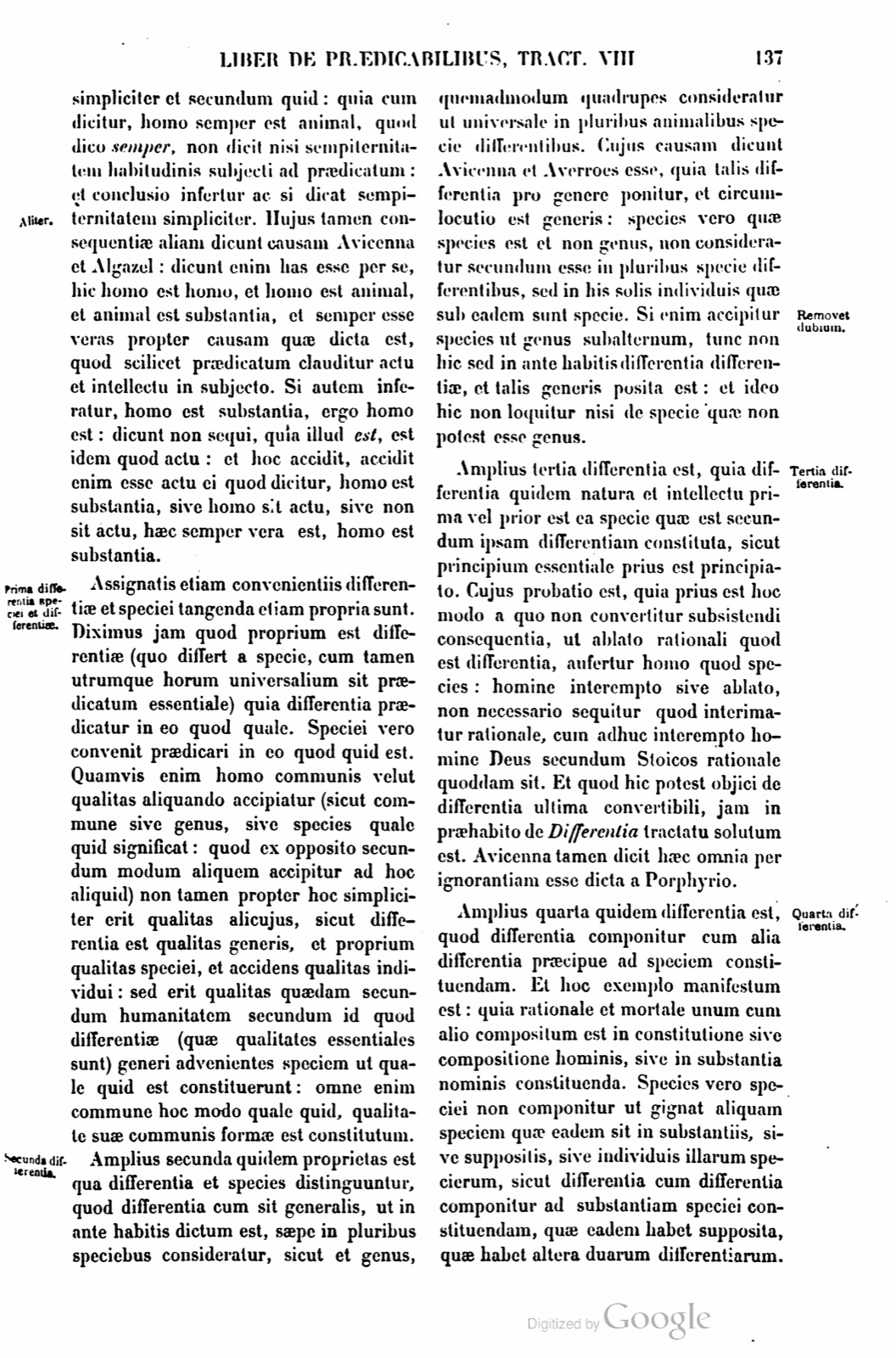
Assignatis etiam convenientiis differentiae et speciei tangenda etiam propria sunt. Diximus jam quod proprium est differentiae quo differt a specie, cum tamen utrumque horum universalium sit praedicatum essentiale, quia differentia praedicatur in eo quod quale. Speciei vero convenit praedicari in eo quod quid est. Quamvis enim homo communis velut qualitas aliquando accipiatur, sicut commune sive genus, sive species quale quid significat, quod ex opposito secundum modum aliquem accipitur ad hoc aliquid, non tamen propter hoc simpliciter erit qualitas alicujus, sicut differentia est qualitas generis, et proprium qualitas speciei, et accidens qualitas individui: sed erit qualitas quaedam secundum humanitatem secundum id quod differentiae, quae qualitates essentiales sunt, generi advenientes speciem ut quale quid est constituerunt: omne enim commune hoc modo quale quid, qualitate suae communis formae est constitutum.
Amplius secunda quidem proprietas est qua differentia et species distinguuntur, quod differentia cum sit generalis, ut in ante habitis dictum est, saepe in pluribus speciebus consideratur, sicut et genus, quemadmodum quadrupes consideratur ut universale in pluribus animalibus specie differentibus. Cujus causam dicunt Avicenna et Averroes esse, quia talis differentia pro genere ponitur, et circumlocutio est generis: species vero quae species est et non genus, non consideratur secundum esse in pluribus specie differentibus, sed in his solis individuis quae sub eadem sunt specie. Si enim accipitur species ut genus subalternum, tunc non hic sed in ante habitis differentia differentiae, et talis generis posita est: et ideo hic non loquitur nisi de specie quae non potest esse genus.
Amplius tertia differentia est, quia differentia quidem natura et intellectu prima vel prior est ea specie quae est secundum ipsam differentiam constituta, sicut principium essentiale prius est principiato. Cujus probatio est, quia prius est hoc modo a quo non convertitur subsistendi consequentia, ut ablato rationali quod est differentia, aufertur homo quod species: homine interempto sive ablato, non necessario sequitur quod interimatur rationale, cum adhuc interempto homine Deus secundum Stoicos rationale quoddam sit. Et quod hic potest objici de differentia ultima convertibili, jam in praehabito de Differentia tractatu solutum est. Avicenna tamen dicit haec omnia per ignorantiam esse dicta a Porphyrio.
Amplius quarta quidem differentia est, quod differentia componitur cum alia differentia praecipue ad speciem constituendam. Et hoc exemplo manifestum est: quia rationale et mortale unum cum alio compositum est in constitutione sive compositione hominis, sive in substantia nominis constituenda. Species vero speciei non componitur ut gignat aliquam speciem quae eadem sit in substantiis, sive suppositis, sive individuis illarum specierum, sicut differentia cum differentia componitur ad substantiam speciei constituendam, quae eadem habet supposita, quae habet altera duarum differentiarum. Eadem enim sunt supposita rationalis et mortalis. Quamvis enim quidam equus cuidam asinae permisceatur ad muli generationem, equus tamen si simpliciter sive universaliter sit acceptus, et in specie asinae permisceatur universaliter, nunquam perficit mulum.
With the agreements of difference and species assigned, their proper features must also be touched on. We have already said that it is proper to difference, by which it differs from species, although each of these universals is an essential predicate, that difference is predicated in what-sort-of. But it belongs to species to be predicated in what it is. For although common man is sometimes taken as a quality, as common, whether genus or species, signifies a what-sort-of something, which in some mode is taken oppositely to this something, nevertheless on this account it will not simply be a quality of something, as difference is the quality of genus, proper the quality of species, and accident the quality of the individual; but it will be a certain quality according to humanity according to this, that differences, which are essential qualities, coming to the genus have constituted species as what-sort-of something. For every common thing in this way, a what-sort-of something, is constituted by the quality of its common form.
Further, the second property by which difference and species are distinguished is that difference, since it is general, as has been said in the preceding matters, is often considered in several species, as genus also is, just as quadruped is considered as a universal in several animals differing in species. Avicenna and Averroes say the cause of this is that such a difference is put in place of genus and is a circumlocution of genus. But species which is species and not genus is not considered according to being in several things differing in species, but only in those individuals which are under the same species. For if species is taken as subaltern genus, then the difference of difference and of such a genus was posited not here but in the preceding matters; and therefore here he speaks only of species which cannot be genus.
Further, the third difference is that difference is first or prior by nature and understanding to that species which is constituted according to that difference, just as an essential principle is prior to the thing principled. The proof of this is that what is prior in this way is that from which the consequence of subsisting is not converted: for when rational, which is difference, is removed, man, which is species, is removed; but when man is destroyed or removed, it does not necessarily follow that rational is destroyed, since when man has been destroyed, God according to the Stoics is still something rational. And what can be objected here concerning the final convertible difference has already been solved in the preceding tractate on Difference. Yet Avicenna says that all these things were said by Porphyry through ignorance.
Further, the fourth difference is that difference is composed with another difference especially for constituting species. This is manifest by example, because rational and mortal, one composed with the other, is in the constitution or composition of man, or in constituting the substance of the name. But species is not composed with species so as to beget some species which is the same in the substances, supposits, or individuals of those species, in the way difference is composed with difference to constitute the substance of species, which has the same supposits that the other of the two differences has. For the supposits of rational and mortal are the same. For although a certain horse is mixed with a certain ass for the generation of a mule, nevertheless if horse is taken simply or universally, and is mixed universally in the species of ass, it never perfects a mule.
Quod autem hic dicitur quod differentia differentiae componitur, sciendum quod impossibile est si utraque differentiarum ut actus ultimus accipiatur: si autem una accipiatur ut imperfecta et in potentia ad aliam, tunc prima est sicut genus ad alteram, et secunda est sicut actus et perfectio, et tunc est possibile. Et hoc est quod dicit Avicenna, quod duae differentiae non ejusdem ordinis conveniunt ad speciei constitutionem: quarum una est prior, et altera posterior, sicut rationale quod est communius quam homo, et mortale quod posterius in eadem rationali natura acceptum est determinans ad speciem hominis. Quod autem dicitur quod species non conveniunt, ideo dictum est quia species est id quod actu ultimo perfectum est in illis quae formaliter perfecta sunt: et ex duobus actu perfectis non potest fieri aliquid in aliqua natura. Et quod dicitur de equo et asina convenientibus, quod fit mulus, in multis aliis fit animalibus, sicut in cane, et vulpe, et aliis, quae sunt vicina secundum complexionem, ita quod unum temperat semen alterius, sicut frigiditate asinae temperatur calor seminis equi et quorum idem est tempus impraegnationis. Et tunc etiam, ut dicit Avicenna, non conveniunt ad constitutionem animalis cujus individua sunt convenientia cum individuis alterius illarum specierum, sicut constitutum a duabus differentiis idem est cum individuis utriusque illarum differentiarum, quia individua muli non conveniunt cum individuis asini nec cum individuis equi. Quod autem quidam dicunt, et videtur Porphyrius dicere, quod scilicet quidam equus et quaedam asina conveniunt ad muli generationem, et quod equus simpliciter et asina simpliciter conveniunt ad muli hujus generationem, valde inconsiderate dictum est: quia etiam equus simpliciter cum equa simpliciter non conveniunt ad hujus equi generationem: actiones enim et operationes non sunt universalium, sed tantum particularium: et universalia non generantur nisi per accidens, vel per consequens in particularium generationem. Simpliciter enim universalia ingenerabilia sunt et incorruptibilia.
But concerning what is said here, that difference is composed with difference, one must know that this is impossible if each of the differences is taken as final act. But if one is taken as imperfect and in potency to the other, then the first is as genus to the other, and the second is as act and perfection, and then it is possible. And this is what Avicenna says, that two differences not of the same order come together for the constitution of species, of which one is prior and the other posterior, as rational, which is more common than man, and mortal, which is posterior and taken in the same rational nature as determining to the species man. But what is said, that species do not come together, was said because species is that which is perfected by final act in those things which are formally perfected; and from two things perfected in act something cannot come to be in any nature. And what is said of horse and ass coming together so that a mule is made occurs in many other animals, as in dog and fox and others which are near according to complexion, so that one tempers the seed of the other, as the heat of the seed of the horse is tempered by the coldness of the ass, and whose time of impregnation is the same. And then also, as Avicenna says, they do not come together for the constitution of an animal whose individuals agree with the individuals of the other of those species, as what is constituted from two differences is the same as the individuals of each of those differences, because the individuals of mule do not agree with the individuals of ass nor with the individuals of horse. But what certain people say, and what Porphyry seems to say, namely that a certain horse and a certain ass come together for the generation of a mule, and that horse simply and ass simply come together for the generation of this mule, is said very inconsiderately, because even horse simply with mare simply do not come together for the generation of this horse. For actions and operations are not of universals, but only of particulars; and universals are generated only per accidens, or consequently in the generation of particulars. For simply speaking, universals are ingenerable and incorruptible.
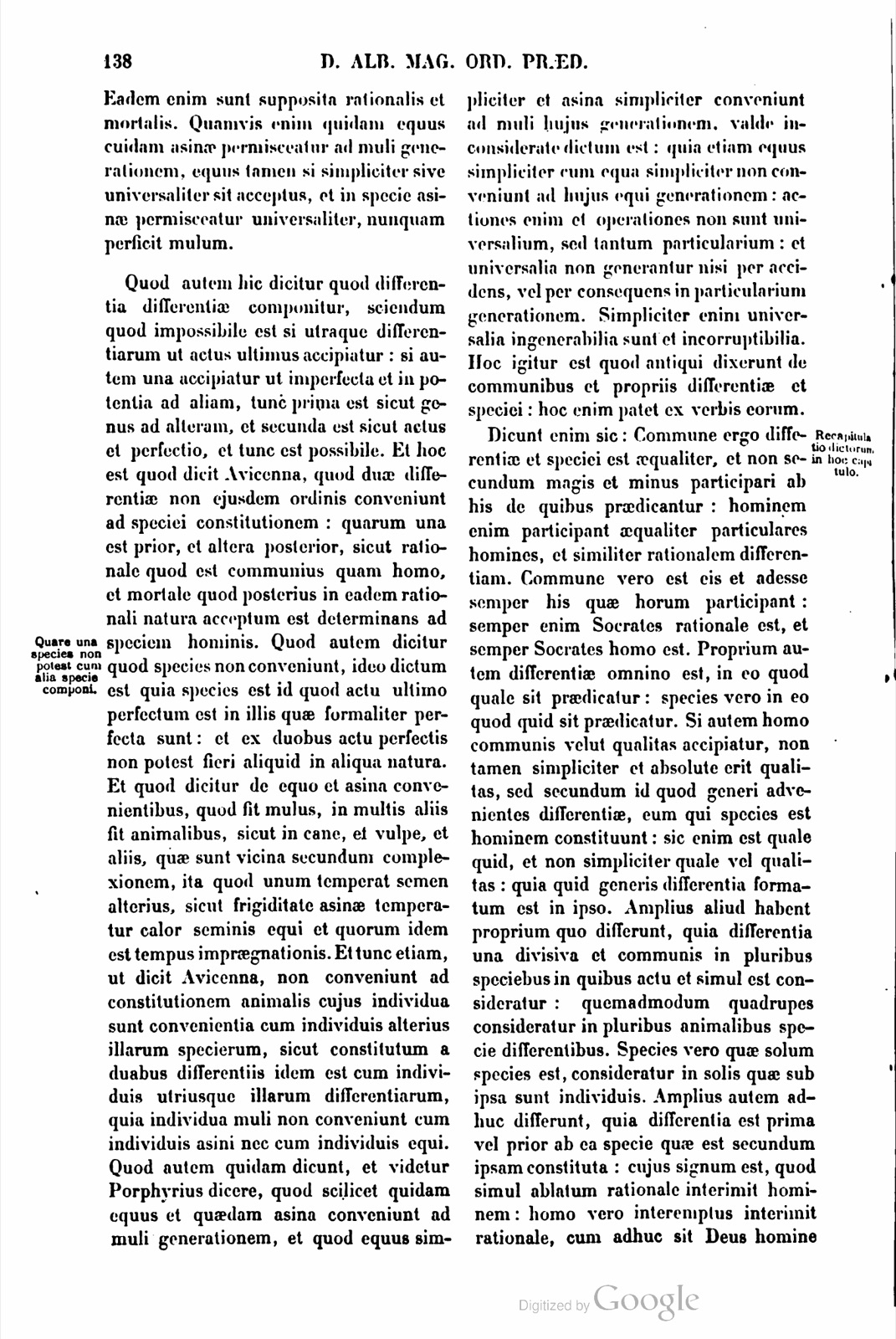
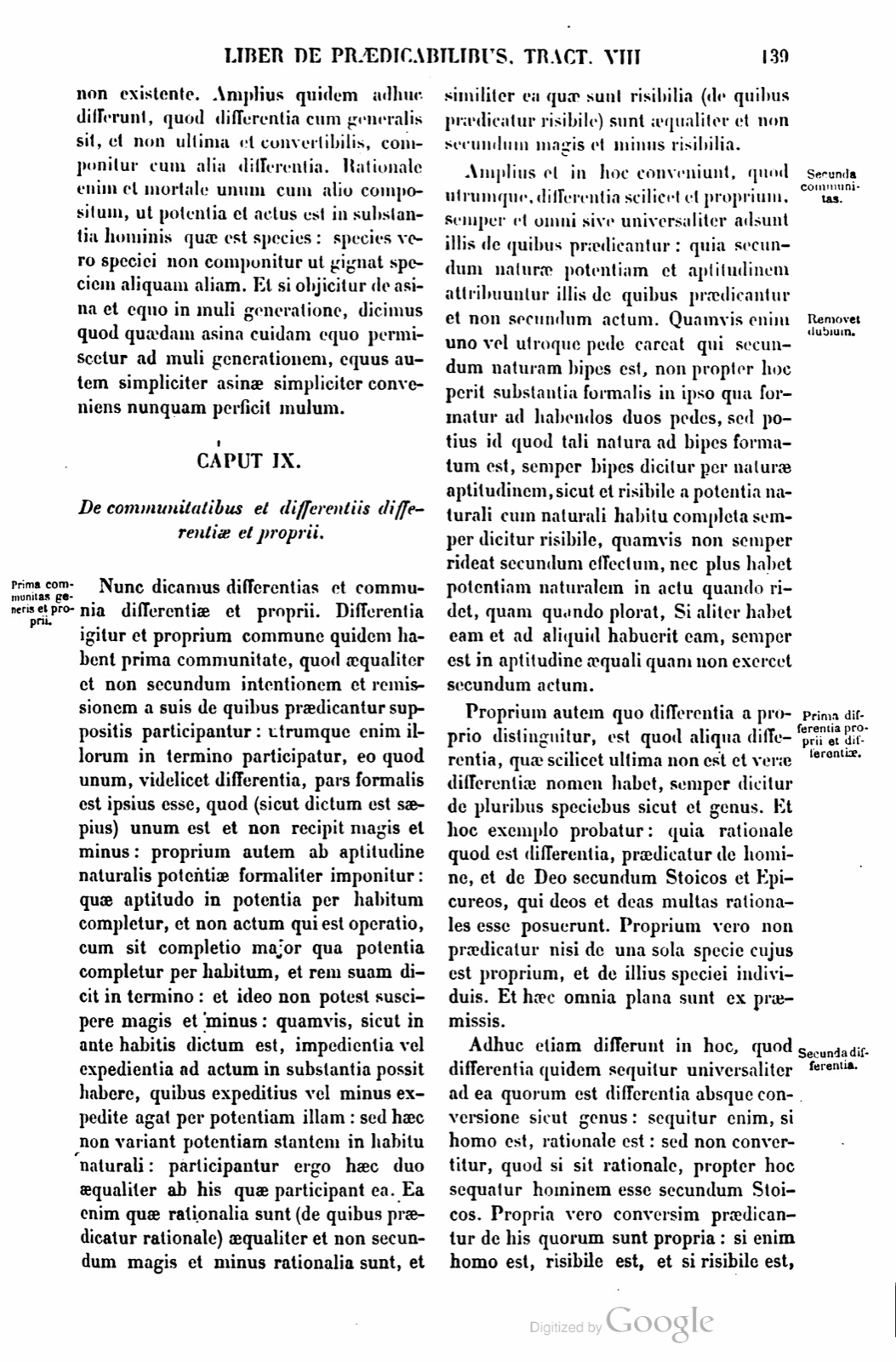
Hoc igitur est quod antiqui dixerunt de communibus et propriis differentiae et speciei: hoc enim patet ex verbis eorum. Dicunt enim sic: Commune ergo differentiae et speciei est aequaliter, et non secundum magis et minus participari ab his de quibus praedicantur: hominem enim participant aequaliter particulares homines, et similiter rationalem differentiam. Commune vero est eis et adesse semper his quae horum participant: semper enim Socrates rationale est, et semper Socrates homo est. Proprium autem differentiae omnino est, in eo quod quale sit praedicatur: species vero in eo quod quid sit praedicatur. Si autem homo communis velut qualitas accipiatur, non tamen simpliciter et absolute erit qualitas, sed secundum id quod generi advenientes differentiae, eum qui species est hominem constituunt: sic enim est quale quid, et non simpliciter quale vel qualitas: quia quid generis differentia formatum est in ipso. Amplius aliud habent proprium quo differunt, quia differentia una divisiva et communis in pluribus speciebus in quibus actu et simul est consideratur: quemadmodum quadrupes consideratur in pluribus animalibus specie differentibus. Species vero quae solum species est, consideratur in solis quae sub ipsa sunt individuis. Amplius autem adhuc differunt, quia differentia est prima vel prior ab ea specie quae est secundum ipsam constituta: cujus signum est, quod simul ablatum rationale interimit hominem: homo vero interemptus interimit rationale, cum adhuc sit Deus homine non existente. Amplius quidem adhuc differunt, quod differentia cum generalis sit, et non ultima et convertibilis, componitur cum alia differentia. Rationale enim et mortale unum cum alio compositum, ut potentia et actus est in substantia hominis quae est species: species vero speciei non componitur ut gignat speciem aliquam aliam. Et si objicitur de asina et equo in muli generatione, dicimus quod quaedam asina cuidam equo permiscetur ad muli generationem, equus autem simpliciter asinae simpliciter conveniens nunquam perficit mulum.
This therefore is what the ancients said about the common and proper features of difference and species; for this is clear from their words. They say thus: therefore it is common to difference and species to be participated equally, and not according to more and less, by those of which they are predicated; for particular men participate man equally, and similarly rational difference. It is also common to them to be always present to those things which participate them; for Socrates is always rational, and Socrates is always man. But what is altogether proper to difference is to be predicated in what-sort-of; but species is predicated in what it is. But if common man is taken as a quality, nevertheless it will not be quality simply and absolutely, but according to the fact that differences coming to genus constitute man, who is species; thus it is what-sort-of something, and not simply what-sort-of or quality, because the what of the genus has been formed by difference in it. Further, they have another proper feature by which they differ, because one divisive and common difference is considered in several species in which it is actually and at once, just as quadruped is considered in several animals differing in species. But species which is only species is considered only in the individuals which are under it. Further, they also differ because difference is first or prior to that species which is constituted according to it; the sign of this is that rational, when removed, at the same time destroys man, but man when destroyed does not destroy rational, since God still exists when man does not. Further they still differ because difference, since it is general and not final and convertible, is composed with another difference. For rational and mortal, one composed with the other as potency and act, is in the substance of man which is species; but species is not composed with species so as to beget some other species. And if an objection is made about ass and horse in the generation of a mule, we say that a certain ass is mixed with a certain horse for the generation of a mule, but horse simply agreeing with ass simply never perfects a mule.
If a page does not appear, its photograph has not been uploaded yet.